
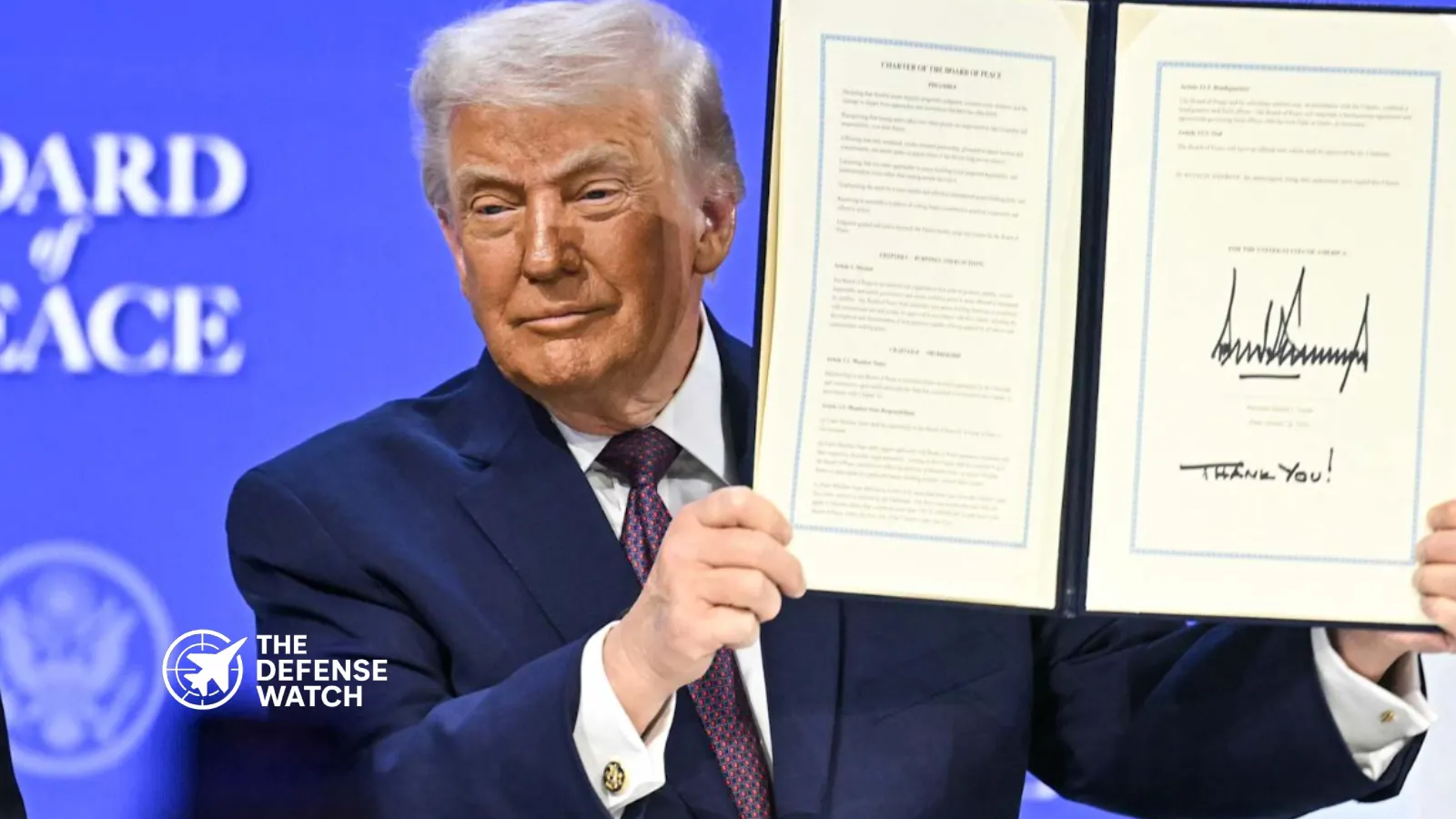
The Trump Board of Peace has triggered swift diplomatic reactions after President Donald Trump formally launched the initiative during the World Economic Forum in Davos, raising concerns about the future role of the United Nations in global security governance.
Unveiled on Thursday at a high-profile signing ceremony in Switzerland, the Trump Board of Peace was presented by U.S. officials as a new forum aimed at conflict mediation and crisis prevention. Nineteen countries signed the founding charter, while several long-standing U.S. allies declined to participate, underscoring early divisions over the initiative’s purpose and legitimacy.
China and Brazil responded on Friday by publicly reaffirming their support for a UN-centered international system, signaling unease among major powers that the new body could dilute or bypass existing multilateral institutions.
Trump Unveils Board of Peace at Davos
President Trump introduced the Board of Peace on the sidelines of the World Economic Forum, framing it as a flexible platform designed to respond faster to global crises than established organizations. According to U.S. officials present in Davos, the body would focus on security dialogue, de-escalation mechanisms, and informal mediation among participating states.
The founding charter was signed by a diverse group of countries, including Saudi Arabia, the United Arab Emirates, Turkey, Pakistan, Hungary, and Indonesia. The mix of Middle Eastern, Asian, and European states highlighted Washington’s effort to assemble a broad coalition outside traditional Western-led frameworks.
Notably absent were several close U.S. partners. Britain, France, Norway, and Sweden declined to join, according to officials familiar with the discussions. Their absence immediately raised questions about allied alignment and the long-term viability of the initiative.
China and Brazil Reaffirm UN-Centered Order
Beijing and Brasilia moved quickly to clarify their positions. In separate statements on Friday, Chinese and Brazilian officials emphasized that the United Nations remains the cornerstone of international peace and security.
China’s foreign ministry said global security challenges should be addressed through inclusive multilateral institutions with universal legitimacy, a clear reference to the UN Security Council. Brazilian officials echoed that view, stressing that parallel structures risk fragmenting global governance at a time of heightened geopolitical tension.
Both countries stopped short of directly criticizing Washington. However, their coordinated messaging underscored concern that the Trump Board of Peace could evolve into a rival forum that weakens established norms and processes.
Allied Hesitation Reflects Broader Unease
The decision by key European allies to stay out of the Board of Peace reflects deeper uncertainty about U.S. strategic direction. Diplomats from several NATO countries privately expressed concern that the new body lacks clear legal authority, defined decision-making rules, or integration with existing international mechanisms.
For European governments, the UN provides a predictable framework for crisis management, peacekeeping, and sanctions enforcement. Any initiative perceived as sidestepping those structures is likely to face resistance, particularly if it risks duplicating or undermining ongoing diplomatic efforts.
Implications for Global Security Governance
The launch of the Trump Board of Peace comes amid growing strain on the international system. Conflicts in Eastern Europe, the Middle East, and the Indo-Pacific have exposed limits in existing institutions, while great power competition has complicated consensus-building at the UN.
Supporters of the Board argue that smaller, interest-based groups can act faster and avoid gridlock. Critics counter that such arrangements favor powerful states and reduce transparency, accountability, and inclusivity.
Defense and security analysts note that any meaningful role for the Board of Peace would depend on how it interacts with established bodies. Without coordination with the UN, NATO, or regional organizations, the forum risks becoming symbolic rather than operational.
U.S. Strategy and Next Steps
The White House has indicated that additional countries may be invited to join the Board of Peace in the coming months. U.S. officials have also suggested that early meetings could focus on confidence-building measures and back-channel dialogue rather than formal negotiations.
Whether the Trump Board of Peace becomes a lasting feature of global diplomacy remains uncertain. Much will depend on participation by major powers, clarity of mandate, and its relationship with the United Nations.
For now, the swift response from China and Brazil highlights the sensitivity surrounding any perceived challenge to the UN-centered global order, and signals that debates over the future of multilateral security governance are far from settled.
Get real time update about this post category directly on your device, subscribe now.
