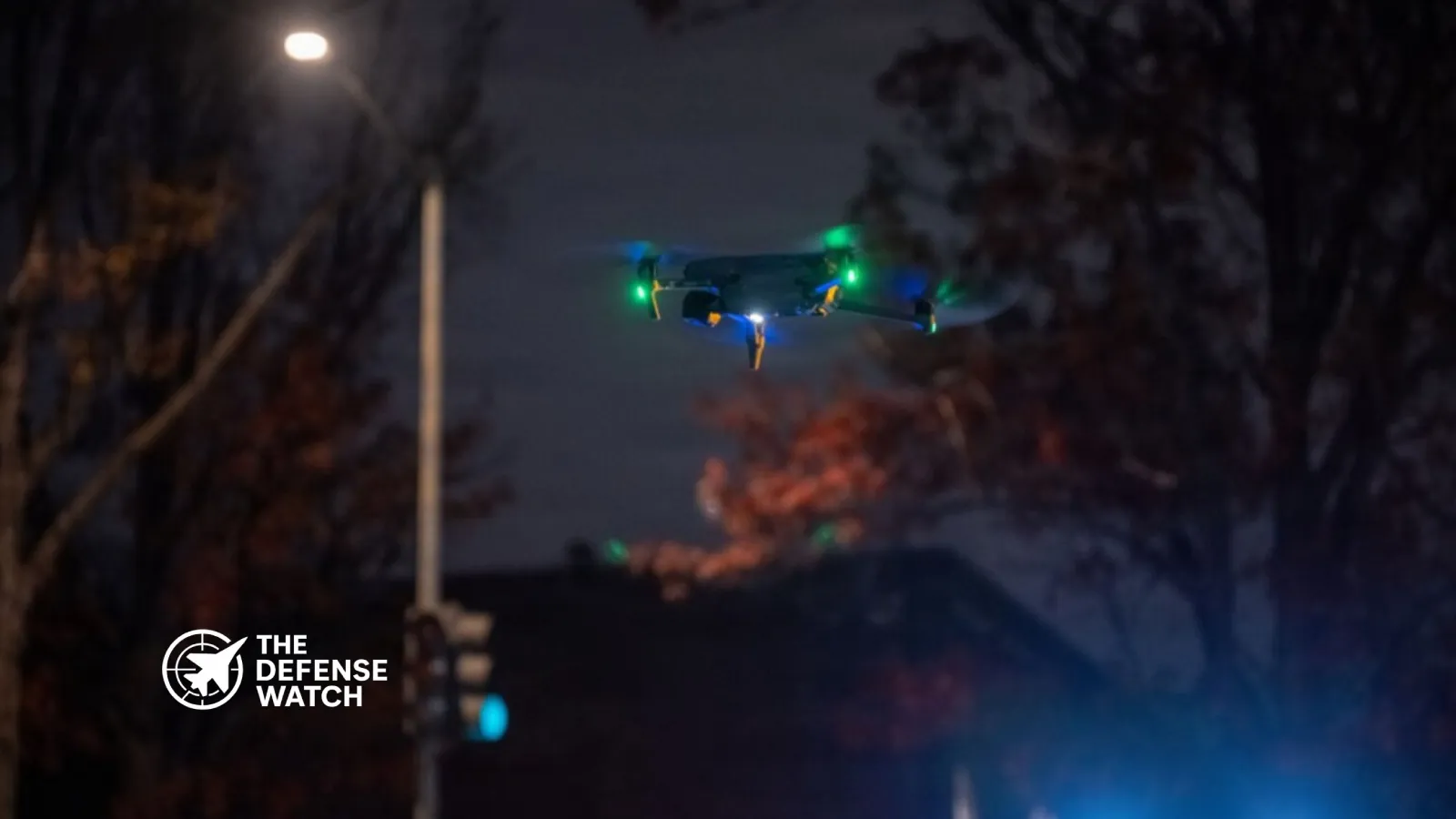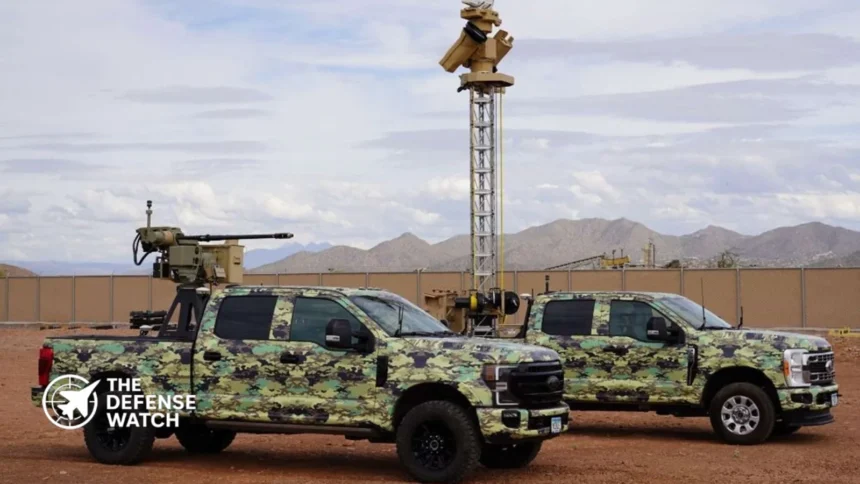
A mobile targeting system developed by Northrop Grumman has demonstrated its ability to coordinate drone detection and cannon engagements during a live-fire counter-unmanned aircraft systems (C-UAS) exercise.
The November 17, 2026 announcement describes an integrated configuration combining the company’s Mobile Acquisition, Cueing and Effector (M-ACE) system, an M230LF 30mm Bushmaster Chain Gun and XM1211 proximity-fuzed ammunition. Northrop Grumman said the combination detected, tracked and engaged multiple drones during the demonstration.
The test is relevant to a growing military requirement: defending mobile forces and critical installations against small unmanned aircraft without relying exclusively on expensive surface-to-air missiles or other dedicated interceptors.
However, Northrop Grumman has not disclosed the number of drones engaged, engagement distances, ammunition expenditure or the exercise location. The reported results therefore demonstrate a company-reported capability rather than independently verified operational performance.
How M-ACE connects detection to the weapon
M-ACE is designed to perform the sensing, tracking and target-coordination functions within a mobile counter-drone architecture.
Rather than relying on the gun crew to independently locate and track every aerial threat, the system collects information from multiple sensors, processes target data and provides engagement cues to a connected weapon.
Northrop Grumman’s published M-ACE technical documentation identifies several components:
- Three-dimensional radar for aerial surveillance and tracking.
- Radio-frequency sensors for detecting relevant electronic emissions.
- Electro-optical and infrared cameras for visual and thermal observation.
- GPS and secure communications for positioning and exchanging information.
- An open-architecture command-and-control system for coordinating sensors and effectors.
The company also describes the use of artificial intelligence and machine-learning capabilities to support threat classification, prioritization and engagement decisions. Its published architecture retains a human operator in the decision-making process.
An important feature is the separation between the sensor platform and the weapon platform.
M-ACE can provide targeting information to a nearby effector rather than requiring every weapon vehicle to carry an identical sensor package. This allows military operators to configure the system around different vehicle types, sensors and weapons.
Northrop Grumman says its open architecture can integrate hundreds of sensors and cameras, although actual compatibility depends on the equipment and integration requirements of each configuration.
Why the M230LF and XM1211 combination matters
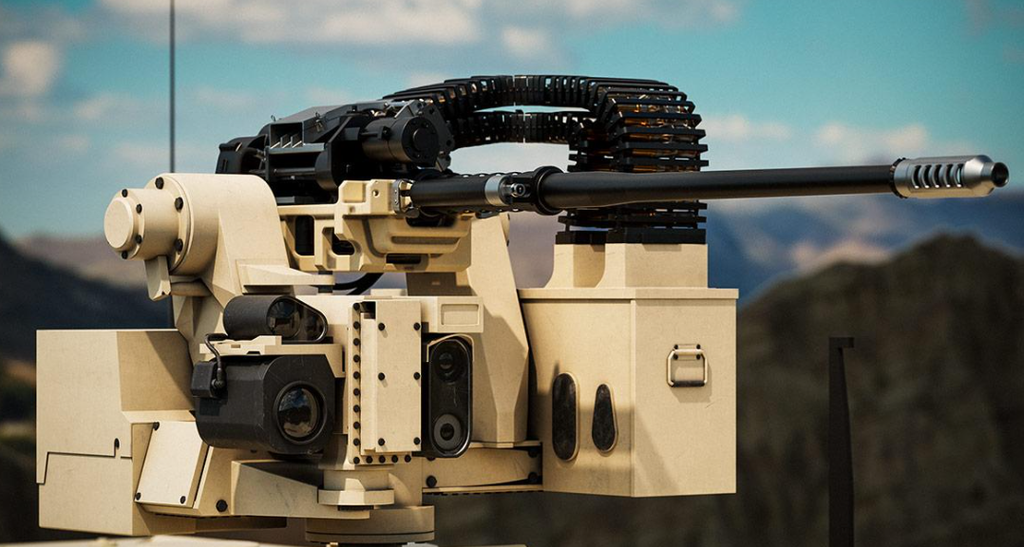
The weapon used in the reported demonstration was the M230LF Bushmaster, a 30x113mm medium-caliber automatic cannon.
The M230LF is a ground-oriented development of the M230 cannon used on the AH-64 Apache attack helicopter. Northrop Grumman designed the M230LF to bring 30mm firepower to relatively lightweight ground platforms.
The cannon can engage conventional ground targets as well as aerial threats, making it relevant to counter-UAS applications.
For the drone engagement, the cannon fired XM1211 proximity ammunition.
Unlike conventional ammunition that generally requires a direct impact to destroy a target, proximity-fuzed ammunition is designed to detonate when it approaches a target within its triggering conditions.
This creates a fragmentation effect around the target and can reduce the need for a direct projectile impact against a small or moving drone.
The approach is particularly relevant when engaging small unmanned aircraft, which can be difficult to hit with conventional direct-impact cannon fire.
The XM1211 ammunition is part of Northrop Grumman’s effort to adapt existing medium-caliber weapons for counter-drone missions. The company has also identified proximity and programmable airburst ammunition as important elements of its wider Bushmaster ammunition portfolio.
A separate U.S. Army assessment at Fort Sill
The Northrop Grumman announcement also comes amid U.S. Army experimentation with mobile counter-drone gun systems.
On November 17, Defence Blog reported that the Army’s Fires Experimentation Division had conducted a week-long assessment of M-ACE and an Agnostic Gun Truck at Fort Sill, Oklahoma.
According to the report, the assessment examined the systems’ ability to detect and engage Group 1 and Group 3 unmanned aircraft. Senior military leaders observed a live-fire demonstration on October 28, 2026.
The Agnostic Gun Truck is intended to serve as the weapon platform, while M-ACE provides sensor and targeting information.
The Army assessment is important because it extends the discussion beyond a manufacturer’s demonstration. It indicates that the technology is also being examined in a U.S. Army experimentation environment.
However, the available reporting does not establish that the Army’s Fort Sill demonstration and the company’s newly announced multiple-drone engagement were the same exercise.
Nor has the Army published detailed performance results, an acquisition decision or a formal procurement timeline for the configuration.
Where the system fits in U.S. short-range air defense
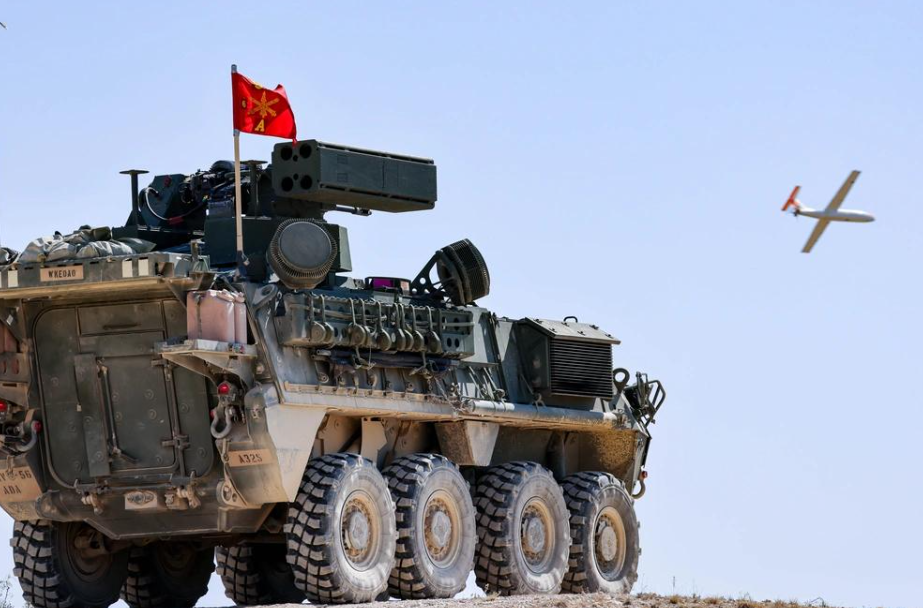
The M-ACE and Bushmaster combination addresses a different requirement from conventional missile-based air defense.
Systems such as the Stryker-based Maneuver Short-Range Air Defense (M-SHORAD) platform provide mobile protection against aerial threats using a combination of sensors and weapon systems.
The U.S. Army’s XM914 30mm cannon, a variant of the M230LF, has also been adopted for the Initial Maneuver Short-Range Air Defense and Mobile-Low, Slow, Small Unmanned Aircraft Integrated Defeat System programs.
This provides an existing institutional context for using medium-caliber cannon systems in counter-drone operations.
A mobile gun-based system could provide an additional engagement option against suitable drone threats, particularly where sustained protection is needed and missile expenditure is a concern.
But cannon-based defense has limitations.
Its effectiveness depends on factors including target detection, tracking accuracy, ammunition characteristics, engagement geometry and the ability to maintain a suitable firing solution. Gun-based systems also have finite engagement envelopes and ammunition supplies.
They cannot replace longer-range air defense systems or provide the same coverage against every class of aerial threat.
A layered approach combining guns, electronic warfare, jamming, missiles and other effectors is therefore more realistic than relying on one counter-drone technology.
Production capacity remains part of the equation
Northrop Grumman also linked the demonstration to its industrial efforts to increase Bushmaster cannon and advanced ammunition production.
The company said it and the U.S. Army are investing in manufacturing equipment, facilities and tooling to expand output and reduce delivery lead times.
It also identified automated manufacturing and testing as measures intended to improve production efficiency and quality.
The announcement did not provide investment figures, annual production targets, current output or a schedule for additional manufacturing capacity.
These details matter because counter-drone defense requires more than successful weapons testing. Militaries need sufficient numbers of weapons, ammunition, replacement components, trained operators and maintenance support to sustain operations.
The ability to manufacture and replenish proximity ammunition at scale could become as important as the performance of the weapon itself.
What remains to be established
Northrop Grumman’s demonstration provides evidence of an integrated detection-to-engagement approach, but several operational questions remain unanswered.
Publicly available information does not establish:
- The number and types of drones engaged in the company’s demonstration.
- The maximum detection and engagement distances.
- The time between initial detection and weapon engagement.
- The ammunition consumed per successful engagement.
- Performance against coordinated drone swarms or electronic warfare interference.
- Whether the demonstrated configuration has entered a formal U.S. Army procurement program.
These details will be important in determining whether the system can move beyond controlled demonstrations into wider military deployment.
For now, M-ACE and the 30mm Bushmaster offer an example of how existing cannon technology can be combined with mobile sensors, automated target processing and proximity ammunition to address the growing unmanned aircraft threat.
The next significant measure will be the availability of independently assessed test results and evidence of sustained operational use.
Enjoying our coverage?
Make The Defense Watch a preferred source on Google to see more of our geopolitical and defense insights when relevant to you.