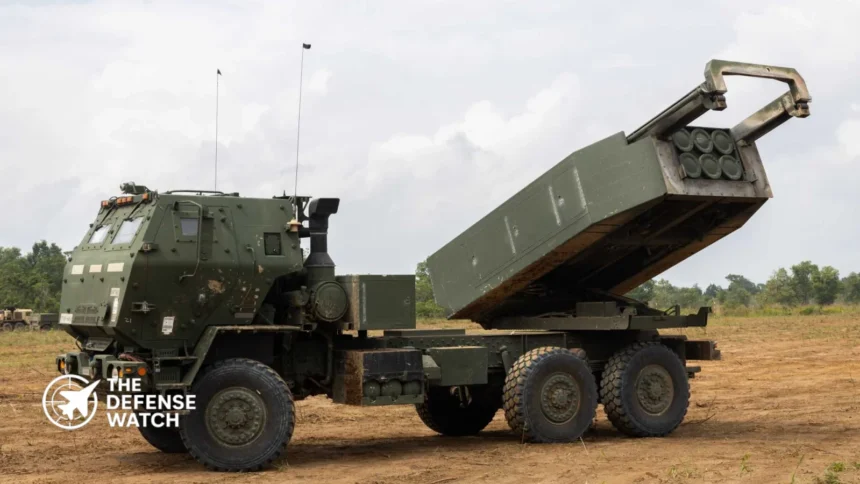
The United States has approved a possible $210 million Foreign Military Sale to Albania covering two M142 High Mobility Artillery Rocket Systems (HIMARS), guided rockets and supporting command-and-control equipment. The proposed acquisition would introduce a US-made precision rocket artillery capability into the Albanian Land Force while expanding military cooperation between Washington and its NATO ally.
The US Department of State announced the approval on November 17, 2026. Lockheed Martin is identified as the principal contractor, while Albania plans to finance the acquisition through US Foreign Military Financing (FMF) loan funds.
The approval is an important procurement milestone, but it does not mean the launchers have been delivered or that Albania has completed the purchase. The transaction remains subject to the Foreign Military Sales process.
What Albania has requested
The proposed package extends beyond the two launch vehicles. It includes guided ammunition, fire-direction systems, tactical communications equipment, transport vehicles and logistical support needed to establish an operational rocket artillery capability.
The principal equipment listed in the proposed sale includes:
| Equipment | Requested quantity |
|---|---|
| M142 HIMARS launchers | 2 |
| M31A2 GMLRS Unitary rocket pods | 6 |
| M30A2 GMLRS Alternative Warhead pods | 6 |
| International Field Artillery Tactical Data Systems | 8 |
| M1152A1 HMMWVs | 2 |
The 12 requested rocket pods contain six rockets each, giving Albania an initial allocation of 72 guided rockets. This comprises 36 M31A2 unitary-warhead rounds and 36 M30A2 alternative-warhead rounds.
The wider package also includes reduced-range practice rocket pods, AN/PRC-158, AN/PRC-160 and AN/PRC-167 tactical radios, navigation equipment, mission routers, intercoms, resupply vehicles, maintenance equipment, spare parts and technical documentation.
Training, transportation, integration, technical assistance and contractor logistics support are also included. These elements matter because acquiring launchers alone would not provide Albania with a complete artillery capability.
Why the fire-control equipment matters
One of the more notable elements of the request is the inclusion of eight International Field Artillery Tactical Data Systems (IFATDS).
IFATDS provides digital fire-support coordination and command functions. It helps military units process fire missions, exchange target information and coordinate artillery engagements with other supporting forces.
For Albania, this equipment could be as important to the long-term value of the purchase as the launchers themselves. Effective precision artillery depends on more than firing accuracy. It requires reliable communications, target identification, fire authorization, coordination and the ability to distribute information between command elements and firing units.
The requested tactical radios and mission routers would support this communications architecture. Together, these systems are intended to connect Albania’s new rocket artillery capability with wider NATO-compatible command and control arrangements.
Eight fire-direction systems for two launchers also suggest that the proposed architecture is not limited to equipment installed directly on the firing vehicles. However, the precise organization of the Albanian artillery units has not been publicly established.
What the GMLRS ammunition provides
The M142 HIMARS is a wheeled, mobile rocket artillery platform developed by Lockheed Martin. It carries one interchangeable launch pod containing six rockets or a compatible missile, allowing crews to conduct precision strikes and relocate after firing.
Albania’s requested ammunition consists of two different GMLRS configurations:
- M31A2 Unitary: Uses a single high-explosive warhead designed primarily for engaging individual targets.
- M30A2 Alternative Warhead: Uses a fragmentation-based warhead designed for effects against area targets.
Both belong to the 227 mm Guided Multiple Launch Rocket System family. The manufacturer lists the conventional GMLRS variants with ranges exceeding 70 kilometers, although actual engagement distances depend on the munition and mission conditions.
The proposed Albanian purchase does not list Extended-Range GMLRS (ER GMLRS), which Lockheed Martin identifies as a developmental variant designed to reach approximately 150 kilometers.
It also does not list the Army Tactical Missile System (ATACMS) or Precision Strike Missile (PrSM). Consequently, the requested configuration should be understood as a conventional GMLRS-based precision rocket artillery capability, not a long-range ballistic missile force.
The initial ammunition allocation also places limits on sustained operations. Each launcher can fire six rockets before requiring a reload. A simultaneous full-pod salvo from both vehicles would consume 12 of Albania’s 72 requested rockets.
This makes ammunition replenishment, storage, maintenance and access to additional rocket stocks important considerations if Albania intends to maintain the capability beyond initial training and limited operational use.
Albania’s modernization and the Western Balkans
Albania joined NATO on April 1, 2009, and has continued to develop its armed forces around alliance interoperability and collective defense.
The proposed HIMARS acquisition fits into that modernization effort by adding a mobile precision-strike system to the country’s land forces. It would also give Albania access to an artillery architecture already used by the United States and several NATO members.
Croatia provides a relevant regional comparison. In August 2024, the US approved a potential $390 million HIMARS sale to Zagreb involving eight launchers, 48 GMLRS rocket pods and associated support equipment. The package also included IFATDS and tactical communications equipment.
The Croatian and Albanian proposals demonstrate how HIMARS is becoming part of the conventional artillery modernization efforts of NATO members in southeastern Europe.
However, their scale differs considerably. Croatia requested eight launchers, compared with Albania’s two. Albania’s proposed purchase is therefore better understood as a small initial capability rather than a large-scale rocket artillery expansion.
The regional security environment also requires careful interpretation. Serbia has pursued its own modernization programs, including the acquisition of the Israeli-made PULS multiple rocket launcher system. Nevertheless, the Albanian HIMARS proposal alone does not establish a change in the regional military balance.
The US State Department’s assessment, as reproduced in the available sale notification reporting, is that the proposed transaction would not alter the basic military balance in the region.
Financing and the next procurement steps
The estimated $210 million package is to be financed through US Foreign Military Financing loan funds. This is important because the acquisition is not being presented as a grant-funded transfer.
In September 2026, the Defense Security Cooperation Agency announced a separate $302 million FMF direct loan agreement with Albania. Washington described that arrangement as a financing mechanism to support Albanian defense modernization through purchases from the US defense industrial base.
Lockheed Martin, headquartered in Grand Prairie, Texas, is the proposed principal contractor for the HIMARS package.
The congressional review process is another step before the transaction can proceed. Under the Arms Export Control Act, qualifying Foreign Military Sales to NATO members are subject to a 15-calendar-day formal congressional notification period. The process allows Congress to review the proposal before the US government proceeds toward a final Letter of Offer and Acceptance.
A final agreement, production arrangements and delivery schedule have not been established in the publicly available reporting.
The proposed sale also envisages US government and contractor personnel travelling to Albania for program management, equipment fielding and training support. This indicates that the acquisition will require a continuing support relationship rather than a one-time equipment transfer.
For Albania, the immediate challenge will be turning two launchers and an initial stock of guided rockets into a sustainable capability. That will require trained crews, a functioning fire-control network, suitable resupply arrangements and sufficient ammunition stocks.
The proposed purchase would give the Albanian Land Force access to a modern precision rocket artillery system, but its longer-term operational value will depend on how effectively Tirana funds and develops the supporting infrastructure.
Enjoying our coverage?
Make The Defense Watch a preferred source on Google to see more of our geopolitical and defense insights when relevant to you.