
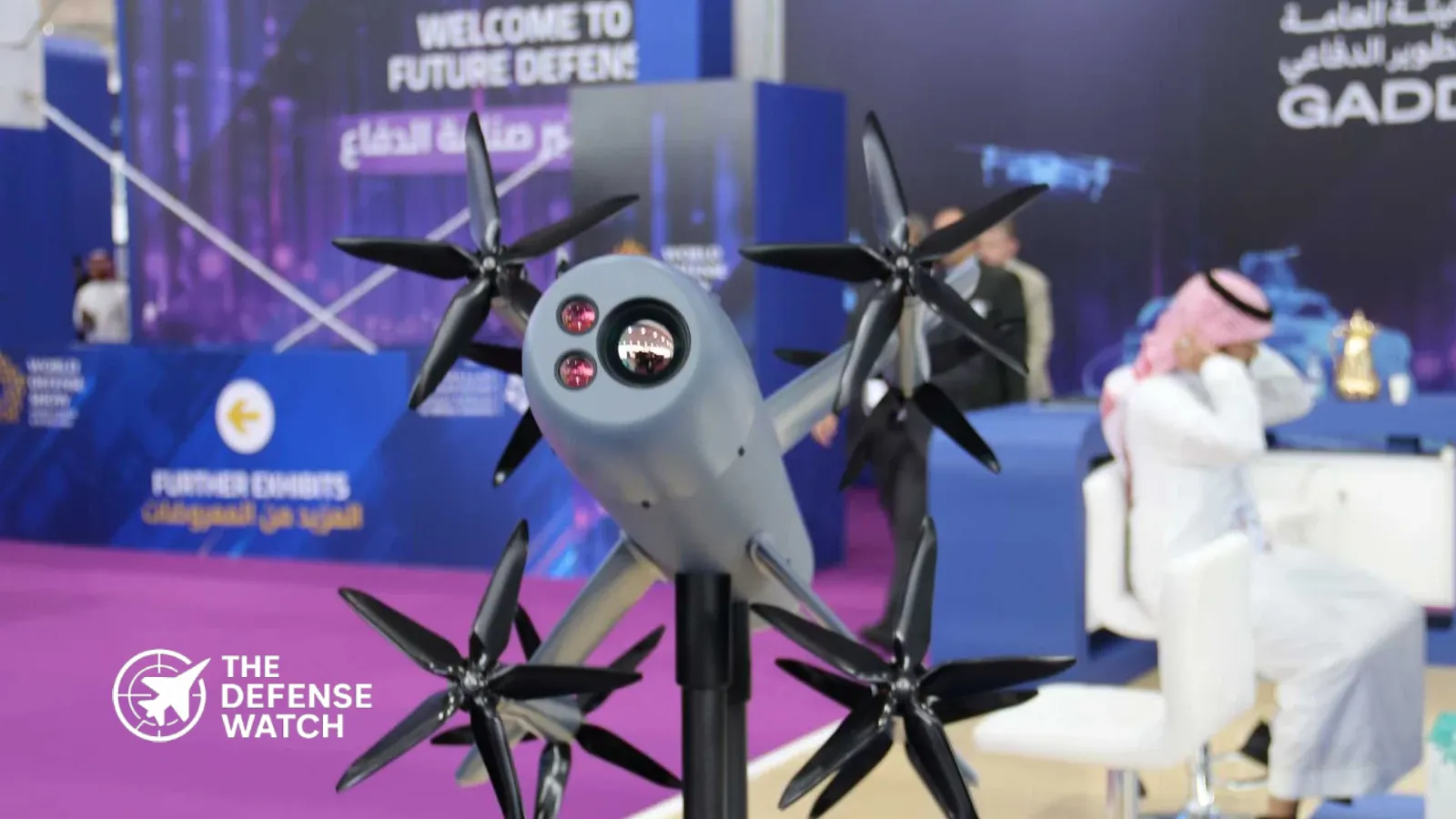
Saudi Unveils Baby Raptor Counter-Drone Interceptor At WDS 2026
At the World Defense Show 2026 in Riyadh, Saudi Arabia showcased a new counter-drone interceptor named Baby Raptor, marking a notable step in its efforts to field indigenous unmanned aerial defense technology. The system aims to provide rapid, airborne response against small hostile UAVs, blending speed, autonomy, and sensor capability in a compact package.
Compact Interceptor Designed For Fast Response
The Baby Raptor is a vertical take-off and landing (VTOL) unmanned interceptor developed by Saudi tech firm Wakeb. The platform weighs roughly 5 kilograms with dimensions suited for deployment from confined spaces, including forward bases or ship decks. Its design targets rapid launch and pursuit of hostile drones during their ingress to defended airspace or infrastructure.
Flight performance highlights include a maximum speed nearing 250 kilometers per hour and more than 20 minutes of endurance on battery power. This positions the system for short-duration interception missions rather than extended surveillance operations. Integrated thermal and electro-optical sensors support day and night target detection and tracking.
AI-Driven Guidance And Target Tracking
Central to the Baby Raptor’s capability is its onboard Raptor Pilot AI flight control system, which fuses inertial and imaging data to automate tracking and engagement of fast-moving aerial targets. The built-in Artificial Intelligence supports autonomous pursuit, reducing operator workload during high-tempo engagements.
The interceptor’s sensor suite and guidance logic aim to lock onto hostile UAVs with minimal external support, reflecting a shift toward autonomous counter-UAS tools able to operate in contested environments without heavy reliance on centralized command systems.
Saudi Defense Industry Moves Toward Indigenous Solutions
The public debut of the Baby Raptor at WDS 2026 underscores Riyadh’s broader push to develop locally designed defense platforms in line with national modernization goals. The World Defense Show, running February 8 to 12 in Riyadh, brings together military officials, OEMs, and international delegations to highlight innovations across air, land, sea, and security domains.
Saudi Arabia has placed increased emphasis on counter-UAS development in recent years, driven by regional drone threats and the need to protect energy infrastructure and forward operating sites. The Baby Raptor’s integration of autonomy and rapid deployment features is part of a wider trend toward layered counter-drone systems combining electronic warfare, ground-based sensors, and airborne intercept capabilities.
Operational Role And Future Prospects
While details on procurement or fielding schedules are not yet public, defense officials at the show positioned Baby Raptor as a component of multi-layered air defense networks. Its VTOL profile and rapid response orientation make it well suited for perimeter defense and protection of high-value sites where fixed installations may be impractical.
Experts note that integrating such airborne interceptors into broader systems can enhance defense against low, slow, and small drone swarms that challenge conventional air defense tools. The Baby Raptor represents a lightweight, autonomous option that can augment existing counter-UAS layers without the cost and infrastructure demands of larger weapons.
Get real time update about this post category directly on your device, subscribe now.
