Lithuania ordered residents in parts of its northern and central regions to seek shelter on October 18 after an unidentified flying object entered the country’s airspace, triggering a temporary airport closure and the deployment of NATO fighter aircraft.
Lithuanian authorities suspected the object was a drone. The incident prompted a red air warning, while neighboring Latvia briefly issued a lower-level warning in areas bordering Lithuania. NATO confirmed that two Italian Eurofighter jets had been scrambled in response.
The incident illustrates the challenge facing NATO’s eastern members as Russia’s war against Ukraine continues to create risks beyond the immediate battlefield. However, the object’s precise origin, flight path and circumstances remained under investigation in the reporting available on October 19.
What happened over Lithuania?
Lithuania’s national crisis management authorities activated an air warning on Sunday morning, October 18, directing residents in affected areas to take shelter for about an hour.
Kaunas Airport, near Lithuania’s second-largest city, was temporarily closed during the alert. The disruption reflected the precautionary measures authorities took while the airborne object remained unidentified.
According to reporting by Reuters, Lithuanian Defense Minister Robertas Kaunas said the object was believed to have entered Lithuanian airspace from Poland. He proposed a joint investigation with his Polish counterpart to establish the circumstances.
Polish authorities, however, said their radar systems had not confirmed that the object crossed the border into Lithuania. Poland remained in contact with Lithuanian officials as the investigation continued.
That distinction is important. Lithuania’s assessment pointed toward a possible entry route, but the available information did not establish a confirmed flight path across Polish territory.
NATO deployed Italian Eurofighter Typhoons
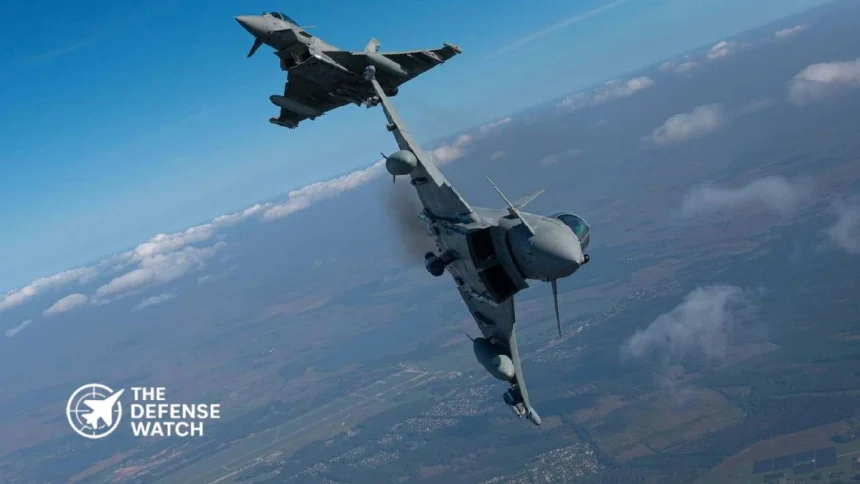
NATO scrambled two Italian Eurofighter Typhoon fighters in response to the incident, according to an alliance official cited by Reuters. The aircraft operated under NATO command as part of the response to the unidentified object.
The Lithuanian crisis management center said the fighters could not visually identify the object because of cloudy weather. They did not attempt to shoot it down.
Lithuanian military personnel were also investigating possible debris near Juodzionys village in the northern part of the country after the object disappeared from radar. The defense minister said some debris struck a civilian vehicle.
The incident therefore involved more than an airspace alert. Authorities had to assess a possible airborne threat, coordinate military and civilian responses, and investigate the remains of an object whose identity had not yet been established publicly.
The available reporting does not establish that NATO aircraft intercepted or destroyed the object.
Ukraine raises the possibility of Russian electronic warfare
Ukraine’s Foreign Ministry said it regretted the incident and suggested that Russian electronic warfare might have diverted Ukrainian drones from their intended routes during an operation against military targets in Russia.
Ukrainian Foreign Ministry spokesperson Heorhii Tykhyi said Kyiv was prepared to share relevant information with Lithuanian authorities to establish what happened. The statement expressed a possible explanation, not a confirmed finding about the object’s identity or route.
Electronic warfare can interfere with satellite navigation and other communications used by unmanned aircraft. Depending on the aircraft’s design and navigation system, such interference may affect its ability to maintain a planned route.
However, the effect of electronic warfare varies by platform and circumstances. The public statements available so far do not establish which navigation systems the object used, whether it experienced jamming, or whether such interference caused the incident.
A joint investigation involving Lithuania, Poland and Ukraine could help determine whether the object was a Ukrainian drone, how it entered Lithuanian airspace, and whether electronic interference contributed to its flight.
Why the incident matters for NATO’s Baltic defenses
Lithuania is a NATO member on the alliance’s eastern flank, bordering Latvia, Poland and Russia’s Kaliningrad exclave. Its location places it near areas affected by Russia’s war against Ukraine and makes airspace monitoring an important part of regional security.
The October 18 alert also affected neighboring Latvia, which briefly issued a yellow air warning in some border regions before withdrawing it. This demonstrated how an uncertain airborne event can prompt precautionary measures across national borders.
Three operational issues stand out.
Early warning and identification. Detecting an object is not the same as identifying it. Military authorities must assess radar tracks, available sensor information and flight behavior before deciding whether a target poses a threat. Poor visibility can complicate visual identification, as it did during this incident.
Coordination with civilian authorities. The shelter instruction and temporary airport closure show how airspace incidents can affect civilians even when an object is not engaged. Effective procedures must balance public safety, aviation continuity and the need to avoid an unnecessary military response.
Cross-border information sharing. Determining where an object originated requires more than a single radar track. Neighboring states may need to compare radar records, sensor data and recovered debris. The disagreement over whether the object crossed from Poland into Lithuania makes that cooperation particularly relevant.
These are established air defense challenges, but the incident does not by itself demonstrate a specific failure in NATO’s surveillance network or prove that the alliance could not defeat a deliberate attack.
A wider pattern of drone-related airspace incidents
Lithuania’s alert came amid repeated reports of Ukrainian drones entering NATO airspace in the Baltic region. Ukrainian officials have previously attributed such incidents to Russian electronic warfare, although the circumstances must be assessed individually.
The security concern is not limited to the physical damage an unmanned aircraft might cause. An unidentified object can force military aircraft to launch, disrupt commercial aviation and require emergency services to prepare for a possible crash or explosion.
Such incidents also create difficult decisions for NATO air policing missions. An aircraft may need to investigate a track without having enough information to determine whether it is hostile, accidentally off course or no longer under effective control.
That uncertainty matters when deciding whether to continue monitoring, issue warnings, divert civilian traffic or use force. An immediate engagement may carry risks if the object is over a populated area, while delaying a decision can leave a genuine threat unresolved.
The appropriate response depends on the assessed threat, available tracking information and the rules governing the mission. Public reporting has not disclosed the complete operational picture from Sunday’s event.
What investigators still need to establish
Several questions remain open following the October 18 incident:
- Identity: Whether the object was a Ukrainian drone or another type of aircraft.
- Flight path: Whether it crossed into Lithuania from Poland, as Lithuanian officials initially assessed.
- Cause: Whether navigation failure, electronic interference or another factor contributed to the incident.
- Debris: Whether the material found near Juodzionys can establish the object’s type and origin.
- Operational response: What information NATO and Lithuanian authorities had available when the warning was issued and fighter aircraft were scrambled.
The findings could clarify whether this was an accidental incursion linked to the conflict in Ukraine or an event requiring a different security assessment.
For now, the confirmed response is clearer than the cause: Lithuania issued a public warning, temporarily closed Kaunas Airport, and received NATO air support. The object’s origin and the circumstances of its flight remained matters for investigation.