
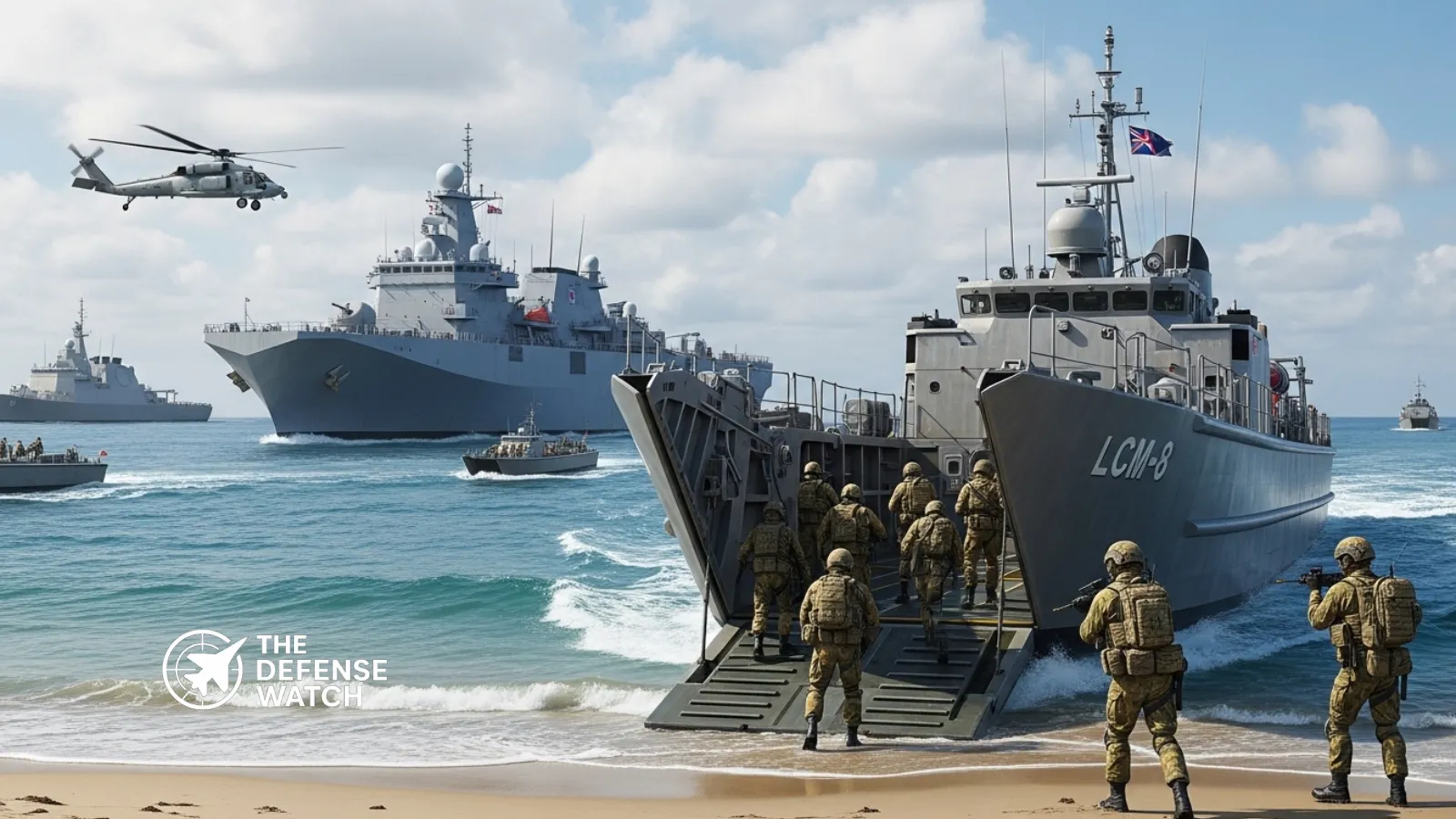
- ► Austal selected to design and build Australia new Heavy Landing Craft fleet for the Army.
- ► Program supports enhanced littoral maneuver and coastal logistics operations.
- ► Construction to take place in Western Australia, reinforcing sovereign shipbuilding capacity.
- ► New craft will replace legacy landing platforms and integrate with joint amphibious forces.
- ► Contract marks a key step in Australia broader force posture and regional deterrence strategy.
Austal Wins Australia Heavy Landing Craft Contract
The Australia heavy landing craft program has been awarded to Austal, marking a major step in Canberra effort to modernize the Australian Army amphibious lift capability.
The contract covers the design and construction of a new fleet of Heavy Landing Craft intended to replace aging platforms and expand operational reach across the Indo Pacific.
The decision underscores Australia focus on littoral maneuver, rapid coastal logistics, and distributed operations in contested maritime environments.
Strengthening Littoral Warfare Capability
The Australia heavy landing craft fleet is designed to move armored vehicles, troops, and supplies between larger amphibious ships and shorelines without developed port infrastructure. That capability is increasingly central to Australia defense planning.
Recent strategic guidance from the Australian Department of Defence emphasizes the need for agile, mobile land forces able to operate across archipelagic terrain. The new landing craft will support that requirement by enabling rapid deployment along Australia vast northern coastline and into regional areas of interest.
In operational terms, heavy landing craft fill a critical gap. They provide the link between strategic sealift and tactical ground maneuver. Without them, even advanced amphibious ships cannot efficiently project land combat power ashore.
Industrial Impact And Sovereign Shipbuilding
Construction will take place in Western Australia, reinforcing domestic shipbuilding capacity. For Canberra, the Australia heavy landing craft award is not only about capability, but also about sustaining a skilled workforce and maintaining sovereign industrial expertise.
Austal has an established footprint in both Australian and international naval programs. Securing this contract strengthens its role in Australia defense industrial base at a time when maritime construction demand is rising across the Indo Pacific.
The move aligns with broader government efforts to localize defense production and reduce supply chain risk. In an era of strategic competition, assured access to shipbuilding and sustainment capacity is viewed as a national security priority.
Replacing Legacy Platforms
The existing Army watercraft fleet has faced limitations in payload, endurance, and survivability. The Australia heavy landing craft program is expected to deliver improved performance across these metrics, though detailed specifications have not been fully disclosed.
Modern landing craft typically incorporate improved hull design, greater payload capacity for armored vehicles, and updated navigation and communications systems. These enhancements allow integration into joint operations alongside the Royal Australian Navy amphibious ships and coalition forces.
The upgrade is part of a broader restructuring of the Australian Army toward a more littoral focused posture. Heavy landing craft support distributed operations, humanitarian assistance, disaster relief, and high intensity conflict scenarios.
Strategic Context In The Indo Pacific
Australia defense policy has shifted in response to a more contested regional security environment. Maritime mobility and rapid force projection are central to deterrence.
Heavy landing craft play a quiet but decisive role in this framework. They enable flexibility. Forces can disperse, regroup, and sustain themselves without reliance on fixed infrastructure that may be vulnerable in crisis.
In practical terms, the Australia heavy landing craft fleet enhances operational resilience. It supports joint force integration and strengthens Australia ability to work alongside regional partners.
Analysis: Why This Program Matters
The Australia heavy landing craft contract reflects a broader trend across Indo Pacific militaries. Nations are investing in platforms that support distributed, island based, and coastal operations.
Unlike headline platforms such as submarines or fighter jets, landing craft receive less public attention. Yet they are essential enablers. Without them, amphibious strategy remains theoretical.
This award signals that Canberra is aligning procurement with strategic doctrine. Littoral maneuver is not just rhetoric. It now has funded hardware behind it.
The contract also reinforces domestic industry at a time when Australia is pursuing major naval projects, including surface combatants and undersea systems. Sustaining multiple production lines strengthens industrial resilience.
From a geopolitical standpoint, the program contributes to deterrence by denial. The ability to rapidly deploy and resupply land forces complicates any adversary planning in maritime approaches.
What Comes Next
Program timelines, delivery schedules, and full technical specifications are expected to emerge as the project advances. Initial construction activity in Western Australia will be closely watched by industry and regional stakeholders.
The Australia heavy landing craft fleet will likely enter service in phases, gradually replacing legacy systems while integrating into joint training cycles.
As Canberra continues reshaping its force posture, amphibious lift capacity will remain a key metric of operational readiness.
Get real time update about this post category directly on your device, subscribe now.
