
Table of Contents
Hypersonic Missile Defense Enters a New trategic Era
Hypersonic missile defense has rapidly evolved from a conceptual study to a top-tier modernization priority for the United States, NATO allies, and Indo-Pacific partners. As China, Russia, and emerging powers accelerate development of maneuverable hypersonic glide vehicles (HGVs) and high-speed cruise missiles, the demand for advanced, layered defenses has reshaped military planning, acquisition timelines, and alliance cooperation.
This article provides a comprehensive, chronological timeline that outlines how hypersonic missile defense systems have progressed — from the earliest early-warning concepts to today’s glide-phase interceptors, space-sensor networks, advanced command-and-control, and multinational research programs. It also examines how these systems are transforming tactical and strategic doctrine across global theaters.
Early Foundations (1960s–1990s): Birth of Missile Defense, Before Hypersonics Emerged
Cold War ABM Experiments Set the Stage
Although modern hypersonic weapons did not exist during the Cold War, several pioneering anti-ballistic missile (ABM) programs laid the groundwork for current counter-hypersonic architectures:
- 1960s–1970s — Soviet A-35 ABM system:
One of the earliest operational missile-defense networks, providing intercept capability against strategic ballistic missiles. - 1960s–1990s — U.S. Safeguard, Ground-based radars, early infrared sensors:
These systems introduced radar-tracking, space-based detection architectures, and interceptor concepts that remain central to counter-hypersonic efforts.
At this stage, missile defense focused exclusively on ballistic trajectories — predictable, high-altitude flight paths that differ substantially from maneuverable hypersonic weapons.
2000s–Early 2010s: Hypersonic Threat Emerges, Defense Architecture Still Lags
Rise of Hypersonic Programs in Russia & China
By the mid-2000s, Russia and China began publicly investing in hypersonic glide vehicles and high-speed cruise missiles. Their ability to maneuver at Mach 5+ speeds highlighted the shortcomings of traditional missile-defense systems built for ballistic threats.
U.S. Strategic Shift: Recognition of a New Class of Missile Threats
U.S. military and intelligence assessments started acknowledging that existing ballistic missile defense (BMD) systems—such as Aegis BMD, THAAD, and GMD—could not reliably track or intercept hypersonic targets.
2019 — The First Major Breakthrough: MDA Leads Hypersonic Missile Defense
In 2019, the U.S. Missile Defense Agency (MDA) was officially designated the lead organization responsible for developing defensive capabilities specifically against hypersonic weapons.
This decision marked a historic shift: hypersonic defense would no longer be treated as an extension of BMD, but a dedicated mission area requiring completely new architectures.
Space-Based Tracking Takes Center Stage (2019–2023)
Hypersonic and Ballistic Tracking Space Sensor (HBTSS)
Space-based infrared sensors became essential for tracking HGVs, which fly at lower altitudes and perform unpredictable maneuvers.
- Satellite sensors were engineered for “birth-to-death tracking”, enabling continuous detection from launch to terminal phase—critical for glide-phase interception.
- HBTSS prototypes successfully completed on-orbit testing phases, demonstrating improved target discrimination.
Why Space Sensors Matter
Ground radars struggle with the low, fast, maneuvering profiles of hypersonic threats.
Space sensors overcome this with:
- Wide-field persistent coverage
- Faster update rates
- Improved discrimination
- Seamless integration with Aegis and other C2 networks
This became one of the most important technological shifts in modern missile defense.
2021–2024: The Glide Phase Interceptor Era Begins
The U.S. Glide Phase Interceptor Program
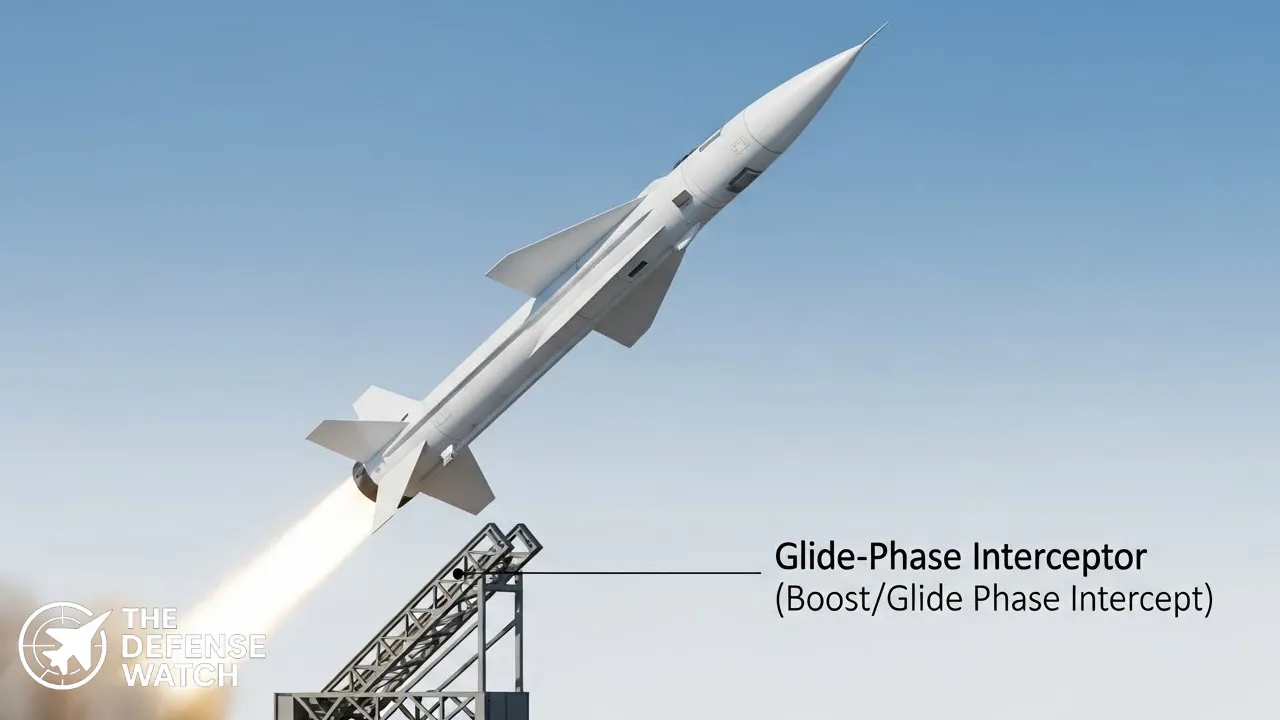
The next milestone occurred with the launch of the Glide Phase Interceptor (GPI) program — a first-of-its-kind interceptor designed to engage hypersonic glide vehicles during the midcourse glide phase, before terminal descent.
- Designed for naval and shore-based launch from Aegis BMD platforms
- Relies heavily on HBTSS and next-generation tracking networks
- Requires extreme speed, maneuverability, and hit-to-kill precision
Congress Mandates Accelerated Fielding (2024)
The 2024 U.S. defense authorization law required:
- Minimum 12 operational GPI interceptors by 2029
- Full 24-interceptor capability by 2032
Congressional pressure signaled a national urgency to counter Chinese and Russian hypersonic deployments.
2025 – Funding Challenges and Delays Surface
Despite ambitious timelines, industry and government faced engineering, testing, and financial hurdles:
- Reduced budgets slowed GPI testing
- Space-sensor integration timelines slipped
- Some interceptors may not achieve full capability until mid-2030s
Europe’s Entry: HYDIS² and the Rise of Allied Hypersonic Defense (2024–2025)
Europe moved aggressively to develop its own defense systems as Russia expanded its hypersonic arsenal.
HYDIS² Multinational Interceptor Program
France, Germany, Italy, and other European partners launched the HYDIS² (Hypersonic Defence Interceptor Study) program to develop a next-generation endo-atmospheric interceptor capable of countering hypersonic threats.
- Early design studies completed
- Aimed at protecting NATO airspace
- Complements U.S. and Japanese interceptor programs
2024–2025: U.S.–Japan Joint Hypersonic Defense Effort Expands
The U.S. and Japan deepened cooperation on hypersonic defense technologies, especially GPI. Tokyo’s strategic interest grew as China improved its DF-17 hypersonic systems and North Korea expanded missile testing.
Radar Breakthroughs: Synthetic Aperture & Multi-Band Systems (2024–2025)
Raytheon and other industry partners revealed advanced radar systems capable of detecting and tracking hypersonic vehicles through atmospheric turbulence and high-speed maneuvers.
Recent Industrial Momentum (2024–2025)
Lockheed Martin, Northrop Grumman, and other U.S. defense giants built new hypersonic production facilities to accelerate manufacturing timelines.
Tactical Evolution — How Hypersonic Defense Changes Modern Warfare
From Ballistic Defense to Multi-Domain Layered Protection
The role of missile defense has expanded from strategic deterrence to integrated air and missile dominance, using:
- Space-based tracking
- Glide-phase interceptors
- Terminal-area defenses
- Cross-domain fusion sensors
- AI-driven C2 networks
Naval Forces Become Central to Hypersonic Defense
Aegis destroyers equipped with GPI will allow fleet commanders to protect:
- Carrier strike groups
- Key maritime choke points
- Indo-Pacific forward operating bases
- Allied commercial shipping routes
Deterrence Rebalanced
Hypersonic missile defense reduces the “first-strike advantage” of hypersonic weapons, restoring strategic stability and complicating adversary planning.
Conclusion
Over six decades, missile defense has transformed from Cold War-era ABM experiments into a sophisticated, multi-layered, space-integrated shield designed to counter the world’s fastest and most unpredictable weapons. The pace of progress — reflected in the launch of interceptor programs, space-sensor constellations, and multinational coalitions — underscores the urgency of the hypersonic threat and the global race to neutralize it.
Hypersonic missile defense is no longer a future concept; it is becoming one of the most critical pillars of modern deterrence, shaping operational planning from Europe to the Indo-Pacific.
FAQs
Their maneuverability, unpredictable flight paths, and low-altitude profiles complicate tracking and interception.
No. It remains in development, with initial capability expected around 2029–2032.
They provide continuous tracking and wider detection coverage — critical for monitoring high-speed glide vehicles.
The United States, Japan, France, Germany, Italy, and the U.K. are the most active in counter-hypersonic programs.
They create stability challenges, but emerging hypersonic missile-defense systems aim to restore balance.
Get real time update about this post category directly on your device, subscribe now.

5 comments
[…] The successful missile launch demonstrates that the Ghost Bat is no longer limited to reconnaissance or support roles. It now has demonstrated lethal strike capability. The event also underlines growing confidence from both the government and industry to invest in unmanned combat aircraft as a viable complement to crewed jets. The significance lies in the effective integration of autonomous capabilities into traditional air combat formations, aligning with broader trends in modern air warfare. […]
[…] Sustaining DCGS capabilities at these locations supports global Air Force intelligence operations, including data processing for remotely piloted aircraft, manned reconnaissance platforms, and space-based sensors. […]
[…] aggression in the Indo-Pacific region. Advanced fighters, stealth bombers, long-range missiles, and space-based sensors all contribute to maintaining technological advantages critical for […]
[…] program continues to reflect deep U.S. Israel defense cooperation. The U.S. Missile Defense Agency has been involved in David’s Sling development and testing for more than a decade, providing […]
[…] single award indefinite delivery indefinite quantity contract enables the Missile Defense Agency to modernize how it develops and manages complex architectures and requirements tied to defending the United […]