
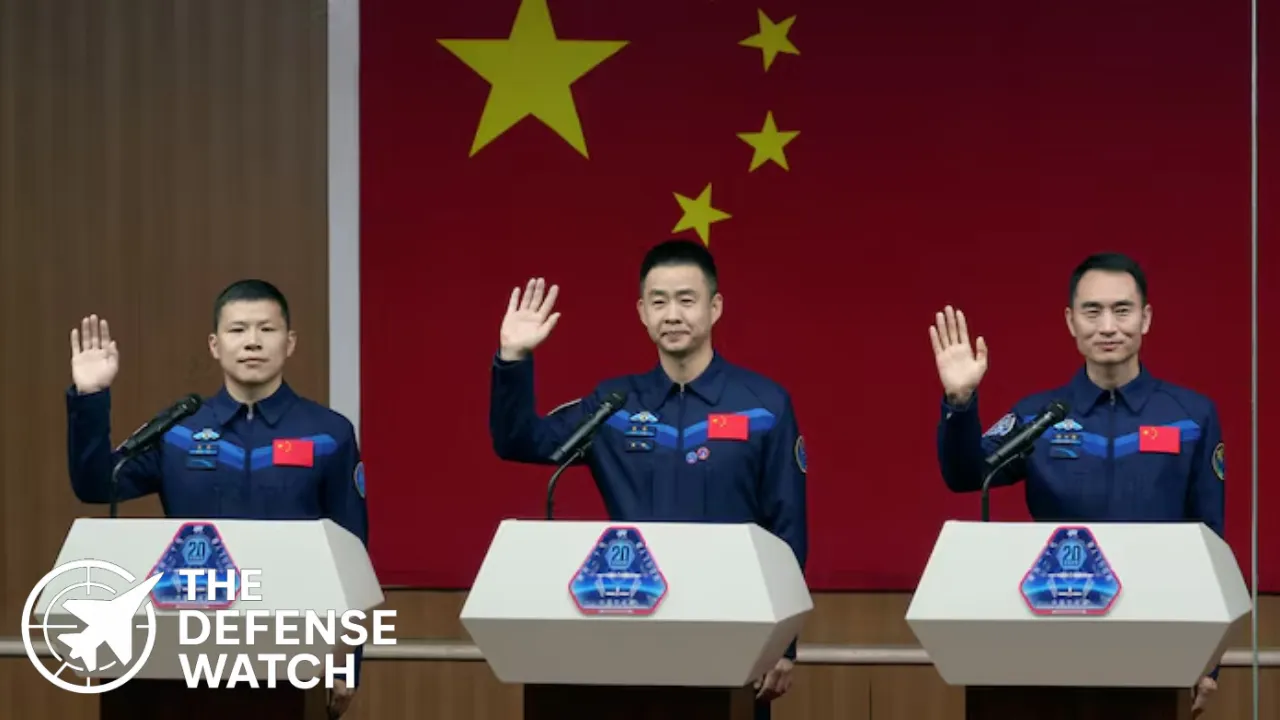
Three Chinese astronauts returned to Earth on November 14 after a nine-day delay when their Shenzhou-20 spacecraft sustained damage from suspected space debris while docked at the Tiangong space station. The crew used the recently arrived Shenzhou-21 capsule for their return instead of their original vehicle, which remains at the station with window cracks.
The China Manned Space Agency revealed that crews discovered tiny cracks in the return capsule’s viewport window, most likely caused by external impact from space debris. The incident marks a significant operational disruption for China’s space program and underscores the mounting risks posed by orbital debris to military and civilian space operations.
The three astronauts—mission commander Chen Dong, Chen Zhongrui, and Wang Jie—completed a 204-day mission aboard Tiangong, setting a new endurance record for Chinese astronauts. Their original return date of November 5 was postponed after the damage was discovered, forcing mission planners to implement an alternative return procedure.
Operational Implications for Chinese Space Program
The incident leaves China facing an unprecedented situation: the Shenzhou-21 crew currently aboard Tiangong has no working spacecraft available for emergency evacuation. The damaged Shenzhou-20 vessel was deemed unfit to fly and remains docked at the station.
China’s Manned Space Agency announced that the Shenzhou-22 spacecraft will be launched at an appropriate time in the future, though no specific timeline was provided. The premature deployment of Shenzhou-22, originally scheduled for April launch, may draw on experience from Russia’s Soyuz program, upon which Chinese Shenzhou vessels are based.
This represents the first time a Shenzhou vessel has been left behind in space while its crew returned to Earth. The debris-damaged spacecraft must be either repaired in orbit or removed entirely, as Tiangong requires a vacant docking port to accommodate newly arrived vessels. Russian space experts suggest that if damage is significant, the vessel could be undocked and deorbited over the Pacific Ocean.
Space Debris: An Escalating Military and Strategic Concern
The Shenzhou-20 incident highlights the growing operational risks that space debris poses to military space assets and national security infrastructure. According to NASA, more than 45,000 human-made objects currently orbit Earth, with the global space economy valued at over $600 billion. While objects larger than 10 centimeters can be tracked, the real danger comes from smaller debris traveling at speeds exceeding 27,000 kilometers per hour.
The European Space Agency’s 2024 Space Environment Report indicates that approximately 35,000 objects are now tracked by space surveillance networks, but the actual number of space debris objects larger than one centimeter—capable of causing catastrophic damage—exceeds one million.
This is not the first debris incident affecting China’s space program. In March 2024, a fragment struck one of Tiangong’s solar panels, causing power loss that required astronauts to conduct spacewalks for repairs. The frequency of such incidents demonstrates the vulnerability of long-duration space infrastructure to debris impacts.
Defense analysts note that China’s space program operates under military control, making incidents like the Shenzhou-20 damage relevant to broader defense and strategic considerations. China developed Tiangong after being excluded from the International Space Station over U.S. national security concerns.
Comparative Analysis: International Space Station Precedents
The Shenzhou-20 incident parallels challenges faced by other space programs. The International Space Station experienced delayed astronaut returns in 2024 when NASA astronauts Butch Wilmore and Suni Williams saw their one-week Boeing Starliner test flight extend to nine months after propulsion problems developed with their capsule.
Space policy experts argue that two separate incidents within approximately one year should serve as a wake-up call that space rescue capabilities or organizations are needed. Both the Boeing Starliner and China Shenzhou episodes benefited from occurring during missions to space stations, which could act as safe havens until rescue plans were implemented.
However, commercial free-flyer missions where docking with a station is not an option face greater risks, as rescue must happen quickly due to limited onboard supplies. Experts identify compatible docking systems, communications systems, and established rescue coordination procedures as critical enablers for future space rescue capabilities.
The Accelerating Orbital Debris Crisis
Recent data underscores the severity of the space debris problem. The European Space Agency’s 2024 report shows that 2023 saw the highest payload launch traffic ever recorded, with most satellites joining large commercial communication constellations. Two-thirds of all active satellites—over 6,000—currently operate between 500 and 600 kilometers altitude.
Within certain heavily populated altitude bands, the density of active objects now equals the order of magnitude of space debris. In 2024, several major fragmentation events added over 3,000 tracked objects in a single year. These fragmentations result from anti-satellite tests, propulsion system failures, and collisions.
Active satellites must perform an increasing number of collision avoidance maneuvers to dodge other satellites and debris fragments. Without further change, the collective behavior of spacefaring entities remains unsustainable in the long term.
Military Space Operations Under Threat
The Shenzhou-20 damage carries significant implications for military space operations globally. Space-based assets provide critical capabilities for modern warfare, including communications, navigation, reconnaissance, and early warning systems. The vulnerability of these systems to debris impacts represents a strategic concern for defense planners.
According to Georgetown University research analysts, there are currently more than 34,000 debris objects in orbit. The problem traces to decades of space activity where spent rocket stages, defunct satellites, and mission-related hardware were discarded without adequate disposal protocols.
Historical events demonstrate the lasting impact of debris-generating incidents. China’s 2007 anti-satellite test destroyed a weather satellite and created approximately 3,500 debris fragments that remain in orbit. The 2009 collision between the inactive Russian Cosmos-2251 satellite and the operational U.S. Iridium 33 communications satellite generated over 2,000 trackable debris pieces.
Mitigation Efforts and Future Outlook
The European Space Agency has implemented debris mitigation rules for partner missions and awarded an €86 million contract to ClearSpace SA for a mission demonstrating active debris removal. Space agencies worldwide are exploring technical solutions including space-based removal systems and novel deorbiting techniques.
The Inter-Agency Space Debris Coordination Committee published Space Debris Mitigation Guidelines in 2002, establishing voluntary measures for designing, flying, and disposing of space missions to prevent further debris creation. However, adoption of these guidelines has been insufficient to halt debris accumulation.
The space debris removal market is experiencing rapid growth. Market valuations indicate expansion from $70 million in 2023 to a projected $400 million by 2028, driven by increased satellite deployments, growing awareness of space sustainability, and the proliferation of mega-constellations.
Defense and space policy experts emphasize that without legally binding international treaties establishing cleanup responsibilities and operational standards, the orbital environment will continue deteriorating. The voluntary nature of current guidelines has proven inadequate to address the scale of the problem.
Strategic Assessment and Recommendations
Mission commander Chen Dong acknowledged the challenges upon returning to Earth, stating that human space exploration is filled with difficulties and challenges, which is precisely why they choose this path. His comments reflect the broader reality that space operations now occur in an increasingly hazardous environment.
For defense planners and military space operators, the Shenzhou-20 incident provides several lessons. First, long-duration missions require robust contingency planning for debris-related emergencies. Second, maintaining backup transportation capabilities at orbital facilities is essential for crew safety. Third, the accumulation of debris threatens the long-term viability of military space operations.
The incident also highlights the interconnected nature of space security. Debris generated by any nation or entity threatens assets belonging to all spacefaring powers. This reality argues for enhanced international cooperation on debris mitigation, even among geopolitical competitors.
As satellite constellations expand and military space operations intensify, the orbital debris problem will worsen before improvement occurs. The European Space Agency’s new Health Index for the space environment indicates that if current behaviors continue, risk levels will pass beyond the point of sustainability.
Conclusion
The damage to China’s Shenzhou-20 spacecraft represents more than an operational setback for Beijing’s space program. It serves as a stark reminder that the orbital debris problem poses immediate risks to space operations, including military and intelligence assets critical to national security.
With the Shenzhou-21 crew currently lacking immediate emergency escape capability, China faces operational constraints unprecedented in its space station program. The incident underscores the urgent need for comprehensive international agreements on debris mitigation, active removal capabilities, and standardized rescue procedures.
As space becomes increasingly central to military operations and strategic competition, the sustainability of the orbital environment emerges as a critical defense issue. The Shenzhou-20 damage demonstrates that space debris threatens all spacefaring nations equally, regardless of terrestrial geopolitical divisions.
Get real time update about this post category directly on your device, subscribe now.

5 comments
[…] a small rotating contingent of Norwegian defense personnel and functions as both a meteorological station and military outpost. It also hosts Jan Mayensfield, a modest airstrip used for occasional flights and […]
[…] under the authority of 10 U.S. Code Section 130i. The comprehensive framework addresses what military officials describe as a direct and growing threat posed by the proliferation of inexpensive, capable, and weaponizable UAS by both peer competitors […]
[…] Deployable, Attritable Optical Systems receives $22.15 million to develop cost-effective space-based surveillance and tracking capabilities. These investments align with broader Pentagon efforts to maintain space superiority amid growing threats to orbital assets. […]
[…] sensors must remain highly reliable to detect, track, and characterize objects ranging from operational satellites to debris and potential adversary […]
[…] The Mengzhou spacecraft represents China’s new generation crewed capsule, designed to eventually replace the Sh…. […]