- U.S. intelligence assessed Iran held the Middle East’s largest ballistic missile stockpile entering 2025 — estimated at over 3,000 missiles before active hostilities began.
- On March 20, 2026, Iran fired two ballistic missiles toward the joint U.S.-UK base at Diego Garcia — approximately 4,000 km from Iranian territory — shattering assumptions about Tehran’s maximum strike range.
- As of mid-March 2026, U.S. Central Command reported missile launch rates had dropped roughly 90 percent from Day 1 of the conflict; drone attacks were down approximately 86 percent — though analysts warn the decline reflects inventory management, not depletion.
- Israel reportedly disabled up to 290 of Iran’s estimated 410–440 ballistic missile launchers through sustained strikes, according to a senior Israeli official cited by the Institute for the Study of War.
- Iran’s Shahed-series drones — costing between $20,000 and $50,000 per unit — can be produced rapidly in dispersed, simple facilities, giving Tehran a cost-asymmetric edge that is extremely difficult to neutralize from the air.
Iran’s Missile Arsenal in 2026: Stockpiles, Surviving Capability, and the Diego Garcia Shock
When the United States and Israel launched Operation Epic Fury against Iran on February 28, 2026, one of their central strategic objectives was clear: neutralize Tehran’s missile and drone forces before they could be turned against American bases, Gulf partners, and Israeli cities. Four weeks into the conflict, that mission is proving far more complicated than Washington’s initial battle damage assessments suggested.
The power of its air force diminished by Western sanctions over decades, Iran invested heavily in missiles and drones, amassing what U.S. intelligence called in early 2025 the “largest stockpile” of such systems in the Middle East. That arsenal — a combination of ballistic missiles, cruise missiles, and one-way attack drones — has now become both the primary target of American and Israeli air power and Tehran’s only meaningful tool of retaliation.
How Large Was Iran’s Missile Arsenal Before the War?
Accurately sizing Iran’s missile inventory has long been one of the hardest problems in Middle Eastern defense intelligence. U.S. military assessments have suggested Iran possessed more than 3,000 ballistic missiles — a commonly cited estimate — though analysts stress that the exact stockpile size remains unknown. Other defense research groups and regional intelligence estimates place the pre-war figure closer to around 2,500 missiles, noting such figures are approximations rather than confirmed totals.
Iranian ballistic missile capacity is difficult to independently verify, given the limited reliable information on quantities. The U.S. Air Force and some non-governmental organizations have released estimates in the past, but these typically count launchers rather than missiles themselves, since launchers are, in principle, easier to track and observe.
The arsenal itself spans multiple categories. Iran’s medium-range ballistic missiles (MRBMs), with heavy warheads, put the entire Middle East and parts of southeastern Europe, Southeast Asia, and northeast Africa within reach from Iranian territory. Meanwhile, short-range ballistic missiles and cruise missiles pose the greatest threat to U.S. bases, forces, and Gulf partners, given their shorter flight times and exposure to less robust air defenses.
Iran has also invested heavily in survivability. At least five known underground “missile cities” exist in provinces including Kermanshah and Semnan, as well as near the Gulf. These facilities include storage depots, concealed launch systems, and transport tunnels. Iran demonstrated in 2020 the ability to fire a ballistic missile from underground — establishing that degrading its capabilities would require sustained operations rather than a single decisive strike.
What Has the War Cost Iran So Far?
Weeks of intensive U.S. and Israeli strikes have made a measurable dent in Iran’s operational missile infrastructure. According to a senior Israeli military official cited by the Institute for the Study of War, Israel has put up to 290 launchers out of service, out of an estimated 410 to 440 total launchers.
U.S. Central Command reported that Iran had fired more than 500 ballistic missiles and in excess of 2,000 drones since the war began. Western officials noted a sharp drop in attack rates in recent days, with the top U.S. commander General Dan Caine noting an 86 percent decline in ballistic missile strikes from the first day of fighting, while Central Command cited a further 23 percent reduction in drone attacks.
Yet defense analysts are warning against reading those declining numbers as a sign that Iran is running out of weapons. The pattern of Iranian attacks is more consistent with recalibration than capacity constraints. Tehran could be using this period to learn, adapt, and refine its tactics — including stockpiling weapons for larger coordinated salvos designed to saturate air defenses, a tactic Moscow has repeatedly employed against Ukrainian defenses in Ukraine.
The White House declared on March 15 that Iran’s ballistic missile capacity was “functionally destroyed” and its navy “combat ineffective.” Yet just days later, Qatar announced it had intercepted an incoming Iranian missile, and new drone strikes were reported across the UAE, including a fire near Dubai International Airport that temporarily disrupted flights.
The Diego Garcia Revelation: A 4,000-Kilometer Surprise
The single most strategically significant development of the conflict came on March 20, 2026, when Iran launched two ballistic missiles toward the joint U.S.-UK military base at Diego Garcia — an island in the Indian Ocean that had never previously been considered within Tehran’s strike envelope.
UK Housing Secretary Steve Reed confirmed the attack, stating: “Our assessment is that the Iranians certainly targeted Diego Garcia. As we understand it, one missile fell short and failed. The other was intercepted and prevented.”
Israel’s military chief, Lieutenant General Eyal Zamir, stated that Iran employed a two-stage intercontinental ballistic missile with a range of approximately 4,000 kilometers to target the base, warning that such weapons put European capitals — including Berlin, Paris, and Rome — within direct threat range.
Analysts described the attack as potentially changing the strategic calculus of the conflict. “These missiles to Diego Garcia mean Iran has 4,000km-plus ballistic missiles, and that hasn’t been revealed before,” said Muhanad Seloom of the Doha Institute for Graduate Studies. If you reverse the direction of these missiles, they could reach London, so that changes the calculus not only for the U.S. but also for a reluctant London and European Union.”
Defense analysts have linked the weapons system to the Khorramshahr-4 (Kheibar) ballistic missile — one of Iran’s most advanced long-range systems, assessed by many researchers to be derived from the North Korean Musudan intermediate-range ballistic missile, which has an estimated range of 2,500 to 4,000 kilometers depending on payload and trajectory.
Iran has formally denied responsibility for the Diego Garcia strike, with Tehran’s Foreign Ministry calling the claims an “Israeli false flag” operation. However, the denial has done little to reduce international alarm over the demonstrated capability.
The Drone Wildcard: Cheap, Dispersed, and Hard to Kill
While the ballistic missile debate dominates strategic headlines, Iran’s drone fleet may prove the more durable long-term threat. Iran relies heavily on one-way attack drones — slower and cheaper than ballistic missiles — which can be deployed in waves to overwhelm air defenses or apply sustained pressure on airports, ports, and energy infrastructure.
The Shahed-136 drone can be built quickly in large numbers in relatively simple factories. With a speed of just 185 km/h, it can theoretically be shot down by helicopters — yet many have still managed to penetrate U.S. and Gulf air defense systems.
The economics are stark. Shahed drones cost between $20,000 and $50,000 to produce, according to Stacie Pettyjohn of the Center for a New American Security, while the interceptors used to destroy them can cost many times more. That cost asymmetry is one Iran intends to exploit for as long as possible.
Prewar estimates placed Iran’s total drone inventory at several thousand to well above 10,000 units. Even assuming Iran’s manufacturing capacity has been significantly degraded — for which there is no confirmed evidence — Tehran likely retains a substantial operational inventory. The Shahed requires no dedicated launch infrastructure, no transporter-erector launcher, and no fixed facility. It launches from an angled rail on a pickup truck, after which crews can quickly relocate — a design specifically engineered to frustrate the targeting methods effective against ballistic missiles.
Analysis: Iran’s Strategy Is Attrition, Not All-Out Barrage
The trajectory of this conflict points to something more nuanced than a straightforward war of annihilation. Tehran appears to be operating from a deliberate playbook — conserving high-value ballistic missiles for psychologically and strategically significant targets, deploying cheap drones to maintain continuous pressure on Gulf infrastructure and shipping, and managing launch rates to avoid the rapid depletion of key systems.
The Diego Garcia strike fits this pattern perfectly. Even though both missiles failed to reach their target, the political signal was unmistakable: Iran possesses — or is rapidly developing — the ability to threaten assets far beyond the Middle East. The fact that one missile failed mid-flight may indicate Iran is operating these extended-range systems at the edge of their tested capabilities. But the attempt itself has already reshaped the escalation calculus for U.S. allies in Europe, who had until now viewed the conflict as a regional matter.
Meanwhile, the persistent flow of drone strikes, however reduced in frequency, continues to impose real economic costs. Disruptions near Dubai International Airport, maritime paralysis in the Strait of Hormuz, and sporadic strikes on Gulf energy infrastructure are grinding down regional confidence even as U.S. officials claim the air campaign is succeeding.
Ultimately, assessing Iran’s remaining strength is as much a psychological exercise as a bean-counting one. As one analyst put it plainly: “It does not matter how many you launch as long as you maintain a credible threat. It takes one successful drone to shatter a sense of security.” Tehran, for the moment, still has enough to keep that threat alive.
FAQs
How many ballistic missiles does Iran have left in 2026?Exact figures are classified and disputed. Pre-war estimates placed Iran’s inventory at approximately 2,500–3,000 ballistic missiles. After the June 2025 twelve-day war with Israel and weeks of Operation Epic Fury, Israeli intelligence estimates suggest the functional stockpile may be closer to 1,500 missiles — though Tehran has shown signs of active replenishment efforts.
Can Iran really hit targets 4,000 kilometers away?The March 20, 2026, strike attempt on Diego Garcia demonstrated Iran’s intent to reach targets at 4,000 km. However, both missiles failed — one fell short, one was intercepted. Analysts suggest Iran may be operating extended-range systems at or beyond their reliably tested limits, and that these weapons are expensive and likely held in limited numbers.
What is Iran’s most dangerous missile system?Defense analysts point to Iran’s medium-range ballistic missiles — particularly the Khorramshahr-4 (Kheibar) and the hypersonic-class Sejil — as the most dangerous in its inventory due to their combination of range, payload, and speed. Short-range ballistic missiles and cruise missiles pose the greatest practical threat to U.S. bases and Gulf infrastructure.
How does Iran’s drone program compare to its missile forces?Iran’s drone fleet — led by the Shahed-136 loitering munition — complements its missile forces through cost asymmetry. Drones are far cheaper to produce and harder to fully neutralize from the air. While individually less destructive than ballistic missiles, they can be launched in coordinated swarms that overwhelm layered air defense systems.
Has the U.S.-Israel air campaign neutralized Iran’s missile threat?U.S. officials have claimed Iran’s ballistic missile capacity is “functionally destroyed,” but persistent Iranian launches — including attacks into the UAE, Qatar, and the Gulf — indicate significant residual capability. Analysts widely assess that declining launch rates reflect deliberate conservation rather than a collapse in inventory.
¦ KEY FACTS AT A GLANCE- OCCAR confirmed a successful Akeron LP anti-tank missile test supporting the MAST-F program.
- The missile is designed for next-generation European attack helicopters, including the Tiger Mk III.
- Akeron LP features beyond line-of-sight engagement and multi-mode guidance capabilities.
- The MAST-F program aims to replace legacy anti-tank missile systems across European forces.
- The test highlights continued European investment in precision strike and battlefield survivability.
Akeron LP Anti-Tank Missile Test Advances MAST-F Program
The Akeron LP anti-tank missile test has marked a significant milestone in the development of Europe’s MAST-F program, underscoring steady progress toward a next-generation precision strike capability for rotary-wing platforms.
According to the Organisation for Joint Armament Cooperation (OCCAR), the recent test validated key performance parameters of the Akeron LP system, which is being developed to equip future Europea
Next-Generation Capability for European Forces
The Akeron LP anti-tank missile is designed to deliver beyond line-of-sight engagement, a capability increasingly seen as essential in modern high-threat environments. Unlike legacy anti-tank guided missiles, the system integrates advanced imaging and data-link technologies, allowing operators to engage targets at extended ranges while maintaining flexibility during flight.
Developed by MBDA, the missile incorporates multi-mode guidance, enabling it to operate in fire-and-forget as well as man-in-the-loop configurations. This dual capability enhances both survivability and precision, particularly in contested environments where electronic warfare and countermeasures are prevalent.
From an operational standpoint, this flexibility allows aircrews to adapt in real time, whether engaging armored vehicles, fortified positions, or moving targets.n combat helicopters, including upgraded variants of the Tiger attack helicopter.
The test represents a critical step in reducing technical risk as the program moves closer to operational deployment.
Supporting the MAST-F Modernization Effort
The MAST-F (Missile Air-Sol Tactique Futur) program is a multinational European initiative aimed at replacing aging anti-tank missile systems currently in service. It is closely aligned with broader efforts to modernize rotary-wing fleets, particularly the Tiger Mk III upgrade program.
The Akeron LP anti-tank missile is central to this effort, providing a scalable and future-proof solution that aligns with NATO interoperability standards. The system is expected to enhance the lethality and survivability of European attack helicopters, ensuring they remain effective against evolving armored threats.
The recent test demonstrates that the program is transitioning from development toward validation, a phase that will ultimately determine readiness for integration into operational units.
Strategic Context: Why It Matters
The successful Akeron LP anti-tank missile test comes at a time when European defense priorities are shifting toward high-intensity conflict preparedness. Lessons from recent conflicts, particularly in Eastern Europe, have reinforced the importance of precision-guided munitions capable of operating in contested environments.
Modern battlefields increasingly demand stand-off engagement capabilities, where platforms can strike targets without entering the effective range of enemy air defenses. The Akeron LP system addresses this requirement by combining extended range with real-time targeting flexibility.
Additionally, the emphasis on network-enabled warfare means that missiles like Akeron LP are no longer standalone weapons. Instead, they function as part of a broader ecosystem, integrating with sensors, drones, and command-and-control systems.
This shift reflects a wider transformation in military doctrine, where information dominance and precision strike are becoming decisive factors.
Industrial and Program Implications
For Europe’s defense industrial base, the progress of the MAST-F program carries significant implications. The involvement of MBDA highlights continued investment in indigenous missile technologies, reducing reliance on external suppliers and strengthening strategic autonomy.
The Akeron LP anti-tank missile also represents a continuation of the Akeron family of weapons, building on previous systems while introducing new capabilities tailored to modern operational needs.
From a program management perspective, OCCAR’s oversight ensures coordination among participating nations, helping to streamline development and maintain schedule discipline. This is particularly important given the complexity of multinational defense programs, which often face challenges related to funding, requirements alignment, and industrial cooperation.
Outlook for Deployment
While the successful test marks clear progress, additional trials and validation phases are expected before the Akeron LP anti-tank missile reaches full operational capability. These will likely include integration testing with helicopter platforms, live-fire exercises, and interoperability assessments.
If development continues on schedule, the missile is expected to become a cornerstone of Europe’s future anti-tank and precision strike arsenal.
The trajectory of the MAST-F program suggests that European forces are prioritizing adaptable, high-precision systems capable of operating in complex and contested environments.
¦ KEY FACTS AT A GLANCE- Lockheed Martin is increasing Precision Strike Missile production to meet U.S. Army demand.
- PrSM replaces ATACMS with extended range and improved targeting capability.
- Expansion supports U.S. long range fires modernization and multi domain operations.
- Production ramp up aligns with planned fielding timelines later this decade.
- Program strengthens deep strike deterrence against near peer adversaries.
Precision Strike Missile Production Expands To Meet U.S. Army Demand
Precision Strike Missile production is increasing as Lockheed Martin moves to scale output in response to growing U.S. Army requirements for long range precision fires. The expansion reflects sustained demand for next generation surface to surface strike capabilities as the Army accelerates modernization efforts.
The move follows continued investment in the Precision Strike Missile program, widely known as PrSM, which is set to replace the legacy Army Tactical Missile System.
The Big Picture
The U.S. Army has prioritized long range precision fires as one of its top modernization pillars. This shift reflects lessons from recent conflicts and evolving operational concepts focused on contested environments.
Future battlefields will likely involve denied access zones, advanced air defenses, and dispersed forces. In that context, ground launched long range missiles provide a critical capability to strike high value targets without relying solely on airpower.
PrSM sits at the center of this transformation. It supports multi domain operations by enabling deep strikes against command nodes, air defenses, logistics hubs, and mobile targets.
What’s Happening
Lockheed Martin is increasing Precision Strike Missile production capacity to meet rising demand from the U.S. Army. The company is scaling manufacturing processes and supply chains to support higher output rates.
The PrSM is designed to replace the ATACMS system, offering improved range, accuracy, and flexibility. It is compatible with existing launch platforms, including the M270 Multiple Launch Rocket System and the M142 HIMARS.
The missile has already progressed through testing phases, and the Army has begun initial fielding efforts. Production increases aim to support both U.S. inventory requirements and potential future foreign military sales.
Why It Matters
The Precision Strike Missile production ramp up directly supports the Army’s ability to conduct long range precision fires at scale.
PrSM delivers several operational advantages:
It increases engagement range, allowing forces to strike targets deeper behind enemy lines.
It improves targeting flexibility with modern guidance systems.
It enables higher missile loadouts per launcher compared to ATACMS.These improvements translate into greater battlefield effectiveness, particularly in high intensity conflicts where rapid targeting and strike density are critical.
Strategic Implications
Expanding Precision Strike Missile production strengthens U.S. deterrence posture by enhancing deep strike capability.
The system allows ground forces to hold adversary assets at risk across extended distances. This reduces reliance on air superiority in early phases of conflict and complicates enemy planning.
In the Indo Pacific, long range fires are especially important due to vast distances and contested maritime zones. In Europe, they reinforce NATO’s ability to counter advanced anti access and area denial systems.
Higher production rates also ensure stockpile resilience, a key factor highlighted by recent conflicts where munitions consumption exceeded peacetime expectations.
Competitor View
China and Russia are likely to view increased Precision Strike Missile production as part of a broader U.S. effort to enhance long range strike capabilities.
Both countries have invested heavily in their own ground based missile systems, particularly those designed to target logistics hubs, airfields, and command infrastructure.
From their perspective, PrSM adds another layer to U.S. strike options, particularly when integrated with joint and allied systems.
This development reinforces an ongoing trend where long range precision fires play a central role in great power competition.
What To Watch Next
The next phase of the Precision Strike Missile program will focus on continued testing, incremental capability upgrades, and expanded procurement.
Future variants are expected to include enhanced seekers for maritime targets, enabling the missile to engage moving ships. This would significantly expand its operational role.
Observers should also watch for increased international interest, as allied nations look to acquire similar capabilities.
Production scaling will remain a key factor, especially as the Army seeks to build sufficient inventory levels for sustained operations.
Capability Gap
The Precision Strike Missile addresses a critical gap left by the aging ATACMS system.
ATACMS offers limited range and fewer missiles per launcher, constraining operational flexibility. PrSM improves both factors, enabling more efficient use of launch platforms and greater strike depth.
However, limitations remain. The system still depends on targeting data from external sensors, including satellites and reconnaissance platforms. This reliance highlights the importance of resilient command and control networks.
The Bottom Line
The Precision Strike Missile production increase signals a decisive U.S. Army shift toward scalable, long range strike power designed for high intensity conflict against advanced adversaries.
¦ KEY FACTS AT A GLANCE- 🎯 The S-400 Triumf remains the world’s most widely exported advanced air defense system, deployed by Russia, China, India, and Turkey.
- 🎯 THAAD (Terminal High Altitude Area Defense) is the only U.S. system proven to intercept ballistic missiles in their terminal phase at high altitude.
- 🎯 Israel’s Iron Dome has achieved an interception rate exceeding 90% against short-range rockets and artillery shells in live combat conditions.
- 🎯 The Patriot PAC-3 system, operated by over 17 nations, has evolved into a layered multi-threat interceptor capable of targeting cruise missiles, drones, and ballistic threats.
- 🎯 China’s HQ-9B, the domestic challenger to the S-400, extends engagement range to approximately 300 km and is actively deployed across the Indo-Pacific.
Top 5 Air Defense Systems in the World: The Most Powerful Shield Technologies of 2026
As aerial threats evolve from supersonic fighters to swarms of autonomous drones, the race to field the most capable air defense systems in the world has never been more consequential.
Why Air Defense Defines Modern Warfare
The battlefields of Ukraine, the Middle East, and the South China Sea have delivered a sobering lesson to defense planners worldwide: air superiority alone no longer guarantees victory. The ability to deny an adversary access to your airspace — and protect critical infrastructure, forward forces, and civilian populations from aerial attack — has emerged as a decisive factor in 21st-century conflict.
The top 5 air defense systems in the world represent the pinnacle of ground-based air defense technology. From Russia’s export-dominant S-400 to Israel’s battle-tested Iron Dome, each system reflects a distinct strategic philosophy and threat environment. Understanding how they compare is essential for anyone tracking the balance of military power in 2025.
1. S-400 Triumf (Russia) — The Global Benchmark
Russia’s S-400 Triumf (NATO reporting name: SA-21 Growler) remains the most widely discussed and diplomatically contested air defense platform on the planet. Developed by Almaz-Antey and entering service with the Russian Armed Forces in 2007, the S-400 is designed to engage virtually every class of aerial threat simultaneously — from low-flying cruise missiles to manned aircraft and intermediate-range ballistic missiles.
The system’s headline specification is an engagement range of up to 400 kilometers, supported by the 40N6E very-long-range missile. It can simultaneously track up to 160 targets and engage 80 of them at once, using a layered combination of the 40N6, 48N6, and 9M96 missile family to cover low-, medium-, and high-altitude threats.
What has made the S-400 geopolitically explosive is its export success. India, China, and Turkey — all significant U.S. partners or allies — have purchased or received the system, triggering sanctions disputes and alliance tensions. Turkey’s acquisition in 2019 resulted in its expulsion from the F-35 program. The system’s ongoing deployment in Russia’s war against Ukraine has provided real-world data on both its capabilities and its vulnerabilities, particularly against Western-supplied counter-drone and standoff strike weapons.
The S-400’s operational record in Ukraine has been mixed. While it has successfully engaged several Ukrainian aircraft and cruise missiles, Ukraine’s use of Neptune anti-ship missiles, Storm Shadow cruise missiles, and ATACMS has exposed gaps in the system’s ability to counter low-observable, terrain-hugging threats. Russia has reportedly lost multiple S-400 batteries to Ukrainian strikes, suggesting that even sophisticated systems are vulnerable when persistently targeted by intelligent standoff munitions.
2. Patriot PAC-3 (USA) — The West’s Most Proven Defender
The Patriot Advanced Capability-3 (PAC-3) is America’s most combat-tested long-range air defense system and the backbone of NATO’s integrated air defense architecture. First fielded in the early 1980s and continuously upgraded, the PAC-3 MSE (Missile Segment Enhancement) variant now represents a genuinely multi-role interceptor capable of engaging ballistic missiles, cruise missiles, tactical aircraft, and — increasingly — large-format drones.
Unlike the S-400, which relies primarily on fragmentation warheads, the PAC-3 uses a hit-to-kill intercept technology, colliding directly with incoming threats at closing speeds exceeding Mach 5. With a maximum engagement range of approximately 160 kilometers and ceiling exceeding 24 kilometers, the system is less capable of engaging long-range strategic threats than the S-400 but significantly more reliable in a dense, multi-threat environment.
More than 17 nations currently operate Patriot variants, including Germany, the Netherlands, Japan, Saudi Arabia, Ukraine, and Israel. The transfer of Patriot batteries to Ukraine in 2023 marked a strategic watershed — the system has since claimed multiple Russian cruise missiles, hypersonic Kinzhal missiles, and aircraft. Its engagement of the Kh-47M2 Kinzhal — previously described by Russian officials as “unstoppable” — was a particularly significant operational milestone.
3. THAAD — Terminal High Altitude Area Defense (USA)
THAAD occupies a unique niche in the global air defense hierarchy: it is explicitly designed to intercept ballistic missiles during their terminal phase at high altitudes of 40 to 150 kilometers, filling a critical gap between the lower-tier Patriot system and the upper-tier, space-based layers of the U.S. Missile Defense Architecture.
Developed by Lockheed Martin and deployed by the U.S. Army since 2008, THAAD uses a purely kinetic interceptor — no warhead, just a 900-kilogram kill vehicle guided by an advanced infrared seeker. With a defended footprint of approximately 200 kilometers, each THAAD battery includes six launchers, 48 interceptors, a powerful AN/TPY-2 X-band radar, and a command suite. The AN/TPY-2 is itself a strategic asset — its forward deployment in South Korea, Israel, and Turkey provides early warning data shared across the broader U.S. missile defense network.
THAAD has achieved a 17-for-17 perfect intercept record in controlled flight tests, though it has not been used in live combat. Its deployment to South Korea in 2017 triggered a major diplomatic crisis with China, underscoring how air defense systems have become instruments of geopolitical signaling as much as military protection.
Analyst Note: THAAD’s Achilles’ heel is cost and capacity. Each interceptor costs approximately $10 million, and each battery carries only 48 rounds. Against a saturation attack employing dozens or hundreds of ballistic missiles — the scenario China or North Korea might employ — THAAD’s magazine depth is a serious constraint. This has driven investment in lower-cost interceptors and directed-energy alternatives under the Next Generation Interceptor program.
4. Iron Dome (Israel) — Combat’s Most Tested Shield
Israel’s Iron Dome is unlike any other system on this list: it was designed for a specific, persistent, and operationally demanding threat — the mass employment of short-range unguided rockets, mortars, and artillery shells by non-state actors operating across contested urban terrain.
Developed by Rafael Advanced Defense Systems and IAI, Iron Dome entered service in 2011 and has since participated in every major Gaza and Lebanon conflict, accumulating what is arguably the most extensive live-combat air defense record in history. The system uses a Tamir interceptor missile with a proximity-fuzed fragmentation warhead and is guided by the ELM-2084 multi-mission radar, which continuously calculates whether an incoming projectile will land in a populated area before authorizing an intercept — an economically critical algorithm that prevents wasteful engagement of harmless rural impacts.
With a maximum engagement range of approximately 70 kilometers and proven intercept rates above 90% in operational conditions, Iron Dome has saved thousands of lives. The United States has purchased two Iron Dome batteries under a co-production agreement with Raytheon, reflecting serious interest in short-range air defense for U.S. forward bases.
Analyst Note: The October 7, 2023 Hamas attack, while primarily a ground infiltration operation, demonstrated that Iron Dome can be numerically overwhelmed if a mass salvo is launched at a precise timing window. The system’s success rate, while extraordinary, is not absolute — and Israel’s subsequent investment in multi-layer defense integration (Arrow-3, David’s Sling, Iron Dome working in concert) reflects the understanding that no single layer is sufficient.
5. HQ-9B (China) — The Indo-Pacific Challenger
China’s HQ-9B (Red Flag-9B) is the People’s Liberation Army Air Force’s most capable ground-based long-range surface-to-air missile system and Beijing’s direct answer to both the S-400 and the Patriot. Developed by CASIC (China Aerospace Science and Industry Corporation), the HQ-9B is an evolution of the original HQ-9, which itself was developed with significant study of the Russian S-300 architecture.
The HQ-9B boasts an engagement range of approximately 300 kilometers, capable of targeting aircraft, cruise missiles, ballistic missiles, and stealth platforms. Its phased-array radar and multi-channel engagement capability allow simultaneous tracking of over 100 targets. China has deployed the system extensively across the South China Sea, including its artificial island network, and has exported variants (FD-2000) to Uzbekistan, Turkmenistan, and other regional partners.
Unlike the S-400 or Patriot, the HQ-9B has not been tested in major live-combat conditions, which makes independent performance assessment difficult. Its integration into China’s broader Integrated Air Defense System (IADS) — combining long-range sensors, datalinks, and multi-layer missile batteries — is the more significant operational development. In any Taiwan Strait contingency, the HQ-9B network would be one of the most complex air defense environments U.S. and allied forces have ever faced.
The Broader Picture: Layered Defense Is the New Standard
The five systems profiled here are rarely deployed in isolation. Modern air defense doctrine — whether in Israel, Russia, the United States, or China — is built around layered integration: multiple systems covering different altitude bands, ranges, and threat types, networked together through common command-and-control architecture.
Israel’s three-layer system (Iron Dome for short range, David’s Sling for medium range, Arrow-3 for exo-atmospheric threats) is the most mature example. The U.S. Army’s emerging Integrated Air and Missile Defense (IAMD) architecture seeks to replicate this layering globally, connecting Patriot, THAAD, and future interceptors through a common battle management system.
What the Ukraine conflict has confirmed above all is that magazine depth, supply chain resilience, and interceptor cost are as important as raw performance specifications. A system that runs out of missiles — or one that costs $3 million per shot to defeat a $50,000 drone — is a system with a fundamental strategic problem. This calculus is now driving investment in directed-energy weapons, high-energy laser systems, and hypervelocity railgun interceptors as cost-competitive complements to traditional missile defense.
FAQs
Which is the best air defense system in the world in 2026?There is no single “best” system — each excels in its design role. The S-400 offers the greatest range and export reach; THAAD is unmatched for high-altitude ballistic intercept; Iron Dome holds the most combat-proven record in live operations against high-volume short-range threats.
Does the U.S. have a better air defense system than Russia’s S-400?The U.S. does not have a direct S-400 equivalent but operates a layered architecture that, in combination, exceeds the S-400’s capability. THAAD, Patriot PAC-3, and the Ground-Based Midcourse Defense (GMD) system together cover short-, medium-, and strategic-range ballistic threats.
How many countries operate the S-400?Russia, China, India, Turkey, and Belarus operate the S-400. Its export has been a significant source of U.S.-Russia and U.S.-ally diplomatic tension, particularly with Turkey’s acquisition in 2019.
Can Iron Dome stop ballistic missiles?Iron Dome is not designed for ballistic missile defense. That role in Israel’s layered architecture is handled by the Arrow-2 and Arrow-3 systems. Iron Dome is optimized for short-range rockets, mortars, and artillery.
What is the difference between THAAD and Patriot?Patriot PAC-3 intercepts threats at lower altitudes (up to approximately 24 km) and shorter ranges, making it suitable for theater air defense against aircraft, cruise missiles, and short-range ballistic missiles. THAAD engages ballistic missiles at high altitudes (40–150 km) during terminal phase flight, covering a much wider geographical area per battery.
¦ KEY FACTS AT A GLANCE- UK and Germany launched a joint program to develop a stealth hypersonic cruise missile.
- The system is expected to combine high speed, low observability, and precision strike capability.
- The initiative aims to strengthen NATO deterrence and long-range strike capacity in Europe.
- Development follows growing concerns over Russian and Chinese hypersonic weapon advances.
- The program reflects deeper UK-Germany defense cooperation and European strategic autonomy efforts.
UK Germany Hypersonic Cruise Missile Program Advances European Strike Capability
The UK Germany hypersonic cruise missile program marks a significant step in European defense modernization, with both nations agreeing to jointly develop a stealthy, high-speed strike weapon designed for future conflict environments.
The initiative reflects growing urgency among NATO allies to field advanced long-range strike systems capable of penetrating contested air defenses.
The Big Picture
NATO faces a widening capability gap in hypersonic weapons as competitors accelerate development and deployment.
Russia has already fielded systems such as the Kinzhal and Zircon, while China continues to expand its hypersonic arsenal with systems like the DF-17. These weapons challenge existing missile defenses due to their speed, maneuverability, and unpredictable flight paths.
European allies have historically relied on U.S. capabilities for advanced strike systems. However, recent geopolitical tensions and the need for operational independence have pushed European powers to invest in indigenous solutions.
The UK Germany hypersonic cruise missile program fits into a broader effort to strengthen NATO’s conventional deterrence and reduce reliance on external suppliers.
What’s Happening
The United Kingdom and Germany have agreed to collaborate on the development of a new stealth hypersonic cruise missile.
According to reporting from UK Defence Journal, the program aims to produce a weapon capable of traveling at hypersonic speeds while maintaining a low observable profile, making it harder to detect and intercept.
The missile is expected to integrate advanced propulsion systems, likely involving scramjet technology, alongside precision guidance and survivability features tailored for high-threat environments.
Both governments have framed the initiative as part of a wider defense cooperation effort, building on existing bilateral agreements and NATO commitments.
While specific timelines and contract values remain undisclosed, the program signals early-stage development with long-term operational goals.
Why It Matters
Hypersonic weapons redefine the timeline of modern warfare.
A stealth hypersonic cruise missile compresses decision-making cycles for adversaries. It can strike targets with minimal warning, bypass traditional radar systems, and penetrate layered air defenses.
For NATO, this capability strengthens conventional deterrence without relying on nuclear escalation.
The UK Germany hypersonic cruise missile also enhances flexibility in joint operations. Air-launched or ground-based deployment options could allow rapid response across multiple theaters, including Eastern Europe and the North Atlantic.
The program addresses a clear operational need: credible deep-strike capability against heavily defended targets.
Strategic Implications
The development of a European hypersonic strike capability strengthens NATO’s overall deterrence posture.
A credible hypersonic system complicates adversary planning by increasing the survivability and effectiveness of allied strike forces. It also signals that European powers are willing to invest in high-end capabilities traditionally dominated by the United States.
The program may also accelerate defense industrial cooperation across Europe.
Joint development reduces costs, spreads technological risk, and fosters interoperability. It could serve as a model for future multinational weapons programs.
At the same time, integrating such systems into NATO command structures will require careful planning to ensure coordination and avoid escalation risks.
Competitor View
Russia is likely to interpret the UK Germany hypersonic cruise missile program as a direct response to its own hypersonic deployments.
Moscow has emphasized hypersonic weapons as a key component of its strategic deterrent. A comparable European capability could reduce Russia’s perceived advantage in this domain.
China may view the development as part of a broader Western effort to counter its technological rise.
While Europe is not the primary theater for U.S.-China competition, increased hypersonic capabilities among NATO allies contribute to a wider global balance of power.
Regional actors may also reassess their air defense investments, particularly in systems designed to counter low-observable, high-speed threats.
What To Watch Next
Testing milestones will be a key indicator of program progress.
Observers should monitor announcements related to propulsion breakthroughs, flight testing, and prototype development.
Procurement decisions and funding allocations from both governments will also provide insight into the program’s scale and priority.
Integration with existing platforms, such as fighter aircraft or ground launch systems, will determine operational flexibility.
NATO’s evolving doctrine on hypersonic weapons will further shape how this capability is deployed.
Capability Gap
European forces currently lack an indigenous hypersonic strike capability.
Most existing systems rely on subsonic or supersonic cruise missiles, which face increasing vulnerability against modern air defense networks.
The UK Germany hypersonic cruise missile aims to close this gap by offering speed, survivability, and precision in contested environments.
However, technical challenges remain.
Hypersonic propulsion, thermal management, and guidance at extreme speeds present significant engineering hurdles. Costs are also likely to be high, potentially limiting production scale.
The Bottom Line
The UK Germany hypersonic cruise missile program marks a decisive move to restore European long-range strike credibility in an era defined by high-speed, hard-to-intercept weapons.
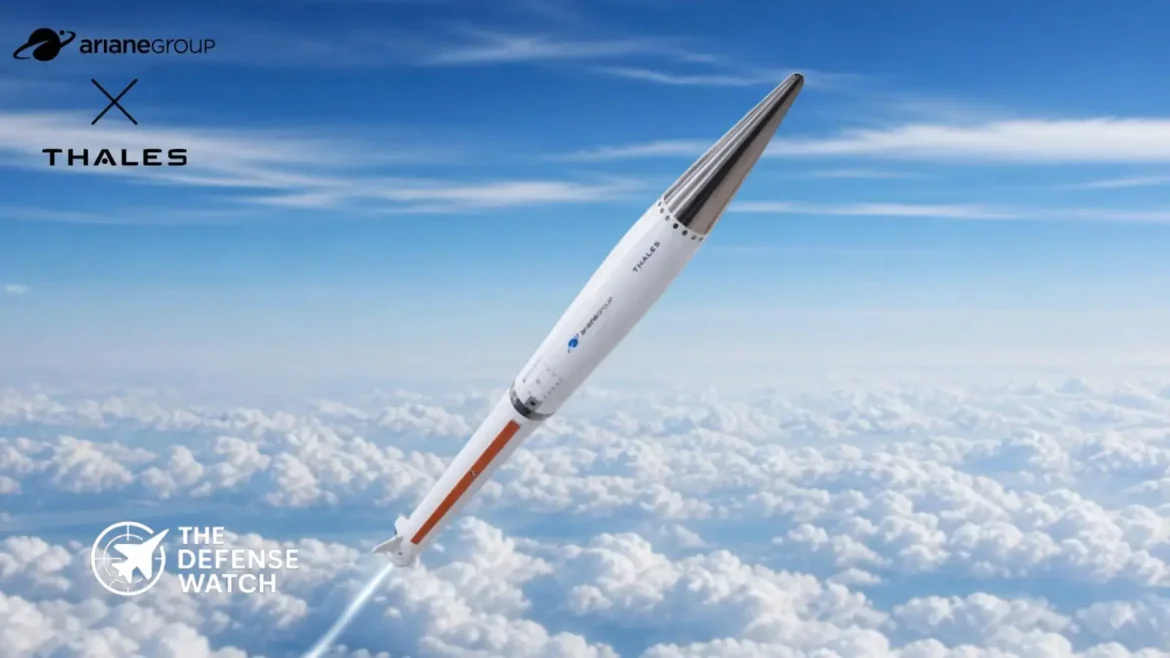
¦ KEY FACTS AT A GLANCE- ArianeGroup and Thales unveiled the FLP-T 150 rocket artillery system for France’s long-range land strike program.
- The precision-guided rocket is designed to strike targets at ranges up to about 150 kilometers.
- The system aims to replace the French Army’s aging LRU rocket launchers based on the M270 MLRS platform.
- A technology demonstrator is expected to undergo testing during the first half of 2026.
- The ITAR-free architecture allows export and deployment without U.S. export restrictions.
ArianeGroup And Thales Develop FLP-T 150 Rocket Artillery System
The FLP-T 150 rocket artillery system is being developed by ArianeGroup and Thales as part of France’s effort to field a sovereign long-range precision strike capability for its land forces. The system is designed to deliver guided rocket strikes at distances of up to 150 kilometers while operating from a mobile ground launcher.
The project forms part of France’s broader Feux Longue Portée-Terre (FLP-T) program, which seeks to replace the French Army’s aging Lance-Roquettes Unitaire (LRU) rocket artillery systems derived from the M270 Multiple Launch Rocket System.
A technology demonstrator of the FLP-T 150 rocket is expected to undergo testing in the first half of 2026, marking a key milestone in France’s push to restore domestic long-range firepower capabilities.
The Big Picture
European militaries are reassessing their long-range fires capabilities following the large-scale artillery warfare observed in Ukraine and broader concerns about NATO’s ability to conduct deep precision strikes in high-intensity conflict.
Rocket artillery has emerged as one of the most decisive battlefield tools in modern warfare. Systems such as the U.S. M142 HIMARS and M270 MLRS demonstrated the ability to strike command posts, logistics hubs, and ammunition depots far behind enemy lines with precision-guided rockets.
France currently fields only a small number of LRU launchers, the French designation for the upgraded M270 MLRS platform. Several of these systems were transferred to Ukraine during the ongoing war, further reducing the country’s available rocket artillery inventory.
The FLP-T program aims to rebuild that capability using a domestically developed system that avoids dependence on foreign suppliers.
The FLP-T 150 rocket artillery system represents the first phase of that effort.
What’s Happening
ArianeGroup and Thales publicly revealed their concept for the FLP-T 150 guided rocket and its associated launcher as part of France’s FLP-T land-based long-range fires initiative.
The rocket is designed to achieve a strike range of approximately 150 kilometers while maintaining high precision against point or surface targets.
The companies state that the weapon will deliver sub-decametric accuracy, meaning less than ten meters of circular error probable under ideal conditions. The design also incorporates resilience against electronic warfare and jamming.
One of the system’s defining features is its ITAR-free architecture, meaning the weapon avoids U.S.-controlled components subject to International Traffic in Arms Regulations. This allows France to export or deploy the system without relying on American export approval.
The launcher concept is designed as a modular system mounted on a heavy 8×8 military truck chassis, providing high mobility and rapid deployment on the battlefield.
The containerized launcher module reportedly carries eight ready-to-fire rockets, enabling rapid salvo launches against high-value targets.
Why It Matters
The development of the FLP-T 150 rocket artillery system highlights a broader shift in European defense policy toward technological sovereignty.
Many European countries rely heavily on U.S.-built rocket artillery systems, particularly HIMARS. While these systems are highly effective, they also come with export controls and logistical dependencies tied to American supply chains.
France has increasingly emphasized the need for independent defense production, particularly in areas such as missiles, long-range strike systems, and electronic warfare.
An ITAR-free rocket artillery capability offers several strategic advantages:
• Greater operational autonomy
• Easier export opportunities
• Reduced vulnerability to supply chain disruptions
• Increased flexibility in coalition operationsFor European defense planners, long-range fires are also a critical component of modern multi-domain operations.
Precision rockets can suppress air defense systems, destroy command nodes, and disrupt logistics networks before ground forces maneuver into contested territory.
Strategic Implications
The FLP-T program reflects France’s long-term effort to rebuild deep strike capabilities that were reduced after the Cold War.
The French Army currently operates only a limited number of rocket artillery systems, far fewer than comparable NATO militaries. This gap has become more visible as European armies reconsider large-scale land warfare scenarios.
Under current plans, France intends to acquire 13 new rocket artillery launchers by 2030, followed by 26 systems between 2030 and 2035.
That procurement plan would significantly expand the country’s long-range strike capacity.
The program also aligns with broader European efforts to develop long-range strike systems capable of reaching 500 kilometers or more in future increments.
If realized, those capabilities could eventually provide NATO forces with additional deep-strike options independent of U.S. weapons.
Competitor View
Strategic competitors are closely watching NATO’s efforts to rebuild long-range precision strike capabilities.
Russia has long relied on rocket artillery systems such as the Tornado-S and Iskander tactical ballistic missiles to conduct deep fires against military infrastructure and logistics networks.
China is also investing heavily in long-range rocket artillery through systems such as the PHL-16, which can launch guided rockets and tactical missiles at extended ranges.
For these countries, NATO’s renewed focus on precision rocket artillery signals a shift toward more distributed and survivable firepower on future battlefields.
France’s development of the FLP-T 150 rocket artillery system may also influence European procurement decisions if the platform proves competitive with HIMARS-class systems.
What To Watch Next
Several milestones will determine the future of the FLP-T program.
The most immediate is the technology demonstrator test expected in 2026, which will validate the rocket’s propulsion, guidance, and strike accuracy.
The French defense procurement agency will then evaluate competing proposals submitted by multiple industrial teams participating in the FLP-T program.
Alongside the ArianeGroup–Thales concept, alternative designs have emerged from other French defense companies, including MBDA and Safran.
Paris has also kept open the possibility of acquiring an interim system from foreign suppliers if domestic development faces delays.
Potential candidates discussed in defense circles include HIMARS or other established rocket artillery platforms.
Capability Gap
The FLP-T 150 rocket artillery system is intended to address a clear operational gap in France’s land forces.
France’s current LRU systems date back to earlier generations of rocket artillery and operate in limited numbers.
Modern warfare requires precision deep strike capabilities that can engage targets at ranges beyond traditional tube artillery while maintaining rapid mobility and survivability.
However, several limitations remain.
A 150 km range places the system in the same general category as extended-range guided rockets such as ER GMLRS. While effective, it does not match the reach of tactical ballistic missiles or cruise missiles used for deeper strikes.
Future phases of the FLP-T program may extend that range significantly.
The Bottom Line
France’s FLP-T 150 rocket artillery system represents a key step toward restoring sovereign long-range precision strike capabilities for the French Army and strengthening Europe’s defense industrial autonomy.
KEY FACTS AT A GLANCE- The United Kingdom has launched production of 37 RCH155 artillery weapon systems for its next generation mobile fires platform.
- The RCH155 combines a remotely operated 155mm L52 artillery module with the Boxer 8×8 armored vehicle.
- The system can engage targets at ranges approaching 70 kilometers depending on ammunition type.
- The program includes investment in UK industrial capacity including Rheinmetall’s new large-caliber gun barrel facility.
- The platform will replace aging AS90 artillery and strengthen NATO long-range fires capability.
UK Begins Production Of RCH155 Self-Propelled Howitzers
The RCH155 self propelled howitzer program has entered production for the British Army, marking a major milestone in the United Kingdom’s effort to modernize its artillery forces. The initial production effort will manufacture 37 weapon systems for the Boxer-based artillery platform that will form the backbone of the Army’s future mobile fires capability.
The production contract covers key elements of the artillery module including the gun barrel, breech mechanism, recoil system, muzzle brake, and trunnions used to mount the weapon within the turret assembly. The RCH155 system integrates a remotely operated 155mm artillery gun module onto the highly mobile Boxer 8×8 armored vehicle, creating a modern wheeled self-propelled artillery platform designed for rapid deployment and long-range precision fires.
The system is part of the British Army’s Mobile Fires Platform (MFP) program, which aims to replace the aging AS90 self-propelled howitzers while restoring artillery capability following equipment transfers to Ukraine.
The Big Picture
European armies are accelerating artillery modernization as the war in Ukraine highlights the decisive role of long-range fires on the modern battlefield.
NATO planners increasingly emphasize the need for mobile, long-range artillery capable of rapid shoot-and-scoot operations, which allow units to fire and relocate before enemy counter-battery systems can respond.
The British Army’s RCH155 program reflects a broader shift within NATO toward wheeled artillery systems with extended range, high automation, and networked targeting capabilities. These systems allow forces to deliver accurate fires at longer distances while reducing crew exposure and improving battlefield survivability.
At the same time, the program supports deeper defense industrial cooperation between the United Kingdom and Germany, two of NATO’s largest European military powers.
What’s Happening
The United Kingdom has initiated production of 37 RCH155 artillery weapon systems as part of the early phase of the Mobile Fires Platform program.
The RCH155 combines two core elements:
• The Boxer 8×8 armored vehicle chassis
• The Artillery Gun Module (AGM) featuring a remotely operated 155mm L52 cannonThis modular configuration allows the system to deliver heavy artillery firepower while maintaining the mobility and logistical advantages of a wheeled armored platform.
The artillery system can fire at rates of up to eight rounds per minute and engage targets at ranges approaching 70 kilometers depending on ammunition type. The platform can also operate with a reduced crew, typically two personnel inside the vehicle, thanks to a high level of automation.
The program also includes significant investment in domestic manufacturing capability. Rheinmetall is expanding its large-caliber gun barrel production facility in Telford, which will produce barrels for the RCH155 and other major British Army weapon systems.
Why It Matters
The RCH155 self propelled howitzer provides the British Army with a step change in mobility, automation, and firing range compared with legacy artillery systems.
The previous AS90 tracked howitzer entered service in the early 1990s and lacks many modern features such as automated loading systems, networked digital fire control, and extended-range precision munitions.
Replacing that capability is critical for maintaining NATO artillery parity against potential adversaries that have heavily invested in long-range fires.
Russia, for example, continues to field a large inventory of tube and rocket artillery systems that have proven decisive in high-intensity conflict environments.
Modern artillery platforms such as the RCH155 help address this challenge by combining rapid mobility, digital targeting integration, and extended strike range.
Strategic Implications
The British Army’s RCH155 program strengthens NATO’s ability to conduct distributed long-range fires operations across the alliance’s eastern flank.
Wheeled artillery systems provide several advantages for European operations.
They can deploy rapidly across long road networks, require less maintenance than tracked platforms, and can reposition quickly after firing. This mobility improves survivability against counter-battery radars and precision strikes.
The program also reinforces European defense industrial resilience. Establishing domestic production of large-caliber artillery barrels reduces reliance on foreign suppliers and increases surge production capacity during crises.
These industrial capabilities have become increasingly important as Western nations expand ammunition production and artillery manufacturing in response to rising global demand.
Competitor View
Strategic competitors closely monitor NATO artillery modernization programs.
Russia has long emphasized massed artillery fires as a central element of its military doctrine. The introduction of longer-range and more mobile NATO artillery systems complicates Russian counter-battery operations and increases the survivability of Western artillery units.
China is also investing heavily in long-range artillery and rocket forces designed for high-tempo maneuver warfare. Programs such as the RCH155 demonstrate how NATO armies are adapting to similar operational concepts.
From a strategic perspective, the system reinforces the alliance’s ability to sustain precision long-range fires across contested environments.
Capability Gap
The British Army faced a significant artillery capability gap after transferring 32 AS90 self-propelled howitzers to Ukraine, reducing its available artillery inventory.
To address the immediate shortfall, the United Kingdom procured Archer wheeled artillery systems from Sweden as an interim solution while the long-term Mobile Fires Platform program progressed.
The RCH155 now represents the long-term solution designed to replace older artillery systems with a more modern and survivable capability.
However, the program also reflects broader challenges facing Western artillery forces, including limited ammunition production capacity and the need for integrated digital fire control networks across NATO formations.
What To Watch Next
Several key milestones will determine how quickly the RCH155 system enters operational service.
Upcoming developments include:
• Completion of artillery module production for the initial batch
• Integration with the Boxer armored vehicle fleet
• Operational testing with Royal Artillery units
• Expansion of domestic barrel manufacturing capacity in the United KingdomThe British Army expects the RCH155 system to enter service later in the decade as the core of its future artillery force.
The Bottom Line
The RCH155 self propelled howitzer program marks a major step in rebuilding British long-range artillery capability while strengthening NATO’s mobile fires capacity for high-intensity warfare.
KEY FACTS AT A GLANCE- The PAC-3 interceptor demonstrated extremely high effectiveness during recent missile defense testing.
- The missile uses hit-to-kill technology designed to destroy ballistic and advanced maneuvering threats.
- Testing reflects growing demand for layered missile defense against emerging hypersonic weapons.
- The Patriot PAC-3 system remains a key component of U.S. and allied air and missile defense architecture.
- Modernization of missile defense systems is accelerating amid rising global missile threats.
PAC-3 Interceptor Shows Strong Performance Against Emerging Missile Threats
The PAC-3 interceptor has demonstrated extremely high effectiveness against ballistic and hypersonic missile threats during recent testing, reinforcing the growing importance of advanced missile defense systems in modern military operations.
The interceptor is a central component of the Patriot air and missile defense system, widely deployed by the United States and numerous allied nations. Its latest testing highlights the system’s capability to defeat increasingly complex missile threats that are reshaping global defense planning.
The Big Picture
Missile defense has become a critical pillar of U.S. and allied military modernization strategies. Nations such as China, Russia, Iran, and North Korea continue to expand their arsenals of ballistic and advanced maneuvering missile systems, including hypersonic weapons designed to evade traditional defenses.
These developments have increased the urgency for layered missile defense architectures capable of detecting, tracking, and intercepting high-speed threats across multiple phases of flight.
The PAC-3 interceptor sits at the center of this architecture. Integrated within the Patriot system, it provides terminal phase missile defense against short and medium range ballistic missiles, cruise missiles, and advanced aerial threats.
Recent testing results underscore the system’s continued relevance as militaries seek to counter evolving missile technologies.
What’s Happening
Recent missile defense testing demonstrated the PAC-3 interceptor successfully engaging advanced target threats designed to replicate modern ballistic and hypersonic missile profiles.
The interceptor uses hit-to-kill technology, which destroys incoming threats through direct kinetic impact rather than relying on explosive warheads. This approach increases interception accuracy and reduces the risk of debris or secondary damage.
The PAC-3 missile is part of the Patriot Advanced Capability program developed by Lockheed Martin and integrated within the Patriot air and missile defense system, originally developed by Raytheon.
Modern variants such as the PAC-3 Missile Segment Enhancement (MSE) feature improved propulsion, enhanced maneuverability, and extended engagement ranges. These upgrades allow the interceptor to engage faster and more agile threats compared to earlier Patriot interceptors.
Testing typically takes place at U.S. missile ranges such as the White Sands Missile Range, where advanced target vehicles simulate real-world missile attack profiles.
Why It Matters
The demonstrated effectiveness of the PAC-3 interceptor is significant because missile threats are evolving faster than many existing defense systems.
Ballistic missiles continue to proliferate globally, while hypersonic weapons introduce additional challenges due to their high speed and maneuverability. Hypersonic glide vehicles can change trajectory during flight, complicating traditional interception methods.
The PAC-3 interceptor provides a critical terminal defense layer within a broader integrated missile defense network. Systems such as the Patriot battery often protect high-value assets including air bases, command centers, and critical infrastructure.
Operational experience has reinforced the system’s importance. Patriot systems equipped with PAC-3 interceptors have been deployed in Europe, the Middle East, and the Indo-Pacific to defend allied forces and infrastructure.
Strategic Implications
Effective missile defense enhances deterrence by reducing the potential impact of adversary missile strikes. The performance of the PAC-3 interceptor supports broader U.S. and allied strategies aimed at strengthening integrated air and missile defense.
Countries across Europe, the Middle East, and Asia continue to invest heavily in Patriot systems and PAC-3 interceptors as missile threats expand regionally.
Several NATO members are increasing procurement as part of Europe’s evolving air and missile defense architecture. Similarly, partners in the Indo-Pacific view Patriot systems as a key defense against regional missile capabilities.
By demonstrating strong effectiveness during testing, the PAC-3 program helps reinforce confidence among allied militaries that rely on the system for frontline missile defense.
Competitor View
Strategic competitors closely monitor developments in U.S. missile defense technologies.
China and Russia have invested heavily in maneuverable hypersonic systems partly designed to complicate existing missile defense networks. Systems such as Russia’s Avangard hypersonic glide vehicle and China’s DF-17 hypersonic missile reflect this trend.
These weapons aim to exploit gaps in traditional air defense by flying at extremely high speeds and maneuvering during flight.
Testing results showing strong performance from interceptors like PAC-3 signal that missile defense technologies are continuing to evolve in response.
Capability Gap
The PAC-3 interceptor addresses a key operational challenge in modern warfare, defending against short and medium range ballistic missiles during the final phase of flight.
While the system provides highly effective terminal defense, it represents only one layer within a broader missile defense architecture.
Long range ballistic missiles and advanced hypersonic weapons may require additional systems such as high altitude interceptors, space based sensors, and early warning networks.
For this reason, U.S. missile defense strategy relies on a layered structure combining Patriot, THAAD, Aegis Ballistic Missile Defense, and emerging hypersonic defense programs.
What To Watch Next
Several developments will shape the future of the PAC-3 interceptor program.
Production of PAC-3 MSE interceptors continues to expand to meet growing global demand. The United States and allied nations are also investing in improved radar systems, enhanced command and control networks, and integrated air defense frameworks.
Future upgrades could further increase interception ranges, engagement speeds, and system integration across multi domain defense networks.
As missile threats continue to evolve, testing and modernization efforts will remain essential to maintaining the effectiveness of the Patriot system.
The Bottom Line
The PAC-3 interceptor remains a cornerstone of modern missile defense, providing proven capability against ballistic and emerging hypersonic missile threats.
KEY FACTS AT A GLANCE- Raytheon has completed expansion of its missile integration facility in Huntsville, Alabama.
- The $115 million project added about 26,000 square feet of production and integration space.
- The facility supports U.S. missile defense programs including the Standard Missile family and Glide Phase Interceptor.
- The expansion increases production capacity by more than 50 percent and adds roughly 185 jobs.
- The project strengthens U.S. missile defense manufacturing amid rising demand for advanced interceptors.
Raytheon Alabama Missile Integration Facility Expansion
The Raytheon Alabama missile integration facility expansion marks a significant step in strengthening the United States’ missile production capacity as demand for advanced air and missile defense systems continues to grow.
Raytheon, a business unit of RTX, completed the expansion of its Redstone Missile Integration Facility in Huntsville, Alabama, adding roughly 26,000 square feet of new production space and increasing the site’s integration capacity by more than 50 percent. The $115 million investment aims to accelerate delivery of critical missile defense systems for the U.S. military and allied partners.
The Huntsville facility serves as a final integration hub for several major U.S. missile programs operated by the U.S. Navy, the Missile Defense Agency, and other defense customers.
The Big Picture
U.S. defense planners have increasingly emphasized expanding the industrial base that supports missile production. Rising demand for interceptors and air defense systems has exposed capacity constraints across the U.S. defense manufacturing sector.
Recent conflicts and emerging threats, particularly hypersonic weapons and advanced cruise missiles, have pushed the Pentagon to accelerate missile procurement programs. These trends have forced defense contractors to expand production infrastructure to meet both U.S. and allied demand.
The Raytheon Alabama missile integration facility expansion reflects a broader effort by the U.S. Department of Defense to scale up missile defense manufacturing. Huntsville has become one of the most important hubs in this ecosystem, often called the center of U.S. missile defense development.
Multiple government agencies and contractors operate major programs in the region, including the Missile Defense Agency, NASA’s Marshall Space Flight Center, and several large defense contractors.
What’s Happening
Raytheon originally opened the Redstone Missile Integration Facility in 2012. The site integrates multiple missile systems before delivery to military customers.
The newly completed expansion increases production floor space by more than half and adds approximately 185 new jobs, bringing Raytheon’s workforce in Alabama to more than 2,200 employees.
The facility integrates multiple variants of the Standard Missile family, including:
- Standard Missile 3
- Standard Missile 6
These interceptors form a core component of U.S. naval missile defense architecture. They support missions ranging from ballistic missile interception to advanced air defense.
The facility will also support development and integration work for the Glide Phase Interceptor program, a next generation system designed to defeat hypersonic glide vehicles.
The Glide Phase Interceptor is expected to become one of the most important future missile defense capabilities for the United States and its allies.
Why It Matters
Expanding missile integration capacity directly addresses one of the Pentagon’s biggest challenges, scaling production of complex missile systems.
Missile defense programs require sophisticated integration work that combines guidance systems, propulsion units, warheads, and sensor packages into operational interceptors. Integration facilities like the one in Huntsville represent the final step before systems are delivered to military units.
Increasing this capacity allows Raytheon to shorten production timelines and deliver more systems to operational forces.
This matters at a time when the United States is replenishing interceptor inventories while simultaneously developing new systems designed to counter emerging threats.
The expansion also strengthens supply chain resilience. The defense industrial base has struggled in recent years with production bottlenecks and limited manufacturing capacity for advanced weapons.
By expanding integration infrastructure, Raytheon is positioning itself to support larger procurement orders expected from the U.S. Navy and Missile Defense Agency.
Strategic Implications
Missile defense remains a central element of U.S. deterrence strategy.
Standard Missile interceptors deployed aboard Aegis destroyers and cruisers provide a layered defense against ballistic missiles, cruise missiles, and aircraft. Increasing the rate at which these interceptors can be produced improves fleet readiness.
The addition of Glide Phase Interceptor production capability also signals a shift toward counter hypersonic defense.
Hypersonic glide vehicles travel at extreme speeds while maneuvering unpredictably during flight. Traditional missile defense systems struggle to intercept these weapons during the boost or terminal phases.
The Glide Phase Interceptor aims to engage these threats during their glide phase, a critical but technically challenging window.
By expanding the Huntsville facility, Raytheon is aligning its production capacity with this next generation mission set.
Competitor View
Strategic competitors such as China and Russia closely monitor U.S. missile defense infrastructure developments.
Both countries are rapidly expanding their own missile arsenals, including hypersonic weapons and advanced ballistic missile systems.
In response, U.S. missile defense modernization aims to maintain credible deterrence by improving interception capabilities and increasing available interceptor inventories.
Expanded manufacturing capacity signals to competitors that the United States intends to sustain large scale missile defense deployments while developing new technologies to counter emerging threats.
What To Watch Next
Several developments will determine how the expanded facility shapes future missile defense capabilities.
First, the Glide Phase Interceptor program remains in early development. Testing and design validation over the next several years will determine production timelines.
Second, procurement decisions by the U.S. Navy and Missile Defense Agency will influence how quickly interceptor production ramps up.
Third, allied demand for missile defense systems is increasing. Many U.S. partners rely on American produced interceptors for integrated air and missile defense architectures.
As a result, the Huntsville facility may play an increasingly important role in supporting both U.S. and allied missile defense networks.
Capability Gap
The Raytheon Alabama missile integration facility expansion addresses a clear operational gap.
The U.S. military requires larger inventories of missile interceptors to counter expanding missile threats from peer and regional adversaries.
However, missile production has historically been constrained by limited industrial capacity and complex manufacturing requirements.
Expanding integration infrastructure helps close this gap by enabling faster assembly, testing, and delivery of advanced missile systems.
That said, scaling missile production still depends on broader supply chain performance, including propulsion systems, guidance electronics, and specialized materials.
Integration capacity alone cannot fully eliminate production bottlenecks across the defense industrial base.
The Bottom Line
Raytheon’s expanded Huntsville facility strengthens the U.S. missile defense industrial base and supports the next generation of interceptor programs.
¦ KEY FACTS AT A GLANCE- The US Army and Lockheed Martin conducted a successful flight test of the Precision Strike Missile Increment 2.
- The new variant is designed to strike moving land targets and maritime targets at long range.
- The capability strengthens US long range precision fires and supports joint operations against naval threats.
- PrSM is designed to launch from HIMARS and M270A2 launchers that already serve in US and allied forces.
- Increment 2 development marks a key step toward operational deployment later in the decade.
PrSM Increment 2 Test Marks Major Step In Long Range Precision Fires
The Precision Strike Missile Increment 2 recently completed a flight test conducted by the Lockheed Martin and the US Army, demonstrating progress toward a new long range weapon capable of striking moving land and maritime targets.
The test represents another milestone in the evolution of the Precision Strike Missile program, which is replacing the aging Army Tactical Missile System. The new missile aims to extend range, improve precision, and enable new targeting capabilities across modern battlefields.
According to Lockheed Martin, the latest test successfully demonstrated the missile’s ability to support future moving target engagement missions. The capability would significantly expand the operational role of US ground based long range fires.
The Big Picture
Long range precision fires remain one of the central priorities in US military modernization. Army planners see deep strike weapons as critical tools for penetrating contested environments where aircraft or naval platforms may face heavy defenses.
The Precision Strike Missile program sits at the center of this effort. The missile allows ground forces to strike high value targets hundreds of kilometers away while operating from mobile launchers.
The introduction of a moving target capability reflects changing operational demands. Modern conflicts increasingly involve dynamic targets such as mobile missile launchers, command vehicles, or naval vessels operating within contested littoral zones.
US defense leaders have repeatedly emphasized that future conflicts may require land forces to help control maritime spaces. The development of maritime strike capability for the Precision Strike Missile supports that concept.
What Is Happening
Engineers from Lockheed Martin and the US Army conducted the recent flight test of PrSM Increment 2 as part of the program’s development campaign.
The test evaluated the missile’s ability to engage moving targets. This represents a major upgrade over the baseline PrSM design, which focuses primarily on fixed land targets.
The missile is designed to launch from existing US Army platforms including the M142 HIMARS and the M270A2 MLRS. Both launchers already serve widely across the US military and allied forces.
Using these launch systems allows the Army to integrate the new missile without major infrastructure changes. This approach speeds up deployment while maintaining interoperability with existing units.
The new Increment 2 version is expected to add a multi mode seeker that allows the missile to track and engage moving targets, including maritime vessels.
Why It Matters
Moving target capability fundamentally changes how the Precision Strike Missile can be used in combat.
Traditional long range artillery weapons are effective against fixed targets such as infrastructure, airfields, or logistics hubs. However, modern warfare increasingly involves mobile systems that relocate quickly to avoid detection.
A missile capable of tracking moving targets allows the Army to strike assets such as mobile missile launchers, armored formations, and naval vessels.
This capability also strengthens joint operations with the US Navy and Air Force. Army launchers deployed on islands or coastal areas could provide long range maritime strike support during regional conflicts.
Military planners often refer to this concept as land based anti ship capability. It creates additional dilemmas for adversaries by expanding the number of platforms that can threaten naval forces.
Strategic Implications
The development of PrSM Increment 2 fits into a broader US strategy focused on distributed strike capabilities.
Instead of relying on a limited number of high value platforms, the US military is spreading long range weapons across multiple services and domains. Ground based missile systems add another layer to that approach.
This concept is particularly relevant in the Indo Pacific. Island chains across the region could host mobile missile units capable of targeting hostile ships operating nearby.
A network of such systems would complicate adversary planning and increase deterrence by expanding the threat envelope.
The mobility of launchers such as the M142 HIMARS also allows units to relocate quickly after firing, reducing vulnerability to counter attacks.
Competitor View
China and Russia closely monitor US developments in long range precision fires.
Both countries have invested heavily in their own land based missile forces designed to threaten ships and bases across large regions.
China in particular has developed multiple anti ship ballistic missile systems as part of its anti access and area denial strategy.
The addition of maritime targeting capability to the Precision Strike Missile suggests the United States is moving toward a more symmetrical capability set. Land based strike systems could help counter adversary naval operations in contested regions.
Regional rivals may interpret the development as another step in expanding the reach of US ground forces into maritime domains.
What To Watch Next
Testing for PrSM Increment 2 is expected to continue as engineers refine guidance systems and target tracking capabilities.
Future flight tests will likely focus on validating the missile’s seeker technology and its ability to engage maneuvering targets in complex environments.
The US Army also plans additional increments of the Precision Strike Missile program. Later versions may introduce further range improvements and expanded target sets.
Operational deployment timelines will depend on the results of ongoing testing and procurement decisions by the Department of Defense.
Capability Gap
The Precision Strike Missile program addresses several limitations of earlier US Army missile systems.
The aging Army Tactical Missile System offers limited missile capacity per launcher and lacks the advanced targeting flexibility required for modern battlefields.
PrSM increases the number of missiles carried per launcher while adding improved accuracy and digital integration.
Increment 2 specifically addresses the challenge of engaging moving targets. Without that capability, long range artillery systems struggle against mobile adversaries.
However, long range targeting still depends on reliable sensors and networked data sources. Accurate tracking data from drones, satellites, or reconnaissance aircraft remains essential for successful engagements.
The Bottom Line
The Precision Strike Missile Increment 2 test signals a major step toward giving US ground forces the ability to strike moving land and maritime targets at long range.