(adsbygoogle = window.adsbygoogle || []).push({});Executive Summary:
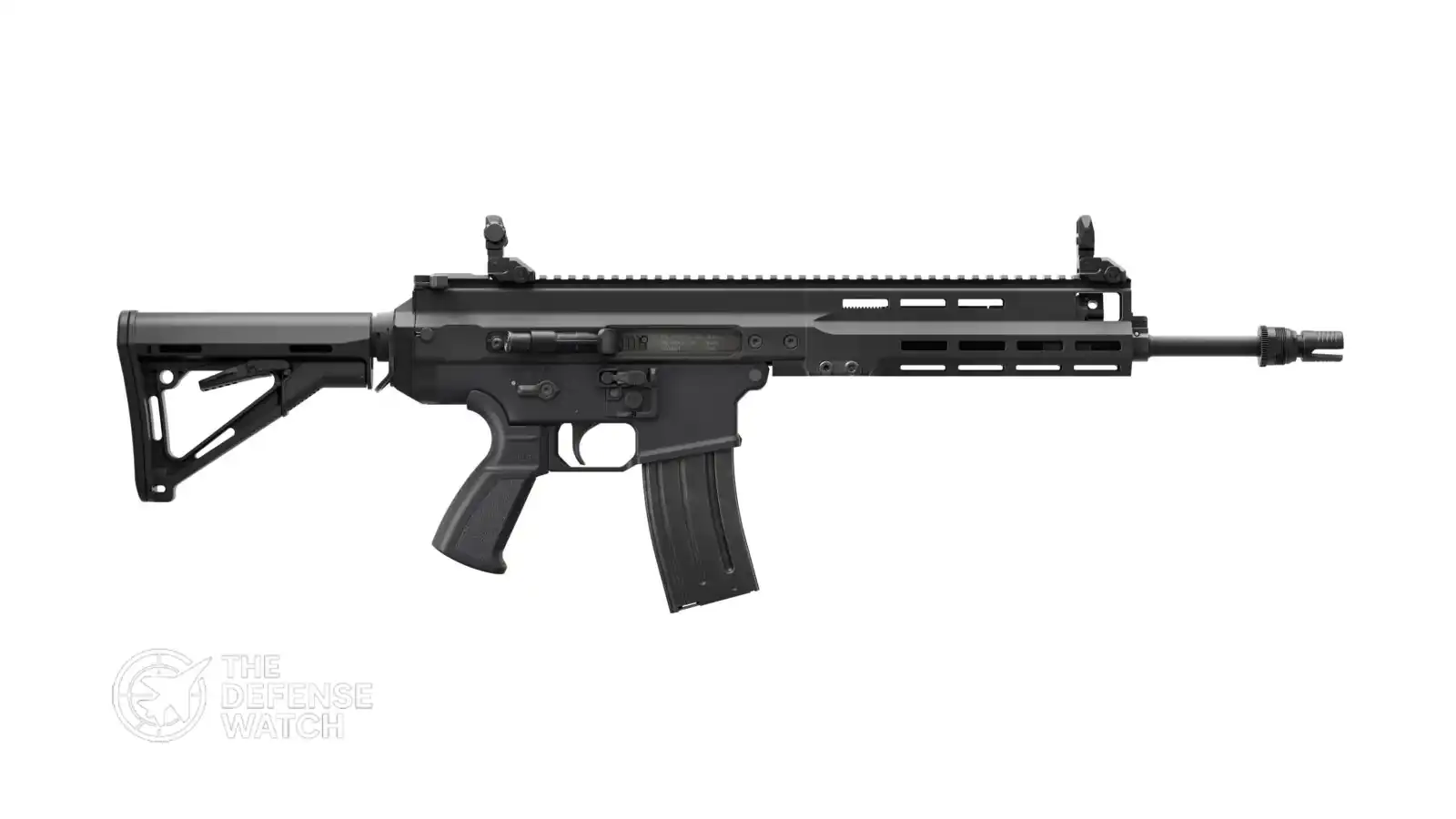
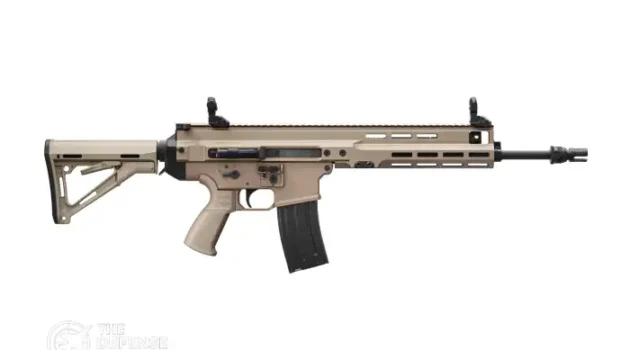
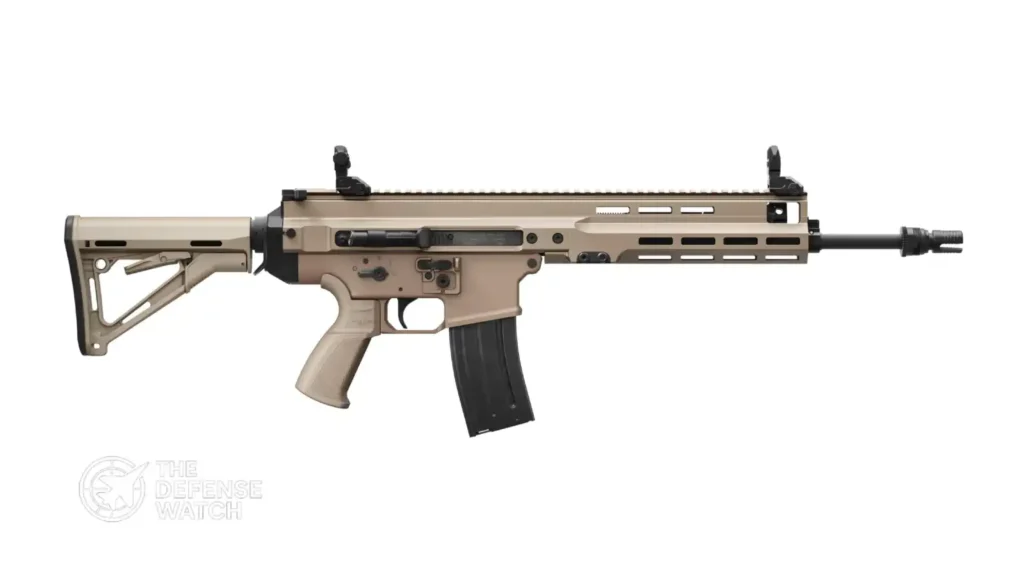
Belgian small arms manufacturer FN Herstal has unveiled the new FN ARKA assault rifle, a weapon designed to combine the combat-proven operating system of the FN SCAR with the ergonomics and accessory compatibility commonly associated with AR-pattern rifles. The announcement reflects growing demand among military and law enforcement customers for rifles that can integrate into existing training, logistics, and modernization programs while reducing transition costs.
FN Herstal Introduces the New ARKA Assault Rifle
FN Herstal has formally introduced the FN ARKA assault rifle, marking the company’s latest effort to expand its presence in the highly competitive global military rifle market. According to reporting from Army Recognition, the ARKA is chambered in 5.56×45mm NATO and is intended for modern military and law enforcement users seeking a rifle that combines familiar AR-style handling with the proven reliability of the FN SCAR family.
The launch comes at a time when many NATO and partner nations are reviewing future infantry weapon requirements, replacing aging service rifles, and seeking systems that reduce training burdens while maintaining combat effectiveness.
Unlike a clean-sheet design, the ARKA appears to leverage significant elements of the SCAR’s operating architecture while adopting a control layout familiar to users trained on AR-15 and M4-type rifles. This approach positions the weapon in a market increasingly driven by interoperability and user familiarity rather than radical technological change.
Designed Around Existing Military Training Pipelines
One of the most notable aspects of the ARKA is its apparent focus on reducing transition costs for military organizations.
(adsbygoogle = window.adsbygoogle || []).push({});Many armed forces have invested heavily in training programs, accessories, optics, and maintenance systems centered around AR-pattern rifles. By incorporating familiar ergonomics while retaining the SCAR’s internal operating principles, FN Herstal appears to be targeting customers that want enhanced reliability without requiring major changes to existing doctrine and support infrastructure.

Image Source : FN HERSTAL Industry observers have increasingly noted that procurement decisions are often influenced as much by sustainment costs and training requirements as by raw weapon performance.
For defense ministries facing budget constraints, a rifle that minimizes retraining while maintaining compatibility with existing equipment can offer significant long-term value.
SCAR Heritage Remains a Key Selling Point
The FN SCAR family has established a strong reputation among military users worldwide since entering service in the late 2000s.
The SCAR-L variant, chambered in 5.56×45mm NATO, remains in service with multiple military organizations and special operations forces. Its short-stroke gas piston operating system is widely recognized for reliability under harsh environmental conditions.
FN SCAR-L Key Characteristics
Feature Details Caliber 5.56×45mm NATO Operating System Short-stroke gas piston Origin Belgium Manufacturer FN Herstal Military Adoption Multiple NATO and partner nations Design Focus Reliability, modularity, adaptability Source: FN Herstal and military reference data.
(adsbygoogle = window.adsbygoogle || []).push({});By building on the SCAR’s operational reputation, FN Herstal may be attempting to offer a lower-risk option for procurement authorities compared with entirely new rifle designs.
Potential Relevance to Future Military Rifle Competitions
The ARKA’s introduction is particularly noteworthy given ongoing and anticipated rifle replacement programs across NATO countries.
Recent reporting has linked the rifle to discussions surrounding future infantry weapon requirements, including interest in platforms that combine modern ergonomics with proven combat systems. Publicly available images from 2025 showed a prototype ARKA reportedly being evaluated in connection with discussions surrounding the United Kingdom’s future rifle requirements. While no official selection decisions have been announced, the appearance highlighted the weapon’s relevance to upcoming procurement competitions.
The timing is also significant. FN Browning Group recently announced the acquisition of British precision rifle specialist Accuracy International, strengthening its industrial footprint in the United Kingdom and potentially expanding its position in future British small arms programs.
Why the ARKA Matters Beyond a Single Rifle Launch
The unveiling of the ARKA reflects a broader trend shaping the global small arms market.
For decades, rifle manufacturers often focused on maximizing technical performance. Today, military customers increasingly prioritize ecosystem compatibility, lifecycle affordability, and reduced training requirements.
Key Trends Driving Rifle Development
- Increased emphasis on NATO interoperability.
- Greater demand for modular weapon architectures.
- Preference for compatibility with existing optics and accessories.
- Reduced training costs through familiar control layouts.
- Focus on long-term sustainment and logistics efficiency.
The ARKA appears designed specifically around these priorities. Rather than replacing the SCAR outright, it expands FN Herstal’s portfolio into a segment where AR-pattern ergonomics have become a de facto standard among many military users.
(adsbygoogle = window.adsbygoogle || []).push({});From a strategic perspective, this allows FN Herstal to compete for contracts where procurement requirements specify AR-style controls while still leveraging the company’s decades of experience developing piston-driven combat rifles.
Competitive Position in the Global Rifle Market
The global military rifle market has become increasingly crowded, with manufacturers such as SIG Sauer, Heckler & Koch, Colt Canada, and others pursuing major modernization opportunities.
The U.S. Army’s adoption of the XM7 under the Next Generation Squad Weapon program has also intensified interest in future infantry weapon development and modernization initiatives. Meanwhile, many countries continue to procure advanced 5.56mm rifles while evaluating longer-term transitions to new calibers and weapon concepts.
Against that backdrop, the ARKA represents FN Herstal’s effort to offer a familiar yet modern solution that can compete in both military and law enforcement markets.
Outlook
The FN ARKA enters a market where procurement authorities increasingly seek evolutionary rather than revolutionary solutions. By combining SCAR-derived reliability with AR-pattern ergonomics and compatibility, FN Herstal is positioning the rifle as a bridge between proven combat performance and modern user expectations.
Whether the ARKA secures major military contracts remains to be seen, but its design philosophy aligns closely with current trends in infantry weapon modernization. As armed forces across NATO and beyond evaluate future rifle requirements, the ARKA is likely to emerge as a notable contender in upcoming competitions.
(adsbygoogle = window.adsbygoogle || []).push({});Executive Summary:
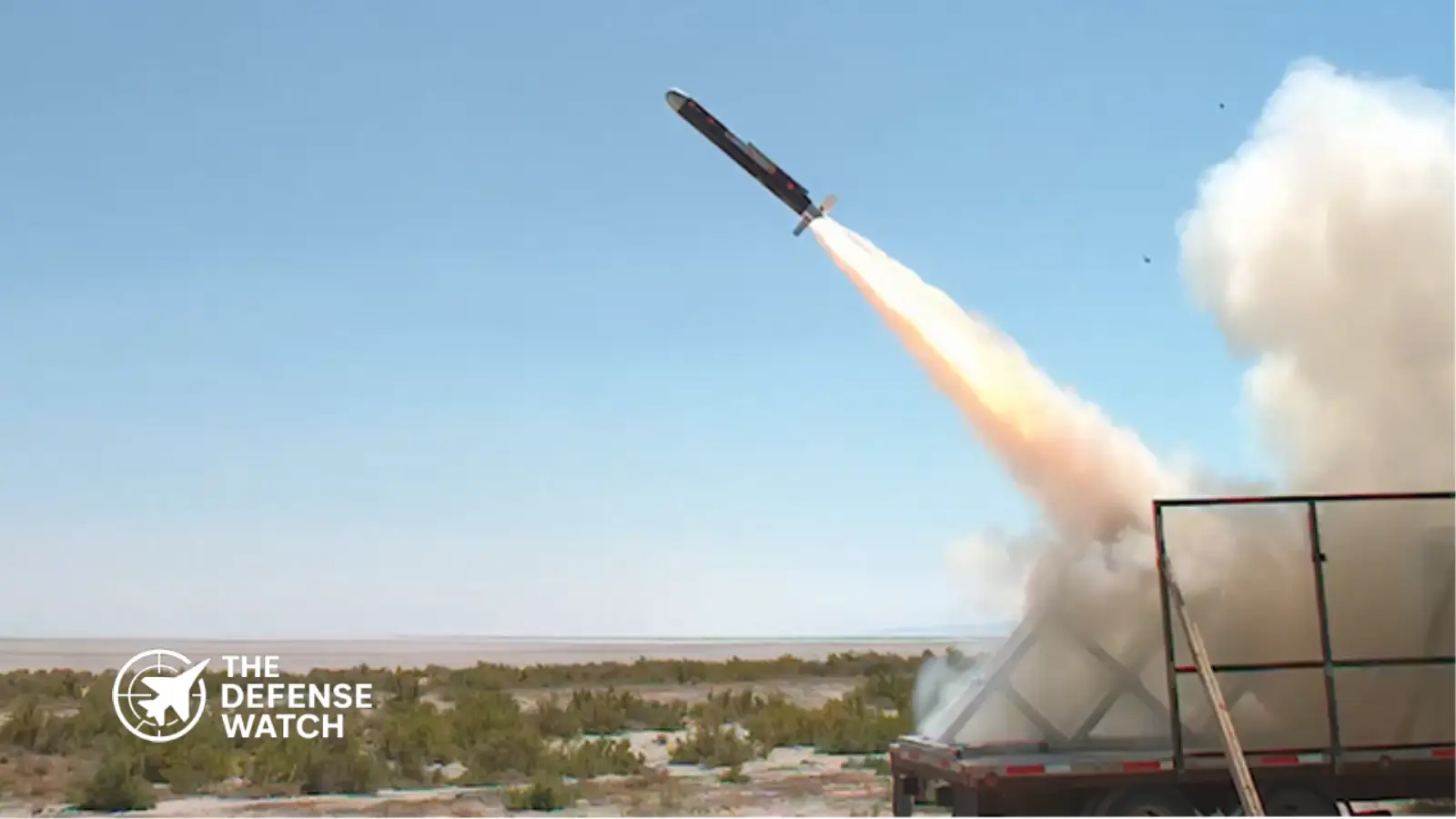
Northrop Grumman announced on June 1, 2026, the successful completion of a key flight test for its Jackal next-generation precision strike missile. The test validated critical flight systems, including propulsion, autopilot performance, and autonomous capabilities. This milestone supports U.S. Army efforts to field affordable, multi-domain strike options capable of operating in GPS-denied and contested electromagnetic environments.
Jackal Precision Strike Missile Advances in Flight Testing
Northrop Grumman completed a key flight test for the Jackal precision strike missile, demonstrating the platform’s flight system readiness, the company announced June 1, 2026.
The test involved multiple flights that showcased rapid turbojet engine start, precise autopilot-controlled flight profiles, and overall system maturity. Jackal is engineered as a compact, affordable weapon for air, land, and sea platforms, with particular emphasis on integration with U.S. Army light tactical vehicles and aerial assets.
Technical Specifications and Capabilities
Jackal is a turbojet-powered missile designed for high subsonic speeds and extended range:
- Speed: Sustains over 300 mph (some references note capability exceeding 400 mph in sprint modes).
- Range: Up to 100 km from surface launch; 125 km from air launch.
- Navigation: Autonomous waypoint navigation with GPS-denied operation.
- Targeting: AI-driven algorithms for target discrimination, automatic recognition, and engagement without continuous line-of-sight from the operator.
- Payload: Modular options supporting lethal warheads as well as non-lethal payloads for ISR or electronic warfare missions.
- Launch Flexibility: Compatible with ground vehicles, aircraft, and maritime platforms.
The missile’s low-altitude flight profile (under 50 meters in some modes) and onboard power generation (up to 1 kW) support advanced electronic warfare packages and modular payloads.
Strategic Context and Operational Relevance
The Jackal program aligns with U.S. military priorities for affordable mass in contested environments. Peer adversaries have invested heavily in integrated air defense systems and electronic warfare capabilities that challenge traditional precision-guided munitions reliant on GPS and datalinks.
By emphasizing autonomy and resilience, Jackal aims to provide maneuver forces with organic, beyond-line-of-sight strike options that reduce dependence on contested satellite navigation and high-value aerial platforms. Its design supports rapid retasking mid-flight and potential future swarm operations.
Analysis: In an era where U.S. forces face sophisticated anti-access/area-denial (A2/AD) networks, systems like Jackal represent a shift toward distributed lethality. Rather than relying solely on expensive, exquisite platforms, the U.S. Army can deploy larger numbers of attritable, intelligent munitions from forward positions. This approach complicates enemy targeting calculus and enables sustained pressure even when communications are degraded. Technical hurdles remain in AI robustness against advanced jamming and decoys, as well as ensuring safe integration with existing Army fire control architectures.
Development Path and Testing
Northrop Grumman conducted multiple flight tests to advance Jackal’s development. The recent milestone focused on propulsion, autonomy, and precision strike operations. Data collected will inform subsequent development phases, including integration testing and expanded mission profiles.
(adsbygoogle = window.adsbygoogle || []).push({});The program builds on Northrop Grumman’s extensive experience in munitions, propulsion, autonomy, and digital engineering. Jackal was publicly unveiled in 2024-2025 and has progressed rapidly through early testing phases.
Implications for U.S. Defense Strategy
Jackal enhances the U.S. military’s ability to maintain overmatch in multi-domain operations. For the Army, it offers a complementary capability to existing systems like GMLRS and ATACMS, filling a niche for lighter, more mobile, and attritable precision effects at the tactical edge.
Its multi-platform compatibility also supports joint operations, potentially integrating with Marine Corps and Navy assets for littoral and maritime strike missions. As defense budgets face scrutiny, the emphasis on affordability and modularity positions Jackal as a scalable solution for high-volume production if required by evolving threats.
(adsbygoogle = window.adsbygoogle || []).push({});- U.S. Army Modernization Alignment: Supports transformation toward lighter, more lethal formations capable of dispersed operations.
- Contested Environment Focus: Directly addresses lessons from ongoing conflicts involving heavy electronic warfare and layered air defenses.
- Industrial Base Benefit: Reinforces Northrop Grumman’s role in advanced weapons development while leveraging modern manufacturing techniques for cost control.

(adsbygoogle = window.adsbygoogle || []).push({});Executive Summary:
Sweden has awarded Saab a contract worth approximately 1.2 billion Swedish kronor to deliver sensor and command systems for brigade level ground based air defense. The systems will be delivered between 2029 and 2030 under a procurement managed by Swedish Defence Materiel Administration. The upgrade strengthens Sweden’s ability to detect, track, and engage evolving aerial threats at the tactical level.
Sweden Advances Brigade Level Air Defense With Saab GBAD Order
Sweden has expanded its ground based air defense capabilities through a new procurement of sensor and command and control systems from Saab. The contract, awarded by Swedish Defence Materiel Administration, is valued at approximately 1.2 billion Swedish kronor and supports the Swedish Army’s brigade level air defense architecture.
The order focuses on integrating radar surveillance and command systems designed to improve detection speed and response coordination against modern aerial threats. Deliveries are scheduled between 2029 and 2030, reflecting long term modernization planning for Sweden’s layered air defense network.
System Scope and Capability Focus
The procurement centers on two core components, sensors and command and control systems. These elements are designed to operate as a unified ground based air defense framework, improving situational awareness and engagement efficiency at brigade level.
(adsbygoogle = window.adsbygoogle || []).push({});Key capability areas include
- Expanded air picture generation for brigade commanders
- Faster target detection and classification
- Integrated engagement coordination across units
- Improved response to low altitude and fast moving aerial threats
The system builds on earlier deliveries to Sweden, reinforcing continuity in national air defense modernization rather than introducing a standalone capability.
Role of Giraffe AMB in Swedish Air Defense
A central element of the system is Saab’s Giraffe AMB radar, a mobile surveillance platform designed for short to medium range air defense operations. The radar is paired with integrated command and control functionality, allowing operators to rapidly process airspace data and coordinate responses.
Giraffe AMB radar provides continuous airspace monitoring and supports identification of a wide range of aerial targets, including low flying aircraft and unmanned systems.
The integration of radar and command systems allows brigade level units to shorten decision cycles. This is increasingly important as modern air threats rely on speed, low observability, and coordinated multi axis approaches.
Technical and Operational Context
Ground based air defense systems are shifting toward networked architectures that combine sensors, command nodes, and firing units into a single operational picture. Sweden’s approach reflects this trend by strengthening the intermediate brigade layer rather than relying solely on strategic level systems.
Operational benefits include
- Reduced detection to engagement timelines
- Improved coordination between dispersed air defense units
- Greater resilience against electronic interference
- Enhanced tracking of unmanned aerial systems and cruise missiles
From an operational standpoint, brigade level GBAD systems are critical for protecting maneuver forces. They provide a protective envelope that enables ground forces to operate with reduced exposure to aerial threats.
Strategic Context for Sweden and NATO
Sweden’s investment in brigade level air defense aligns with broader European defense modernization efforts following increased concern over airspace security and contested electromagnetic environments.
The integration of Saab systems into Swedish Army brigades enhances interoperability with NATO air defense frameworks, particularly as Sweden deepens its defense integration following accession.
This procurement also highlights a shift toward distributed air defense rather than centralized systems. Instead of relying on a small number of high value platforms, modern doctrine emphasizes layered coverage across multiple mobile units.
Analysis: What This Means for Modern Air Defense Doctrine
The Saab contract reflects three broader shifts in air defense development.
(adsbygoogle = window.adsbygoogle || []).push({});First, detection speed is becoming as important as interceptor performance. Modern aerial threats, including drones and low observable cruise missiles, compress reaction windows. Systems like Giraffe AMB prioritize early detection and tracking stability under cluttered conditions.
Second, command and control integration is now a primary capability rather than a support function. The ability to fuse sensor inputs and distribute targeting data in real time determines whether air defense units can respond effectively in fast moving scenarios.
Third, brigade level autonomy is increasing. Instead of relying on centralized air defense headquarters, frontline units are being equipped with their own sensor and engagement coordination tools. This reduces vulnerability to communication disruption and improves survivability in dispersed battlefield conditions.
For Sweden, this procurement is less about introducing new technology and more about scaling an existing architecture into wider brigade coverage. That continuity reduces training burden and improves operational consistency across units.
Program Timeline and Delivery
The contract timeline extends from 2029 to 2030, indicating a phased rollout aligned with broader Swedish Army modernization cycles. This schedule allows for integration testing, training, and incremental deployment across multiple brigades.
Long lead times are common in air defense procurement due to system integration complexity and the need to synchronize sensors, command systems, and kinetic interceptors across multiple platforms.
Conclusion
Sweden’s latest GBAD procurement underscores a steady shift toward networked, brigade level air defense systems built around integrated radar and command architectures. By expanding the role of Saab’s sensor and control technologies, the Swedish Army is reinforcing its ability to respond to rapidly evolving aerial threats within a layered defense framework.
The program highlights a broader European trend toward distributed, mobile air defense systems designed to operate in contested and high tempo environments.

Executive Summary:
The British Army has selected Digital Concepts Engineering (DCE) to provide its first operational fleet of unmanned ground vehicles (UGVs), marking a significant milestone in the UK’s military robotics program.
The move transitions British Army ground robotics efforts from experimentation into operational service, reflecting growing demand for autonomous logistics, reconnaissance, and force protection capabilities.
British Army Selects DCE For First Operational UGV Fleet
The British Army UGV fleet program has reached a major milestone with the selection of Digital Concepts Engineering (DCE) to supply the service’s first operational unmanned ground vehicle capability.
The decision signals a shift from years of trials and technology demonstrations toward the fielding of deployable robotic ground systems capable of supporting military operations. The development comes as NATO militaries increasingly pursue autonomous and semi-autonomous systems to improve battlefield effectiveness while reducing risks to personnel.
The procurement represents the first operational UGV fleet acquired by the British Army, establishing a formal capability rather than an experimental or developmental program.
From Trials To Operational Service
The British Army has spent years evaluating robotic and autonomous systems through a range of experimentation efforts, including Army Warfighting Experiments, logistics demonstrations, and heavy UGV trials.
DCE has been closely involved in many of these activities. The company previously developed autonomous and remotely operated ground systems for British military experimentation and has demonstrated capabilities ranging from logistics support to deception operations and reconnaissance missions.
The firm’s X-Series robotic vehicles have evolved through multiple development cycles. The latest X3 platform features a modular design capable of carrying payloads, towing equipment, and operating across difficult terrain including mud, sand, rubble, and steep gradients.
The British Army’s decision to move forward with an operational fleet suggests confidence that the technology has matured sufficiently for military service.
Why Unmanned Ground Vehicles Matter
The introduction of a British Army UGV fleet reflects broader changes in modern warfare.
Recent conflicts have demonstrated the growing value of unmanned systems across land, air, and maritime domains. While aerial drones have received significant attention, ground robots are increasingly viewed as critical tools for logistics, casualty evacuation, reconnaissance, engineering support, and force protection.
Military planners see several advantages:
- Reduced exposure of soldiers to enemy fire.
- Increased operational endurance.
- Improved logistics support in contested environments.
- Enhanced reconnaissance capabilities.
- Greater flexibility in dispersed operations.
These advantages align with the British Army’s ongoing modernization efforts, which emphasize digital integration, human-machine teaming, and increased battlefield survivability.
Part Of A Larger UK Defense Robotics Strategy
The contract also reflects years of investment by the UK Ministry of Defence in autonomous ground systems.
Earlier initiatives such as Project Theseus and the Autonomous Last Mile Challenge explored the use of robotic vehicles for battlefield resupply missions. Those efforts sought to understand the capabilities and limitations of autonomous logistics systems while reducing risk to frontline personnel.
The UK’s Defence Science and Technology Laboratory (Dstl) and Defence Equipment & Support (DE&S) have repeatedly tested unmanned ground vehicles to determine how they can be integrated into future force structures.
The DCE selection appears to be a direct continuation of that long-term effort.
Analysis: A Significant Shift In British Army Modernization
The importance of this contract extends beyond the number of vehicles involved.
For years, Western militaries treated unmanned ground vehicles primarily as experimental technologies. The British Army’s move toward an operational fleet indicates that robotic systems are increasingly viewed as deployable military assets rather than future concepts.
This transition mirrors developments across NATO, where armed forces are examining how autonomous systems can supplement traditional combat formations.
The decision is particularly notable because ground robotics has historically progressed more slowly than aerial drone technology. Terrain complexity, communications challenges, and mobility requirements have made land-based autonomy difficult to operationalize.
By selecting DCE for an operational capability, the British Army is effectively acknowledging that certain UGV missions have matured enough for routine military use.
The move may also influence future procurement decisions involving logistics robots, reconnaissance platforms, engineering support vehicles, and potentially armed robotic systems.
As lessons from Ukraine continue to highlight the growing role of unmanned technologies on the battlefield, Western armies are under increasing pressure to accelerate robotic integration across their force structures. Recent operational trends suggest that human-machine teaming is becoming a core element of modern military doctrine rather than a niche capability.
Looking Ahead
The introduction of the first operational British Army UGV fleet represents a significant step in the service’s modernization roadmap.
While details regarding fleet size, deployment timelines, and specific operational roles remain limited, the procurement demonstrates a clear commitment to expanding robotic capabilities within the Army.
For DCE, the contract represents a major achievement after years of involvement in British military robotics development. For the British Army, it marks the beginning of operational ground robotics as a permanent part of its force structure.

(adsbygoogle = window.adsbygoogle || []).push({});Executive Summary: L3Harris Technologies has expanded its Advanced Manufacturing Facility-South (AMF-South) in Huntsville, Alabama, through a $25 million investment that adds 130,000 square feet of manufacturing space. The expansion increases the company’s Huntsville footprint to approximately 670,000 square feet and is intended to support rising U.S. Department of Defense demand for accelerated missile and munitions production. The investment reflects broader efforts across the U.S. defense industrial base to increase manufacturing capacity for critical weapon systems.
L3Harris Expands Huntsville Manufacturing Capacity
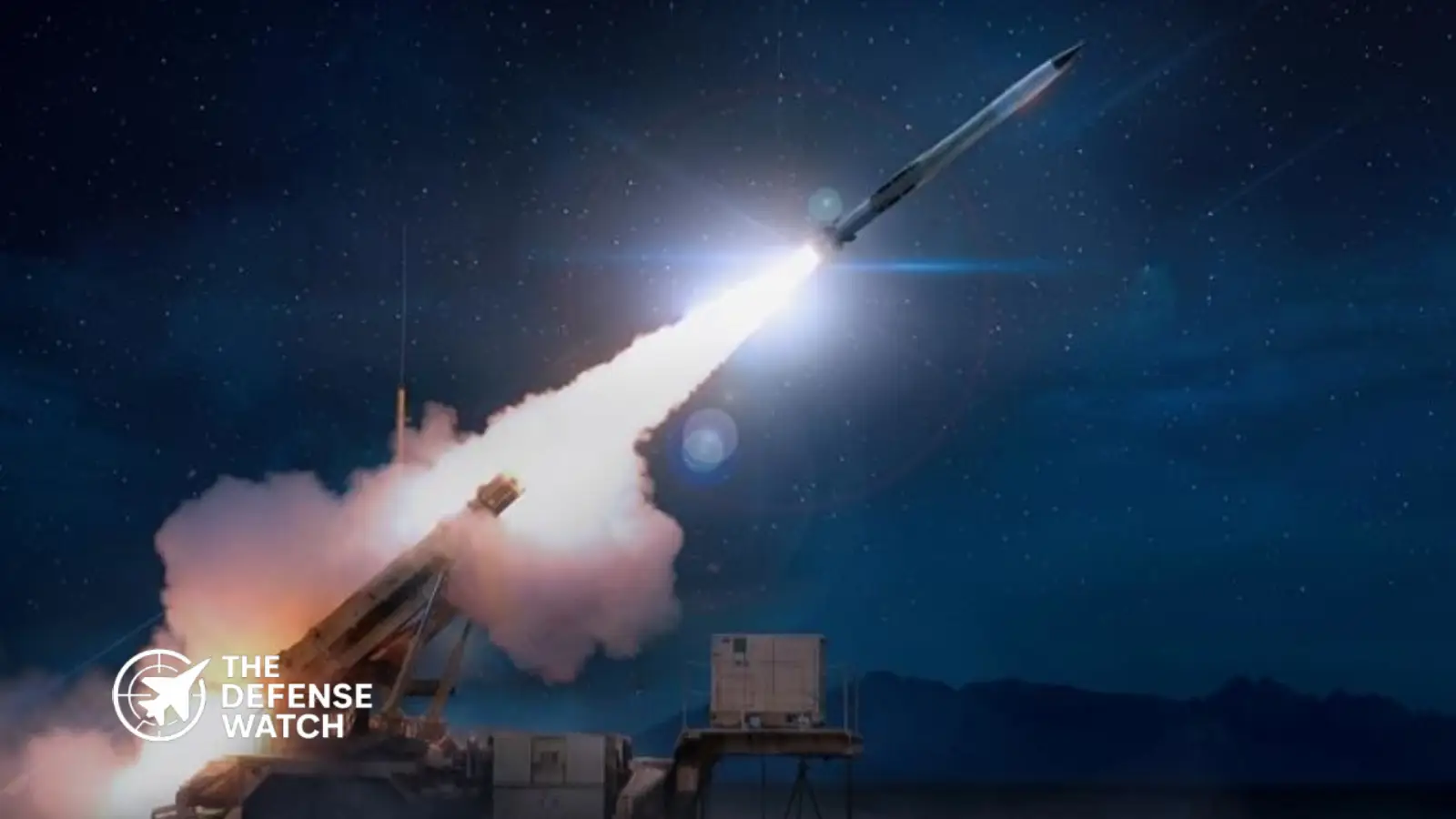
L3Harris Technologies has announced a significant expansion of its Advanced Manufacturing Facility-South (AMF-South) in Huntsville, Alabama, adding 130,000 square feet of manufacturing space through a $25 million investment.
According to the company’s June 1 announcement, the expansion increases L3Harris’ total operational footprint in Huntsville to approximately 670,000 square feet spread across three facilities. The additional manufacturing area is designed to rapidly scale production by leveraging existing industrial infrastructure already available at the site.
The expansion comes as the U.S. Department of Defense continues to emphasize increased production rates for missiles, munitions, and other critical defense systems amid growing global security challenges and sustained demand from both U.S. and allied military customers.
Ken Bedingfield, President of Missile Solutions at L3Harris, said the investment will allow the company to increase production capacity while maintaining flexibility to respond to changing defense requirements.
The additional space allows us to lean forward and surge capacity in a way that directly aligns with the Department of War’s demand for critical munition acceleration,” Bedingfield stated.
Huntsville’s Growing Role In U.S. Missile Manufacturing
Huntsville has become one of the most important centers of the American missile and space industry. Often referred to as “Rocket City,” the Alabama city hosts major defense contractors, missile manufacturers, Army modernization programs, and missile defense organizations.
L3Harris has steadily increased its investment in the region. The company reported that its capital spending in Huntsville tripled between 2024 and 2025, reflecting a broader industry trend toward expanding domestic production capacity.
(adsbygoogle = window.adsbygoogle || []).push({});The company noted that Huntsville operations currently support more than half of its solid rocket motor programs through the production of inert components, with manufacturing output continuing to increase annually.
Key Expansion Figures
| Category | Details |
|---|---|
| Investment Value | $25 million |
| New Manufacturing Space | 130,000 square feet |
| Total Huntsville Footprint | Approximately 670,000 square feet |
| Number of Huntsville Sites | 3 |
| Focus Area | Missile and defense manufacturing |
| Location | Huntsville, Alabama |
Why The Expansion Matters
The facility expansion reflects a larger shift underway across the U.S. defense industrial base.
Since 2022, Pentagon officials have repeatedly highlighted the need to expand production capacity for precision-guided weapons, missile interceptors, solid rocket motors, and other critical munitions. Operational lessons from conflicts in Ukraine and the Middle East have demonstrated that modern warfare can rapidly consume missile inventories, placing pressure on manufacturers to increase output.
For companies such as L3Harris, expanding existing facilities often provides a faster path to increased production than constructing entirely new manufacturing complexes. By utilizing industrial space with existing utilities, logistics infrastructure, and workforce access, manufacturers can accelerate production ramp-ups while reducing construction timelines.
This approach has become increasingly important as the Department of Defense seeks to shorten procurement timelines and improve supply chain resilience.
Impact On Missile And Munitions Programs
Although L3Harris did not identify specific missile programs that will benefit from the expansion, the company’s Missile Solutions business supports a broad portfolio of defense systems, including propulsion technologies, missile components, seekers, electronic systems, and related manufacturing activities.
The company’s growing involvement in solid rocket motor production is particularly noteworthy.
Solid rocket motors remain a critical component for numerous U.S. military systems, including:
- Surface-to-air missile interceptors
- Tactical ballistic missiles
- Air-launched precision weapons
- Rocket artillery systems
- Hypersonic weapon development programs
- Missile defense interceptors
Industry analysts have repeatedly identified solid rocket motor production as one of the most constrained segments of the U.S. defense supply chain. Additional manufacturing capacity therefore has implications that extend beyond a single weapons program.
(adsbygoogle = window.adsbygoogle || []).push({});Strengthening The Defense Industrial Base
The Huntsville investment aligns with broader Pentagon objectives aimed at strengthening domestic manufacturing capacity and reducing production bottlenecks.
Over the past several years, defense contractors have expanded facilities across multiple states to meet increasing demand generated by U.S. modernization programs and international security assistance efforts.
Key priorities include:
- Expanding missile production capacity
- Increasing solid rocket motor output
- Improving supply chain resilience
- Accelerating delivery timelines
- Supporting allied and partner nation requirements
- Enhancing surge production capability during crises
The ability to rapidly increase output has become a central requirement for both industry and government planners as military inventories face sustained operational demand.
Workforce Expansion Accompanies Facility Growth
L3Harris also announced that AMF-South is actively recruiting personnel across several technical and manufacturing disciplines.
Current hiring priorities include:
- Mechanical Engineers
- Manufacturing Engineers
- Project Engineers
- Quality Engineers
- Machinists
- Composite Technicians
The workforce expansion underscores another critical challenge facing the defense industrial base: securing and retaining skilled labor capable of supporting advanced weapons manufacturing.
Many defense manufacturers have identified workforce development as a key factor influencing future production growth, particularly in specialized areas such as precision machining, composites manufacturing, propulsion systems, and advanced materials processing.
Strategic Outlook
The expansion of L3Harris’ Advanced Manufacturing Facility-South represents another step in the ongoing effort to rebuild and modernize U.S. defense manufacturing capacity.
While the $25 million investment is modest compared with some large-scale defense industrial projects, its operational significance lies in its ability to rapidly increase production throughput using existing infrastructure. As demand for missiles, munitions, and propulsion systems continues to grow, facilities such as AMF-South are expected to play an increasingly important role in supporting Pentagon modernization priorities and sustaining long-term defense readiness.
(adsbygoogle = window.adsbygoogle || []).push({});Executive Summary:
Ukraine is seeking U.S. approval to locally manufacture Patriot PAC-3 MSE interceptor missiles as Russian ballistic missile attacks continue to place heavy pressure on existing air defense inventories. President Volodymyr Zelenskyy confirmed that Kyiv is pursuing production licenses from Washington while simultaneously exploring the development of a domestic anti-ballistic missile capability. The request highlights a broader challenge facing the United States and its allies: demand for advanced missile defense interceptors is growing faster than current production capacity.
Ukraine Pushes For Patriot PAC-3 MSE Production Capability
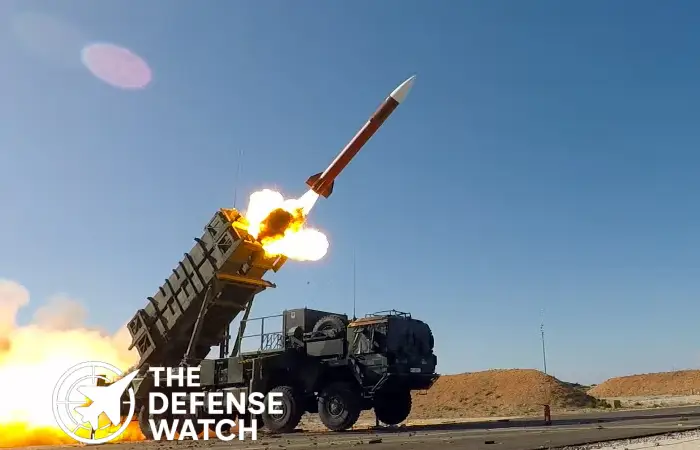
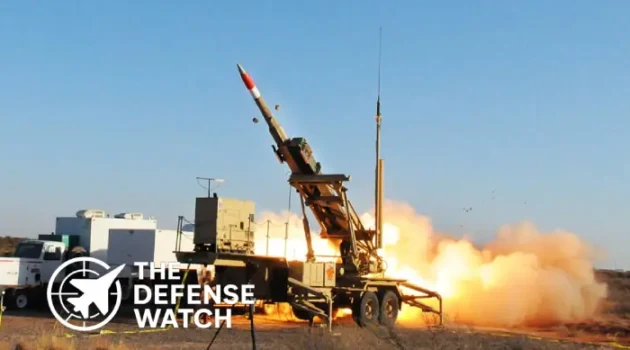
Ukraine has formally intensified efforts to obtain a production license for the Patriot PAC-3 Missile Segment Enhancement (MSE), one of the most advanced operational missile defense interceptors in the Western arsenal.
Speaking during a joint appearance with Swedish Prime Minister Ulf Kristersson, Ukrainian President Volodymyr Zelenskyy stated that Kyiv wants its defense industry to receive authorization to manufacture PAC-3 missiles domestically. According to Zelenskyy, Patriot remains the only combat-proven Western system currently capable of reliably countering ballistic missile attacks targeting Ukrainian cities and infrastructure.
Zelenskyy said discussions on the issue began during the Biden administration and would continue with the Trump administration, emphasizing Ukraine’s long-term goal of securing both missile supplies and sovereign production capability.
The request comes as Russia continues to employ a mix of ballistic missiles, cruise missiles, drones, and high-speed strike systems against Ukrainian targets, creating sustained demand for high-end interceptors.
Why PAC-3 MSE Matters To Ukraine’s Air Defense Network
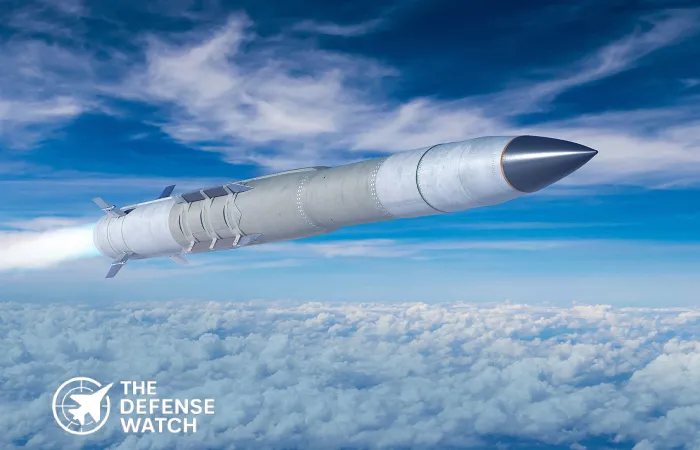
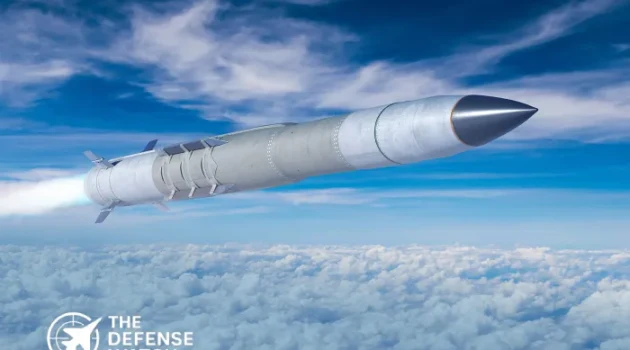
The PAC-3 MSE interceptor is the most advanced missile currently fielded within the Patriot family for ballistic missile defense missions.
Unlike traditional surface-to-air missiles that rely primarily on blast fragmentation warheads, PAC-3 MSE uses a hit-to-kill approach, destroying incoming targets through direct kinetic impact. The missile is specifically designed to engage tactical ballistic missiles, cruise missiles, and advanced aerial threats.
Key PAC-3 MSE Characteristics
Capability Details Primary Mission Ballistic missile defense Intercept Method Hit-to-kill kinetic impact Compatible System MIM-104 Patriot Target Set Ballistic missiles, cruise missiles, aircraft Major Manufacturer Lockheed Martin Current Production Expansion Planned growth from roughly 600 to 2,000 missiles annually Sources: U.S. Army, Lockheed Martin, Pentagon announcements.
(adsbygoogle = window.adsbygoogle || []).push({});Ukraine has repeatedly credited Patriot batteries with intercepting Russian ballistic missile attacks, including engagements against Iskander-class systems and other high-speed threats. Germany has also transferred additional PAC-3 interceptors to support Ukraine’s air defense operations.
The Industrial Challenge Behind Patriot Missile Demand
Ukraine’s request arrives at a time when the United States is already undertaking a major expansion of Patriot interceptor production.
In January 2026, the Pentagon and Lockheed Martin announced a framework agreement intended to increase PAC-3 MSE production from approximately 600 missiles annually to roughly 2,000 per year over a seven-year period. The initiative represents one of the most significant missile production expansions undertaken by the U.S. defense industrial base since the start of the Ukraine war.

The effort gained additional momentum in April when the U.S. Army awarded Lockheed Martin a .76 billion contract action to accelerate production and strengthen supply chain capacity for the interceptor. According to Army officials, expanded output is intended to support both U.S. military requirements and allied demand.
Notably, roughly 94 percent of the initial funding associated with that production effort came through Foreign Military Sales channels, demonstrating that international demand has become a major driver of Patriot manufacturing growth.
Strategic Implications Of A Ukrainian Production License
A licensed production arrangement would represent a major shift in how advanced U.S. missile defense technology is shared with partner nations.
For Ukraine, local manufacturing could provide several advantages:
- Reduced dependence on foreign deliveries.
- Faster replenishment of interceptor stocks.
- Greater resilience during prolonged conflict.
- Expansion of Ukraine’s domestic defense industrial base.
- Potential integration into future European missile defense supply chains.
However, obtaining a PAC-3 production license would involve significant technical, industrial, and political hurdles.
PAC-3 MSE contains sensitive guidance technologies, propulsion systems, seekers, and software components that fall under strict U.S. export controls. Any production arrangement would likely require extensive government oversight, technology security measures, and congressional support.
Even if approved, establishing a complete production ecosystem could take years. Manufacturing advanced missile interceptors requires highly specialized facilities, secure supply chains, precision electronics production, rocket motor manufacturing capacity, and rigorous testing infrastructure.
Growing Allied Interest In Local Patriot Production
Ukraine is not the only country seeking deeper involvement in Patriot missile manufacturing.
Several NATO allies are pursuing expanded industrial participation in Patriot-related production as demand for missile defense systems grows across Europe. Reports in recent weeks indicate Poland has received preliminary approval to explore domestic Patriot missile manufacturing opportunities, while Germany has also expanded its involvement in Patriot-related industrial programs.
(adsbygoogle = window.adsbygoogle || []).push({});This reflects a broader trend within NATO toward regionalizing portions of missile production to reduce bottlenecks and increase resilience during major conflicts.
The shift is particularly significant because interceptor availability has increasingly become the limiting factor in missile defense operations. Modern Patriot batteries can only remain effective if sufficient reload inventories are available to sustain combat operations during prolonged missile attacks.
What This Means For U.S. And Allied Missile Defense Strategy
The significance of Ukraine’s request extends beyond the battlefield.
For Washington, the proposal underscores a growing reality across multiple theaters, including Eastern Europe, the Middle East, and the Indo-Pacific. Missile defense demand is rising faster than traditional production models were designed to support.
The Pentagon’s ongoing expansion of PAC-3 MSE manufacturing capacity reflects this challenge. U.S. planners are attempting to balance domestic requirements, allied procurement programs, and wartime support commitments simultaneously.
(adsbygoogle = window.adsbygoogle || []).push({});Ukraine’s push for licensed production therefore highlights a larger strategic question facing Western defense planners: whether future missile defense architectures will rely primarily on centralized U.S. production or evolve toward a distributed allied manufacturing model.
As missile threats continue to proliferate globally, industrial capacity may become just as important as launcher numbers or radar performance. The ability to rapidly produce and replenish interceptors is increasingly emerging as a central element of modern air and missile defense strategy.
(adsbygoogle = window.adsbygoogle || []).push({});Executive Summary
The U.S. Army is seeking funding for 857 Terminal High Altitude Area Defense (THAAD) interceptors as part of a major expansion of America’s missile defense inventory. The move reflects growing concerns over ballistic and hypersonic missile threats in the Indo-Pacific and signals a broader Pentagon effort to strengthen both operational readiness and defense industrial capacity.
U.S. Army Requests 857 THAAD Interceptors As Missile Defense Demand Surges
The U.S. Army’s reported request for 857 THAAD interceptors represents one of the largest missile defense procurement efforts in the history of the program, highlighting Washington’s growing focus on layered air and missile defense across the Indo-Pacific theater.
According to defense reporting and budget-related disclosures, the planned procurement increase is tied to broader Pentagon efforts to expand strategic missile defense inventories while addressing concerns over stockpile depth, industrial capacity, and sustained readiness in a high-intensity conflict environment.
The request comes as U.S. military planners increasingly emphasize the need for larger inventories of advanced interceptors capable of defending forward-deployed forces, strategic bases, and allied territories against expanding ballistic missile arsenals.
THAAD Remains A Critical Layer In U.S. Missile Defense Architecture
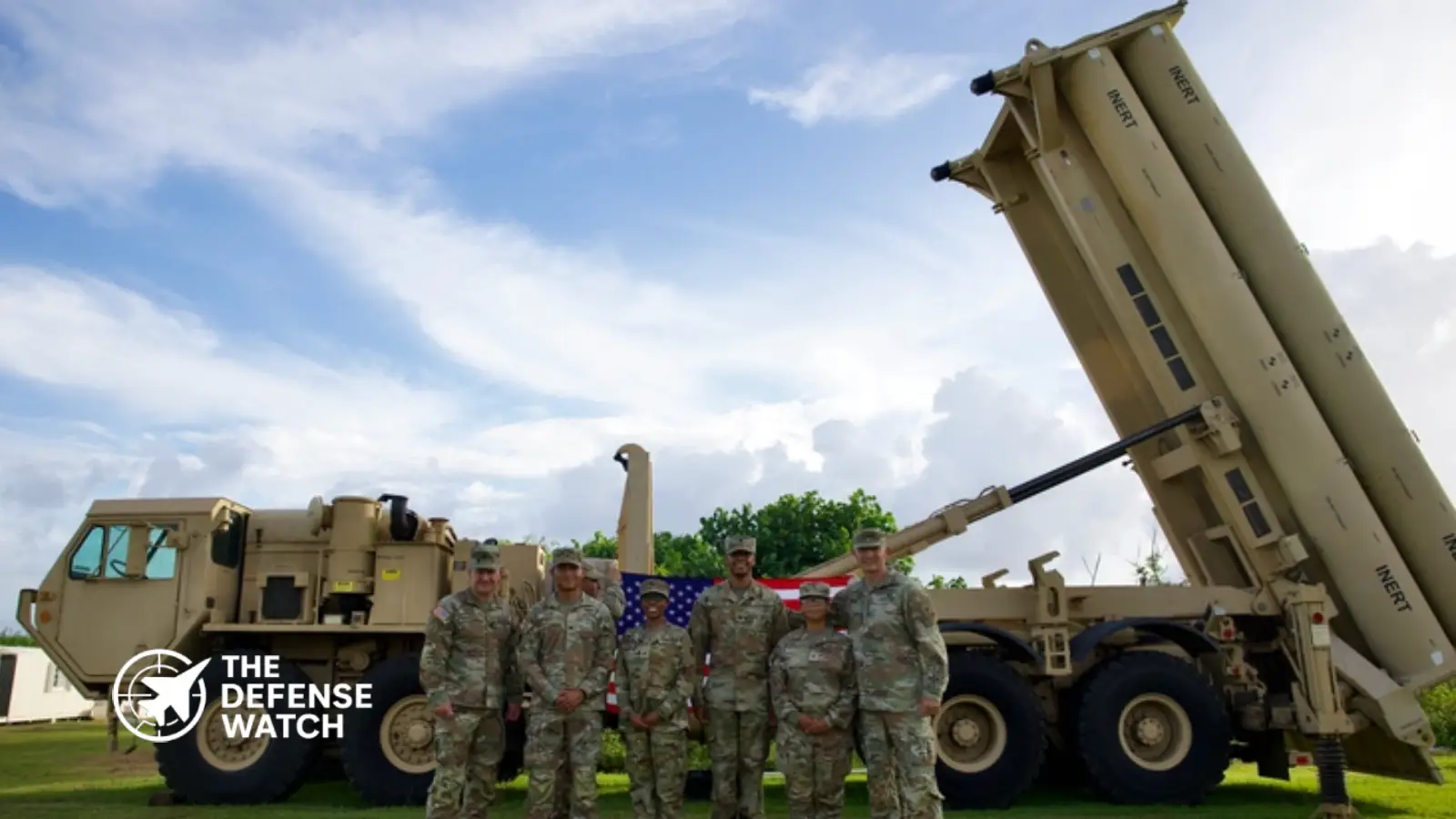
Developed by Lockheed Martin, the Terminal High Altitude Area Defense system is designed to intercept short, medium, and intermediate-range ballistic missiles during their terminal phase of flight.
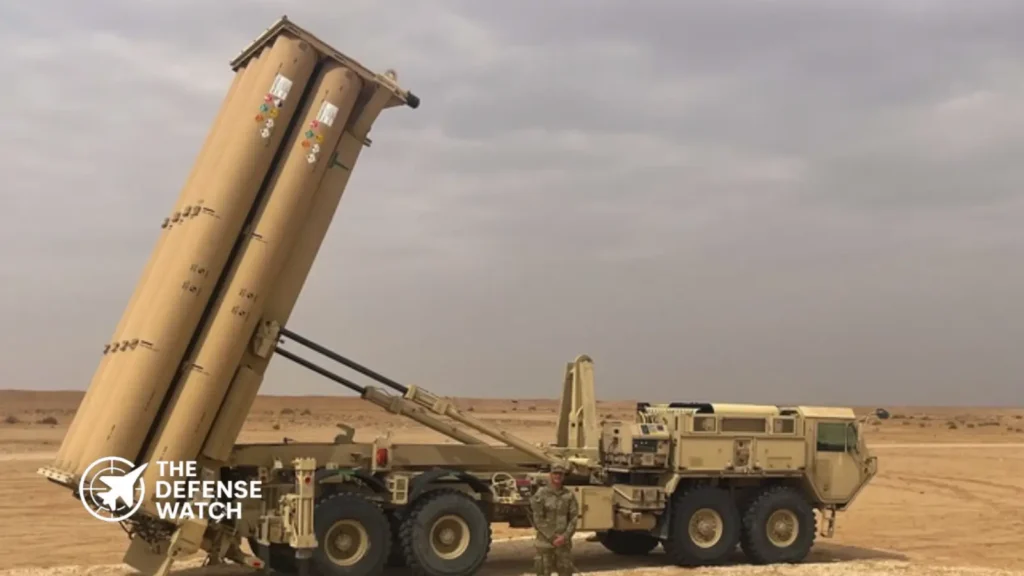
Unlike traditional missile systems that rely on explosive warheads, THAAD uses a hit-to-kill approach, destroying incoming targets through direct kinetic impact. The system is capable of engaging threats both inside and outside Earth’s atmosphere, providing commanders with a higher-altitude defensive layer than systems such as Patriot PAC-3 MSE.
A typical THAAD battery includes:
| Component | Function |
|---|---|
| THAAD Launchers | Fire interceptor missiles |
| THAAD Interceptors | Engage incoming ballistic threats |
| AN/TPY-2 Radar | Long-range detection and tracking |
| Fire Control System | Battle management and engagement coordination |
| Communications Network | Integration with broader missile defense architecture |
The system currently serves as a key component of the U.S. Army’s integrated air and missile defense network and is deployed in several strategically important regions.
Indo-Pacific Requirements Are Driving Procurement Growth
The scale of the reported 857-interceptor request reflects growing concern among defense planners regarding missile threats in the Western Pacific.
China continues to expand its inventory of ballistic missiles, anti-ship ballistic missiles, and emerging hypersonic systems designed to challenge U.S. power projection capabilities. At the same time, North Korea continues testing increasingly capable missile systems capable of threatening U.S. regional bases and allied territory.
(adsbygoogle = window.adsbygoogle || []).push({});For U.S. commanders, missile defense is no longer viewed as a niche capability. It has become a foundational requirement for maintaining freedom of maneuver across the Indo-Pacific.
The Army has already taken steps to strengthen regional missile defense by expanding Patriot formations, investing in Integrated Battle Command System (IBCS) networks, deploying Indirect Fire Protection Capability (IFPC) systems, and increasing procurement of PAC-3 MSE interceptors.
The THAAD expansion appears to fit within this broader modernization effort.
Production Capacity Has Become A Strategic Priority
The procurement request also highlights a growing Pentagon focus on defense industrial resilience.
In January 2026, Lockheed Martin announced a framework agreement to increase THAAD interceptor production from approximately 96 missiles annually to as many as 400 per year over a multi-year period. The expansion includes major investments in manufacturing facilities, workforce growth, and advanced production technologies.
A separate initiative launched in March 2026 seeks to quadruple production of THAAD infrared seekers, one of the most technically complex components of the interceptor. Defense officials described the effort as necessary to remove supply chain bottlenecks and support future production targets.
Key Production Expansion Measures
- THAAD interceptor output planned to increase from 96 to 400 annually
- Expanded seeker manufacturing capacity
- Multi-year industrial investment programs
- New missile production facilities and automation upgrades
- Increased workforce recruitment across missile manufacturing sites
These measures indicate that Washington is increasingly treating missile production capacity as a strategic asset rather than simply a procurement issue.
Lessons From Recent Missile Defense Operations
Another factor influencing procurement decisions is the growing operational demand placed on U.S. missile defense inventories.
Recent reporting and defense assessments have highlighted concerns regarding interceptor consumption rates during large-scale regional contingencies. Analysts have warned that modern conflicts involving extensive missile exchanges can rapidly deplete inventories of advanced interceptors.
This has elevated concerns regarding what military planners often describe as “magazine depth,” the ability to sustain defensive operations over extended periods without exhausting available stocks.
For the Pentagon, the challenge is not simply developing sophisticated missile defenses. It is ensuring sufficient inventory exists to support prolonged operations across multiple theaters simultaneously.
Strategic Implications For The Indo-Pacific
The reported request for 857 THAAD interceptors suggests the United States is preparing for a future security environment characterized by larger missile salvos, longer-duration conflicts, and more contested operating environments.
(adsbygoogle = window.adsbygoogle || []).push({});From a strategic perspective, THAAD plays a unique role because it bridges the gap between lower-tier systems such as Patriot and higher-tier missile defense architectures operated by the U.S. Navy.
The system provides an additional engagement opportunity against incoming ballistic threats while helping preserve lower-cost interceptors for other targets. This layered approach has become increasingly important as adversaries field larger and more diverse missile arsenals.
For allies and partners across the Indo-Pacific, expanded THAAD inventories could also strengthen confidence in U.S. extended deterrence commitments by ensuring sufficient missile defense capacity remains available during a crisis.
A Shift Toward Sustained Missile Defense Readiness
The scale of the Army’s reported THAAD procurement request underscores a broader shift occurring across the U.S. defense establishment.
Rather than focusing solely on next-generation weapons development, Pentagon planners are increasingly prioritizing stockpile depth, production scalability, and long-term sustainment. The combination of expanded interceptor procurement, industrial base investment, and missile defense modernization suggests Washington is preparing for a strategic environment where missile defense readiness will be measured not only by technological superiority but also by production capacity and inventory resilience.
If approved by Congress, the acquisition of 857 THAAD interceptors would represent a significant expansion of U.S. missile defense capabilities and further reinforce the Indo-Pacific’s position as the central focus of American defense planning.

(adsbygoogle = window.adsbygoogle || []).push({});Executive Summary: China’s People’s Liberation Army Rocket Force (PLARF) has fielded a three-tier suite of anti-ship ballistic and hypersonic missiles — the DF-21D, DF-26, and YJ-21/YJ-20 — capable of engaging carrier strike groups from stand-off ranges of 900 km to 4,500 km. Designed explicitly to challenge U.S. naval freedom of maneuver in the western Pacific, these systems collectively constitute an Anti-Access/Area-Denial (A2/AD) architecture that compels significant operational and doctrinal adjustments from the U.S. Navy and its regional allies. Their continued development and deployment represent the most consequential shift in naval threat calculus since the introduction of nuclear-powered carrier aviation.
Why “Carrier Killers” Matter
For nearly eight decades, the U.S. aircraft carrier has served as the preeminent instrument of power projection, capable of surging combat airpower to any ocean within days. That strategic calculus rested on a fundamental assumption: that no adversary possessed the precision strike capability to hold carriers at operationally relevant risk beyond the range of shipborne air defenses. China’s PLARF has systematically invalidated that assumption.
Beginning with the operational deployment of the DF-21D — the world’s first land-based ballistic missile explicitly designed to engage moving naval targets — and extending through the intermediate-range DF-26 and the shipborne hypersonic YJ-21, the PLA has constructed overlapping engagement envelopes that can hold carrier strike groups at risk from well within China’s continental territory. The strategic consequence is direct: any U.S. carrier operating within the first island chain faces a threat environment without historical precedent.
DF-21D: The Pioneer ASBM
Technical Specifications & Operational Concept
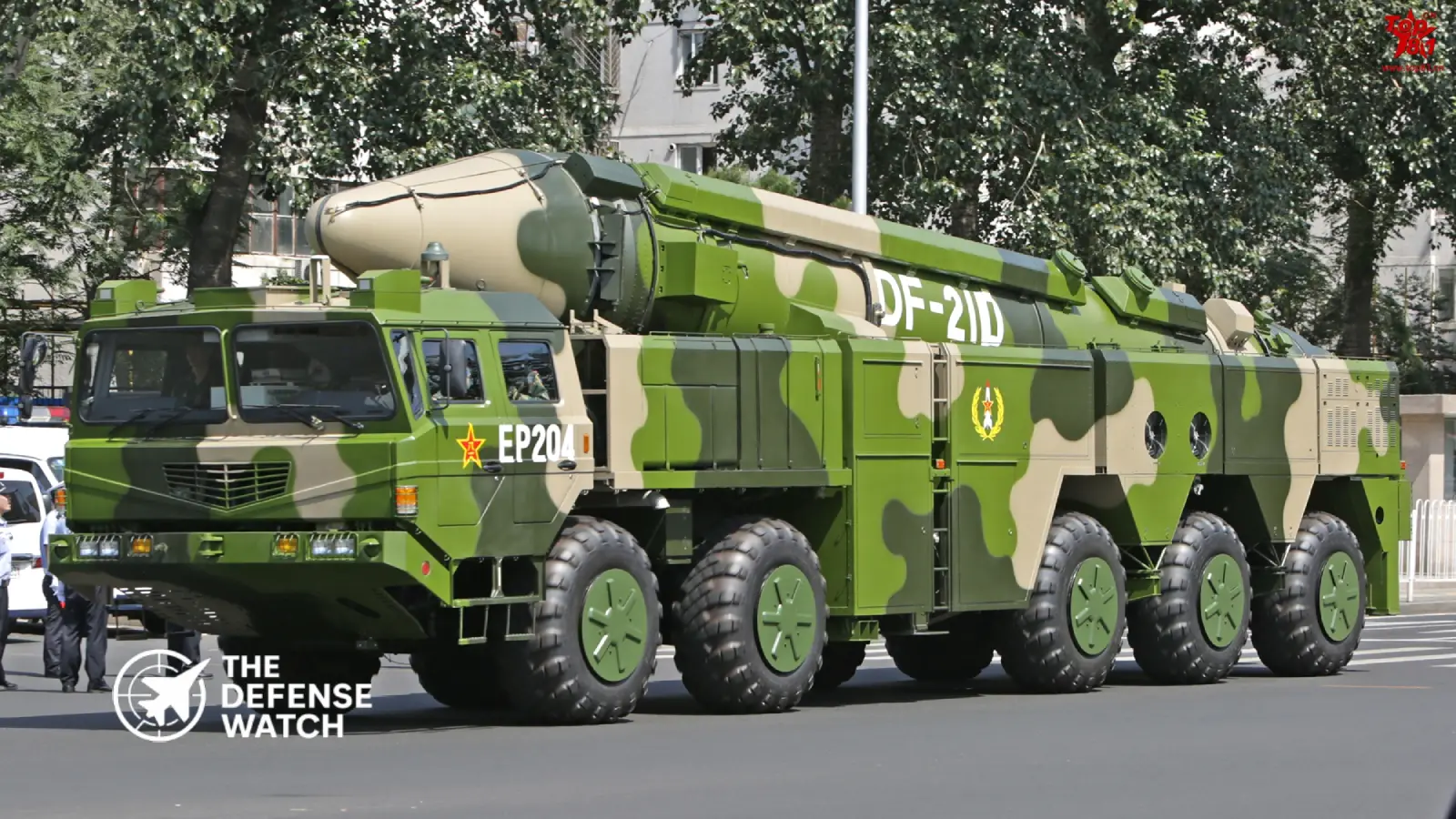
The DF-21D (Dongfeng-21D), designated CSS-5 Mod 5 in NATO parlance, represents the operational proof-of-concept for the anti-ship ballistic missile (ASBM) concept. Launched from road-mobile transporter-erector-launchers (TELs) that significantly complicate pre-launch targeting, the missile’s estimated range of 1,500–1,800 km — exact figures remain classified — covers a substantial portion of the western Pacific from launch positions within China’s interior.
(adsbygoogle = window.adsbygoogle || []).push({});The guidance architecture integrates inertial mid-course navigation with over-the-horizon targeting data fused from a constellation of sensors: the Yaogan series of imagery and electronic intelligence satellites, long-range maritime patrol aircraft, submarine-relayed acoustic intelligence, and surface vessel radar tracks. The terminal phase employs an active radar seeker capable of discriminating a carrier against sea clutter, combined with maneuvering reentry vehicle (MaRV) technology that allows terminal trajectory correction against a target moving at up to approximately 30 knots.
Key Capabilities at a Glance
- Mobile launch platform: Road-mobile TELs allow rapid repositioning, complicating adversary suppression-of-enemy-air-defenses (SEAD) targeting cycles.
- Maneuvering reentry vehicle (MaRV): Terminal course corrections challenge interceptors designed against ballistic trajectories.
- Over-the-horizon targeting: Dependent on satellite, airborne, and naval sensor fusion rather than organic seeker-only acquisition — a known vulnerability in high-EW environments.
- Anti-ship ballistic missile (ASBM) pioneer: First system in the world to transition from concept to declared operational status against moving naval targets.
- Estimated CEP: Open-source assessments suggest a circular error probable (CEP) of approximately 20–40 meters against a stationary target, with degraded accuracy against evasive maneuvering.
“To calculate the theoretical interception window for an Aegis combat system reacting to these ballistic trajectories, utilize our Missile Range & Time-of-Flight Calculator.”
DF-26: Dual-Role Intermediate Strike — The “Guam Express”
Extended Range and Nuclear Ambiguity
The DF-26, first publicly displayed during the September 2015 Beijing Victory Day parade and declared operational by the PLARF in April 2018, substantially extends China’s sea-denial envelope to approximately 4,000–4,500 km. This range brings the U.S. strategic hub at Guam — and the forward-deployed assets it supports — within persistent strike threat, earning the informal designation “Guam Express” in Western defense analyses.
(adsbygoogle = window.adsbygoogle || []).push({});The DF-26’s most operationally significant characteristic is its dual conventional/nuclear capability. Unlike the conventionally-dedicated DF-21D, the DF-26 is assessed by the U.S. Department of Defense as nuclear-capable, introducing a dangerous ambiguity problem: an adversary observing DF-26 launch preparation cannot immediately determine the warhead type, potentially triggering escalatory responses disproportionate to a conventional strike. The more recent DF-26D variant is reported to incorporate an upgraded guidance package and multi-warhead options designed to further complicate point-defense intercept solutions.
Key Capabilities at a Glance
- 4,000–4,500 km range: Covers Guam, the Philippine Sea operating areas, and portions of the Indian Ocean from western China.
- Dual conventional/nuclear role: Creates escalation ambiguity at the strategic level; adversary launch detection does not resolve warhead type prior to intercept decision window.
- DF-26D multi-warhead variant: Reported to carry multiple independently targetable or salvo sub-munitions to saturate shipborne point defenses.
- Rapid reload capability: PLARF mobile launchers are assessed to carry reload rounds, increasing salvo depth beyond a single-shot scenario.
- Land and naval target flexibility: Cleared for both fixed-infrastructure precision strikes and anti-ship missions, unlike the ASBM-specific DF-21D.
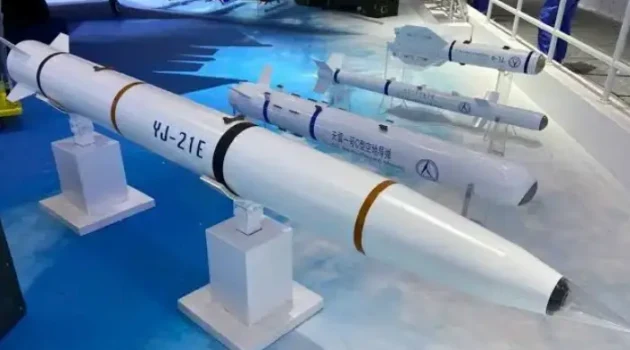
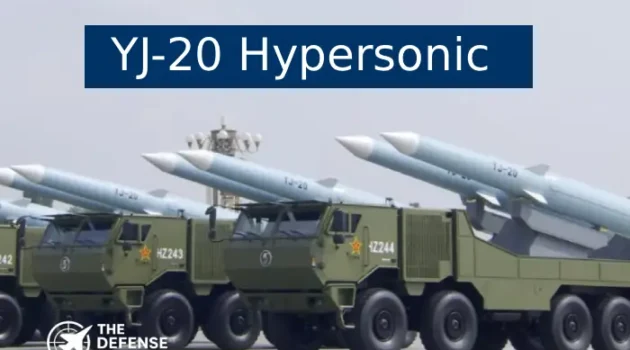
YJ-21 and YJ-20: The Hypersonic Sea-Launched Tier
Terminal Hypersonic Intercept Challenge
While the DF-21D and DF-26 represent land-based ballistic threats, the YJ-21 (Eagle Strike-21) and YJ-20 extend the carrier-killer concept to surface combatants, embedding hypersonic anti-ship strike capability directly into the PLA Navy’s (PLAN) surface fleet. The ship-launched YJ-20 integrates into the 112-cell vertical launch system (VLS) of the Type 055 Renhai-class cruiser — China’s most capable surface combatant — and is assessed to achieve cruising speeds in the Mach 4–6 envelope with a terminal-phase velocity reported to exceed Mach 10.
(adsbygoogle = window.adsbygoogle || []).push({});The combination of high terminal velocity, low radar cross-section in the terminal phase, and significant kinetic energy on impact creates an interception problem that exceeds the engagement parameters of current shipborne air defense systems, including the SM-6 Block IB, which has a maximum engagement velocity of approximately Mach 3.5 in the anti-air warfare mission. Directed-energy systems under development by the U.S. Navy are assessed to offer future capability against this threat class, but no currently fielded system provides reliable intercept assurance.
Key Capabilities at a Glance
- VLS integration: Fits standard vertical launch cells, enabling deployment from any Type 055 or future PLAN combatant without platform modification.
- Mach 10+ terminal velocity: Exceeds the kinematic intercept envelope of currently fielded U.S. Navy shipborne air defense missiles.
- Distributed threat: Unlike land-based systems, ship-launched missiles can be prosecuted from multiple geographic vectors simultaneously.
- Reduced warning time: High terminal speed compresses the intercept decision window from minutes (ballistic) to seconds at close range.
- Layered threat synergy: Designed to exploit air defense saturation created by simultaneous DF-21D/DF-26 engagement — forcing defenders to allocate interceptors against multiple simultaneous threat axes.
System Comparison: DF-21D vs. DF-26 vs. YJ-21/YJ-20 vs. Legacy Threats
Terminal Hypersonic Intercept Challenge
While the DF-21D and DF-26 represent land-based ballistic threats, the YJ-21 (Eagle Strike-21) and YJ-20 extend the carrier-killer concept to surface combatants, embedding hypersonic anti-ship strike capability directly into the PLA Navy’s (PLAN) surface fleet. The ship-launched YJ-20 integrates into the 112-cell vertical launch system (VLS) of the Type 055 Renhai-class cruiser — China’s most capable surface combatant — and is assessed to achieve cruising speeds in the Mach 4–6 envelope with a terminal-phase velocity reported to exceed Mach 10.
(adsbygoogle = window.adsbygoogle || []).push({});The combination of high terminal velocity, low radar cross-section in the terminal phase, and significant kinetic energy on impact creates an interception problem that exceeds the engagement parameters of current shipborne air defense systems, including the SM-6 Block IB, which has a maximum engagement velocity of approximately Mach 3.5 in the anti-air warfare mission. Directed-energy systems under development by the U.S. Navy are assessed to offer future capability against this threat class, but no currently fielded system provides reliable intercept assurance.
Key Capabilities at a Glance
- VLS integration: Fits standard vertical launch cells, enabling deployment from any Type 055 or future PLAN combatant without platform modification.
- Mach 10+ terminal velocity: Exceeds the kinematic intercept envelope of currently fielded U.S. Navy shipborne air defense missiles.
- Distributed threat: Unlike land-based systems, ship-launched missiles can be prosecuted from multiple geographic vectors simultaneously.
- Reduced warning time: High terminal speed compresses the intercept decision window from minutes (ballistic) to seconds at close range.
- Layered threat synergy: Designed to exploit air defense saturation created by simultaneous DF-21D/DF-26 engagement — forcing defenders to allocate interceptors against multiple simultaneous threat axes.
System Comparison: DF-21D vs. DF-26 vs. YJ-21/YJ-20 vs. Legacy Threats
Terminal Hypersonic Intercept Challenge
While the DF-21D and DF-26 represent land-based ballistic threats, the YJ-21 (Eagle Strike-21) and YJ-20 extend the carrier-killer concept to surface combatants, embedding hypersonic anti-ship strike capability directly into the PLA Navy’s (PLAN) surface fleet. The ship-launched YJ-20 integrates into the 112-cell vertical launch system (VLS) of the Type 055 Renhai-class cruiser — China’s most capable surface combatant — and is assessed to achieve cruising speeds in the Mach 4–6 envelope with a terminal-phase velocity reported to exceed Mach 10.
The combination of high terminal velocity, low radar cross-section in the terminal phase, and significant kinetic energy on impact creates an interception problem that exceeds the engagement parameters of current shipborne air defense systems, including the SM-6 Block IB, which has a maximum engagement velocity of approximately Mach 3.5 in the anti-air warfare mission. Directed-energy systems under development by the U.S. Navy are assessed to offer future capability against this threat class, but no currently fielded system provides reliable intercept assurance.
(adsbygoogle = window.adsbygoogle || []).push({});Key Capabilities at a Glance
- VLS integration: Fits standard vertical launch cells, enabling deployment from any Type 055 or future PLAN combatant without platform modification.
- Mach 10+ terminal velocity: Exceeds the kinematic intercept envelope of currently fielded U.S. Navy shipborne air defense missiles.
- Distributed threat: Unlike land-based systems, ship-launched missiles can be prosecuted from multiple geographic vectors simultaneously.
- Reduced warning time: High terminal speed compresses the intercept decision window from minutes (ballistic) to seconds at close range.
- Layered threat synergy: Designed to exploit air defense saturation created by simultaneous DF-21D/DF-26 engagement — forcing defenders to allocate interceptors against multiple simultaneous threat axes.
System Comparison: DF-21D vs. DF-26 vs. YJ-21/YJ-20 vs. Legacy Threats
System Range Launch Platform Terminal Speed Warhead Type Primary Target Key Technology Status DF-21D ~1,500–1,800 km Road-mobile TEL ~Mach 10 (reentry) Conventional HE, penetrator Carrier strike groups MaRV + active radar seeker; satellite/OTH targeting Operational (PLARF) DF-26 / DF-26D ~4,000–4,500 km Road-mobile TEL ~Mach 18 (reentry) Conv. / Nuclear (dual-capable) Carriers + land infrastructure Dual-role warhead; multi-warhead variant (DF-26D) Operational (PLARF, since Apr 2018) YJ-21 / YJ-20 Est. 1,000–1,500 km VLS (Type 055 cruiser) Mach 4–6 cruise; Mach 10+ terminal Conventional HE, penetrator Carriers, large surface combatants Hypersonic glide terminal phase; VLS-compatible airframe Operational (PLAN, Type 055) Legacy: P-700 Granit (SS-N-19) ~625 km Submarine / surface VLS Mach 2.5 Conventional / Nuclear Carrier groups Active radar + datalink; salvo logic In service (Russian Navy) Legacy: Harpoon Block II+ ~280 km Ship / air / sub ~Mach 0.85 Conventional HE Surface combatants GPS/INS + active radar terminal In service (U.S. Navy, allies) The Strategic Impact on U.S. Navy Operations and NATO Readiness
The U.S. Navy’s response calculus involves multiple concurrent lines of effort. The DDG(X) next-generation destroyer program incorporates directed-energy weapon provisions and substantially upgraded power generation for future hypersonic intercept lasers. The SM-6 Block IB upgrade extends engagement altitude and improves discrimination against maneuvering targets. The Conventional Prompt Strike (CPS) program — a hypersonic weapon carried aboard Virginia-class submarines — directly mirrors China’s land-attack hypersonic capability, signaling a bilateral hypersonic competition that carries its own escalation risks.
(adsbygoogle = window.adsbygoogle || []).push({});For NATO allies operating in the Indo-Pacific — particularly Australia, Japan, and South Korea — the DF-26 range ring fundamentally changes the geography of alliance commitments. Japanese Aegis destroyers, upgraded with SM-3 Block IIA interceptors under the bilateral Aegis cooperation program, provide the most capable currently-fielded allied intercept capability against the DF-26’s midcourse phase. However, intercept probability against a salvo of six or more missiles — a plausible PLARF employment option — remains a classified variable not addressed in open-source literature.
Technical Breakthroughs in Targeting Architecture
The most underappreciated element of China’s ASBM capability is not the missile itself but the targeting kill chain required to support it. A ballistic missile taking approximately 12–15 minutes from launch to impact at DF-21D range must be cued with carrier position data accurate enough to place the terminal seeker’s acquisition basket over the target. This requires a persistent, real-time maritime surveillance architecture.
China has invested substantially in this supporting layer. The Yaogan-30 constellation — a series of electronic intelligence (ELINT) and signals intelligence (SIGINT) satellites operating in low-Earth orbit in groups of three — provides persistent radar emission tracking of surface combatants. The Yaogan-31 series complements this with synthetic aperture radar (SAR) imagery. Shore-based over-the-horizon backscatter radars, operating in the 3–30 MHz band, provide wide-area cueing against major surface contacts at ranges exceeding 3,000 km. The integration of this multi-source picture into a coherent common operating picture remains a recognized Chinese military priority and a continuing intelligence-collection focus for the U.S. Navy.
The Kill Chain: How China Tracks Moving Targets at Sea
An anti-ship ballistic missile is, in isolation, a precision instrument without a target. The true operational capability of China’s DF-21D, DF-26, and YJ-21 systems is inseparable from the surveillance and targeting architecture that supports them — a multi-domain sensor network the PLA refers to internally as the Integrated Joint Operations Platform (IJOP) maritime branch. This kill chain is the operational linchpin that converts a ballistic missile’s physics into a credible naval threat, and it warrants dedicated examination.
A carrier strike group underway generates a substantial electromagnetic and acoustic signature. It radiates radar emissions, communications traffic, and aircraft sortie patterns across a wide electromagnetic spectrum. China’s targeting architecture is engineered to exploit each of these signatures simultaneously, fusing multiple sensor inputs into a continuously updated common operating picture that can cue a missile launch with sufficient accuracy to place the terminal seeker’s acquisition basket over a target moving at 25–30 knots.
The Five-Layer Sensor Architecture
Open-source analysis of Chinese military publications and observable satellite deployments indicates a layered sensor architecture with at least five distinct input streams, each providing different coverage geometry and update rates:
The Kill Chain: Multi-Layered Targeting Network
Layer 1Yaogan-30 ELINT/SIGINT Constellation
Low-Earth orbit triplets passively collect radar and radio emissions from surface combatants. Provides wide-area cueing at global range. Revisit rate estimated at 2–4 hours per triplet cluster.
Layer 2Yaogan-31 SAR Imaging
Synthetic aperture radar satellites provide all-weather, day/night imagery for track confirmation and group-size assessment. Complement ELINT data with physical contact geometry.
Layer 3OTH-B Backscatter Radar
Shore-based over-the-horizon backscatter radars operating in the 3–30 MHz HF band detect large surface contacts at ranges exceeding 3,000 km. Provides persistent wide-area cueing independent of weather.
Layer 4Y-8/Y-9 ELINT Patrol Aircraft
Airborne electronic intelligence platforms extend sensor reach beyond shore-based radar horizons. Capable of discriminating individual ship emissions within a strike group formation.
Layer 5SSK/SSN Submarine Acoustic Reporting
Forward-deployed Type 039A (Yuan-class) and Type 093 (Shang-class) submarines provide acoustic track data via low-probability-of-intercept communications buoys.
The Time-Distance Problem
The most technically demanding aspect of the ASBM targeting problem is temporal. At DF-21D maximum range of approximately 1,800 km, flight time from launch to target is estimated at 12–15 minutes. A carrier group maneuvering at 30 knots can translate approximately 9–11 km from its last known position during that interval. The missile’s terminal seeker must therefore be cued to a predicted position basket — not a last-known position — requiring the targeting system to maintain track continuity and apply a projection algorithm that accounts for likely course and speed variations.
“The performance of surface-based tracking radar against low-observable profiles can be calculated directly using our Radar Detection Range Calculator.”
For the longer-ranged DF-26 at 4,000 km, flight time extends to approximately 25–30 minutes, and the positional uncertainty cone grows proportionally. This is the primary engineering rationale for the DF-26D’s reported multi-warhead or salvo payload options: distributing submunitions or warheads across a wider footprint increases probability of engagement against a maneuvering target when track data is degraded.
Analyst note on EW vulnerability: The kill chain’s dependence on real-time sensor fusion creates a recognized operational seam. U.S. carrier strike group defensive doctrine employs electronic attack assets — including EA-18G Growlers — to deny, degrade, or deceive the targeting sensor layer. If the common operating picture fed to PLARF launch controllers contains falsified or degraded contact data, ASBM terminal seeker acquisition probability falls significantly. Whether China’s sensor redundancy is sufficient to overcome a sustained, coordinated EW campaign at scale remains a classified analytical debate within USINDOPACOM and the Office of Naval Intelligence.
Known Vulnerabilities in the Kill Chain
Assessed kill chain vulnerabilities (open-source)
- Satellite revisit gaps: Yaogan-30 triplets provide roughly 2–4 hour revisit cycles in any given ocean area — sufficient for cueing, but allowing maneuvering carriers to open significant positional uncertainty windows between passes.
- OTH radar geolocation imprecision: Backscatter HF radar provides area cueing, not precision targeting. Estimated CEP at maximum range is on the order of tens of kilometers — adequate to cue follow-on sensors but insufficient for direct ASBM launch authority.
- Communications relay latency: Submarine-relayed acoustic data requires buoy surfacing or VLF relay, introducing lag into the targeting picture and creating potential intercept opportunities for adversary anti-submarine forces.
- EW/deception susceptibility: ELINT-based tracking is inherently dependent on target emissions. Emissions-controlled (EMCON) operations by carrier strike groups significantly degrade the ELINT component, forcing greater reliance on SAR and OTH layers with lower update rates.
- C2 link integrity: The data fusion pipeline from satellite ground stations through PLARF launch authority chains is a high-value target for adversary cyber and kinetic operations. Disruption of even one relay node could deny timely launch authorization.
It is precisely these vulnerabilities that drive U.S. Navy investment in EMCON discipline, the EA-18G Growler electronic attack program, and emerging concepts of distributed maritime operations designed to present adversary ISR networks with a more diffuse, lower-signature target set. The kill chain is a system, and like any system, its operational effectiveness is bounded by its weakest node.
Looking Ahead
China’s carrier-killer architecture is not static. The DF-27, assessed by the U.S. DoD Annual Report on Chinese Military Power (2023) to be in development, is expected to extend ASBM range further while incorporating hypersonic glide vehicle (HGV) technology that renders mid-course intercept substantially more difficult than against a classical ballistic trajectory. Meanwhile, the YJ-21’s integration into PLAN combatants signals an intent to export the sea-denial problem far beyond China’s continental margins, as Type 055 cruisers operate increasingly in the central and western Pacific.

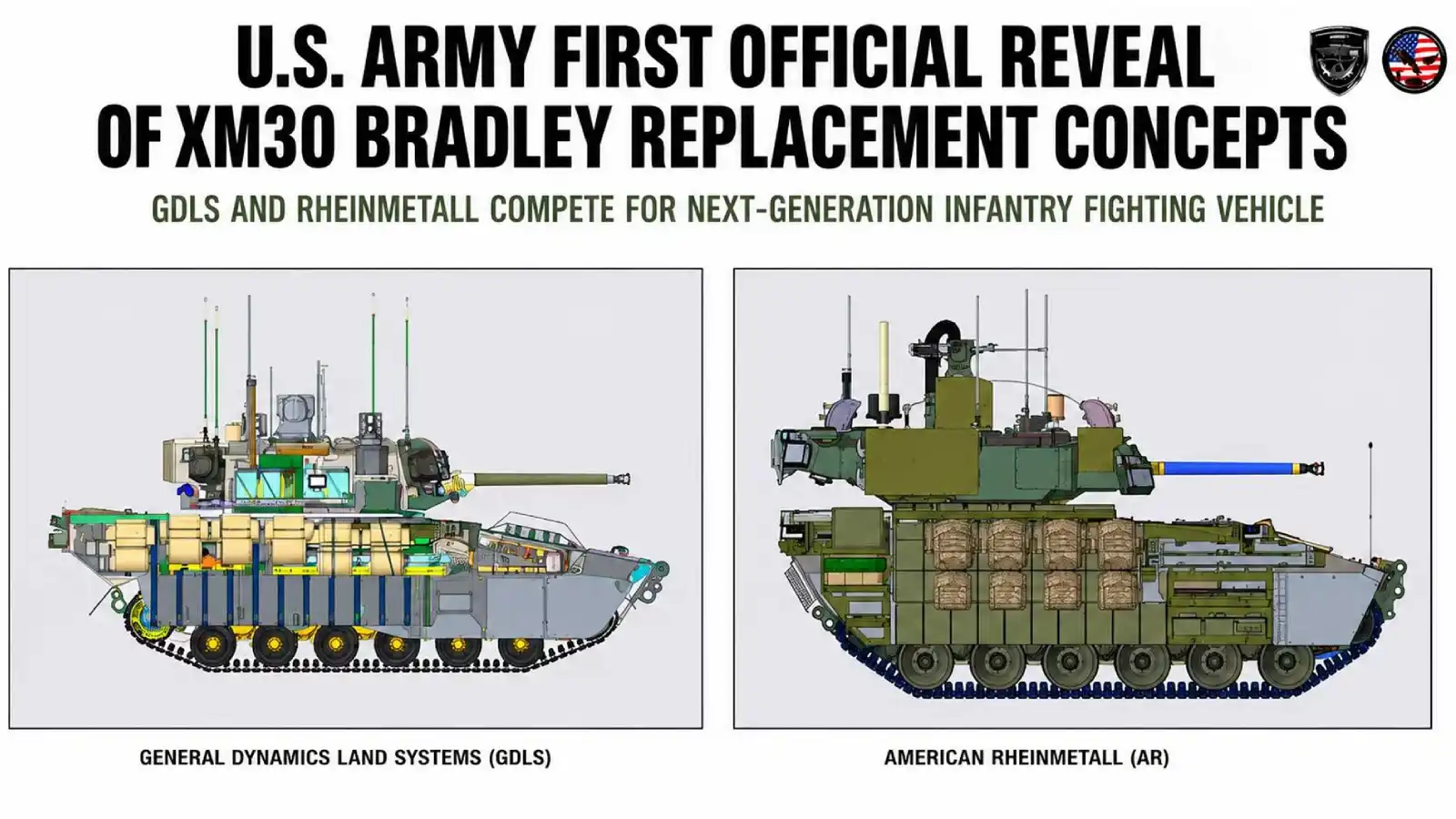
The U.S. Army has released the first official designs of its XM30 mechanized infantry combat vehicle contenders, marking a major step in replacing the aging Bradley fleet.
(adsbygoogle = window.adsbygoogle || []).push({});Executive Summary:
The U.S. Army has unveiled the first official designs of two XM30 infantry fighting vehicle candidates competing to replace the M2 Bradley. The program focuses on AI integration, survivability, and future battlefield networking as the Army accelerates armored modernization efforts.U.S. Army Reveals First XM30 Infantry Fighting Vehicle Designs
The U.S. Army’s XM30 infantry fighting vehicle program has entered a new phase after officials revealed the first designs of two competing armored vehicle concepts intended to replace the long serving M2 Bradley infantry fighting vehicle.
The two competing teams are led by General Dynamics Land Systems and American Rheinmetall Vehicles. Both companies are developing advanced mechanized infantry platforms designed for future multidomain combat operations.
The XM30 program, previously known as the Optionally Manned Fighting Vehicle initiative, represents one of the Army’s most important armored modernization projects. The new vehicle is intended to replace thousands of Bradley fighting vehicles that have served since the early 1980s.
Focus On AI Integration And Battlefield Networking
A defining feature of the XM30 infantry fighting vehicle program is its emphasis on artificial intelligence enabled battlefield capabilities.
The Army is seeking a platform capable of integrating autonomous systems, advanced targeting technologies, predictive maintenance tools, and sensor fusion networks. The goal is to reduce crew workload while improving battlefield awareness and operational survivability.
The two XM30 concepts feature modular architectures that could support future software upgrades and autonomous operations. Army planners have repeatedly stressed that future armored combat vehicles must operate within highly connected combat environments where electronic warfare, drone threats, and rapid sensor sharing play critical roles.
This marks a broader doctrinal shift in U.S. armored warfare. Instead of relying solely on heavier armor protection, future infantry fighting vehicles are increasingly expected to survive through networked awareness, active protection systems, mobility, and AI assisted decision making.
Competing Designs Reflect Different Operational Approaches
The two competing XM30 infantry fighting vehicle concepts appear to reflect different engineering priorities.
The General Dynamics Land Systems proposal reportedly emphasizes survivability and integrated digital architecture. Meanwhile, the American Rheinmetall Vehicles design appears influenced by modern European infantry fighting vehicle trends, including unmanned turret concepts and advanced mission systems.
Both vehicles are expected to include hybrid propulsion technologies aimed at reducing fuel consumption while increasing onboard electrical power generation for future systems.
The Army has also prioritized reduced logistical burden. That includes easier maintenance access, improved operational readiness rates, and greater adaptability across combat scenarios.
The XM30 infantry fighting vehicle will likely serve as a central component of future U.S. Army mechanized formations for decades, making the program strategically significant beyond simple fleet replacement.
Lessons From Ukraine Continue To Shape Requirements
Combat operations in Ukraine continue to influence global armored vehicle development, including U.S. Army modernization priorities.
Recent battlefield experience has demonstrated the growing vulnerability of armored vehicles to loitering munitions, armed drones, top attack missiles, and long range precision fires. As a result, survivability requirements for next generation infantry fighting vehicles have expanded beyond traditional armor thickness.
The XM30 infantry fighting vehicle program reflects those evolving realities. Future vehicles are expected to operate in highly contested electromagnetic environments while maintaining communications resilience and situational awareness.
The Army’s emphasis on optional manning capability also highlights increasing interest in reducing soldier exposure during high risk operations. While the XM30 is expected to remain crewed in most operational scenarios, future autonomous capabilities could support remote operations in contested areas.
Industrial Competition And Strategic Importance
The competition between major defense manufacturers underscores the long term industrial importance of the XM30 program.
Replacing the Bradley fleet represents a multibillion dollar opportunity likely to shape the future of the U.S. armored vehicle industrial base. The eventual production winner could secure decades of manufacturing work, sustainment contracts, and export opportunities.
The program also demonstrates continued Pentagon investment in conventional land warfare modernization despite growing focus on Indo Pacific competition and emerging technologies.
Army modernization officials have repeatedly stated that armored maneuver forces remain essential for deterrence and large scale combat operations. The XM30 infantry fighting vehicle is therefore expected to play a key role in future combined arms doctrine alongside the M1 Abrams and future robotic combat systems.
Program Timeline And Next Steps
The U.S. Army is expected to continue detailed design evaluations before selecting prototypes for further testing phases.
Future testing will likely examine mobility, survivability, digital integration, operational reliability, and interoperability with existing Army combat systems.
If development remains on schedule, the XM30 infantry fighting vehicle could begin gradually replacing Bradley vehicles during the next decade.
The modernization effort reflects the Army’s broader push to prepare for future high intensity conflicts where speed, data integration, autonomous support systems, and survivability will define battlefield effectiveness.
Washington is rapidly scaling missile interceptor production as demand for air and missile defense systems surges across Europe, the Middle East, and the Indo-Pacific.
Executive Summary:
The U.S. government and Lockheed Martin are dramatically increasing production of THAAD and PAC-3 missile interceptors to address rising global missile threats and replenish defense inventories. The effort reflects growing pressure on America’s missile defense industrial base amid expanding operational demand from U.S. forces and allies.U.S. Expands THAAD And PAC-3 Missile Production Capacity
The United States is accelerating production of THAAD and PAC-3 missile interceptors as Washington moves to strengthen its missile defense industrial base amid growing global security pressures.
Lockheed Martin announced a series of framework agreements with the U.S. government aimed at sharply increasing annual output of both the Terminal High Altitude Area Defense (THAAD) interceptor and the Patriot Advanced Capability-3 Missile Segment Enhancement (PAC-3 MSE).
Under the agreement, THAAD interceptor production is expected to rise from 96 missiles annually to as many as 400 per year. PAC-3 MSE production is also planned to increase from roughly 600 interceptors annually to approximately 2,000 over a seven year period.
The initiative comes as the Pentagon faces increasing demand for layered missile defense systems following recent conflicts in the Middle East and continued concerns over peer-level missile threats from China, Russia, Iran, and North Korea.
Lockheed Martin Expands U.S. Manufacturing Network
To support the production surge, Lockheed Martin is investing billions of dollars into new manufacturing infrastructure and facility modernization across multiple U.S. states.
The company recently broke ground on new missile production facilities in Arkansas and Alabama designed to support THAAD, PAC-3, Precision Strike Missile, and other advanced munitions programs.
According to Lockheed Martin, the expansion includes modernization of more than 20 facilities across Arkansas, Alabama, Florida, Massachusetts, and Texas. The company also plans to add thousands of manufacturing and engineering jobs over the coming years.
The new facilities are expected to incorporate advanced manufacturing technologies, robotics, digital engineering tools, and automated production systems intended to reduce production timelines and increase output stability.
Why THAAD And PAC-3 Production Matters
The rapid increase in THAAD and PAC-3 missile production reflects a broader shift in U.S. defense planning toward sustained high intensity conflict readiness.
THAAD is designed to intercept short, medium, and intermediate range ballistic missiles both inside and outside the Earth’s atmosphere. The system forms a critical component of the U.S. Army’s layered missile defense architecture and is deployed in several strategic regions worldwide.
PAC-3 MSE interceptors are used within the Patriot air defense system and are designed to counter ballistic missiles, cruise missiles, and hostile aircraft using hit-to-kill technology.
Recent operational deployments have highlighted how quickly advanced missile stockpiles can be consumed during sustained combat operations. Reports linked to U.S. military operations supporting Israel’s missile defense efforts against Iranian attacks have raised concerns over interceptor inventory levels and industrial replenishment rates.
That pressure is driving the Pentagon to prioritize munitions production acceleration as a core national security objective.
Pentagon Pushes New Acquisition Strategy
The production surge is also tied to a broader Pentagon acquisition reform effort aimed at creating long term demand certainty for defense manufacturers.
The framework agreements with Lockheed Martin are part of what officials describe as a new acquisition model that enables industry partners to invest in workforce growth, supplier expansion, and factory modernization with reduced financial risk.
In April 2026, the U.S. Army awarded Lockheed Martin a $4.7 billion contract action supporting accelerated PAC-3 MSE production through 2030.
Defense officials argue that traditional procurement timelines are too slow to sustain current operational requirements and alliance commitments.
The shift toward long term missile procurement agreements signals that Washington increasingly views industrial production capacity as a strategic deterrence capability alongside the weapons themselves.
Growing Global Demand For Missile Defense
Demand for THAAD and PAC-3 systems continues to expand among U.S. allies and partner nations.
Several NATO countries, Middle Eastern states, and Indo-Pacific allies are actively seeking additional air and missile defense capabilities as regional tensions intensify.
Industry analysts note that PAC-3 MSE interceptors remain among the most sought after missile defense systems globally due to their operational record and interoperability with existing Patriot batteries.
The production expansion also aligns with broader U.S. efforts to improve military readiness in anticipation of potential long duration conflicts requiring sustained missile defense operations.
Strategic Analysis
The acceleration of THAAD and PAC-3 missile production highlights a major transformation in how the United States approaches defense industrial preparedness.
For decades, U.S. defense procurement emphasized efficiency and lower peacetime production rates. Current conflicts and rising geopolitical competition are now forcing a shift toward scalable wartime manufacturing capacity.
The emphasis on interceptor production is particularly significant because missile defense systems consume expensive, technologically complex munitions at a rapid pace during modern combat operations.
By expanding domestic missile production capacity now, Washington appears focused on preventing future shortages that could undermine deterrence or reduce operational flexibility during a major regional conflict.
The initiative also demonstrates how missile defense has evolved from a niche capability into a central pillar of U.S. and allied military strategy.