

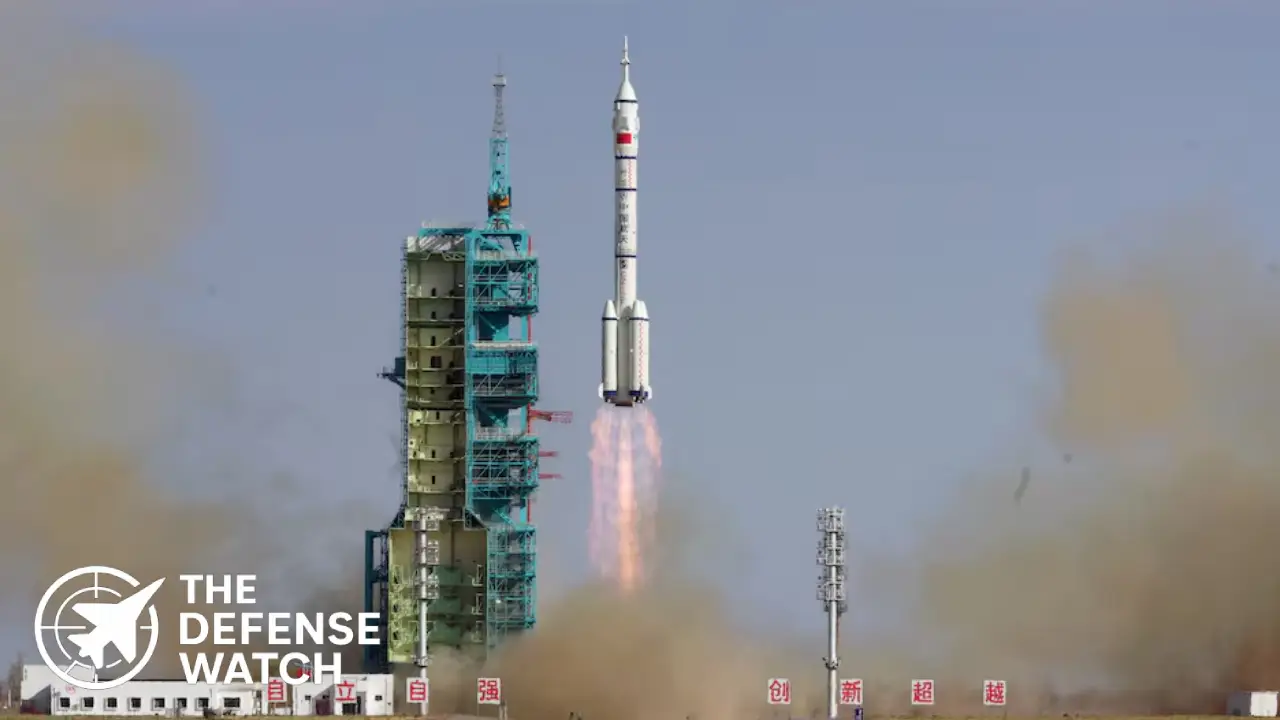
Three Chinese astronauts aboard the Shenzhou-20 mission experienced a delayed return to Earth after a suspected collision with space debris struck their spacecraft. The mission, which was slated for a November 5 landing following a six-month stay aboard China’s Tiangong space station, was postponed while the China Manned Space Agency (CMSA) conducted an impact assessment.
Background
Launched on April 24 2025 by a Long March 2F rocket from Jiuquan, the Shenzhou-20 crew — composed of veterans Chen Dong (commander), Chen Zhongrui and Wang Jie — entered the Tiangong station to begin a six-month mission. The return was originally scheduled for early November, coinciding with the arrival of the Shenzhou-21 crew, to enable a seamless handover period. The incident marks a rare disruption to China’s otherwise robust human spaceflight schedule.
Collision Details and Mission Impact
On November 5, CMSA publicly confirmed that “a suspected impact from tiny space debris” had struck the Shenzhou-20 spacecraft, prompting a postponement of its return to Earth. According to reports, minor cracks were observed in the return-capsule window of Shenzhou-20, most likely attributable to a high-velocity orbital fragment.
As a result of the damage, the decision was taken to return the three-person crew aboard the docked Shenzhou-21 spacecraft instead. This rearrangement leaves the Shenzhou-21 crew temporarily aboard Tiangong without their originally planned return vehicle. CMSA stated that the next vessel, Shenzhou-22, will be launched at “an appropriate time in the future.”
In a related communiqué the agency affirmed that the astronauts remain in “good condition, working and living normally.”
Risk Environment and Orbital Debris Context
The incident spotlights broader concerns about the growing density of orbital debris in low Earth orbit (LEO). According to observers, tinier fragments — often the product of launch-vehicle break-ups, anti-satellite tests or defunct satellite collisions — pose disproportionate risks due to their high velocities and relative invisibility.
This dynamic is underlined by the theoretical “Kessler syndrome” scenario, in which cascading collisions produce ever-more debris, threatening the usability of key orbits. China itself has in prior years voiced concerns at the United Nations about orbital fragment loads resulting from other nations’ anti-satellite tests.
Expert and Policy Perspectives
Space-policy specialists note that the Shenzhou-20 event underscores the need for enhanced orbital traffic management and debris-mitigation regimes. One analyst commented:
“What we’re witnessing with the Shenzhou-20 return-delay is a sign that even state-of-the-art spacecraft are vulnerable to millimetre-size fragments in orbit.”
While also emphasizing that CMSA’s decision to employ the Shenzhou-21 vehicle highlights built-in redundancy in China’s human-space system, the expert stressed that redundancy does not replace robust debris-tracking and avoidance infrastructures.
From a strategic angle, China’s willingness to publicly acknowledge the risk reflects both its confidence in its manned-space program and a growing interest in promoting international cooperation on space-traffic management — an area Beijing has raised in previous UN forums.
Closing / What’s Next
The landing of the Shenzhou-20 crew aboard Shenzhou-21 is now scheduled imminently, though CMSA has not specified an exact date. In the meantime, the incident will likely prompt closer scrutiny of orbital-debris hazards, especially for crewed missions operating around the Tiangong station and other low-Earth orbits.
Looking ahead, the event may accelerate efforts within China and internationally to establish shared debris-tracking data, coordinate avoidance protocols and expand ‘clean-orbit’ design measures for new assets. The Shenzhou-20 delay thus serves as a tangible reminder of how the orbital environment — once considered a benign frontier — is increasingly contested and constrained.

2 comments
[…] Shenzhou-20 incident parallels challenges faced by other space programs. The International Space Station experienced delayed astronaut returns in 2024 when NASA astronauts […]
[…] optimal global coverage with a constellation of approximately 31 operational satellites. The satellites are distributed across six orbital planes, ensuring that multiple satellites are visible from any point on Earth at any given […]