Boeing Secures $11.1M Kuwait F/A-18 Training Contract
Boeing has received an $11.14 million contract modification from the U.S. Navy to provide instructor-pilot services, ground-training specialists and program support for the Kuwait Air Force’s F/A-18 fighter fleet. The work will take place at Ahmad al-Jaber Air Base in Kuwait and is scheduled for completion in October 2027.
The award, administered by the Naval Air Warfare Center Training Systems Division (NAWCTSD) in Orlando, Florida, extends Boeing’s role in supporting Kuwait’s combat-aircraft training requirements. The Navy said the full $11,144,746 will be obligated from Foreign Military Sales (FMS) customer funds at the time of award.
The modification, identified as P00012 under contract N6134023C0004, was not competitively procured. The announcement does not disclose the number of instructors, training specialists or personnel covered by the agreement.
What the contract covers
The contract combines two pricing arrangements, firm-fixed-price and cost-plus-fixed-fee, for training and associated support services.
Its main elements include:
- Instructor-pilot services: Support for developing and maintaining pilot proficiency on Kuwait’s F/A-18 aircraft.
- Ground-training specialists: Instruction and related training activities supporting aircrew preparation.
- In-country support: Services performed at Ahmad al-Jaber Air Base.
- Program support: Additional activities associated with delivering and managing the training requirement.
The Navy’s announcement does not provide a breakdown of the $11.14 million between these activities. It also does not specify the number of training hours, aircraft involved or individual qualifications covered by the modification.
The October 2027 completion date establishes the expected end of the work covered by this contract action. It does not, by itself, establish the duration of Kuwait’s wider F/A-18 training program.
Kuwait’s transition to the F/A-18E/F Super Hornet
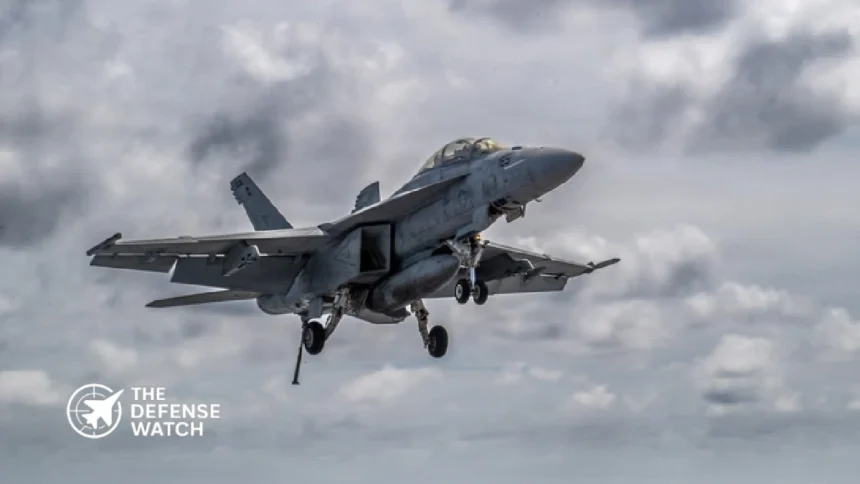
The award comes within Kuwait’s broader effort to introduce and support the Boeing F/A-18E/F Super Hornet, an updated member of the Hornet fighter family.
The U.S. Navy’s Naval Air Warfare Center Training Systems Division previously described a program to provide Kuwait with F/A-18E/F Block III training systems and contractor instructional services. Its published planning documentation identified pilot transition training, computer-based instruction and tactical operational flight trainers among the program requirements.
The Super Hornet is a multirole fighter designed for air-to-air combat and strike missions. Its two-seat F/A-18F variant can accommodate a pilot and a second crew member, while the single-seat F/A-18E is designed for pilot-only operations.
Training support is an important part of introducing a new aircraft type or configuration. Pilots must learn the aircraft’s systems, procedures and mission capabilities, while ground personnel need the knowledge required to support safe and effective operations.
Kuwait’s transition also involves differences between the newer Super Hornet and its earlier F/A-18 aircraft. In 2022, the U.S. Navy reported that Kuwaiti maintenance personnel were receiving training on the F/A-18E/F to help prepare experienced technicians to support the newer aircraft and assist less experienced personnel.
The current modification, however, does not specify whether its instructor and ground-training services are exclusively for the newer Block III aircraft or cover a broader set of Kuwait’s F/A-18 training needs.
Why continued training support matters
For Kuwait, maintaining a trained cadre of pilots and ground specialists is a practical requirement for sustaining fighter operations. Aircraft procurement alone does not provide a complete operational capability. Training, maintenance expertise, technical support and established procedures all contribute to the ability to use a fleet effectively.
Boeing’s continued involvement gives Kuwait access to contractor-provided expertise tied to the aircraft manufacturer and its associated training requirements. The arrangement also illustrates how U.S. defense sales can involve recurring services after the initial aircraft acquisition, rather than ending with delivery.
The FMS funding mechanism means Kuwait is financing the work through the U.S. government’s foreign military sales framework. The Navy’s announcement identifies the customer funds but does not provide a wider program cost or explain how this modification compares financially with earlier training awards.
The award is therefore best understood as a specific support contract, rather than evidence of a new aircraft purchase or an expansion of Kuwait’s fighter fleet.
What remains undisclosed
Several details needed to assess the full scope of the award are not available in the announcement.
The Navy has not published a task-by-task funding breakdown, the number of personnel Boeing will provide, or the precise training syllabus covered by the modification. The announcement also does not establish whether additional options or follow-on contract actions are planned.
Those details matter when assessing how much training capacity the contract will provide and how it fits into Kuwait’s longer-term transition to the F/A-18E/F Super Hornet.
For now, the confirmed outcome is a further $11.14 million commitment to Boeing-led F/A-18 training and program support in Kuwait, with the contracted work expected to conclude in October 2027.