Lockheed Martin will produce additional AN/SLQ-32(V)6 shipboard electronic warfare systems under a $74.29 million U.S. Navy contract modification supporting Canada, Japan and the U.S. Coast Guard. The award, issued Oct. 9, 2026, extends production work under contract N00024-20-C-5503 through September 2029.
The U.S. Navy’s Naval Sea Systems Command awarded the firm-fixed-price modification to Lockheed Martin’s Rotary and Missions Systems business in Liverpool, New York. Canada accounts for 52% of the purchases, Japan for 47%, and the U.S. Coast Guard for the remaining 1%, according to the award details.
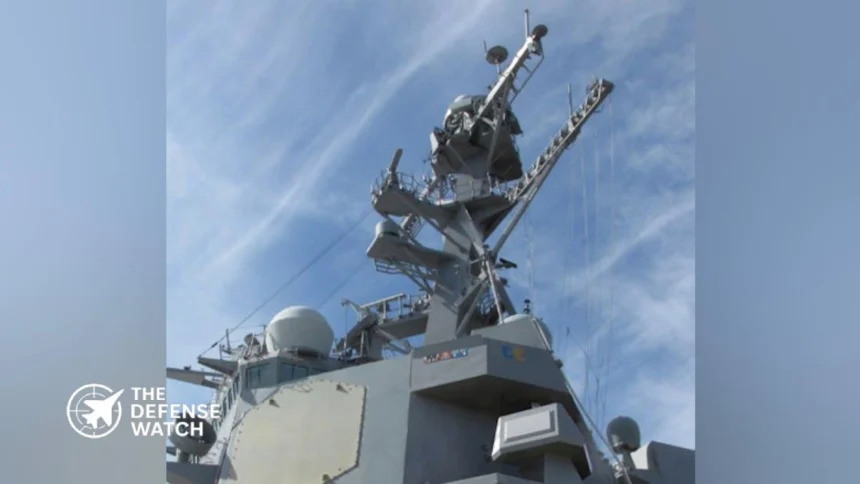
The contract continues procurement of a system designed to help surface ships detect and assess electromagnetic threats, including radar emissions associated with potential anti-ship missile attacks.
Canada and Japan Fund Nearly the Entire Order
The $74,294,440 modification is financed primarily through Foreign Military Sales (FMS) funding for the two partner nations, with a small contribution from the U.S. Coast Guard.
The announced funding allocations are:
| Customer | Funding | Share |
|---|---|---|
| Canada | $38,388,165 | 52% |
| Japan | $35,448,507 | 47% |
| U.S. Coast Guard | $457,768 | 1% |
The listed funding amounts total $74,294,440. Canada and Japan together account for $73.84 million, reflecting the central role of allied procurement in this production order.
Work is scheduled to take place at two U.S. manufacturing locations. Lockheed Martin’s Liverpool facility will perform 78% of the work, while Lansdale, Pennsylvania, will account for the remaining 22%.
The Navy said the obligated funds will not expire at the end of the current fiscal year. The award notice does not specify the number of systems to be delivered to each customer, the receiving ships or the individual delivery schedule.
What the AN/SLQ-32(V)6 Does
The AN/SLQ-32(V)6 is part of the U.S. Navy’s Surface Electronic Warfare Improvement Program (SEWIP), an incremental modernization effort for the Navy’s long-serving AN/SLQ-32 electronic warfare family.
According to the Naval Sea Systems Command, SEWIP Block 2 improves electronic support through upgraded antennas, receivers and interfaces with the ship’s combat system. These improvements help ships detect and characterize electromagnetic signals, supporting threat awareness and defensive decision-making.
Electronic warfare systems serve a different function from a ship’s missile interceptors or close-in guns. They help crews understand the electromagnetic environment, identify potential threats and support appropriate defensive responses. Their effectiveness depends on the signals encountered, the system configuration and how the information is integrated into the ship’s wider combat system.
The AN/SLQ-32(V)6 also incorporates technology associated with the SEWIP Block 1B3 High Gain High Sensitivity adjunct sensor, according to a 2020 U.S. Defense Department contract announcement. That combination distinguishes the system from earlier configurations of the AN/SLQ-32 family.
The latest modification is for production, not a newly announced development program. The contract notice does not identify a new technical configuration or disclose performance changes associated with this order.
Why the Order Matters for Allied Fleets
For Canada and Japan, the award provides another procurement step toward equipping naval forces with shipboard electronic warfare equipment supported by a U.S. defense contractor.
Both countries operate maritime forces with responsibilities that include protecting surface vessels and maintaining awareness of potential threats in contested waters. Electronic warfare is one component of that effort, alongside radar, combat management systems, missile defenses and other shipboard sensors.
Japan’s maritime security responsibilities include operations in the western Pacific, while Canada’s navy operates in the Atlantic, Pacific and Arctic regions. The contract announcement, however, does not identify the intended ships or establish where the systems will be deployed.
The purchase also illustrates how Foreign Military Sales can support allied acquisition through U.S. production contracts. Rather than announcing separate awards for each customer, the Navy has combined the purchases under an existing production contract, with funding assigned to the respective governments.
For Lockheed Martin, the modification sustains production activity across its New York and Pennsylvania facilities. The award notice does not disclose the number of units, the value of earlier production lots under the same contract or the cumulative value of the underlying contract after this modification.
Production Continues Through September 2029
The September 2029 completion date gives the contractor several years to carry out the work. It should not be interpreted as a confirmed delivery date for every system or as evidence that all equipment will enter operational service at that time.
The Navy’s established SEWIP program has progressed through successive upgrades to the AN/SLQ-32 family. Earlier production awards under contract N00024-20-C-5503 covered AN/SLQ-32(V)6 and AN/SLQ-32C(V)6 systems, demonstrating the contract’s role in continued procurement.
The distinction between these variants matters because shipboard electronic warfare equipment is not necessarily interchangeable across every vessel configuration. The latest award specifically identifies AN/SLQ-32(V)6 systems and does not state that AN/SLQ-32C(V)6 systems are included in this modification.
The immediate significance of the $74.3 million order is therefore clear but limited: it funds additional production for three government customers, with most of the money coming from Canada and Japan. The public announcement leaves the system quantities, individual ship assignments and delivery sequence undisclosed.