BAE Systems Wins $70.5M Trident II D5 Support Deal
BAE Systems Technology Solutions & Services Inc. has received a potential $70.52 million U.S. Navy contract to provide technical support and facilities engineering services for the Trident II D5 Strategic Weapon System, extending the company’s support role through September 2031.
The cost-plus-fixed-fee award, issued by the Navy’s Portfolio Acquisition Executive Strategic Systems Programs (PAE SSP) in Washington, D.C., has a potential value of $70,524,268 when all optional line items are exercised. The Navy is obligating $18,408,391 at award using fiscal 2025 One Big Beautiful Bill Act funds. The department said none of those funds will expire at the end of the current fiscal year.
The contract is also identified as benefiting a Foreign Military Sale, although the award announcement does not identify the foreign customer.
Where the work will take place
The largest share of the work will be performed in Washington, D.C., which accounts for 68% of the effort. Another 16% will take place at Kings Bay, Georgia, while Bangor, Washington, accounts for the remaining 16%.
The geographic distribution is significant because Kings Bay and Bangor are the two U.S. Navy locations associated with the Atlantic and Pacific fleets of Ohio class ballistic missile submarines. The Navy’s Trident II D5 Strategic Weapon System is deployed aboard Ohio class SSBNs, while the system is also part of the United Kingdom’s sea based strategic deterrent under the Polaris Sales Agreement.
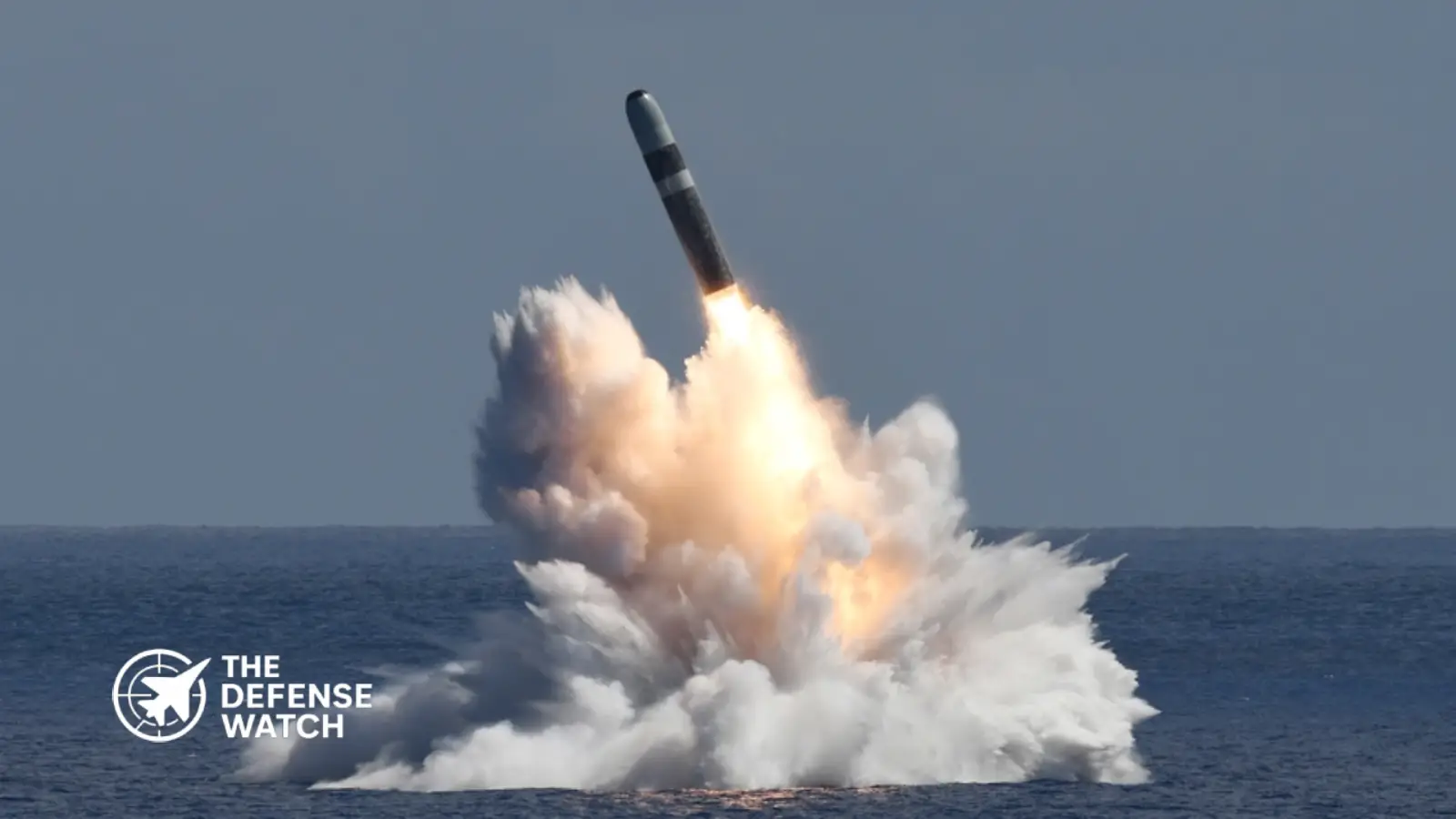
The Navy describes the Trident II system as consisting of the Trident II D5 submarine launched ballistic missile, reentry system, and supporting shipboard systems. The D5 is a three stage, solid fuel, inertially guided missile that entered operational service in 1990.
The new BAE Systems award is focused on the broader technical and facilities support needed to sustain that strategic weapons enterprise rather than on the production of a new missile.
To model ballistic trajectories and speed metrics across extended standoffs, explore our Missile Range & Time-of-Flight Calculator.
A support contract tied to a longer modernization cycle
The timing of the award is important because the Navy is managing both continued operation of the existing D5 system and the transition toward a second life extension.
The Navy’s Strategic Systems Programs organization has responsibility for the life cycle support of the sea based leg of the U.S. nuclear triad. That includes systems, equipment, facilities, personnel, training, logistics and other activities supporting the Trident II D5 Life Extension, or D5LE, system.
The current D5LE system is expected to remain in service into the 2040s. It is also being integrated with the first Columbia class ballistic missile submarines as those boats replace the aging Ohio class fleet.
That creates a long transition period in which the Navy must maintain the existing weapon system while preparing infrastructure and technical processes for newer configurations.
A 2024 congressional hearing document described the Navy’s plan to sustain the D5 and D5LE Strategic Weapon System through 2042 and install the D5LE system on the initial Columbia class submarines.
Why facilities engineering matters
The contract’s facilities engineering component is notable because the Trident system depends on more than the missile itself.
Strategic weapon facilities support activities such as maintenance, testing, storage, handling and integration of weapon system components. The Navy has continued investing in infrastructure associated with the D5 program as modernization proceeds.
In February 2026, Naval Facilities Engineering Systems Command reported construction of new facilities at the Naval Ordnance Test Unit to support maintenance and storage of key Trident II D5 components. The Navy said those facilities would support the launcher systems associated with the program.
Strategic Systems Programs also brought the Strategic Weapons Systems Ashore facility into operation in 2025. The facility provides a land based environment for testing modernizations and alterations to the Trident II D5 Strategic Weapon System and related support equipment before fleet deployment.
The BAE Systems award therefore fits into a wider effort to maintain the engineering and infrastructure base surrounding the D5 system while the Navy moves toward its next configuration.
D5LE2 is already shaping the future program
The Navy is developing the Trident II D5 Life Extension 2 (D5LE2) as the longer term successor to the current D5LE configuration.
PAE SSP states that D5LE2 will combine proven components with redesigned and updated elements, including changes to avionics, guidance and system architecture. The program reached Milestone B in 2025 and is in the engineering and manufacturing development phase, with initial fleet introduction planned for fiscal 2039.
Congressional testimony has also highlighted an industrial base challenge behind the effort. Some components used by the existing system have become obsolete, with suppliers either leaving the market or ending production. That has made long term sustainment increasingly dependent on modernization and replacement of aging components.
This means technical support contracts are relevant to the transition even when they do not directly procure missiles or submarines. Engineering expertise, testing, facilities and system integration are required to keep the existing weapon system operational while newer elements are developed.
Sole source award and funding profile
The BAE Systems contract was awarded as a sole source acquisition under 10 U.S. Code 2304(c)(1) and had previously been synopsized through SAM.gov.
The $70.52 million figure represents the potential contract value including optional line items. The $18.41 million obligation at award is therefore not equivalent to the full contract value.
The cost-plus-fixed-fee structure also differs from a firm-fixed-price procurement. Under this type of arrangement, the government pays allowable contract costs plus a negotiated fixed fee, subject to the terms of the contract. The award therefore provides support capacity over the performance period rather than representing a single procurement of $70.5 million worth of hardware.
The Navy expects the work to continue until September 30, 2031.
Sustaining the system while the fleet changes
The award comes during a period when the Navy is simultaneously sustaining the Ohio class fleet, introducing Columbia class submarines and developing the D5LE2 weapon system.
The current Trident II D5 remains a central component of the U.S. sea based strategic deterrent. The Navy’s own planning documents show that sustaining this capability requires an extensive technical and infrastructure enterprise alongside the missiles and submarines themselves.
For BAE Systems, the new contract places technical and facilities engineering work across the Navy’s strategic weapons infrastructure in Washington, Georgia and Washington state. For the Navy, the award supports continuity of the existing system while the larger D5LE2 modernization effort moves through development.
The contract does not itself announce a new missile capability or a change to the Trident II D5’s operational specifications. Its importance is instead in maintaining the engineering and facilities support needed to keep the existing Strategic Weapon System available during a lengthy transition between submarine classes and weapon system generations.