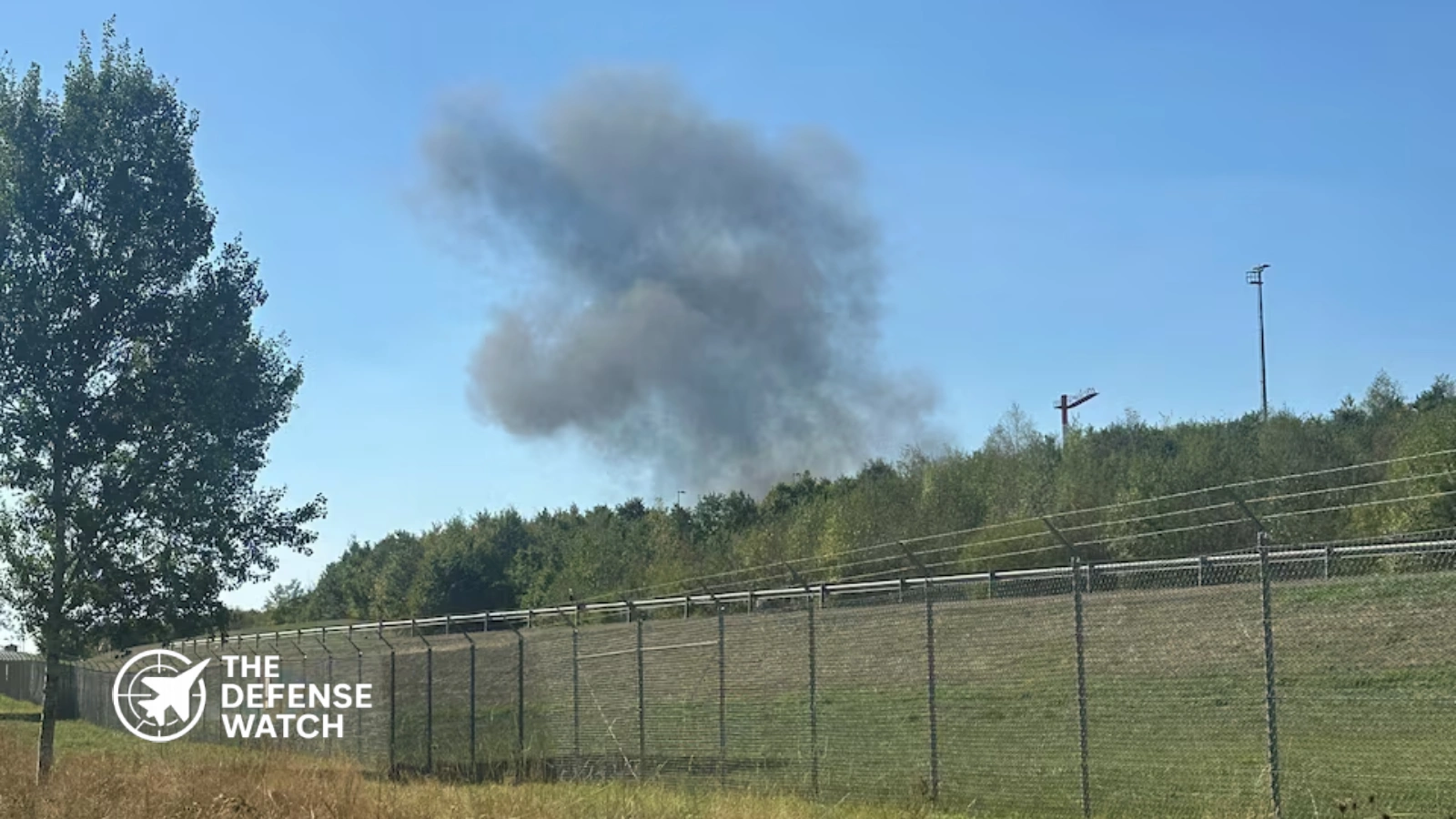
F-16 Crashes at Spangdahlem Air Base in Germany
A U.S. Air Force F-16 Fighting Falcon assigned to the 52nd Fighter Wing crashed at Spangdahlem Air Base in western Germany on September 22, 2026, while returning from a routine training flight. The pilot ejected safely and was receiving medical care, while emergency personnel responded to the crash site, according to the U.S. military.
Executive Summary
- A U.S. Air Force F-16 assigned to the 52nd Fighter Wing crashed at Spangdahlem Air Base in western Germany on September 22, 2026, during approach following a routine training flight. The pilot ejected safely and was receiving medical treatment.
- The training flight involved four F-16s. Two aircraft were returning to Spangdahlem when the crash occurred, while the remaining aircraft diverted to Ramstein Air Base and landed safely.
- The cause remains under investigation. At this stage, there is no verified evidence in the available official reporting identifying a mechanical failure, weather problem, pilot error, or hostile action as the cause.
The incident occurred at approximately 2:30 p.m. local time during the aircraft’s approach to Spangdahlem. Germany’s air traffic control authority said four F-16s had participated in the training activity. Two were still in the training area, while two were returning to Spangdahlem. The other three aircraft ultimately landed safely at Ramstein Air Base.
The immediate operational impact remains unclear because the 52nd Fighter Wing has not publicly disclosed how long its F-16 operations will be affected. The more important question for U.S. Air Forces in Europe will be whether the investigation identifies an aircraft-specific problem or a broader issue that could require inspections or changes to training procedures.
What Happened at Spangdahlem
The aircraft was assigned to the 52nd Fighter Wing, which operates F-16s from Spangdahlem. The wing’s F-16 force supports U.S. Air Force and NATO operations from Germany and regularly conducts training with allied forces.
According to the U.S. military statement cited by Reuters, the aircraft was returning to Spangdahlem following a routine training flight involving four F-16s. The remaining three aircraft diverted to Ramstein after the crash and landed safely.
The pilot’s successful ejection prevented a potentially fatal outcome. Spangdahlem’s current F-16 fleet is equipped with an ejection system designed to provide emergency escape capability when an aircraft becomes uncontrollable or otherwise cannot safely continue flight.
The base has previously documented the importance of aircrew egress systems. In August 2026, Spangdahlem published material describing maintenance and safety inspections of the ACES II ejection seat used by F-16 crews.
Crash Cause Remains Unresolved
The U.S. military has not yet released a cause for the September 22 crash. Emergency response personnel were sent to the scene, and an investigation is underway.
That distinction is important because an F-16 accident during approach can result from multiple categories of failure. Investigators normally examine aircraft systems, engine and flight-control performance, maintenance records, pilot actions, weather, airfield conditions, communications and other available evidence before assigning a cause.
No specific technical failure has been publicly identified in the available reporting.
Likewise, there is no verified information indicating that the aircraft was damaged by another aircraft, a surface-to-air system, a drone or another external threat. Such claims would be premature until investigators release evidence supporting them.
The investigation should therefore be treated as the primary source for determining what happened rather than early eyewitness reports or social media speculation.
Why the Incident Matters for the 52nd Fighter Wing
The crash is significant beyond the loss of an individual aircraft because Spangdahlem is an important U.S. Air Force operating location in Europe.
The 52nd Fighter Wing’s F-16s provide a combat aviation capability that can be used for air-to-air and air-to-ground missions. The aircraft also participate in exercises designed to maintain interoperability with NATO partners.
U.S. Air Force material from earlier training deployments shows that Spangdahlem F-16 units have conducted multinational training across Europe and worked alongside allied aircraft. The 480th Fighter Squadron has also participated in exercises with German and other NATO aircraft.
This makes aircraft availability an important readiness issue. A single fighter loss does not by itself establish a major reduction in U.S. combat power, but repeated aircraft losses or a prolonged grounding of a fleet can create additional pressure on available aircraft, maintenance capacity and pilot training.
A Second F-16 Mishap in Days
The Spangdahlem accident occurred only days after another U.S. F-16 crash in the United States.
Air & Space Forces Magazine reported that a Texas Air National Guard F-16 assigned to the 149th Fighter Wing crashed during a training mission in Michigan on September 17, with the pilot ejecting safely. The two incidents occurred in different locations and under different circumstances. There is currently no public evidence establishing a connection between them.
The timing is nevertheless relevant for fleet safety monitoring. Air Force investigators will examine each mishap independently, while service-level safety organizations can assess whether investigations reveal any common technical, maintenance or operational factors.
It would be premature to characterize the two incidents as a systemic F-16 problem without evidence from the respective investigations.
F-16 Operations at Spangdahlem
The F-16 remains a major component of U.S. tactical airpower in Europe despite the arrival of newer aircraft such as the F-35A at other European bases.
Spangdahlem’s F-16 force has historically supported both conventional fighter missions and specialized training. The 480th Fighter Squadron has been associated with the suppression of enemy air defenses mission, giving the aircraft a role that extends beyond basic air-policing duties. Air & Space Forces Magazine identifies the squadron as specializing in the Wild Weasel mission set.
That role makes readiness particularly relevant. Modern air operations depend on fighters being available not only for combat sorties but also for training, electronic warfare integration, weapons employment and multinational exercises.
The September 22 crash therefore creates an immediate aircraft availability question, but the scale of that impact cannot be determined from the information currently released.
What Investigators Will Look For
The investigation will likely focus on several broad areas:
| Investigation area | Key questions |
|---|---|
| Aircraft systems | Did any flight-control, electrical, hydraulic or avionics malfunction occur? |
| Propulsion | Was there evidence of an engine or fuel-system problem? |
| Maintenance | Did maintenance records identify unresolved discrepancies or recent work? |
| Pilot actions | What happened during the approach and what emergency actions were taken? |
| Weather | Did visibility, wind, precipitation or other conditions contribute? |
| Airfield factors | Were runway, approach or airfield conditions relevant? |
| External factors | Was there any evidence of another aircraft, object or other external event? |
These categories describe the normal lines of inquiry rather than conclusions about this particular crash.
Previous F-16 investigations at Spangdahlem demonstrate why waiting for evidence matters. In a 2015 crash near Grafenwoehr, investigators ultimately identified a structural failure inside the engine control system as the cause. In a separate 2019 Spangdahlem F-16 crash, an investigation concluded that a combination of partial electrical power loss and poor weather contributed to the accident.
Those earlier cases also show that an F-16 crash can have very different causes even when the aircraft type and operating location are similar.
Operational Implications for U.S. Air Forces in Europe
The immediate priority will be determining whether the crashed aircraft represents an isolated mishap or whether investigators identify a condition affecting other F-16s.
If the investigation finds an aircraft-specific failure, the operational response could remain relatively contained. If investigators identify a broader technical or maintenance issue, additional inspections could affect aircraft availability.
The diversion of the three other F-16s to Ramstein also illustrates an important feature of operating U.S. fighters from Europe. Aircraft can use alternative bases when circumstances prevent operations from continuing normally at their primary location. That flexibility is particularly relevant to NATO air operations, where aircraft may operate from dispersed locations during exercises or contingency operations.
U.S. Air Force training at Spangdahlem has also incorporated Agile Combat Employment concepts and multinational activity. Official Air Force material has documented F-16 operations involving allied bases and aircraft, including training with German Tornado crews.
What Is Known and What Is Not
| Item | Current status |
|---|---|
| Aircraft type | F-16 Fighting Falcon |
| Assigned unit | 52nd Fighter Wing |
| Location | Spangdahlem Air Base, Germany |
| Date | September 22, 2026 |
| Circumstances | Crash during approach after routine training |
| Training formation | Four F-16s |
| Pilot | Ejected safely and received medical treatment |
| Other aircraft | Three aircraft diverted to Ramstein and landed safely |
| Cause | Under investigation |
| Aircraft technical failure | Not publicly established |
| Hostile involvement | No verified evidence publicly reported |
| Operational impact | Not yet publicly established |
The Next Key Data Point Is the Investigation
The most important information still to come is the preliminary and final investigation findings.
Investigators will need to establish the aircraft’s condition before the accident, reconstruct the flight, examine recovered components and review maintenance and operational records. Until that work is completed, assigning a specific cause would go beyond the available evidence.
For the 52nd Fighter Wing, the practical issue is whether the accident remains an isolated aircraft loss or produces findings that affect the wider F-16 fleet at Spangdahlem.
The successful ejection is the clearest positive outcome from the incident. The broader readiness implications will depend on the condition of the remaining aircraft, any temporary flight restrictions and the findings of the investigation.