The Invisible War Has a New Architecture
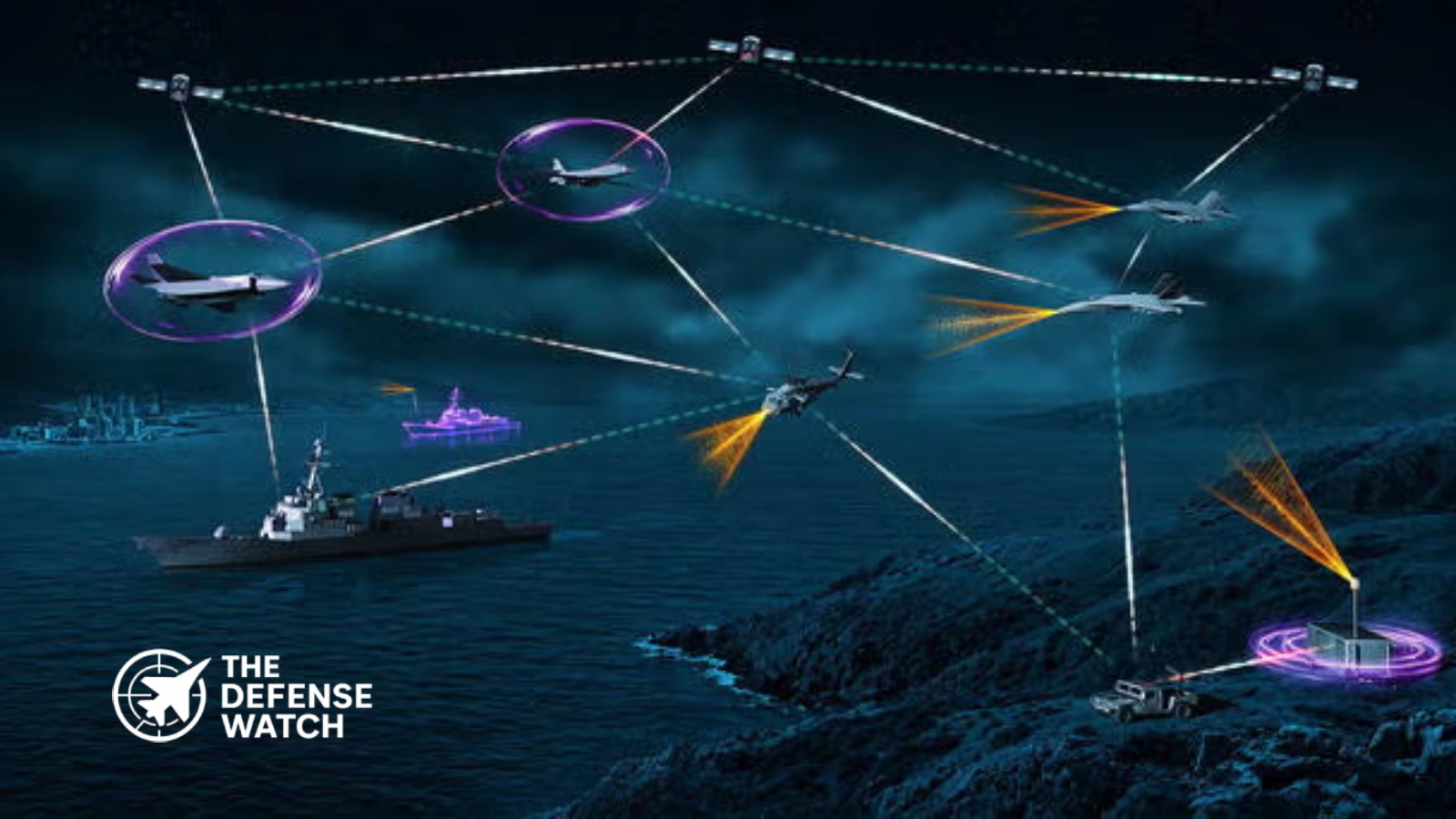
L3Harris is moving its electronic warfare portfolio toward a distributed architecture in which software, sensors and electronic effects can be reused across multiple platforms instead of being permanently tied to individual weapon systems. The company described the approach in a Sept. 16, 2026 editorial, highlighting the relationship between its modular EW portfolio, the Deceptor payload and its Distributed Spectrum Collaboration and Operations, or DiSCO, architecture.
Executive Summary
- L3Harris is expanding a modular electronic warfare approach built around software-defined payloads, commercial hardware and an open architecture that can support different platforms and mission functions.
- Its DiSCO architecture is designed to connect distributed EW sensors, data links, processing and command functions, while Deceptor provides a compact EW payload intended for expendable and unmanned platforms.
- The approach aligns with a broader U.S. military shift toward modular, interoperable EW systems. Army programs including CMOSS, TLS and Integrated Electronic Warfare Systems are also moving toward open architectures, rapid reprogramming and distributed capabilities.
The significance is less about a single new EW device than about how the systems are intended to operate together. L3Harris is pursuing software-defined capabilities that can be installed on different form factors, combined with an enterprise-level architecture that can share electromagnetic data between sensors, effectors and command elements.
That direction mirrors a broader U.S. military requirement. The Army is pursuing modular and open architectures for EW, including CMOSS-based equipment, distributed EW systems and rapid reprogramming mechanisms intended to keep pace with changing electromagnetic threats.
From Platform-Specific EW to Software-Defined Systems
Traditional electronic warfare architectures have often been closely integrated with the aircraft, ship or ground vehicle carrying them. That approach can deliver highly specialized capabilities, but hardware and software changes can become difficult when the threat environment changes faster than an acquisition program.
L3Harris is attempting to separate more of the mission functionality from the physical platform.
The company says its modular EW approach allows customers to select a form factor, software-defined radio and commercial hardware appropriate to the required frequency coverage. An open middleware layer then provides a common software environment through which different EW capabilities can be integrated.
This matters because the same underlying architecture can potentially support electronic support, electronic attack and intelligence collection functions without requiring an entirely new EW system for every mission.
L3Harris describes these capabilities as software-based skills that can be loaded, updated or reconfigured. The company also says third-party capabilities can be incorporated, an approach intended to reduce dependence on a single supplier.
The distinction is important. Open architecture does not automatically mean every EW application can run on every platform. Integration still depends on factors including processing capacity, radio-frequency hardware, antennas, power availability, software interfaces, security requirements and testing.
The architectural goal is therefore better described as portability and adaptability rather than unlimited interchangeability.
Deceptor Extends EW Toward Distributed Platforms
Deceptor is one of the clearest examples of this approach.
L3Harris describes Deceptor as a compact RF EW system based on commercial off-the-shelf hardware and software. The company says its design supports electronic support and electronic attack functions, rapid payload configuration and third-party reprogramming. It is intended for expendable unmanned platforms operating in air, ground and maritime environments.
That creates a different force-generation model from traditional high-value EW platforms.
Instead of concentrating the entire EW mission on a small number of specialized aircraft or vehicles, smaller payloads can distribute sensing and electronic effects across a larger number of platforms.
The operational benefit is not simply that there are more EW nodes. Distribution can also make it harder for an adversary to remove the entire capability by targeting one platform or communications node.
L3Harris demonstrated Deceptor during a U.S. Army experiment in 2026. According to the company, multiple unmanned aircraft equipped with the payload detected and geolocated RF threats, fused information from multiple sensors and conducted RF jamming through the DiSCO environment.
The demonstration should not be treated as evidence that the system can defeat every class of modern RF threat. Public information does not establish the full threat set, operating conditions, jamming power, frequency coverage or effectiveness achieved during the experiment.
Those details remain important when assessing operational capability.
DiSCO Addresses the Network Problem
A distributed EW force introduces another challenge.
If sensors and effectors are spread across aircraft, ground vehicles, maritime systems and expendable platforms, commanders need a mechanism to combine the information and coordinate responses.
DiSCO is designed around that problem.
L3Harris describes it as an enterprise-level electromagnetic spectrum operations architecture that connects sensors, data links, processing, cloud resources, applications and command functions. The company says the architecture is designed around open standards and can incorporate third-party sensors, software applications, hardware components and user-interface tools.
Its architecture includes sensor interfaces, communications hardware, cross-domain solutions, processing, AI and machine-learning algorithms, cloud access, a user interface and an application marketplace.
That creates a layered model:
| Layer | Function |
|---|---|
| Sensors | Detect and collect electromagnetic activity |
| Edge processing | Process and prioritize information closer to the tactical unit |
| Communications | Move spectrum data between distributed nodes |
| AI and software | Assist with signal analysis and threat characterization |
| DiSCO | Fuse information and support electromagnetic battle management |
| Applications | Provide mission-specific analysis and effects |
| EW payloads | Deliver sensing or electronic effects |
The architecture is significant because it separates the collection of electromagnetic information from the platform that ultimately acts on it.
A sensor on one platform can contribute to a broader spectrum picture, while another node can potentially use that information to support an electronic effect.
From Months to Minutes, With an Important Qualification
L3Harris states that DiSCO can reduce the time required to identify unknown signals from months to minutes. Its company literature also cites an approximately 720-fold improvement in response time.
Those are manufacturer-reported claims rather than independently validated operational measurements. The public material does not provide enough information about the baseline process, threat population, test methodology or conditions to independently verify the figure.
The underlying problem, however, is well established.
Electronic warfare systems must continuously adapt to changes in enemy emitters, waveforms, tactics and operating patterns. The Army’s EW architecture includes dedicated rapid-reprogramming functions intended to analyze changing threat signatures, develop new mission software and distribute updates to deployed systems.
This makes software reprogramming a core part of modern EW rather than a secondary maintenance activity.
U.S. Army Architecture Is Moving in the Same Direction
L3Harris is not pursuing modularity in isolation.
The Army’s Integrated Electronic Warfare System is described in its FY2026 budget documentation as a modular, scalable and open architecture designed to integrate electronic attack, protection and support functions. The architecture is intended to allow commanders to tailor capabilities against different EW threats and scenarios.
The Army is also establishing CMOSS Mounted Form Factor as a program of record. CMFF uses a common chassis and replaceable capability cards to integrate functions such as assured positioning, navigation and timing, communications waveforms, command and control and electronic protection.
In September 2025, the Army announced prototype agreements with General Dynamics Mission Systems and Pacific Defense for CMFF development. The system is intended to replace multiple legacy stovepipe systems with a common hardware and software framework.
The Army’s broader EW modernization effort also includes distributed terrestrial and airborne capabilities. The service has said its TLS Manpack program is intended to provide brigade-level EW capability while supporting distributed EW at division and higher echelons.
This creates an important distinction between L3Harris’s commercial architecture and the government’s overall modernization effort.
DiSCO is a company-developed architecture. CMOSS, TLS and related Army programs are government acquisition efforts with their own requirements, standards and implementation paths. They address overlapping architectural problems, but they are not interchangeable programs.
Competitive Landscape: Open Architecture Is Becoming the Baseline
L3Harris is also operating in a defense market where open architecture and software-defined EW are increasingly common design objectives.
Northrop Grumman says its EW portfolio includes open architecture systems designed to support rapid upgrades and operation across multiple platform categories. The company identifies DRAKE as an open architecture EW system using common standards.
BAE Systems is pursuing a similar direction. Its 2026 Nightshade system is described as a modular electromagnetic attack capability with an open architecture intended to support adaptation to changing threats.
BAE has also demonstrated modular airborne electromagnetic attack capabilities designed for installation across aircraft, UAVs, rotary-wing platforms, ground vehicles, surface vessels and weapon stations. The company says those systems use open architecture hardware, software-defined radios and third-party applications.
The competitive dividing line is therefore moving away from whether a company supports open architecture at all.
The more consequential questions are how widely an architecture can be deployed, how quickly software and mission data can move between systems, how many third-party applications can be integrated, how well the network operates when communications are degraded and how much of the processing can occur at the tactical edge.
The Hardest Problem May Be the Network
Distributed EW only works if the network connecting the nodes remains useful under contested conditions.
An adversary can attempt to jam communications, deceive sensors, attack network infrastructure or manipulate the electromagnetic environment itself. A system that depends heavily on continuous connectivity can therefore introduce a different vulnerability if it cannot continue operating when communications are disrupted.
This is where edge processing becomes important.
L3Harris says DiSCO combines edge nodes with cloud-connected processing, while its Deceptor architecture is designed to conduct RF sensing and effects on small platforms.
The architecture demonstrated during Valiant Shield 2024 provides an example of this distributed model. L3Harris reported that DiSCO shared RF signal data between Hawaii and multiple EW payloads, including small-form-factor payloads on autonomous surface vehicles, while operators conducted remote reprogramming actions.
The company later reported using DiSCO during Talisman Sabre 2025 to connect an aircraft and two autonomous surface vessels, with data sent to a cloud-hosted DiSCO environment.
Those demonstrations indicate progress toward distributed spectrum awareness, but they do not establish how the architecture would perform against a sophisticated adversary deliberately attacking the communications architecture.
That remains a central operational test for networked EW.
AI Can Shorten the Decision Cycle, But It Does Not Replace EW Expertise
Artificial intelligence and machine learning are becoming increasingly important in spectrum operations because the volume of electromagnetic activity can exceed what human operators can manually classify and correlate.
L3Harris has integrated AI and machine learning into DiSCO and demonstrated the architecture with Shield AI’s Hivemind autonomy software. A March 2026 demonstration used multiple unmanned aircraft and a simulated electromagnetic environment to create a fused spectrum picture and enable autonomous maneuver decisions.
In July 2026, L3Harris and Shield AI reported a flight test involving Deceptor-equipped unmanned aircraft, DiSCO and Hivemind. The companies said the test involved detection and characterization of unknown threats, information sharing through DiSCO and autonomous routing of follow-on aircraft.
The significance is the potential compression of the sensor-to-decision cycle.
But AI does not remove the need for validated threat libraries, electronic intelligence, operator oversight, secure communications and reliable rules for employing electronic effects. An automated system that incorrectly classifies an emitter can create operational risks just as a delayed human decision can.
For that reason, the value of AI in EW is likely to depend as much on data quality and system integration as on the underlying algorithm.
Why Commercial Hardware Matters
The use of commercial hardware is another major part of L3Harris’s strategy.
The company says Deceptor uses commercial off-the-shelf hardware to reduce size, weight, power and cost constraints and enable integration across unmanned air, ground and maritime platforms.
Commercial electronics can provide faster access to processors, digital radio components and other technologies than traditional defense-specific development cycles.
But commercial availability does not eliminate military integration requirements.
EW equipment must survive vibration, temperature extremes, electromagnetic interference, cybersecurity threats and demanding power constraints. It must also comply with military interfaces and security requirements.
The advantage of commercial technology is therefore best understood as a way to accelerate hardware refresh and reduce dependence on bespoke components, rather than as a guarantee of lower procurement or lifecycle costs.
The Industrial Implication: EW Becomes a Software Refresh Problem
The architectural shift also changes how militaries may think about EW sustainment.
Under a traditional model, an improvement can require hardware modification, laboratory testing, platform integration and a lengthy fielding process.
Under a modular software-defined model, some improvements can potentially be introduced through software or mission-data updates while the underlying hardware remains in service.
The Army’s own rapid-reprogramming architecture reflects this requirement. Its EW development documentation describes a process for identifying threat-signature changes, developing updated mission software and distributing that software to deployed systems.
This creates a new acquisition priority: the ability to maintain and update the software ecosystem becomes as important as buying the initial hardware.
It also increases the importance of interface standards. Without common interfaces, data models and software frameworks, an open architecture can still become fragmented into separate vendor ecosystems.
The Army’s CMOSS and Integrated Sensor Architecture efforts are intended to address that broader interoperability problem. The Army says its Integrated Sensor Architecture uses a common architecture to connect legacy, current and future sensors and systems.
What Comes Next
The direction represented by L3Harris is a shift from individual EW platforms toward distributed electromagnetic warfare networks.
Deceptor provides a compact node that can bring EW functions to unmanned and potentially expendable platforms. DiSCO provides the network and battle-management layer intended to connect sensors, applications and electronic effects. AI and software-defined radios provide mechanisms for adapting the system as the electromagnetic environment changes.
The broader U.S. military architecture is moving along a similar path through modular open systems, CMOSS, rapid reprogramming and distributed EW programs.
The central challenge is no longer simply building a more capable jammer or electronic support receiver.
It is building an EW force that can continue sensing, sharing, deciding and adapting when the adversary is actively attacking the same spectrum and networks on which those functions depend.
That makes interoperability, edge processing, resilient communications, software updates and common standards increasingly important parts of electromagnetic combat power.
L3Harris’s latest architecture work is one implementation of that model. The company’s demonstrations show that pieces of the architecture can already operate across unmanned air, maritime and ground environments. The next measure of maturity will be how reliably such systems operate at scale, under contested conditions, and across multiple suppliers and military networks.
Key Technical Comparison
| Attribute | Traditional platform-centric EW | L3Harris modular approach | Broader U.S. Army direction |
|---|---|---|---|
| Hardware model | Purpose-built systems | COTS-based and software-defined elements | Modular open systems |
| Mission functions | Often platform-specific | Reconfigurable functions | Integrated EW, SIGINT and spectrum functions |
| Platform integration | Closely tied to platform | Air, ground and maritime unmanned platforms | Mounted, dismounted and airborne |
| Software updates | Often tied to program cycles | Designed for rapid reprogramming | Rapid reprogramming is an explicit Army requirement |
| Network model | Platform or unit focused | Distributed spectrum architecture | Distributed and cross-domain |
| Third-party integration | Varies by program | Explicitly supported by DiSCO and Deceptor architecture | Common standards and modular interfaces |
| AI/ML role | Increasing but system dependent | Integrated into DiSCO ecosystem | Increasingly incorporated into spectrum management |
| Main challenge | Obsolescence and upgrade timelines | Network resilience and integration at scale | Interoperability across programs and services |