Executive Summary
- Northrop Grumman has been selected to build a commercially derived GHOST-R prototype for the Department of War Innovation Unit and U.S. Space Force, using its ESPASat-L spacecraft platform and an optical payload supplied by TRL-11.
- The company says it will assemble, integrate, test and deliver the operational prototype on an accelerated 24-month timeline. No contract value, imaging resolution, spacecraft mass, revisit rate or other detailed performance metrics were disclosed in the announcement.
- GHOST-R is intended to add a commercially derived layer to existing U.S. space domain awareness capabilities, providing high-resolution space-to-space imagery for characterization, battle damage assessment and positive identification of resident space objects in geosynchronous orbit.
Northrop Grumman has been selected to develop a GHOST-R space domain awareness prototype for the U.S. Space Force, giving the service another commercially derived option for observing and characterizing spacecraft in geosynchronous orbit.
Announced September 18, 2026, the program will use Northrop Grumman’s ESPASat-L spacecraft platform and an optical payload from TRL-11 of Irvine, California. The company plans to complete assembly, integration, testing and delivery within 24 months.
The award is part of a broader U.S. effort to move some space surveillance capabilities toward smaller, commercially derived and potentially proliferated spacecraft. Space Systems Command has separately been pursuing proliferated Space Domain Awareness capabilities in GEO through its RG-XX effort, with the stated objective of improving continuity of space-based reconnaissance and surveillance at scale.
GHOST-R Targets a Persistent GEO Surveillance Gap
Geosynchronous orbit is strategically important because spacecraft operating there can provide communications, missile warning, intelligence and other military services while remaining over broadly fixed regions of Earth.
The U.S. government already operates dedicated systems for monitoring objects in this orbital regime. Northrop Grumman is also the builder of the Geosynchronous Space Situational Awareness Program, or GSSAP, which provides the United States with space-based awareness of objects operating around GEO.
GHOST-R represents a different acquisition approach. Rather than relying exclusively on large, highly customized government spacecraft, the program is testing whether commercially developed spacecraft buses and optical payloads can deliver useful GEO reconnaissance capability on shorter acquisition timelines.
The Defense Innovation Unit and Space Systems Command describe the GHOST-R approach as using commercially developed space vehicles, buses and electro-optical payloads to provide high-resolution space-to-space imagery for characterizing resident space objects. The program is also intended to support lower-cost and more rapidly deployable architectures.
Why GEO Characterization Matters
Space domain awareness is more than simply detecting that an object exists. Operators need to determine what an object is, where it is going, whether its behavior has changed and, when possible, what activity it is conducting.
That distinction becomes increasingly important as the number of spacecraft and other objects in orbit grows.
A 2023 Government Accountability Office assessment identified gaps in the geographic distribution of space surveillance sensors and limitations in existing capabilities for objects in deep space. The GAO also noted that commercial space domain awareness data could potentially expand coverage and provide additional sources of information for the Department of Defense.
GHOST-R addresses part of that problem by putting an optical reconnaissance capability directly in the orbital environment being observed.
Northrop Grumman’s ESPASat-L Approach
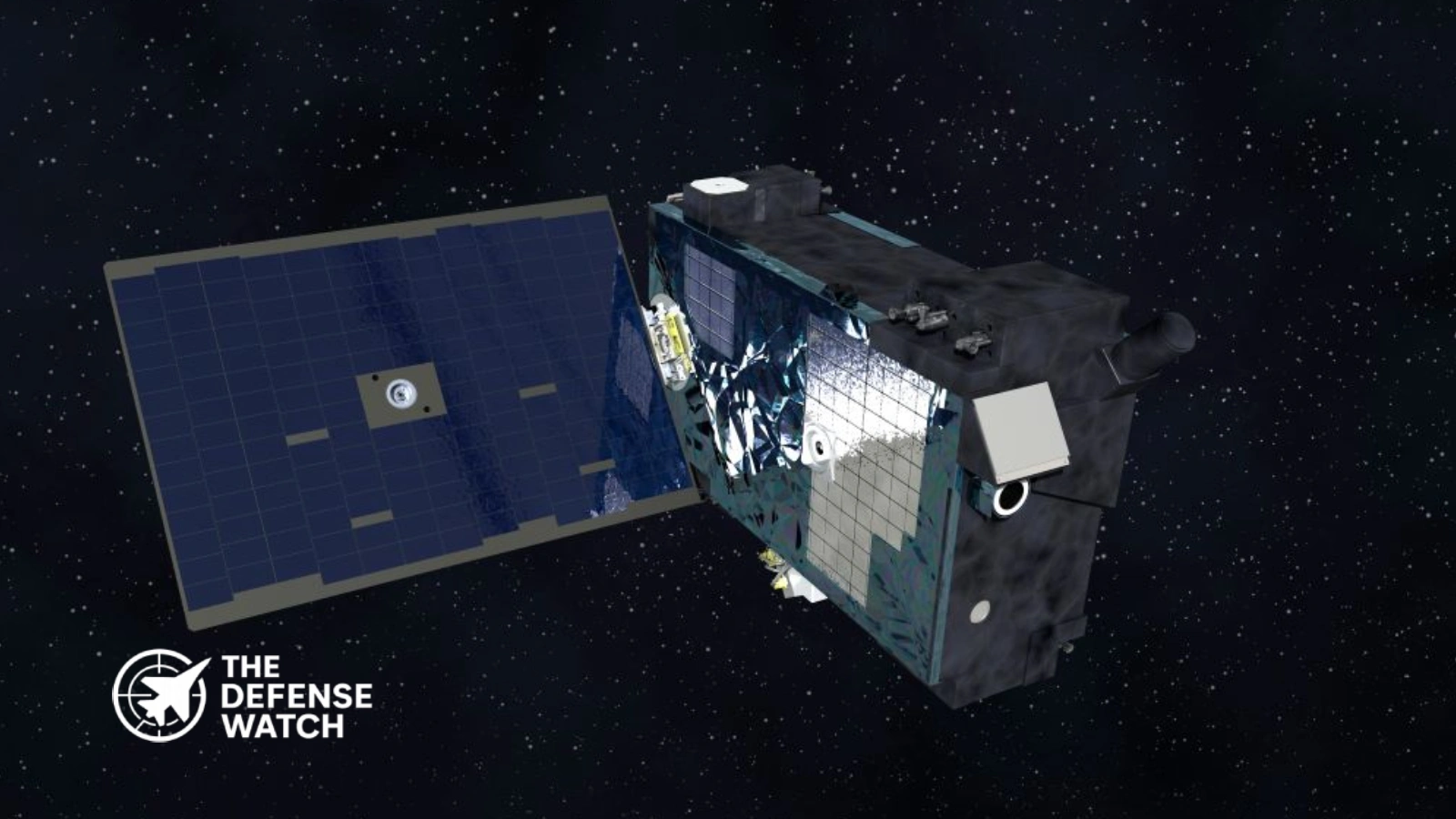
Northrop Grumman plans to build the GHOST-R prototype around its ESPASat-L platform.
The company describes ESPASat-L as a small spacecraft platform designed for high-rate production and integration with its ESPAStar payload rideshare architecture. Northrop says the platform provides a modular path to space and is roughly the size of a small suitcase.
For GHOST-R, the bus will be combined with an optical payload supplied by TRL-11.
This division of responsibilities is significant from an industrial perspective. Instead of developing every element of the spacecraft as a single bespoke system, the program combines an established spacecraft platform with a commercially supplied sensing payload.
That approach can reduce the amount of new hardware that must be qualified before a prototype reaches orbit, although the actual schedule and cost benefits will depend on integration, testing, launch availability and government acceptance.
The 24-month delivery target is therefore one of the most important measurable elements of the announcement. Northrop has committed to assembly, integration, testing and delivery within that period, but the company and government have not publicly disclosed a detailed milestone schedule.
GHOST-R Versus Existing U.S. Space Surveillance
GHOST-R should not be viewed as a direct replacement for GSSAP or terrestrial space surveillance sensors.
Instead, its intended role is complementary.
Capability Existing U.S. Space Surveillance GHOST-R Approach Primary purpose Detection, tracking and characterization across multiple sensor types Space-to-space optical reconnaissance in GEO Sensor location Ground and space Space-based GEO focus Multiple systems contribute Dedicated GEO reconnaissance mission Architecture Mix of legacy and newer systems Commercially derived prototype Acquisition model Traditional government and newer rapid acquisition programs DIU prototype approach Industrial model Government programs and established contractors Commercial spacecraft and payload components Publicly disclosed GHOST-R performance Not applicable Detailed resolution and other performance figures not disclosed The distinction matters because no single sensor type can provide complete awareness of the space environment.
Ground-based optical systems can survey large portions of the sky, while radars can provide tracking information independent of daylight and many weather conditions. Space-based optical systems offer another advantage by observing objects from within the orbital environment rather than exclusively from Earth.
In April 2026, the Space Force reported improvements to its Ground-Based Optical Sensor System at the Maui Space Surveillance Complex. The upgraded system was described as providing a larger field of view, faster search capability and greater sensitivity for finding objects in MEO, GEO, HEO and cislunar orbits.
GHOST-R therefore fits into a broader sensor architecture rather than operating as a standalone replacement.
Northrop Grumman and True Anomaly Take Different Prototype Paths
The GHOST-R effort is not limited to Northrop Grumman.
DIU and Space Systems Command awarded prototype contracts to both Northrop Grumman and True Anomaly. The government is consequently testing two different commercial approaches to the same broad GEO reconnaissance requirement.
Northrop Grumman is bringing established experience from GSSAP together with its ESPASat-L spacecraft architecture and a commercial optical payload.
True Anomaly is approaching the requirement through its Jackal spacecraft and Mosaic ground system. Air & Space Forces Magazine reported that the two companies were selected to demonstrate small satellites using commercial technology for monitoring spacecraft in GEO.
The distinction creates a useful acquisition test.
Northrop’s approach emphasizes established GEO mission experience combined with a commercial spacecraft platform. True Anomaly’s approach places greater emphasis on a newer commercial spacecraft architecture and integrated ground capabilities.
At this stage, neither approach has demonstrated the complete GHOST-R operational requirement. The prototypes will provide the evidence needed to assess factors such as image quality, observation frequency, spacecraft operations, system integration and transition into a larger architecture.
From GHOST-R to a Proliferated GEO Architecture
The larger strategic significance of GHOST-R lies in its potential connection to the Space Force’s move toward proliferated space architectures.
In April 2026, Space Systems Command announced 14 contracts under the Andromeda vehicle for rapidly fielding proliferated Space Domain Awareness capabilities in GEO. SSC said the effort is intended to provide improved continuity of space-based reconnaissance and surveillance and support predictive battlespace awareness at scale.
GHOST-R can therefore be viewed as a prototype-level test of an acquisition model that could eventually support larger numbers of spacecraft.
The concept is straightforward. Instead of placing the entire surveillance burden on a small number of highly capable satellites, a larger number of smaller spacecraft could provide more frequent observations and make the overall architecture less dependent on any single spacecraft.
The resilience argument is already central to other U.S. proliferated space programs. GAO has noted that proliferated constellations can reduce the impact of losing an individual satellite because other spacecraft can continue providing portions of the overall capability.
That does not automatically make a proliferated GEO architecture cheaper or more survivable. More spacecraft also mean more launches, command-and-control requirements, ground infrastructure, replacement cycles and orbital coordination.
The key question is whether the added number of sensors produces enough improvement in observation frequency and resilience to justify those additional demands.
Commercial Space Technology Is Becoming Part of the SDA Architecture
The GHOST-R acquisition also reflects a broader change in how the Pentagon is using commercial space technology.
GAO reported in August 2026 that the Department of Defense was already using commercial space data and services for national security missions. Within the Space Force, the Joint Commercial Operations Cell spent $76.8 million on data and services through the Global Data Marketplace between January 2023 and September 2025, including support for space domain awareness and tactical surveillance, reconnaissance and tracking missions.
GHOST-R moves that commercial relationship beyond purchasing data.
The government is testing commercial spacecraft and sensors as components of an operational military architecture.
That difference is important. A commercial data purchase can supplement government sensors without changing the government’s own spacecraft fleet. A commercially derived satellite prototype, by contrast, tests whether commercially developed hardware can become part of the government’s persistent operational infrastructure.
Counterspace Threats Increase the Value of Distributed Awareness
The requirement for more persistent GEO characterization also reflects the changing security environment in orbit.
U.S. government assessments have repeatedly identified counterspace capabilities, including electronic warfare, directed energy and anti-satellite systems, as threats to space architectures. GAO has noted that satellites operating in higher orbits can present attractive targets when there are relatively few spacecraft providing a critical capability.
A distributed surveillance architecture can address part of that vulnerability.
If several spacecraft can observe the same orbital region, losing one sensor does not necessarily eliminate the entire surveillance capability. The architecture can also provide multiple viewing opportunities, which is important when an operator needs to establish whether a spacecraft has changed its behavior.
However, proliferation is not a substitute for sensor quality.
A larger number of spacecraft with inadequate optical performance would not necessarily produce useful intelligence. The GHOST-R prototypes therefore have to demonstrate that commercially derived hardware can meet the required quality of observation while operating within the constraints of smaller spacecraft.
The 24-Month Schedule Is the Critical Test
Northrop Grumman’s 24-month delivery target is particularly important because traditional space acquisition programs can require substantially longer development cycles.
The company plans to perform spacecraft assembly, integration and testing at facilities in Dulles, Virginia, and Gilbert, Arizona.
The schedule will test whether a commercially derived spacecraft bus can move from contract award through payload integration and environmental testing quickly enough to support a more responsive acquisition cycle.
The government will also need to evaluate whether rapid hardware delivery translates into rapid operational utility.
That requires more than launching the satellite. Ground systems, mission planning, operators, data processing and integration with existing Space Force systems must all work together before the spacecraft can contribute meaningful operational awareness.
What GHOST-R Does Not Yet Establish
Several important details remain undisclosed.
Northrop Grumman’s announcement does not state the contract value, spacecraft mass, optical resolution, sensor aperture, orbital parameters, communications architecture, power generation, expected operational lifetime or specific imaging cadence. Those figures should not be treated as established GHOST-R specifications unless released by the government or contractor.
The announcement also does not establish that the GHOST-R prototype will become a production satellite.
Its significance is that it provides a mechanism for testing the technical and acquisition assumptions behind a larger commercially derived GEO surveillance architecture.
The Space Force’s broader RG-XX effort gives that demonstration a potential pathway into future operational procurement, but the prototype must first show that the concept can meet government requirements.
Strategic Implications for U.S. Space Power
GHOST-R represents three changes in the way the United States is approaching space domain awareness.
First, the mission places greater emphasis on space-based optical characterization of objects in GEO. Detection and tracking are necessary, but high-quality imagery can provide another layer of information about a spacecraft’s identity and condition.
Second, the program tests commercially derived spacecraft as operational military sensors, rather than treating commercial technology solely as an auxiliary data source.
Third, it supports the broader move toward proliferated and hybrid space architectures. The goal is not to eliminate existing government systems such as GSSAP, but to add additional sensing capacity and create more options for maintaining awareness when individual systems are unavailable.
This is particularly relevant as the space environment becomes more crowded and as military planners place greater emphasis on the ability to detect, characterize and respond to changes in orbital behavior.
For the U.S. Space Force, the practical value of GHOST-R will ultimately be determined by whether the prototype can deliver useful imagery at the required frequency, integrate with existing command-and-control systems and demonstrate that commercially derived spacecraft can be acquired and replaced on timelines consistent with an increasingly contested orbital environment.
Key GHOST-R Facts
Item Publicly disclosed information Program GHOST-R Full name Geosynchronous High-Resolution Optical Space-Based Tactical Reconnaissance Government organizations Department of War Innovation Unit and U.S. Space Force Space Systems Command Northrop Grumman platform ESPASat-L Optical payload TRL-11 Mission GEO space domain awareness and reconnaissance Planned delivery 24 months Manufacturing locations Dulles, Virginia and Gilbert, Arizona Contract value Not publicly disclosed Imaging resolution Not publicly disclosed Spacecraft mass Not publicly disclosed Operational lifetime Not publicly disclosed Production quantity Not established Bottom Line
Northrop Grumman’s GHOST-R award is less about a single new satellite than about testing a different way to build military space surveillance capacity.
The combination of an existing commercial spacecraft platform, an externally supplied optical payload and a 24-month delivery target gives the Space Force a concrete test of whether commercial acquisition practices can be applied to a demanding GEO reconnaissance mission.
The parallel prototype effort involving True Anomaly gives the government another architecture against which to assess the approach.
The immediate result will be a prototype. The longer-term question is whether GHOST-R can demonstrate a repeatable model for producing enough GEO surveillance spacecraft to supplement existing systems and provide more persistent characterization of objects in an increasingly contested orbital environment.