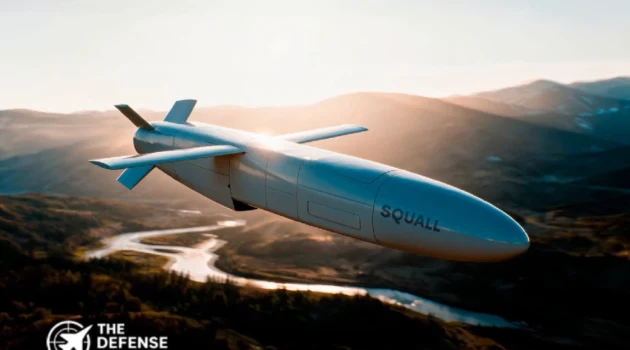
Executive Summary: Spanish defense company Indra has unveiled SQUALL, a new low-cost cruise missile designed to strike strategic targets more than 300 kilometers away. The company says the weapon can be launched from land or naval platforms and is designed for low-altitude flight, precision targeting, and resistance to jamming and spoofing. Indra is also positioning SQUALL for coordinated mass attacks intended to saturate air defenses. The company has not publicly disclosed key specifications including missile dimensions, speed, warhead size, propulsion system, unit price, test schedule, or entry-into-service date.
Indra Introduces SQUALL Cruise Missile
Indra has unveiled the SQUALL cruise missile, a new Spanish-developed weapon designed to conduct precision strikes against targets more than 300 kilometers away.
The company presented the system at UNVEX 2026 in San Javier, Murcia, on September 16. Indra describes SQUALL as a low-cost cruise missile intended for attacks against targets in the adversary’s rear area, including command and control centers, air defense systems, and other high-value military infrastructure.
Indra says SQUALL is designed for both individual precision missions and coordinated attacks involving larger numbers of missiles. The latter concept is intended to create saturation effects against defensive systems.
The company has emphasized that the missile is being developed around a national supply chain, with the aim of maintaining production capacity during periods of disrupted international logistics.
SQUALL Missile Specifications
Indra has released only a limited set of technical information about SQUALL. Several characteristics normally used to evaluate a cruise missile remain undisclosed.
Characteristic SQUALL Manufacturer Indra Country Spain Type Cruise missile Stated range More than 300 km Launch platforms Land and naval platforms Launch methods Ramps, containers and tactical vehicles Flight profile Low altitude, according to Indra Guidance Multiple guidance and navigation systems Electronic warfare resilience Designed to resist jamming and spoofing Intended targets Command and control, air defense and high-value military infrastructure Employment concept Precision strikes and coordinated saturation attacks Unit cost Not disclosed Speed Not disclosed Warhead Not disclosed Propulsion Not disclosed Development schedule Not publicly specified The absence of these specifications is significant. Range alone does not establish the overall capability of a cruise missile, because effectiveness also depends on speed, signature, navigation accuracy, warhead effects, survivability, sensor performance, launch integration, and production capacity.
Low-Altitude Flight and Electronic Warfare
Indra says SQUALL is designed to fly at low altitude. Such flight profiles can reduce radar detection opportunities because the curvature of the Earth and terrain can limit the line of sight available to ground-based sensors.
The company describes this as part of the missile’s ability to operate with a high degree of stealth. That should not be interpreted as evidence that SQUALL is a stealth missile in the same technical sense as systems specifically designed around very low radar cross-section characteristics. Indra has not publicly released a radar cross-section figure or detailed signature data.
SQUALL also incorporates multiple guidance and navigation systems intended to maintain the weapon’s ability to reach its target when subjected to jamming or spoofing.
That feature reflects a central challenge for modern long-range precision weapons. Satellite navigation signals can be disrupted or manipulated, while other navigation and guidance methods introduce their own requirements for sensors, computing, mapping, target information, and system integration.
Indra has not publicly detailed the individual guidance technologies used by SQUALL. It therefore remains unclear how the missile combines navigation sources or how it performs terminal target acquisition.
Designed for Saturation Attacks
One of the most important elements of the SQUALL concept is its intended cost structure.
Indra describes the weapon as low cost compared with conventional missiles. The company says this would allow SQUALL to be used in small numbers for precision attacks or in larger coordinated salvos designed to saturate air defenses.
The concept is closely linked to the changing economics of modern air warfare. Defending against a large number of incoming weapons can require expensive interceptors, radar coverage, command and control capacity, and multiple defensive layers.
A lower-cost offensive missile can therefore change the number of weapons a force can procure and deploy. However, the actual economic advantage of SQUALL cannot yet be quantified because Indra has not disclosed a unit price or production rate.
The same limitation applies to claims about production scale. A missile can be designed around low-cost components while still facing challenges involving propulsion, seekers, electronics, testing, quality control, and supply-chain capacity.
Land and Naval Launch Options
SQUALL is being designed for integration with both land and naval platforms.
Indra says the missile can be launched from ramps, containers, or tactical vehicles. This suggests an emphasis on launcher flexibility rather than dependence on a single specialized platform.
For land forces, containerized or vehicle-based launch could potentially allow cruise missiles to operate from dispersed positions. For naval forces, compatibility with containerized launch arrangements could provide additional integration options, although Indra has not identified specific ships or launch systems that will carry SQUALL.
The distinction between planned compatibility and demonstrated integration is important. At the time of the September 2026 unveiling, the company had not publicly identified a completed operational launcher configuration.
A New Layer in Indra’s Defense Portfolio
SQUALL expands Indra’s activities beyond its established work in sensors, electronic systems, air defense, command and control, and unmanned systems.
The company is also presenting the DRIZZLE effector drone and the TARSIS unmanned aircraft family at UNVEX 2026. Indra says DRIZZLE is intended to intercept drones and attack light targets at ranges of up to 130 kilometers, while TARSIS platforms provide attack, intelligence, surveillance, reconnaissance, and target-designation capabilities.
Indra says these systems are designed to operate within a broader multilayered air defense architecture and combat cloud.
The broader significance is the integration of sensors, command and control, unmanned systems, counter-drone capabilities, and long-range strike effects into a connected architecture. For European militaries, such integration is increasingly important as forces seek to combine relatively inexpensive systems with more sophisticated and expensive weapons.
Why SQUALL Matters for European Long-Range Strike
SQUALL arrives as European defense industries are placing greater emphasis on domestic production capacity and long-range precision weapons.
The missile’s stated range of more than 300 kilometers places it in a class of systems capable of engaging targets well beyond the immediate tactical battlespace. Its intended targets also indicate an emphasis on operational-level effects, particularly command nodes and air defense infrastructure.
For Spain, domestic development could also provide an additional source of sovereign long-range strike technology. Indra specifically highlights control over the supply chain as part of SQUALL’s design philosophy.
That aspect could become important during a major conflict, when demand for precision weapons can rise sharply and international supply chains may face competing requirements from multiple countries.
For the United States and its European allies, the development is relevant to the wider effort to increase the depth, volume, and resilience of allied precision-strike inventories. It also illustrates a shift toward considering not only the performance of individual weapons but the number of weapons that can be produced and sustained during a prolonged conflict.
What Remains Undisclosed
SQUALL remains a newly unveiled system, and several important questions remain unanswered.
Indra has not publicly released the missile’s maximum speed, dimensions, launch weight, warhead configuration, propulsion system, seeker architecture, radar signature, exact unit cost, production rate, flight-test schedule, or operational entry date.
The company also has not publicly announced a procurement contract for SQUALL from the Spanish Armed Forces.
These details will be important for assessing the system’s eventual military value. In particular, the combination of production cost, manufacturing rate, guidance resilience, survivability, and demonstrated accuracy will determine how SQUALL compares with other long-range precision weapons.
For now, the September 2026 announcement establishes SQUALL as a Spanish cruise missile development focused on range, precision, launch flexibility, electronic warfare resilience, and scalable production.
The Defense Watch Assessment
SQUALL’s most notable feature is not simply its stated range of more than 300 kilometers. The larger design objective is to combine long-range precision strike with a lower-cost production model capable of supporting larger salvos.
That approach addresses a practical problem in modern warfare: sophisticated air defenses can be effective against individual threats, but maintaining sufficient interceptor inventories against sustained attacks can become a major logistical and economic challenge.
Whether SQUALL can deliver that intended balance will depend on information that Indra has not yet released, particularly its production cost, propulsion performance, guidance architecture, survivability, test results, and manufacturing capacity.
The September 2026 unveiling therefore represents the beginning of a development story rather than evidence of an already operational cruise-missile capability. Further testing, industrial commitments, and potential Spanish or international procurement decisions will provide the information needed to assess how the system develops.