• Home
  • About
  • Defense Systems
  • Manufacturer
  • Comparisons
  • Compare 
  • Tools
TheDefenseWatch.com
  • Aerospace & Aviation
  • Military & Ordnance
  • Naval & Maritime
  • Cyber & Space Defense
  • Policy & Strategy
  • Global News
  • Tools Library
    • Smart Calculator
    • Drone Flight Time Calculator
    • Drone Range Calculator
    • Counter-Drone Jammer Effective Range Calculator
    • Counter-Battery Radar Detection Calculator
    • Artillery Fire Correction Calculator
    • Thermal Camera Detection Range Calculator
    • Missile Range & Time-of-Flight Calculator
    • Radar Detection Range Calculator
    • FPV Strike Drone Payload vs Range Calculator
    • Loitering Munition Endurance Calculator
    • Sniper Ballistic Drop & Windage Calculator
    • Bullet Drop Calculator
    • U.S. Army Combat Fitness Test (ACFT) Calculator
    • Military Pension Calculator
    • Military Retirement Calculator
    • Military Pension Calculator
    • Large Number Calculator
Font ResizerAa

TheDefenseWatch.com

The Defense Watch | U.S. & Global Defense News, Analysis & Military Updates

Search
  • Home
  • About
  • Defense Systems
  • Manufacturer
  • Comparisons
  • Compare 
  • Tools

Stay Updated

Get the latest update

Subscribe

Explore

  • Drone
  • Fighter Jets & Military Aircraft
  • Hypersonic Weapons
  • Aircraft Carriers
  • Strategic History & Missions
  • Tools Library
Home » U.S. Moves To Enforce Maritime Blockade On Iran As Regional Security Tensions Escalate
Naval & MaritimeNaval Strategy & Maritime Security

U.S. Moves To Enforce Maritime Blockade On Iran As Regional Security Tensions Escalate

Kaleem Sheikh | Regional Defense Correspondent
Last updated: September 7, 2026 4:10 am
Kaleem Sheikh | Regional Defense Correspondent
Share
7 Min Read
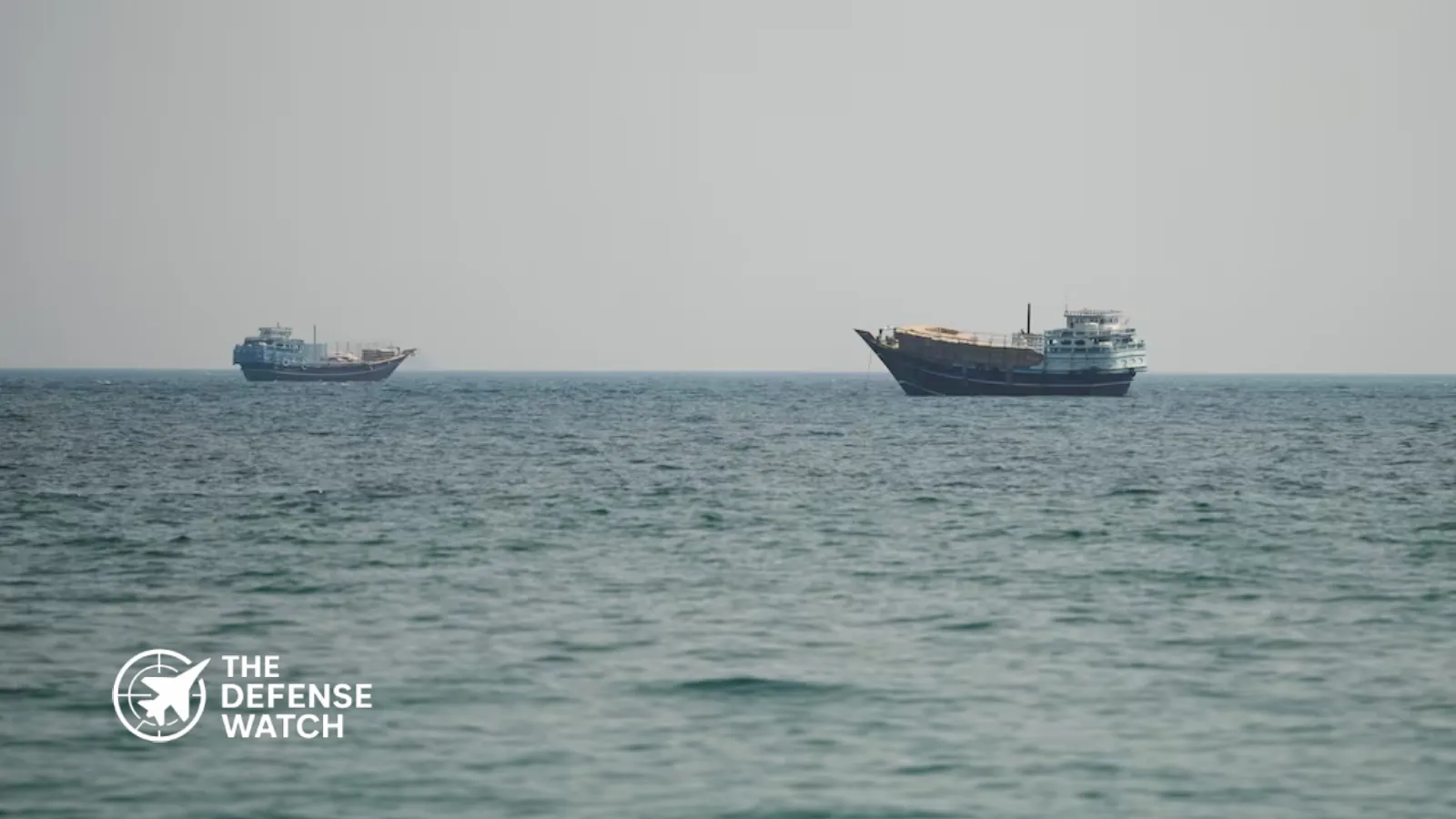
U.S. maritime blockade Iran
Vessels at the Strait of Hormuz, as seen from Musandam, Oman, on July 12, 2026. (Reuters)
SHARE

Executive Summary:
The United States is scheduled to begin enforcing a maritime blockade on Iran on Tuesday as part of a broader effort to increase economic and military pressure on Tehran. The operation is expected to focus on preventing the movement of restricted cargo and military-related supplies while maintaining security across critical regional shipping lanes.

U.S. Begins Maritime Blockade On Iran

The U.S. maritime blockade on Iran is set to begin Tuesday, representing one of Washington’s most significant maritime enforcement measures in recent years. According to Defense News, the operation follows U.S. government directives aimed at tightening restrictions on Iran’s maritime trade while increasing military presence across the region.

Contents
  • U.S. Begins Maritime Blockade On Iran
  • Why The Strait Of Hormuz Matters
  • U.S. Navy Expected To Lead Enforcement Operations
  • Strategic Implications For Regional Security
  • Operational Challenges
  • Broader Defense And Geopolitical Context
  • Outlook

The enforcement effort will involve U.S. naval assets operating in and around key waterways, including the Persian Gulf, Gulf of Oman, and approaches to the Strait of Hormuz. These areas remain among the world’s most strategically important maritime corridors due to the volume of global energy shipments that transit through them each day.

Officials have stated that the mission is intended to intercept prohibited cargo, enforce existing sanctions, and prevent the transfer of military equipment or other restricted materials.

Why The Strait Of Hormuz Matters

The Strait of Hormuz remains one of the world’s most important maritime chokepoints.

- Advertisement -

Approximately one-fifth of globally traded crude oil passes through the narrow waterway, making uninterrupted navigation essential for international energy markets. Any increase in military activity within the region attracts close attention from governments, commercial shipping companies, and global energy traders.

Key characteristics include:

Strategic FactorSignificance
Global oil shipmentsRoughly 20% of global crude exports transit the Strait
Commercial trafficHundreds of merchant vessels operate through the area each month
Military presenceU.S., allied, and regional naval forces regularly conduct patrols
Regional importanceConnects the Persian Gulf with international shipping lanes

U.S. Navy Expected To Lead Enforcement Operations

Although operational details remain limited, the enforcement mission is expected to rely primarily on U.S. Navy surface combatants supported by maritime patrol aircraft, intelligence assets, and logistics vessels already deployed within U.S. Central Command’s area of responsibility.

Carrier strike groups, guided missile destroyers, cruisers, and surveillance aircraft routinely operate throughout the region, providing the United States with substantial maritime domain awareness.

These assets allow commanders to:

  • Monitor commercial shipping traffic.
  • Conduct vessel identification and tracking.
  • Perform compliant maritime interdiction operations.
  • Coordinate with coalition naval partners.
  • Maintain freedom of navigation across international waters.

Officials have not publicly disclosed the full rules governing inspections or interdictions, but maritime enforcement operations typically follow established international legal frameworks and sanctions authorities.

Strategic Implications For Regional Security

The blockade represents more than a naval deployment. It reflects a broader shift toward using maritime power to increase economic and strategic pressure on Iran without immediately expanding conventional military operations.

From a defense planning perspective, maritime enforcement offers several advantages:

- Advertisement -
  • Naval forces can maintain a persistent presence without establishing additional land bases.
  • Maritime interdiction enables targeted enforcement against prohibited cargo rather than broad restrictions on commercial shipping.
  • Coalition naval operations improve intelligence sharing and surveillance across a large operating area.

For U.S. military planners, maintaining credible maritime control in the Persian Gulf also supports broader objectives such as protecting allied shipping, reassuring regional partners, and preserving freedom of navigation.

Operational Challenges

Despite significant naval capabilities, enforcing a maritime blockade presents considerable operational complexity.

The Persian Gulf is among the busiest commercial waterways in the world. Distinguishing legitimate commercial cargo from prohibited shipments requires extensive intelligence collection, legal review, and coordination among military and civilian agencies.

Additional operational challenges include:

  • High commercial shipping density.
  • Limited maneuvering space within the Strait of Hormuz.
  • Potential use of smaller vessels for covert logistics.
  • Continuous surveillance requirements across a large maritime area.
  • Close coordination with allied navies and regional governments.

These factors require sustained intelligence, reconnaissance, and command-and-control capabilities rather than relying solely on naval firepower.

Broader Defense And Geopolitical Context

The enforcement action comes amid continued instability across the Middle East, where maritime security has become an increasingly important component of regional defense strategy.

In recent years, the United States has expanded multinational maritime security initiatives to protect commercial shipping from attacks, deter weapons smuggling, and ensure access to critical sea lanes. These missions have included cooperation with allied naval forces operating under combined maritime task forces.

For Washington, maintaining secure maritime routes remains a strategic priority because disruptions in the Gulf can affect global energy markets, international trade, and military logistics across multiple theaters.

The latest blockade also underscores the growing role of naval power as a tool of economic and strategic competition, complementing sanctions, diplomatic measures, and regional security partnerships.

Outlook

The coming days will likely determine how the maritime blockade is implemented in practice and whether enforcement operations remain limited to inspections and sanctions compliance or evolve into a longer-term naval security mission.

Defense analysts will closely monitor the operational tempo of U.S. naval forces, commercial shipping activity through the Strait of Hormuz, and any changes in regional maritime security conditions.

While the long-term effectiveness of the blockade will depend on sustained enforcement and international cooperation, the operation represents a significant development in U.S. naval strategy in the Middle East and reinforces the central role of maritime power in contemporary geopolitical competition.


TAGGED:IranU.S. Navy
Share This Article
Facebook Copy Link Print
ByKaleem Sheikh | Regional Defense Correspondent
Follow:
Kaleem Sheikh is a regional defense correspondent at TheDefenseWatch.com covering defense and security developments across Asia and the Middle East, including military operations, procurement, and regional security issues.
Leave a Comment

Leave a Reply Cancel reply

Your email address will not be published. Required fields are marked *

New Arrivals

  • Boeing VC-25B Presidential Aircraft Boeing VC-25B Presidential Aircraft
  • SM-3 Block IB Missile SM-3 Block IB Missile
  • USS Abraham Lincoln Aircraft Carrier USS Abraham Lincoln Aircraft Carrier
  • M142 HIMARS M142 HIMARS
  • Terrex S5 Infantry Vehicle Terrex S5 Infantry Vehicle
  • A-29 Super Tucano Aircraft A-29 Super Tucano Aircraft
  • DSAR 15 Rifle DSAR 15 Rifle

Recent Compares

  • Tejas vs Gripen: Key Differences and Capabilities Tejas vs Gripen: Key Differences and Capabilities View Comparison →
  • Tejas vs MiG-21 Bison: How India Replaced Its Iconic Supersonic Fighter Tejas vs MiG-21 Bison: How India Replaced Its Iconic Supersonic Fighter View Comparison →
  • F-35 vs F-16: Stealth, Sensors and Combat Roles F-35 vs F-16: Stealth, Sensors and Combat Roles View Comparison →
  • Tejas Fighter Jet vs F-16 Fighting Falcon: Capability Compared Tejas Fighter Jet vs F-16 Fighting Falcon: Capability Compared View Comparison →
  • Rafale Fighter Jet vs F-16 Fighting Falcon : Which Fighter Has the Edge? Rafale Fighter Jet vs F-16 Fighting Falcon : Which Fighter Has the Edge? View Comparison →
  • Su-57 Fighter Jet vs J-20 Fighter Jet: Stealth and Air Combat Compared Su-57 Fighter Jet vs J-20 Fighter Jet: Stealth and Air Combat Compared View Comparison →
  • Mirage 2000 vs Tejas Mk1A: Legacy Combat Power vs Indigenous Modernization Mirage 2000 vs Tejas Mk1A: Legacy Combat Power vs Indigenous Modernization View Comparison →
  • Rafale Fighter Jet vs F-22 Raptor: Which Air Dominance Fighter Has the Edge? Rafale Fighter Jet vs F-22 Raptor: Which Air Dominance Fighter Has the Edge? View Comparison →
  • Tejas Fighter Jet vs. Rafale Fighter Jet: India’s Indigenous Fighter Meets France’s Proven Multirole Combat Aircraft Tejas Fighter Jet vs. Rafale Fighter Jet: India’s Indigenous Fighter Meets France’s Proven Multirole Combat Aircraft View Comparison →
  • F-22 Raptor vs. F-35 Joint Strike Fighter: Which Fifth Generation Fighter Has the Edge? F-22 Raptor vs. F-35 Joint Strike Fighter: Which Fifth Generation Fighter Has the Edge? View Comparison →

Recent Posts

  • USS Oregon Visits Norway as U.S. Navy Maintains High North Presence
  • Lockheed Martin Unveils PAC-3 Edge Interceptor for U.S. Army
  • Northrop Grumman Completes B-2 Spirit of Kitty Hawk Overhaul
  • Army Report Finds Systemic Failures Behind Fatal 2025 Midair Collision
  • Lockheed Martin to Supply Black Hawk Training Systems to Philippine Air Force

You Might Also Like

Israel strikes Iranian missile sites
Global News

Israel Strikes Iranian Missile Sites And Security Force Headquarters In New Wave Of IDF Operations

March 9, 2026
Atlantic NET undersea programme
Naval & MaritimeSubmarines

UK Assesses 26 Industry Proposals for Atlantic NET Undersea ASW Programme

January 31, 2026
USS Daniel Inouye destroyer returning to fleet after early maintenance completion at US naval facility
Naval & MaritimeNaval Strategy & Maritime Security

US Navy Advances Fleet Readiness As USS Daniel Inouye Returns Early From Maintenance

September 12, 2026
Zumwalt-class combat system
Naval & MaritimeNaval Strategy & Maritime Security

Raytheon Missiles and Defense Secures $213 Million Deal For Zumwalt-class destroyer Combat System Upgrades

September 7, 2026

Logo

Copyright © 2026 TheDefenseWatch.com

Helpful Links

  • Home
  • About Us
  • Privacy Policy
  • Terms of Use / Disclaimer
  • U.S. Privacy Notice – CCPA Compliance

Defense Systems

  • Defense Systems
  • Comparisons 
  • Manufacturer
  • Tactical Calculators

Popuplar

Which 5 Air Forces Possess the Costliest Fighter Jet Fleets in the World
Evolving Strategic Value: Carrier Strike Groups in the Indo-Pacific’s Future Security Architecture
Autonomous Weapon Systems Spark U.S. Ethics Debate Amid Rapid Military AI Integration

We report on developments involving military forces, governments, defense companies, research organizations, and security institutions around the world. 

Welcome Back!

Sign in to your account

Username or Email Address
Password

Lost your password?