• Home
  • About
  • Defense Systems
  • Manufacturer
  • Comparisons
  • Compare 
  • Tools
TheDefenseWatch.com
  • Aerospace & Aviation
  • Military & Ordnance
  • Naval & Maritime
  • Cyber & Space Defense
  • Policy & Strategy
  • Global News
  • Tools Library
    • Smart Calculator
    • Drone Flight Time Calculator
    • Drone Range Calculator
    • Counter-Drone Jammer Effective Range Calculator
    • Counter-Battery Radar Detection Calculator
    • Artillery Fire Correction Calculator
    • Thermal Camera Detection Range Calculator
    • Missile Range & Time-of-Flight Calculator
    • Radar Detection Range Calculator
    • FPV Strike Drone Payload vs Range Calculator
    • Loitering Munition Endurance Calculator
    • Sniper Ballistic Drop & Windage Calculator
    • Bullet Drop Calculator
    • U.S. Army Combat Fitness Test (ACFT) Calculator
    • Military Pension Calculator
    • Military Retirement Calculator
    • Military Pension Calculator
    • Large Number Calculator
Font ResizerAa

TheDefenseWatch.com

The Defense Watch | U.S. & Global Defense News, Analysis & Military Updates

Search
  • Home
  • About
  • Defense Systems
  • Manufacturer
  • Comparisons
  • Compare 
  • Tools

Stay Updated

Get the latest update

Subscribe

Explore

  • Drone
  • Fighter Jets & Military Aircraft
  • Hypersonic Weapons
  • Aircraft Carriers
  • Strategic History & Missions
  • Tools Library
Home » US Transfers Reliance-Class Cutter To Philippines As Maritime Pressure Grows In South China Sea
Naval & MaritimeNaval Strategy & Maritime Security

US Transfers Reliance-Class Cutter To Philippines As Maritime Pressure Grows In South China Sea

Samuel Drake | Defense Analyst
Last updated: September 7, 2026 8:20 am
Samuel Drake | Defense Analyst
Share
7 Min Read
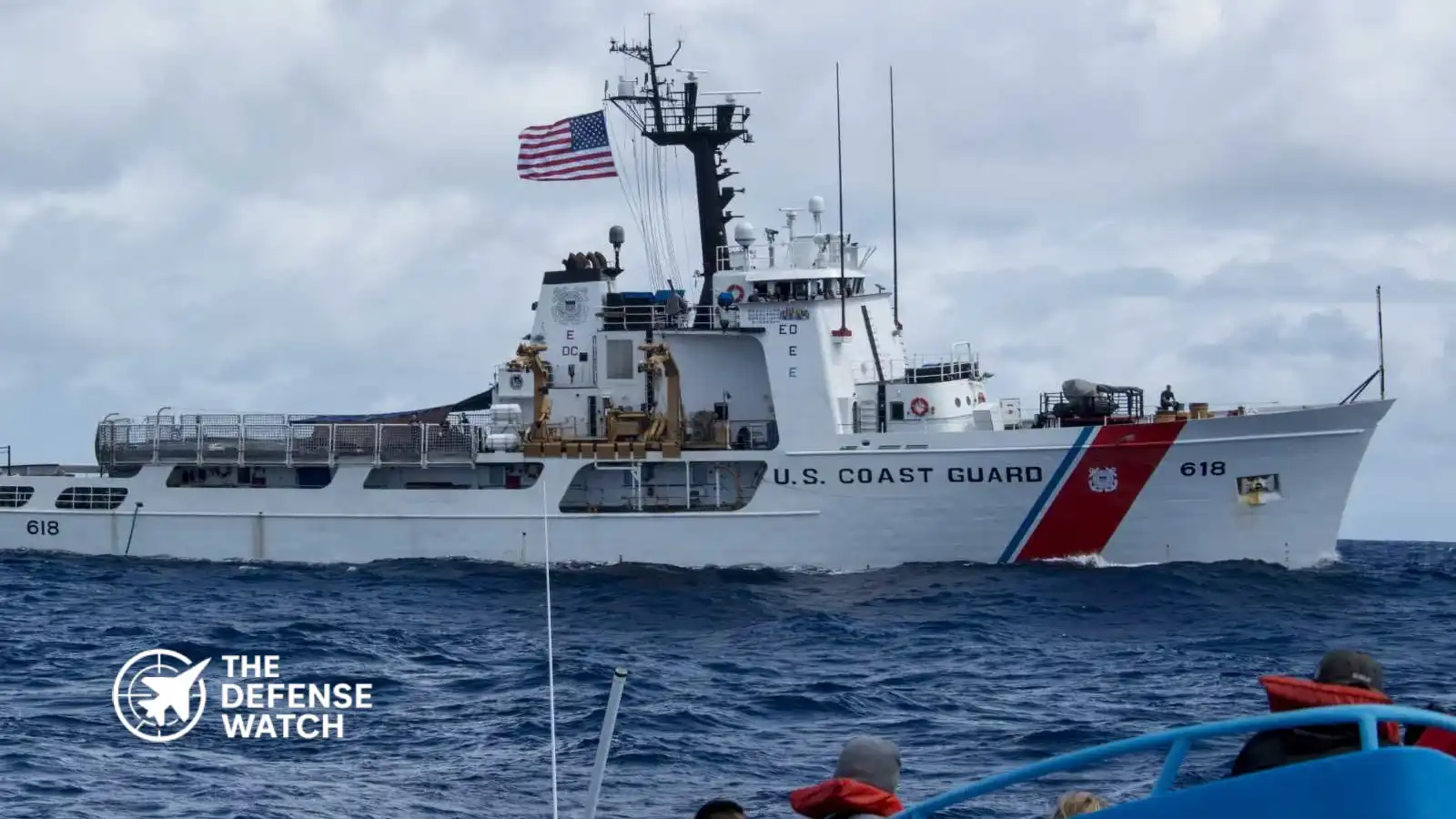
U.S. Coast Guard Reliance-class cutter sailing during maritime operations as the vessel prepares for transfer to the Philippine Coast Guard.
Image Source: U.S. Coast Guard
SHARE

Executive Summary:

The United States has announced the transfer of a 210-foot Reliance-class cutter to the Philippine Coast Guard, marking another significant step in expanding maritime security cooperation between Washington and Manila. The vessel will strengthen Philippine patrol capacity across contested and remote maritime areas as both countries deepen coordination in response to evolving security challenges in the Indo-Pacific. to their endurance, seakeeping characteristics, and ability to remain deployed for extended periods. stretching from the Philippine Sea to the South China Sea. patrol activities. . by U.S. Coast Guard assets alongside Philippine Navy and Coast Guard vessels. and Security Memorandum of Agreement aimed at improving secure information sharing between both countries. To Philippine Coast Guard”

(adsbygoogle = window.adsbygoogle || []).push({});

US Announces Reliance-Class Cutter Transfer To The Philippines

The United States will transfer a decommissioned 210-foot Reliance-class cutter to the Philippine Coast Guard (PCG), providing Manila with an additional medium-endurance vessel capable of extended maritime patrol missions.

Contents
  • US Announces Reliance-Class Cutter Transfer To The Philippines
  • What The Reliance-Class Cutter Brings To The Philippine Coast Guard
    • Key Characteristics
  • Why The Transfer Matters
  • Growing US-Philippines Maritime Cooperation
  • Strategic Analysis: More Than A Ship Transfer
  • Operational Challenges Ahead
  • Outlook

The announcement was made by U.S. Defense Secretary Pete Hegseth during meetings with Philippine defense officials on the sidelines of the 2026 Shangri-La Dialogue in Singapore. Philippine Defense Secretary Gilberto Teodoro Jr. and senior military leaders welcomed the transfer as part of broader bilateral security cooperation.

The vessel will join ongoing U.S. efforts to support Philippine maritime modernization, which already include transfers of patrol boats, surveillance aircraft, training programs, and maritime domain awareness initiatives.

What The Reliance-Class Cutter Brings To The Philippine Coast Guard

The Reliance-class is a medium-endurance cutter originally developed for the U.S. Coast Guard to conduct long-duration offshore missions.

- Advertisement -
(adsbygoogle = window.adsbygoogle || []).push({});

Unlike smaller coastal patrol craft, the class was designed for sustained deployments lasting several weeks, making it suitable for surveillance, law enforcement, search and rescue, and maritime security operations over large distances.

Key Characteristics

SpecificationDetails
ClassReliance-class Medium Endurance Cutter
Length210 feet (64 meters)
Mission TypeOffshore patrol and maritime security
EnduranceUp to several weeks at sea
RangeMore than 6,000 nautical miles
CrewApproximately 75 to 100 personnel
Primary RolesPatrol, law enforcement, SAR, maritime surveillance

While older than many modern patrol vessels, the cutter offers substantially greater endurance than many existing Philippine Coast Guard platforms currently used for routine patrol duties.

Why The Transfer Matters

The transfer arrives as the Philippines continues to expand its maritime presence across its exclusive economic zone and disputed areas of the South China Sea.

The Philippine Coast Guard has increasingly become the frontline agency responding to maritime incidents involving foreign vessels. This has created demand for ships capable of remaining at sea longer and operating farther from shore without frequent logistical support.

A medium-endurance cutter fills an important operational niche between smaller patrol boats and larger offshore patrol vessels. The platform provides greater persistence, allowing crews to maintain patrols in remote areas for extended periods.

Growing US-Philippines Maritime Cooperation

The cutter transfer is part of a broader trend of deepening maritime cooperation between Washington and Manila.

In February 2026, the United States finalized the transfer of three Beechcraft King Air surveillance aircraft to the Philippine Coast Guard to strengthen maritime domain awareness and search and rescue capabilities. The two countries have also expanded joint maritime activities, information sharing, and interoperability efforts.

(adsbygoogle = window.adsbygoogle || []).push({});

Recent Maritime Cooperative Activities conducted by U.S. and Philippine forces further demonstrate the increasing operational coordination between the allies in the Indo-Pacific region.

- Advertisement -

The transfer also coincides with the 75th anniversary of the U.S.-Philippines Mutual Defense Treaty, a milestone that both governments have used to highlight their commitment to regional security cooperation.

Strategic Analysis: More Than A Ship Transfer

From a strategic perspective, the significance of the transfer extends beyond the vessel itself.

The Reliance-class cutter is not a frontline combatant and will not fundamentally alter the military balance in the South China Sea. However, it addresses a critical challenge facing many maritime security agencies: maintaining continuous presence across vast maritime areas.

Persistent presence often matters as much as raw combat capability in maritime disputes. Coast guards play a central role in monitoring activity, enforcing maritime law, supporting fishermen, conducting search and rescue operations, and documenting incidents at sea.

For the Philippines, acquiring a medium-endurance cutter through transfer programs offers a relatively rapid and cost-effective way to expand patrol capacity compared with commissioning an entirely new vessel. Similar U.S. cutter transfers have previously strengthened the maritime fleets of allied and partner nations, demonstrating Washington’s continued use of excess defense assets as a tool of security cooperation.

The transfer also aligns with broader U.S. Indo-Pacific strategy, which emphasizes strengthening the capabilities of regional allies and partners to monitor and secure their maritime approaches without requiring a permanent expansion of U.S. forces in every operating area.

Operational Challenges Ahead

Although the transfer offers immediate benefits, integration will require investment.

The Philippine Coast Guard will need to establish training pipelines, maintenance support, spare parts inventories, and sustainment plans for the aging platform. Operating older vessels can increase maintenance demands compared with acquiring newly built ships.

Nevertheless, many countries continue to operate former U.S. Coast Guard cutters successfully after transfer, suggesting the class remains capable of providing useful service life when properly maintained.

(adsbygoogle = window.adsbygoogle || []).push({});

Outlook

The planned transfer of a Reliance-class cutter represents another step in the ongoing modernization of the Philippine Coast Guard and reflects the growing maritime security partnership between Washington and Manila.

While not a transformational capability on its own, the vessel will enhance the Philippines’ ability to conduct extended offshore patrols, support maritime law enforcement missions, and maintain a more persistent presence across strategically important waters in the Indo-Pacific.


TAGGED:Philippine Coast GuardReliance-class Cutter
Share This Article
Facebook Copy Link Print
BySamuel Drake | Defense Analyst
Follow:
Samuel Drake is a defense analyst at TheDefenseWatch.com covering naval warfare, military ordnance, maritime technology, fleet modernization, and defense procurement. His reporting focuses on documented capabilities, procurement programs, and military technology.
Leave a Comment

Leave a Reply Cancel reply

Your email address will not be published. Required fields are marked *

Latest Defense Systems

  • Tomahawk Block V Missile Tomahawk Block V Missile
  • Tomahawk Block IV Missile Tomahawk Block IV Missile
  • SU-57 Felon Stealth Fighter SU-57 Felon Stealth Fighter
  • Boeing F/A-XX Fighter Boeing F/A-XX Fighter
  • JF-17 Thunder Fighter Jet JF-17 Thunder Fighter Jet
  • Gaurav Glide Bomb Gaurav Glide Bomb
  • F-47 Fighter Jet F-47 Fighter Jet
  • Spirit UAS Spirit UAS
  • GBU-43/B MOAB Bomb GBU-43/B MOAB Bomb

Recent Compares

  • J-10C vs JF-17 Thunder: Which Fighter Is More Capable? J-10C vs JF-17 Thunder: Which Fighter Is More Capable? View Comparison →
  • Tejas vs Gripen: Key Differences and Capabilities Tejas vs Gripen: Key Differences and Capabilities View Comparison →
  • Tejas vs MiG-21 Bison: How India Replaced Its Iconic Supersonic Fighter Tejas vs MiG-21 Bison: How India Replaced Its Iconic Supersonic Fighter View Comparison →
  • F-35 vs F-16: Stealth, Sensors and Combat Roles F-35 vs F-16: Stealth, Sensors and Combat Roles View Comparison →
  • Tejas Fighter Jet vs F-16 Fighting Falcon: Capability Compared Tejas Fighter Jet vs F-16 Fighting Falcon: Capability Compared View Comparison →
  • Rafale Fighter Jet vs F-16 Fighting Falcon : Which Fighter Has the Edge? Rafale Fighter Jet vs F-16 Fighting Falcon : Which Fighter Has the Edge? View Comparison →
  • Su-57 Fighter Jet vs J-20 Fighter Jet: Stealth and Air Combat Compared Su-57 Fighter Jet vs J-20 Fighter Jet: Stealth and Air Combat Compared View Comparison →
  • Mirage 2000 vs Tejas Mk1A: Legacy Combat Power vs Indigenous Modernization Mirage 2000 vs Tejas Mk1A: Legacy Combat Power vs Indigenous Modernization View Comparison →
  • Rafale Fighter Jet vs F-22 Raptor: Which Air Dominance Fighter Has the Edge? Rafale Fighter Jet vs F-22 Raptor: Which Air Dominance Fighter Has the Edge? View Comparison →
  • Tejas Fighter Jet vs. Rafale Fighter Jet: India’s Indigenous Fighter Meets France’s Proven Multirole Combat Aircraft Tejas Fighter Jet vs. Rafale Fighter Jet: India’s Indigenous Fighter Meets France’s Proven Multirole Combat Aircraft View Comparison →

Recent Posts

  • P-800 Oniks Missile: Range, Speed and BrahMos Comparison
  • Ukrainian Drone Unit Caused 70% of Simulated U.S. Brigade Casualties in Germany Exercise
  • OCCAR Marks 25 Years of European Defense Cooperation With 28 Programs
  • Saab Q3 2026 Results Show 30.6% Organic Sales Growth as Orders Surge
  • How Much Does a Tomahawk Missile Cost? Price, Range and Blocks

You Might Also Like

U.S. maritime blockade Iran
Naval & MaritimeNaval Strategy & Maritime Security

U.S. Moves To Enforce Maritime Blockade On Iran As Regional Security Tensions Escalate

September 7, 2026
Pakistan Navy Chinese-built submarine arriving at Karachi naval dockyard
Naval & MaritimeSubmarines

Pakistan Expands Undersea Deterrence In Arabian Sea With First Chinese-Built Submarine

September 7, 2026
HELIOS laser weapon
Naval & MaritimeNaval Strategy & Maritime Security

US Navy Destroyer Shoots Down Drones with HELIOS Laser System

February 3, 2026
HMS Prince of Wales leads Royal Navy High North exercises with carrier strike group in Arctic conditions
Naval & MaritimeNaval Strategy & Maritime Security

UK Royal Navy Expands Carrier Strike Capability In High North Exercises With HMS Prince Of Wales

May 6, 2026

Logo

Copyright © 2026 TheDefenseWatch.com

Helpful Links

  • Home
  • About Us
  • Privacy Policy
  • Terms of Use / Disclaimer
  • U.S. Privacy Notice – CCPA Compliance

Defense Systems

  • Defense Systems
  • Comparisons 
  • Manufacturer
  • Tactical Calculators

Popuplar

Which 5 Air Forces Possess the Costliest Fighter Jet Fleets in the World
Evolving Strategic Value: Carrier Strike Groups in the Indo-Pacific’s Future Security Architecture
Autonomous Weapon Systems Spark U.S. Ethics Debate Amid Rapid Military AI Integration

We report on developments involving military forces, governments, defense companies, research organizations, and security institutions around the world. 

Welcome Back!

Sign in to your account

Username or Email Address
Password

Lost your password?