• Home
  • About
  • Defense Systems
  • Manufacturer
  • Comparisons
  • Compare 
  • Tools
TheDefenseWatch.com
  • Aerospace & Aviation
  • Military & Ordnance
  • Naval & Maritime
  • Cyber & Space Defense
  • Policy & Strategy
  • Global News
  • Tools Library
    • Smart Calculator
    • Drone Flight Time Calculator
    • Drone Range Calculator
    • Counter-Drone Jammer Effective Range Calculator
    • Counter-Battery Radar Detection Calculator
    • Artillery Fire Correction Calculator
    • Thermal Camera Detection Range Calculator
    • Missile Range & Time-of-Flight Calculator
    • Radar Detection Range Calculator
    • FPV Strike Drone Payload vs Range Calculator
    • Loitering Munition Endurance Calculator
    • Sniper Ballistic Drop & Windage Calculator
    • Bullet Drop Calculator
    • U.S. Army Combat Fitness Test (ACFT) Calculator
    • Military Pension Calculator
    • Military Retirement Calculator
    • Military Pension Calculator
    • Large Number Calculator
Font ResizerAa

TheDefenseWatch.com

The Defense Watch | U.S. & Global Defense News, Analysis & Military Updates

Search
  • Home
  • About
  • Defense Systems
  • Manufacturer
  • Comparisons
  • Compare 
  • Tools

Stay Updated

Get the latest update

Subscribe

Explore

  • Drone
  • Fighter Jets & Military Aircraft
  • Hypersonic Weapons
  • Aircraft Carriers
  • Strategic History & Missions
  • Tools Library
Home » Belgium Unveils Offline AI System To Counter Battlefield Identification Threats
AI & Electronic WarfareCyber & Space Defense

Belgium Unveils Offline AI System To Counter Battlefield Identification Threats

Daniel Mercer / Defense & Aerospace Analyst
Last updated: September 7, 2026 10:40 am
Daniel Mercer / Defense & Aerospace Analyst
Share
2 Min Read
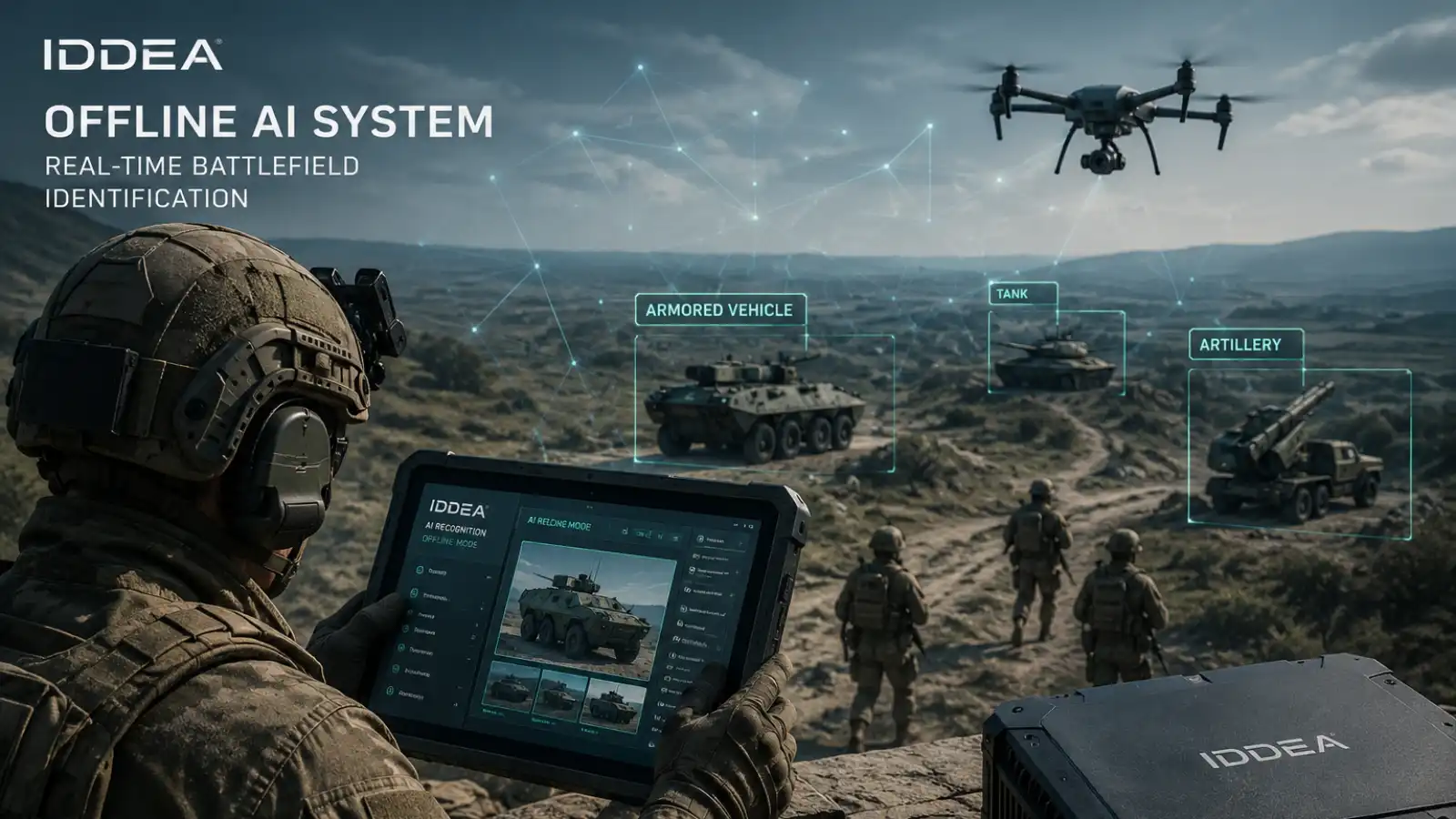
Belgian IDDEA offline AI battlefield identification system analyzing military vehicles in a combat operations environment
SHARE

Executive Summary:
Belgian defense technology company IDDEA has introduced an offline artificial intelligence system designed to identify military equipment in real time on the battlefield. The platform aims to support troops operating in electronically contested environments where internet access and cloud connectivity may be unavailable.

Belgium Introduces Offline AI Battlefield Identification Capability

Belgium-based defense technology company IDDEA has unveiled a new offline AI battlefield identification system designed to recognize military vehicles and equipment in real time during combat operations.

Contents
Belgium Introduces Offline AI Battlefield Identification CapabilityDesigned For Contested And Disconnected BattlefieldsGrowing Demand For Edge AI In Defense OperationsAI Identification Systems Becoming Core Military CapabilityStrategic Implications For NATO And European DefenseOriginal Analysis: Why Offline AI Matters In Future Warfare

The platform uses onboard artificial intelligence algorithms to analyze and classify military assets without relying on cloud infrastructure or internet connectivity. The capability is intended for use in high-intensity operational environments where communications networks may be degraded, jammed, or completely unavailable.

The announcement reflects a broader shift across NATO and allied defense sectors toward edge-based AI systems capable of operating independently in contested electromagnetic environments.

Designed For Contested And Disconnected Battlefields

The offline AI battlefield identification system is built to support frontline troops, reconnaissance teams, unmanned systems operators, and command units requiring rapid target recognition under battlefield conditions.

- Advertisement -

Modern conflicts, particularly in electronically contested theaters, have highlighted the vulnerability of cloud-dependent systems. Military forces increasingly face GPS disruption, communications jamming, and cyber attacks targeting data links and centralized networks.

By processing data locally, IDDEA’s system reduces dependency on remote servers and external communications infrastructure. This allows battlefield units to continue identifying vehicles, armored platforms, artillery systems, and other military assets even during electronic warfare operations.

The company stated that the platform can operate on compact computing hardware integrated into tactical vehicles, drones, observation posts, or mobile command systems.

Growing Demand For Edge AI In Defense Operations

The introduction of offline AI battlefield identification technology comes as defense organizations accelerate investment in edge computing and autonomous battlefield analytics.

The war in Ukraine and other recent conflicts have demonstrated the operational value of rapid sensor-to-shooter decision cycles. Militaries are seeking technologies that can shorten identification times while reducing the cognitive burden on operators.

Unlike traditional AI architectures that rely heavily on cloud computing resources, edge AI systems process information directly at the tactical level. This reduces latency and enables faster responses in dynamic combat scenarios.

The move also aligns with wider NATO modernization priorities focused on resilient command-and-control networks, distributed sensing, and AI-enabled operational awareness.

Analysts note that battlefield identification remains one of the most critical challenges in modern warfare, particularly in environments crowded with drones, armored vehicles, decoys, and mixed civilian infrastructure.

- Advertisement -

AI Identification Systems Becoming Core Military Capability

Defense companies across Europe and North America are increasingly developing AI-powered recognition tools capable of identifying vehicles, aircraft, naval assets, and troop formations from sensor feeds.

These systems often combine computer vision, machine learning, thermal imaging analysis, and pattern recognition technologies to classify targets from live battlefield data.

IDDEA’s offline approach may offer advantages for expeditionary and forward-deployed forces operating in denied environments where satellite communications or secure networks cannot be guaranteed.

The platform could also support unmanned aerial vehicles and autonomous reconnaissance systems by enabling onboard processing without requiring continuous remote connectivity.

As militaries integrate larger numbers of autonomous platforms into operational structures, AI-based recognition systems are expected to become a central component of future battlefield management architectures.

Strategic Implications For NATO And European Defense

The unveiling of Belgium’s offline AI battlefield identification system highlights Europe’s growing role in defense AI development amid rising geopolitical tensions and increased military modernization spending.

European defense firms are under pressure to deliver sovereign technologies that reduce reliance on external infrastructure and strengthen operational resilience.

For NATO forces, offline AI capabilities may prove especially important during operations involving electronic warfare threats from peer adversaries capable of disrupting communications and satellite networks.

The development also reflects a broader transition toward distributed intelligence models in military operations, where frontline units can process and act on information independently rather than relying solely on centralized command systems.

While details regarding deployment timelines, operational testing, or procurement plans were not disclosed, the system demonstrates continued momentum in AI-enabled military technologies designed for real-world combat conditions.

Original Analysis: Why Offline AI Matters In Future Warfare

The significance of IDDEA’s system is not simply the use of AI itself, but the decision to prioritize offline operation. Many commercial AI systems remain dependent on cloud connectivity, which creates a critical vulnerability in military environments.

In modern peer-level conflicts, communications infrastructure is likely to become an immediate target. Satellite disruption, cyber attacks, spectrum denial, and electronic jamming can isolate frontline units within hours of combat initiation.

An offline AI battlefield identification platform directly addresses this operational reality.

The concept also aligns with emerging military doctrine emphasizing distributed lethality, decentralized decision-making, and autonomous battlefield sensing. Instead of sending raw sensor data to remote servers for processing, future forces are increasingly expected to process intelligence at the edge.

This reduces both response times and network exposure.

Another important aspect is scalability. Compact offline AI systems can potentially be integrated across drones, armored vehicles, infantry systems, and reconnaissance platforms without requiring permanent network infrastructure.

That flexibility could make such systems especially valuable for NATO rapid deployment forces and expeditionary units operating in austere environments.


TAGGED:AI & Electronic Warfarecyber warfare
Share This Article
Facebook Copy Link Print
ByDaniel Mercer / Defense & Aerospace Analyst
Follow:
Daniel Mercer is a defense and aerospace analyst at TheDefenseWatch.com covering military aviation, aerospace technology, unmanned systems, air warfare, and defense procurement. His reporting uses official documents, government and military statements, company announcements, and other public sources.
Leave a Comment

Leave a Reply Cancel reply

Your email address will not be published. Required fields are marked *

Search Defense Systems

Latest Defense Systems

  • TRML-4D Radar TRML-4D Radar
  • F-47A Fighter Jet F-47A Fighter Jet
  • China DF-61 Missile China DF-61 Missile
  • B61 Nuclear Bomb B61 Nuclear Bomb
  • Japan E-767 Airborne Japan E-767 Airborne
  • Remington 870 Shotgun Remington 870 Shotgun
  • RUTA B1 Cruise Missile RUTA B1 Cruise Missile
  • XQ-67A Drone XQ-67A Drone
  • B-25 Mitchell Bomber B-25 Mitchell Bomber

Recent Compares

  • J-10C vs JF-17 Thunder: Which Fighter Is More Capable? J-10C vs JF-17 Thunder: Which Fighter Is More Capable? View Comparison →
  • Tejas vs Gripen: Key Differences and Capabilities Tejas vs Gripen: Key Differences and Capabilities View Comparison →
  • Tejas vs MiG-21 Bison: How India Replaced Its Iconic Supersonic Fighter Tejas vs MiG-21 Bison: How India Replaced Its Iconic Supersonic Fighter View Comparison →
  • F-35 vs F-16: Stealth, Sensors and Combat Roles F-35 vs F-16: Stealth, Sensors and Combat Roles View Comparison →
  • Tejas Fighter Jet vs F-16 Fighting Falcon: Capability Compared Tejas Fighter Jet vs F-16 Fighting Falcon: Capability Compared View Comparison →
  • Rafale Fighter Jet vs F-16 Fighting Falcon : Which Fighter Has the Edge? Rafale Fighter Jet vs F-16 Fighting Falcon : Which Fighter Has the Edge? View Comparison →
  • Su-57 Fighter Jet vs J-20 Fighter Jet: Stealth and Air Combat Compared Su-57 Fighter Jet vs J-20 Fighter Jet: Stealth and Air Combat Compared View Comparison →
  • Mirage 2000 vs Tejas Mk1A: Legacy Combat Power vs Indigenous Modernization Mirage 2000 vs Tejas Mk1A: Legacy Combat Power vs Indigenous Modernization View Comparison →
  • Rafale Fighter Jet vs F-22 Raptor: Which Air Dominance Fighter Has the Edge? Rafale Fighter Jet vs F-22 Raptor: Which Air Dominance Fighter Has the Edge? View Comparison →
  • Tejas Fighter Jet vs. Rafale Fighter Jet: India’s Indigenous Fighter Meets France’s Proven Multirole Combat Aircraft Tejas Fighter Jet vs. Rafale Fighter Jet: India’s Indigenous Fighter Meets France’s Proven Multirole Combat Aircraft View Comparison →

Recent Posts

  • Raytheon JR3 Rocket: History, Design and Military Role
  • Raytheon Wins DARPA Contract to Develop All-Optical Signal Processing Technology
  • Lockheed Martin Delivers 100,000th GMLRS Rocket as Production Reaches 14,000 a Year
  • L3Harris CEO Sam Mehta Discusses Defense Spending and Missile Production on CNBC
  • L3Harris Demonstrates Multi-Domain Defense Network for Pacific Security

You Might Also Like

War Department AI
AI & Electronic WarfareCyber & Space Defense

War Department Expands GenAI.mil With ChatGPT And Grok

September 7, 2026
Illustration showing a constellation of U.S. military surveillance satellites in low Earth orbit monitoring aircraft and airborne threats across multiple regions.
Cyber & Space DefenseSpace Assets & Satellites

SpaceX Secures $4.16 Billion Deal For Pentagon Aircraft Tracking Satellite Network

September 8, 2026
VICTUS HAZE mission
Cyber & Space Defense

U.S. Space Force Expands Rapid Space Response Capability As VICTUS HAZE Begins On Orbit Operations

September 9, 2026
Ukrainian AI-powered anti-drone turret tracking a low-flying fiber-optic FPV drone on the battlefield
AI & Electronic WarfareCyber & Space Defense

Ukraine Races To Deploy AI Turret Amid Rising Fiber-Optic Drone Threat

May 10, 2026

Logo

Copyright © 2026 TheDefenseWatch.com

Helpful Links

  • Home
  • About Us
  • Privacy Policy
  • Terms of Use / Disclaimer
  • U.S. Privacy Notice – CCPA Compliance

Defense Systems

  • Defense Systems
  • Comparisons 
  • Manufacturer
  • Tactical Calculators

Popuplar

Which 5 Air Forces Possess the Costliest Fighter Jet Fleets in the World
Evolving Strategic Value: Carrier Strike Groups in the Indo-Pacific’s Future Security Architecture
Autonomous Weapon Systems Spark U.S. Ethics Debate Amid Rapid Military AI Integration

We report on developments involving military forces, governments, defense companies, research organizations, and security institutions around the world. 

Welcome Back!

Sign in to your account

Username or Email Address
Password

Lost your password?