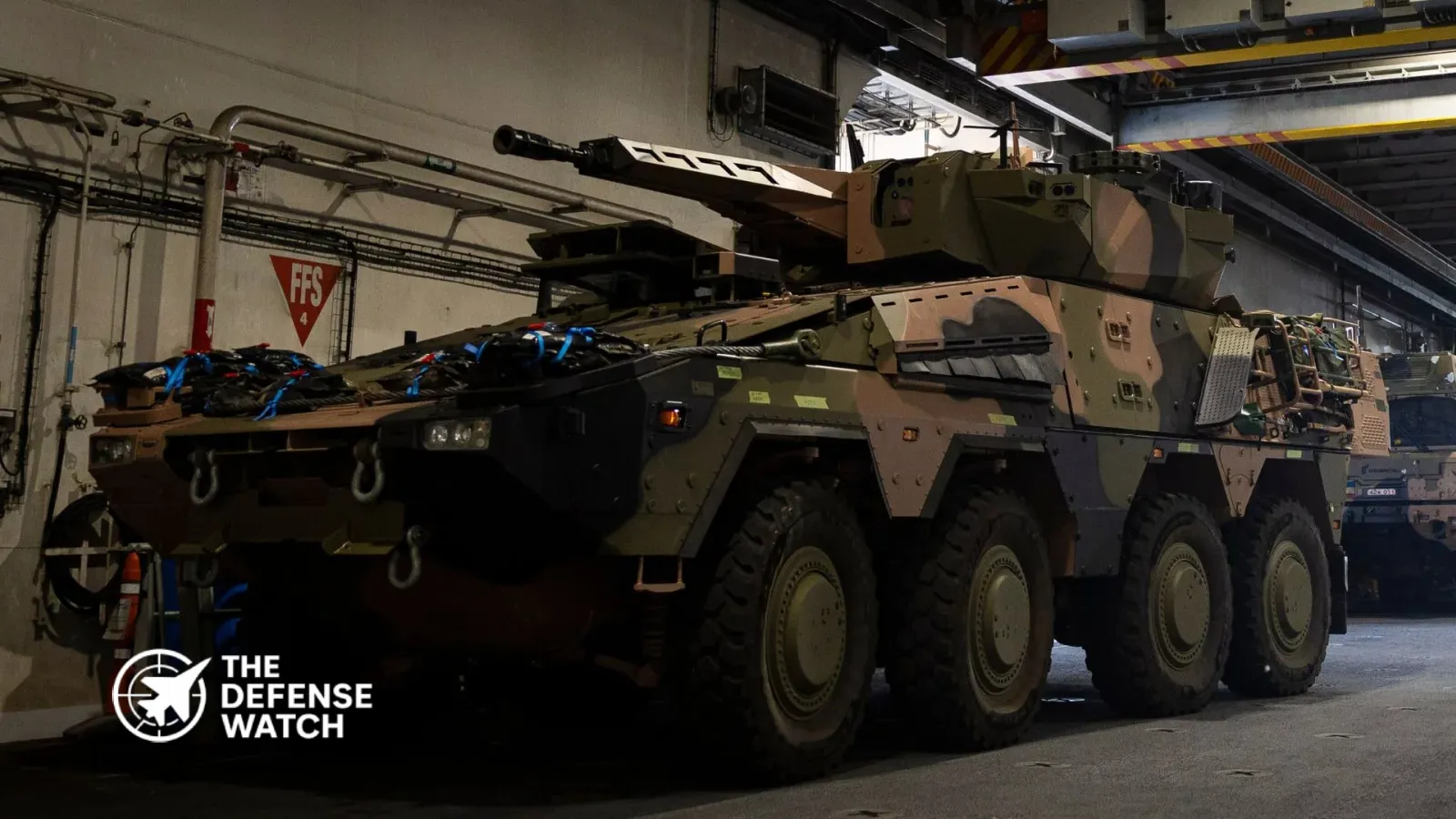
- First Australian-built Boxer combat reconnaissance vehicles have rolled off the production line.
- The vehicles are produced under the Land 400 Phase 2 program for the Australian Army.
- Manufacturing takes place at Rheinmetall’s Military Vehicle Centre of Excellence in Queensland.
- The Boxer CRV provides advanced reconnaissance, protection, and networked battlefield capabilities.
- The rollout strengthens Australia’s sovereign defense industrial base and local production capacity.
Australian-Built Boxer Combat Reconnaissance Vehicles Enter Service Pipeline
The Australian-built Boxer combat reconnaissance vehicles have officially rolled off the production line, marking a significant milestone in the country’s Land 400 Phase 2 modernization program and its push to expand sovereign defense manufacturing.
The rollout took place at the Military Vehicle Centre of Excellence operated by Rheinmetall in Queensland, where the vehicles are being assembled for delivery to the Australian Army.
This development signals the transition from initial overseas production to full domestic assembly, a key objective of Australia’s defense industrial strategy.
Transition to Sovereign Production
The Boxer Combat Reconnaissance Vehicle (CRV) program is part of Australia’s broader effort to modernize its armored fleet while reducing reliance on foreign manufacturing. Earlier vehicles were produced in Germany, but the latest rollout confirms that local production capability is now operational.
This shift carries both operational and strategic significance. From a capability standpoint, domestic production improves sustainment, maintenance, and upgrade cycles. From an industrial perspective, it strengthens local supply chains and workforce expertise in armored vehicle manufacturing.
Rheinmetall’s Queensland facility serves as the central hub for this effort, integrating Australian suppliers into the production process. The company has emphasized local industry participation as a core element of the program, aligning with government requirements for sovereign capability.
Platform Capabilities and Operational Role
The Boxer CRV is an 8×8 wheeled armored vehicle designed for reconnaissance, surveillance, and combat support missions. It features modular architecture, allowing different mission modules to be integrated depending on operational requirements.
Key capabilities include:
- Advanced sensor suites for long-range reconnaissance
- High levels of ballistic and mine protection
- A Lance turret equipped with a 30mm cannon
- Networked communications for integrated battlefield operations
For the Australian Army, the Boxer replaces aging reconnaissance platforms and introduces a more survivable, mobile, and digitally connected capability. Its design reflects modern operational needs, particularly in contested and dispersed environments.
Strategic Context and Regional Implications
The rollout of Australian-built Boxer combat reconnaissance vehicles comes amid broader regional military modernization trends in the Indo-Pacific. Countries across the region are investing in armored mobility, ISR capabilities, and network-centric warfare systems.
Australia’s approach stands out for its emphasis on domestic production. By building vehicles locally, Canberra is aiming to ensure long-term operational independence, particularly in scenarios where global supply chains may be disrupted.
This aligns with recent defense policy shifts that prioritize resilience, self-reliance, and rapid sustainment. The Boxer program is one of several initiatives designed to anchor these objectives in tangible industrial capacity.
Industrial and Economic Impact
Beyond military capability, the program has economic implications. The establishment of Rheinmetall’s facility has created jobs and fostered a domestic ecosystem of suppliers and subcontractors.
Local production also enables technology transfer and skill development, which can be leveraged for future defense projects. Over time, this could position Australia as a regional hub for armored vehicle production and support.
The Land 400 program, therefore, serves a dual purpose, enhancing military readiness while contributing to national industrial growth.
Program Outlook
Deliveries of the Australian-built Boxer CRVs are expected to continue in phases, supporting the gradual integration of the platform into operational units. As production ramps up, the focus will shift toward sustainment, upgrades, and potential export opportunities.
The successful rollout of locally manufactured vehicles suggests that Australia’s investment in defense industry infrastructure is beginning to yield measurable results.