

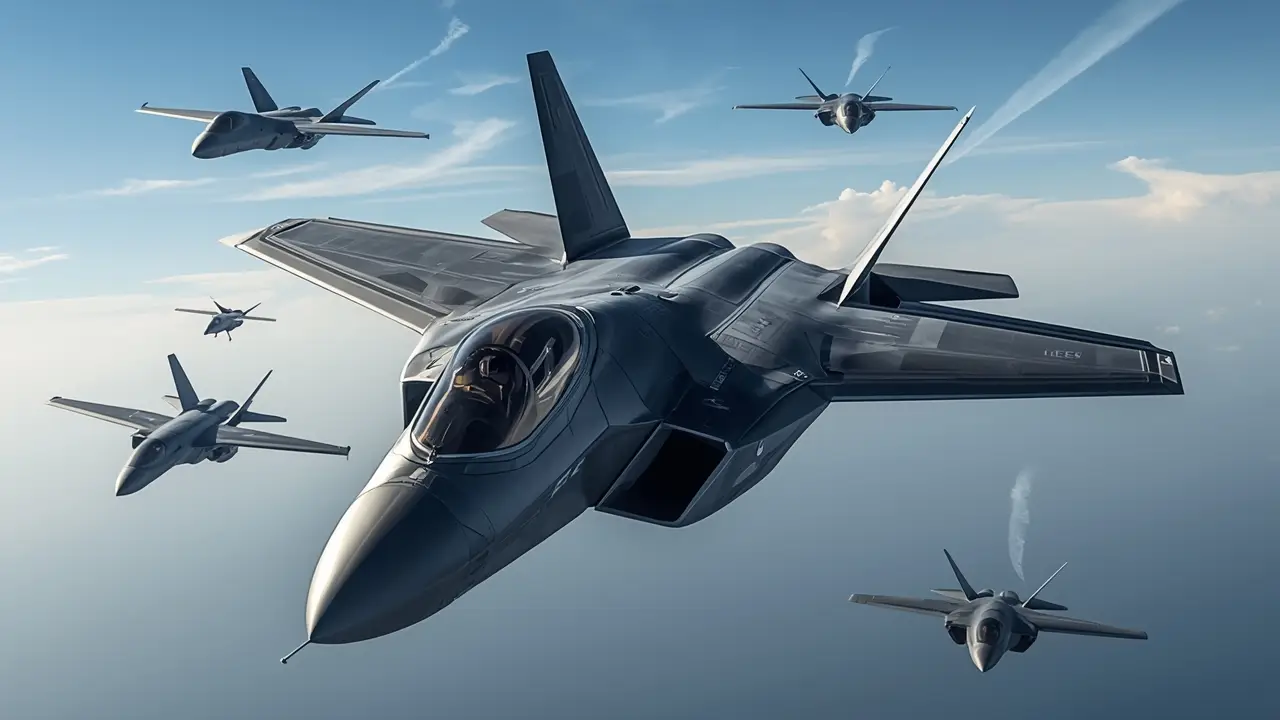
The Future of the F-35: From Manned to ‘Pilot-Optional
Lockheed Martin is pressing forward with a bold concept: transforming the F-35 from a purely piloted fighter into a pilot-optional platform, using advanced stealth, AI autonomy, and integration with drone systems. CEO Jim Taiclet shares that the company is building off its Next-Generation Air Dominance (NGAD) development efforts to bring “fifth-generation plus” capabilities to the current F-35 fleet within the next two to three years.
These upgrades include revamped stealth coatings, refined airframe shaping for enhanced radar and infrared signature reduction, improved electronic warfare systems, and enhanced autonomy—putting the F-35 on a path to becoming optionally piloted .
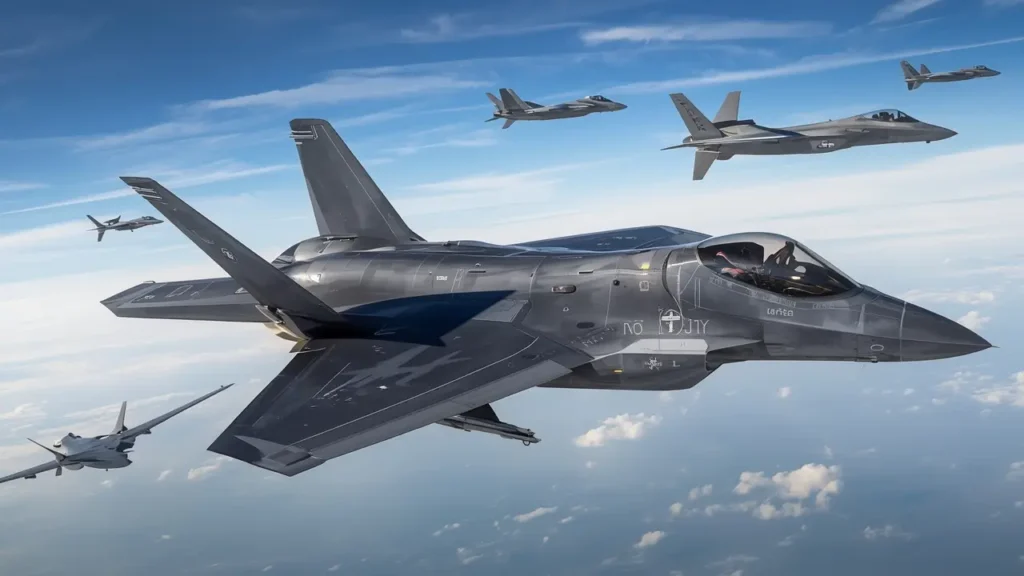
Bridging Generations: NGAD Tech Applied to Fielded Fighters
After losing the NGAD (Next-Generation Air Dominance) contract to Boeing’s F-47, Lockheed Martin is repurposing its NGAD investments into modernizing the F-35—and potentially the F-22—through a phased, cost-effective upgrade strategy.
These “fifth-gen plus” enhancements aim to deliver around 80% of NGAD’s capabilities at half the unit cost, offering a contemporary bridge between today’s operational airframe and tomorrow’s systems.
Block 4 upgrades are already underway, with NGAD-derived tech slated for accelerated adaptation within existing upgrade frameworks.
Networked Airpower: F-35 as Battle Manager in Multi-Domain Warfare
The optionally piloted F-35 could become a sophisticated battle manager and sensor node within a larger family-of-systems—coordinating with loyal wingman drones such as the XQ-58A Valkyrie or MQ-28 Ghost Bat under the Joint All-Domain Command and Control (JADC2) initiative.
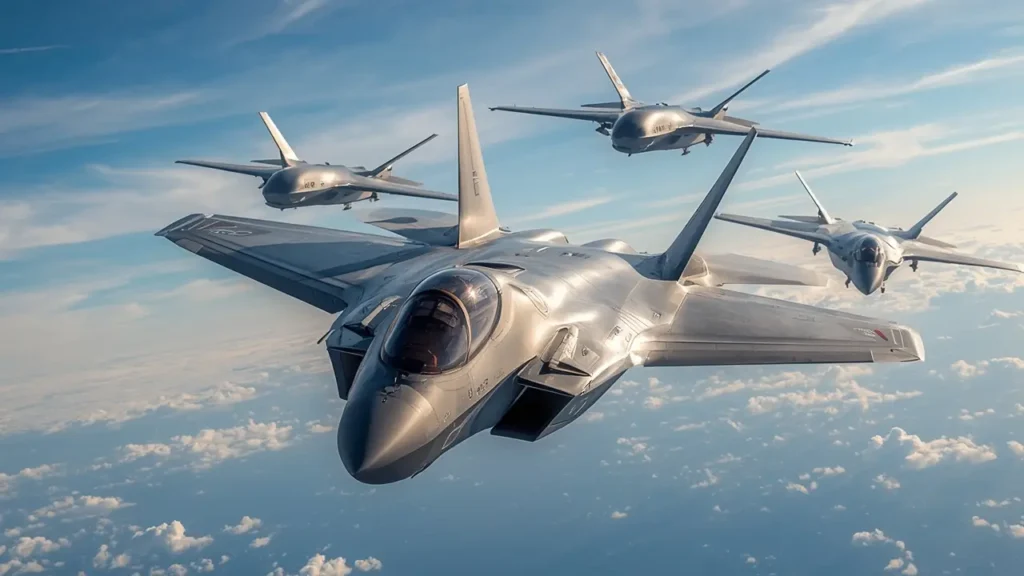
Initial demonstrations of semi-autonomous flight are expected in late 2026, with operational testing beginning in 2027 through the U.S. Air Force Life Cycle Management Center. Though no purchase contract for uncrewed F-35s has been announced yet, Air Force planners see autonomous capability as critical in high-threat, contested environments where pilot survival is at risk.
Context & Strategic Implications
The pilot-optional F-35 comes amid growing criticism of traditional manned platforms. Technology leaders like Elon Musk have labeled platforms like the F-35 obsolete, arguing that drones offer a safer and more cost-effective future for air combat.. However, defense analysts emphasize that fully autonomous systems are not yet a complete substitute—piloted aircraft still offer unmatched flexibility, payload capacity, and decision-making capability in complex airspaces.
Lockheed Martin’s new strategy responds directly to these challenges—offering flexible, blended capabilities that maintain the F-35’s relevance while preparing for a future dominated by automated and networked systems.
Analysis & Insight
Lockheed’s approach reflects a pragmatic modernization path. By integrating NGAD-derived technologies into an existing, proven airframe, the company could offer advanced capabilities without disrupting production lines or incurring steep new development costs. The move toward optional piloting also underscores a shift in doctrine—blurring lines between manned and unmanned combat aviation.
If hit its targets, Lockheed could preserve decades of investment in the F-35 while delivering near-NGAD performance. Success hinges on effective software integration, ensuring reliability of autonomous systems, and securing funding. The timeline—first flight demos by late 2026 and testing in 2027—suggests that the optionally piloted F-35 may soon move from concept into reality.
FAQs
Pilot-optional means the aircraft can be flown both with and without a pilot—operating autonomously or under pilot supervision when needed.
Lockheed plans initial semi-autonomous flight demos in late 2026, with operational testing scheduled to begin in 2027.
Lockheed is applying technologies developed for its NGAD efforts—like stealth improvements and electronic warfare—into the F-35, aiming for NGAD-level capability at lower costs.
It would function as a networked sensor and command node under JADC2, coordinating with drones and next-gen platforms for multi-domain operations.

10 comments
[…] Air Force demonstrated Combined JADC2 (CJADC2) prototypes via Common Tactical Edge Network with nine contractors. […]
[…] The J-10C first drew global attention during a recent India-Pakistan skirmish. Reports suggest that Pakistan deployed J-10Cs equipped with PL-15 missiles and succeeded in downing Indian Rafale fighters—marking the jet’s combat initiation and a symbolic win for Chinese aerospace. […]
[…] teaming & drones: Future air combat may see crewed fighters directing swarms of unmanned platforms, shifting the paradigm of […]
[…] Air Superiority: F-35 (stealth advantage, beyond-visual-range combat) […]
[…] scenarios requiring multirole strike missions, the Rafale holds the edge. In pure air combat and NATO integration, the Typhoon may prove superior. For the U.S., both remain critical allies’ […]
[…] increasing centrality of artificial intelligence, autonomy and machine-speed decision making in air combat. For example, Shield AI’s autonomy software previously controlled a modified F-16 in a dog-fight […]
[…] progress demonstrates the United States’ intent to maintain technological leadership in air combat […]
[…] complicating NATO exercises. However, vulnerabilities persist: reliance on imported components and pilot training gaps could blunt its edge against F-35 swarms. Ultimately, the Su-30SM warns that affordable, high-performance fighters democratize aerial […]
[…] Air combat is evolving. Pilots now rely on AI, drones, and long-range missiles more than close-range dogfighting. Future fighters will emphasize stealth, electronic warfare, hypersonic weapons, and loyal wingman drones. […]
[…] the PL-15 family is poised to remain a critical component of both Chinese and export customers’ air combat […]