• Home
  • About
  • Defense Systems
  • Manufacturer
  • Comparisons
  • Compare 
  • Tools
TheDefenseWatch.com
  • Aerospace & Aviation
  • Military & Ordnance
  • Naval & Maritime
  • Cyber & Space Defense
  • Policy & Strategy
  • Global News
  • Tools Library
    • Smart Calculator
    • Drone Flight Time Calculator
    • Drone Range Calculator
    • Counter-Drone Jammer Effective Range Calculator
    • Counter-Battery Radar Detection Calculator
    • Artillery Fire Correction Calculator
    • Thermal Camera Detection Range Calculator
    • Missile Range & Time-of-Flight Calculator
    • Radar Detection Range Calculator
    • FPV Strike Drone Payload vs Range Calculator
    • Loitering Munition Endurance Calculator
    • Sniper Ballistic Drop & Windage Calculator
    • Bullet Drop Calculator
    • U.S. Army Combat Fitness Test (ACFT) Calculator
    • Military Pension Calculator
    • Military Retirement Calculator
    • Military Pension Calculator
    • Large Number Calculator
Font ResizerAa

TheDefenseWatch.com

The Defense Watch | U.S. & Global Defense News, Analysis & Military Updates

Search
  • Home
  • About
  • Defense Systems
  • Manufacturer
  • Comparisons
  • Compare 
  • Tools

Stay Updated

Get the latest update

Subscribe

Explore

  • Drone
  • Fighter Jets & Military Aircraft
  • Hypersonic Weapons
  • Aircraft Carriers
  • Strategic History & Missions
  • Tools Library
Home » USS Nimitz Completes Carrier Qualification Training for New Navy Pilots
Aircraft CarriersNaval & Maritime

USS Nimitz Completes Carrier Qualification Training for New Navy Pilots

Samuel Drake | Defense Analyst
Last updated: November 10, 2026 10:10 pm
Samuel Drake | Defense Analyst
Share
3 Min Read
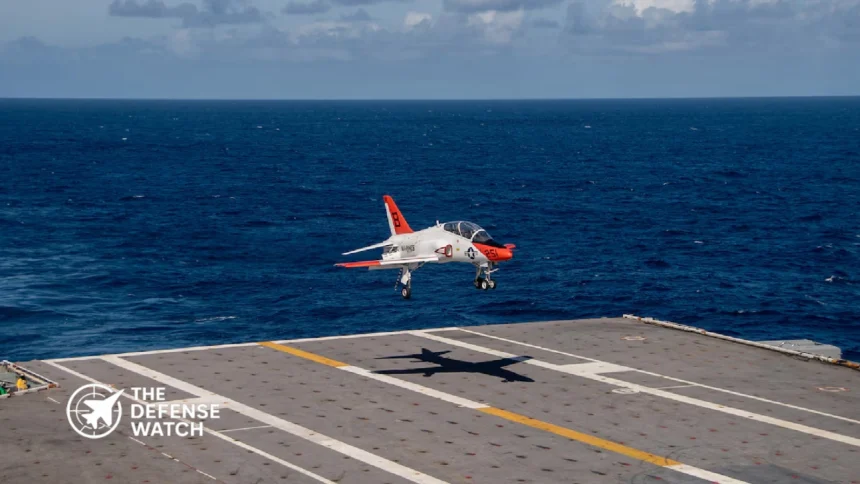
USS Nimitz carrier qualification training
A T-45C Goshawk, assigned to Training Air Wing 2, approaches the flight deck of the aircraft carrier USS Nimitz for landing during student naval aviator carrier qualifications in the Atlantic Ocean, Nov. 4, 2026.
SHARE

The U.S. Navy aircraft carrier USS Nimitz (CVN 68) has completed its first East Coast training deployment focused on qualifying new and returning naval aviators, recording 103 aircraft sorties and 442 arrested landings during the underway.

Contents
Super Hornet Pilots Prepare for Fleet AssignmentsT-45C Goshawk Students Complete Initial Carrier OperationsWhat the 442 Arrested Landings Tell UsUSS Nimitz training activityNimitz Uses Its Remaining Service Life to Support Navy ReadinessMore Carrier Qualification Periods Planned Before Inactivation

The carrier returned to Naval Station Norfolk, Virginia, on November 9, 2026, after supporting flight qualification activities for Carrier Air Wing 1 (CVW-1), Strike Fighter Squadron 106 (VFA-106) and student naval aviators from two Navy training air wings.

The training involved different stages of naval aviation development, from pilots preparing for their first fleet assignments to experienced aviators returning to carrier operations after serving in non-flying sea assignments.

According to the U.S. Navy’s November 9 report, the ship also supported 152 touch-and-go landings during the overall training period. These activities formed part of a broader effort to maintain the Navy’s pipeline of carrier-qualified aircrew.

- Advertisement -

Super Hornet Pilots Prepare for Fleet Assignments

One of the principal training activities involved VFA-106, known as the Gladiators, which operates as a Fleet Replacement Squadron (FRS).

Fleet Replacement Squadrons prepare naval aviators to operate specific aircraft types before they join operational fleet units. In this case, the training focused on F/A-18E/F Super Hornet strike fighters.

For some pilots, the underway provided their first experience conducting catapult launches and arrested recoveries aboard an operational aircraft carrier.

  • USS Nimitz Aircraft Carrier

    USS Nimitz Aircraft Carrier

    • Large Flight Deck: Supports CATOBAR operations
    • Onboard Air Wing: 60+ fixed-wing and rotary aircraft
    • Advanced Command & Control: Integrated CIC and data links
    • Defensive Weapon Systems: CIWS, RAM, Sea Sparrow
    • View Details →
    8.3

    Other aviators were returning to carrier-based flying after completing disassociated sea tours. These assignments involve serving at sea in positions that do not require regular flying, making renewed carrier qualification necessary before returning to operational aviation duties.

    The distinction is important because carrier aviation requires more than proficiency in flying a particular aircraft. Pilots must demonstrate that they can operate safely within the demanding conditions of a moving flight deck, including launch procedures, recovery approaches and coordination with flight deck personnel.

    The Navy said the qualification activities were intended to prepare both groups for their next fleet assignments.

    T-45C Goshawk Students Complete Initial Carrier Operations

    Following the air wing and fleet replacement squadron qualifications, Nimitz supported student naval aviators assigned to Chief of Naval Air Training (CNATRA) Training Air Wings 1 and 2.

    The students used T-45C Goshawk training aircraft to practice carrier launches and recoveries for the first time.

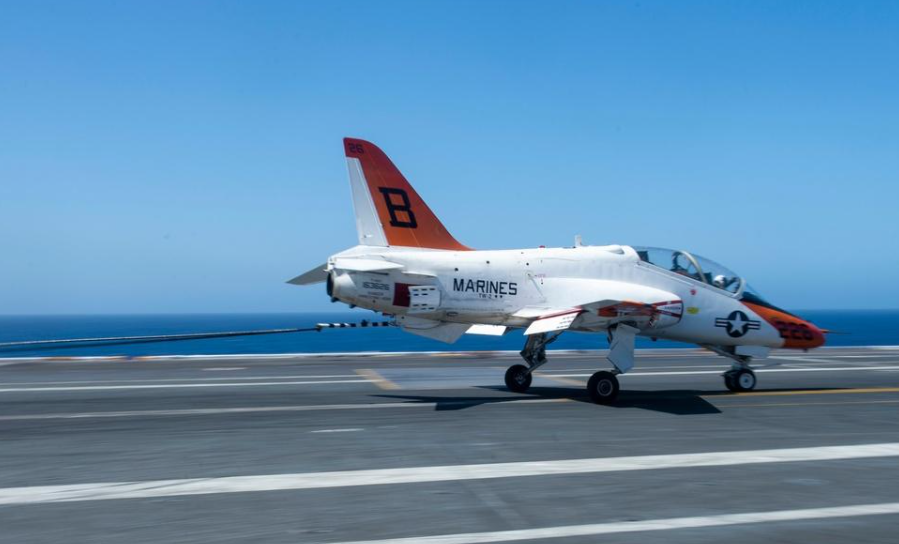
    T-45C
    A T-45C Goshhawk Makes An Arrested Gear Landing

    The T-45C is a carrier-capable jet trainer used in the Navy’s advanced flight training pipeline. Its role includes preparing student pilots for the procedures and operational demands associated with naval aviation.

    Carrier qualification is a particularly important stage because landing on an aircraft carrier presents challenges that are not encountered during conventional runway operations.

    The flight deck is relatively short and constantly moving, while pilots must coordinate their approaches with the ship’s landing signal officers and flight control personnel. Arrested landings require precise aircraft handling and timing to engage the carrier’s arresting system.

    The training also gives students experience operating alongside the sailors responsible for aircraft launches, recoveries and flight deck safety.

    What the 442 Arrested Landings Tell Us

    The training figures provide an indication of the amount of flight activity supported by Nimitz during the underway.

    USS Nimitz training activity

    103
    Aircraft sorties
    442
    Arrested landings
    152
    Touch-and-goes
    Nov. 9
    Return to Norfolk, 2026

    Source: U.S. Navy report published through DVIDS, November 9, 2026. Figures cover the overall underway.

    Arrested landings involve aircraft catching an arresting wire on the flight deck to stop within the available landing area. Touch-and-go training involves an aircraft making contact with the deck before taking off again, rather than completing a full arrested recovery.

    The Navy did not provide a breakdown of the figures by aircraft type, squadron or individual pilot. The totals therefore should be treated as an overall measure of the carrier’s training activity rather than a count of completed qualifications.

    The volume of activity nevertheless demonstrates the flight deck’s ability to support several aviation training requirements during a single underway period.

    Nimitz Uses Its Remaining Service Life to Support Navy Readiness

    The training mission has added importance because Nimitz is approaching the end of its service life.

    The Navy extended the carrier’s service period into March 2027, approximately 10 months beyond its previously planned May 2026 retirement. The extension allows the ship to continue supporting training and readiness activities while the service prepares for its eventual inactivation.

    The timing is also connected to the arrival of the future USS John F. Kennedy (CVN 79), the second Gerald R. Ford-class aircraft carrier. The Navy took preliminary acceptance of Kennedy in September 2026, with formal delivery expected in spring 2027.

    Rather than leaving Nimitz alongside the pier during its final months, the Navy is using the carrier to provide additional opportunities for pilots and sailors to maintain their qualifications.

    This approach also gives the Navy an opportunity to use an experienced carrier crew and an operational flight deck for training without relying exclusively on carriers assigned to deployment preparation or other fleet requirements.

    The ship had previously completed two deployments covering three areas of responsibility in less than two years, according to its commanding officer, Capt. Joseph Furco. That experience provides an established operational environment for personnel training aboard the carrier.

    More Carrier Qualification Periods Planned Before Inactivation

    The November underway is not expected to be Nimitz’s final training assignment.

    The Navy says the carrier is scheduled to conduct multiple additional carrier qualification underways before its eventual deactivation. However, the service has not disclosed the dates or detailed training schedules for those activities. Nimitz Trains New, Returning Naval Aviators

    For the Navy, the remaining training periods offer a practical way to sustain carrier aviation proficiency while preparing for the transition away from one of its longest-serving aircraft carriers.

    The latest qualification period demonstrates that Nimitz continues to contribute to naval aviation readiness beyond its traditional role as a deployed carrier. Its remaining service time is being used to prepare the next generation of naval aviators and help experienced pilots return to operational carrier flying.

TAGGED:Carrier OperationsNaval TrainingU.S. Navy aviationUSS Nimitz
Share This Article
Facebook Copy Link Print
BySamuel Drake | Defense Analyst
Follow:
Samuel Drake is a defense analyst at TheDefenseWatch.com covering naval warfare, military ordnance, maritime technology, fleet modernization, and defense procurement. His reporting focuses on documented capabilities, procurement programs, and military technology.

Search Defense Systems

Latest Defense Systems

  • TRML-4D Radar TRML-4D Radar
  • F-47A Fighter Jet F-47A Fighter Jet
  • China DF-61 Missile China DF-61 Missile
  • B61 Nuclear Bomb B61 Nuclear Bomb
  • Japan E-767 Airborne Japan E-767 Airborne
  • Remington 870 Shotgun Remington 870 Shotgun
  • RUTA B1 Cruise Missile RUTA B1 Cruise Missile
  • XQ-67A Drone XQ-67A Drone
  • B-25 Mitchell Bomber B-25 Mitchell Bomber

Recent Compares

  • J-10C vs JF-17 Thunder: Which Fighter Is More Capable? J-10C vs JF-17 Thunder: Which Fighter Is More Capable? View Comparison →
  • Tejas vs Gripen: Key Differences and Capabilities Tejas vs Gripen: Key Differences and Capabilities View Comparison →
  • Tejas vs MiG-21 Bison: How India Replaced Its Iconic Supersonic Fighter Tejas vs MiG-21 Bison: How India Replaced Its Iconic Supersonic Fighter View Comparison →
  • F-35 vs F-16: Stealth, Sensors and Combat Roles F-35 vs F-16: Stealth, Sensors and Combat Roles View Comparison →
  • Tejas Fighter Jet vs F-16 Fighting Falcon: Capability Compared Tejas Fighter Jet vs F-16 Fighting Falcon: Capability Compared View Comparison →
  • Rafale Fighter Jet vs F-16 Fighting Falcon : Which Fighter Has the Edge? Rafale Fighter Jet vs F-16 Fighting Falcon : Which Fighter Has the Edge? View Comparison →
  • Su-57 Fighter Jet vs J-20 Fighter Jet: Stealth and Air Combat Compared Su-57 Fighter Jet vs J-20 Fighter Jet: Stealth and Air Combat Compared View Comparison →
  • Mirage 2000 vs Tejas Mk1A: Legacy Combat Power vs Indigenous Modernization Mirage 2000 vs Tejas Mk1A: Legacy Combat Power vs Indigenous Modernization View Comparison →
  • Rafale Fighter Jet vs F-22 Raptor: Which Air Dominance Fighter Has the Edge? Rafale Fighter Jet vs F-22 Raptor: Which Air Dominance Fighter Has the Edge? View Comparison →
  • Tejas Fighter Jet vs. Rafale Fighter Jet: India’s Indigenous Fighter Meets France’s Proven Multirole Combat Aircraft Tejas Fighter Jet vs. Rafale Fighter Jet: India’s Indigenous Fighter Meets France’s Proven Multirole Combat Aircraft View Comparison →

Recent Posts

  • Raytheon JR3 Rocket: History, Design and Military Role
  • Raytheon Wins DARPA Contract to Develop All-Optical Signal Processing Technology
  • Lockheed Martin Delivers 100,000th GMLRS Rocket as Production Reaches 14,000 a Year
  • L3Harris CEO Sam Mehta Discusses Defense Spending and Missile Production on CNBC
  • L3Harris Demonstrates Multi-Domain Defense Network for Pacific Security

You Might Also Like

Canadian Patrol Submarine Project
Naval & MaritimeSubmarines

Canada Submarine Bid: Hanwha Ocean and Babcock Pitch Jobs-Focused Partnership for CPSP

September 7, 2026
Spain F-110 frigate program
Naval & Maritime

Spain Advances F-110 Frigate Program With Aegis and SPY-7 Radar

November 6, 2026
U.S. Marines conducting close-quarters urban raid training in a dense training environment during readiness exercise
Naval & Maritime

U.S. Marines Expand Urban Raid Training To Prepare For High-Intensity Combat In Dense Cities

June 1, 2026
MV-22B Osprey sonobuoy testing
Naval & MaritimeNaval Strategy & Maritime Security

MV-22B Osprey Completes First Navy Sonobuoy Acceptance Test

September 24, 2026

Logo

Copyright © 2026 TheDefenseWatch.com

Helpful Links

  • Home
  • About Us
  • Privacy Policy
  • Terms of Use / Disclaimer
  • U.S. Privacy Notice – CCPA Compliance

Defense Systems

  • Defense Systems
  • Comparisons 
  • Manufacturer
  • Tactical Calculators

Popuplar

Which 5 Air Forces Possess the Costliest Fighter Jet Fleets in the World
Evolving Strategic Value: Carrier Strike Groups in the Indo-Pacific’s Future Security Architecture
Autonomous Weapon Systems Spark U.S. Ethics Debate Amid Rapid Military AI Integration

We report on developments involving military forces, governments, defense companies, research organizations, and security institutions around the world. 

Welcome Back!

Sign in to your account

Username or Email Address
Password

Lost your password?