
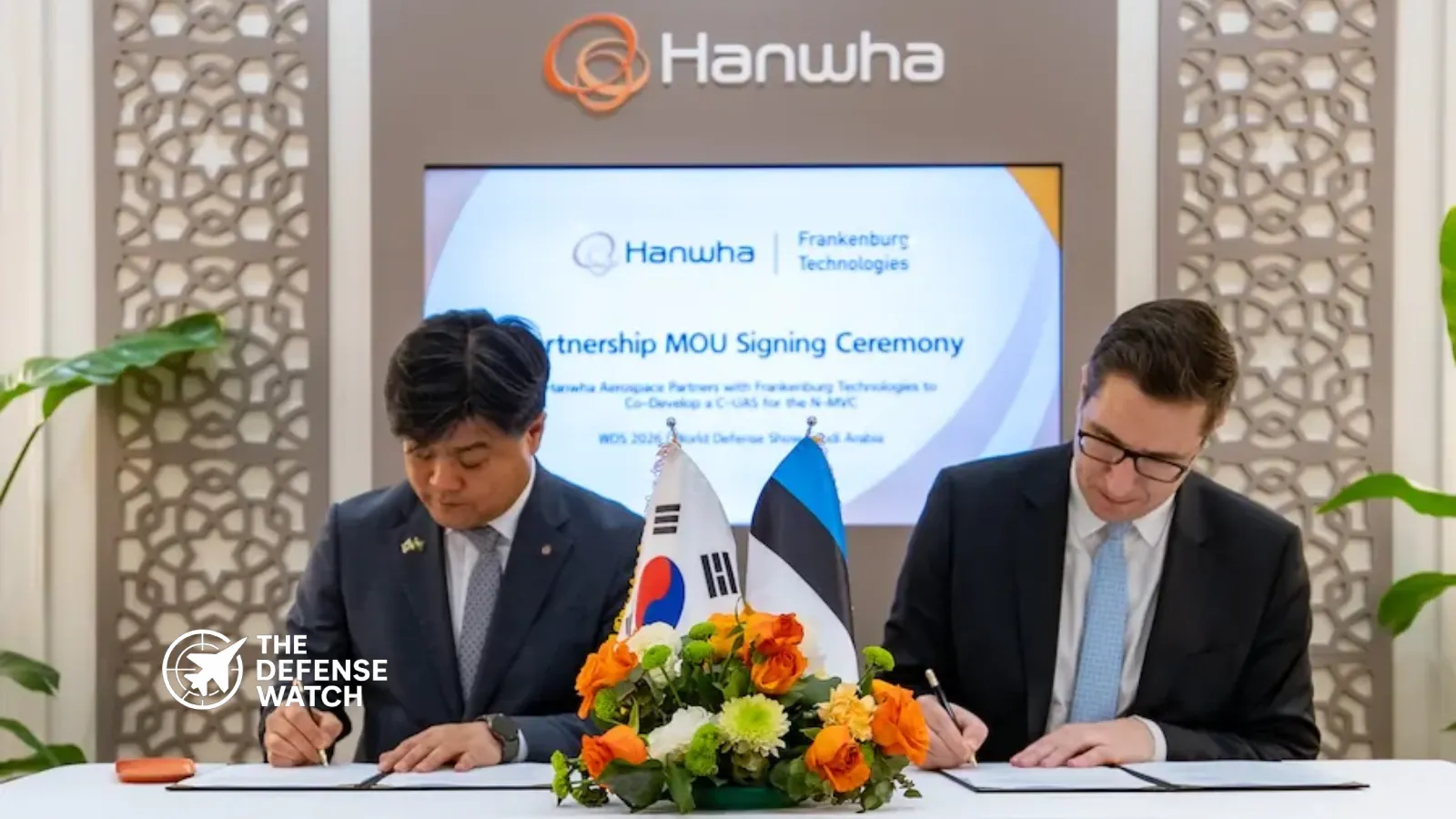
Hanwha Aerospace Counter Drone Systems Cooperation Expands In Europe
Hanwha Aerospace counter drone systems cooperation took a step forward as the South Korean defense firm signed a formal agreement with Estonia based Frankenburg Technologies. The deal focuses on joint development and potential deployment of counter unmanned aerial system capabilities, reflecting growing European demand for layered air and drone defense.
The cooperation was confirmed by Defence Industry Europe and aligns with broader NATO efforts to address the increasing battlefield role of low cost drones in Ukraine and other conflict zones.
Deal Overview And Strategic Context
The agreement establishes a framework for technology cooperation, system integration, and future production related to counter drone systems. While financial terms were not disclosed, both companies highlighted a shared focus on mobile, scalable, and networked solutions designed to counter small and medium sized unmanned aerial threats.
Frankenburg Technologies has positioned itself as a specialist in cost effective air defense concepts, including surface to air interceptor systems optimized for mass drone attacks. Hanwha Aerospace brings established expertise in radar, command and control, and missile systems already in service with multiple armed forces.
See also: South Korea Expands Defense Exports To Europe
Why Counter Drone Systems Matter Now
Counter drone systems have become a top procurement priority across Europe. Conflicts in Ukraine and the Middle East have demonstrated how commercially available drones can deliver reconnaissance, electronic warfare effects, and precision strikes at low cost.
According to NATO assessments, traditional air defense systems often struggle to economically counter large volumes of small UAVs. This has driven interest in hybrid approaches combining sensors, interceptors, electronic warfare, and layered command networks.
Hanwha Aerospace counter drone systems cooperation with Estonia reflects this shift toward affordable and adaptable air defense architectures.
Hanwha Aerospace European Strategy
Hanwha Aerospace has steadily expanded its European defense presence over the past three years. The company has secured major contracts in Poland for artillery, armored vehicles, and rocket systems, while pursuing partnerships across Northern and Eastern Europe.
By working with Estonia, a NATO member with strong digital and defense innovation credentials, Hanwha gains access to regional operational insight and local industrial integration. For Estonia, the partnership offers access to advanced manufacturing capacity and export scale.
Industry analysts note that such cooperation models are increasingly favored by European governments seeking rapid capability development without long procurement cycles.
Implications For NATO And Regional Defense
The Hanwha Aerospace counter drone systems initiative supports NATO’s broader push for distributed air defense and resilience against asymmetric threats. Estonia’s geographic proximity to Russia places a premium on early warning and rapid response systems, including counter UAV solutions.
While the agreement does not confirm immediate procurement by the Estonian Defence Forces, it creates a pathway for future acquisition, testing, and potential multinational use within NATO frameworks.
What Comes Next
Both companies stated that follow on technical work and demonstrations are expected in the near term. Future phases may include joint testing, export marketing to European customers, and system integration with existing NATO command structures.
As drone warfare continues to evolve, partnerships like this signal a shift toward faster, industry driven responses to emerging threats.
Get real time update about this post category directly on your device, subscribe now.
