

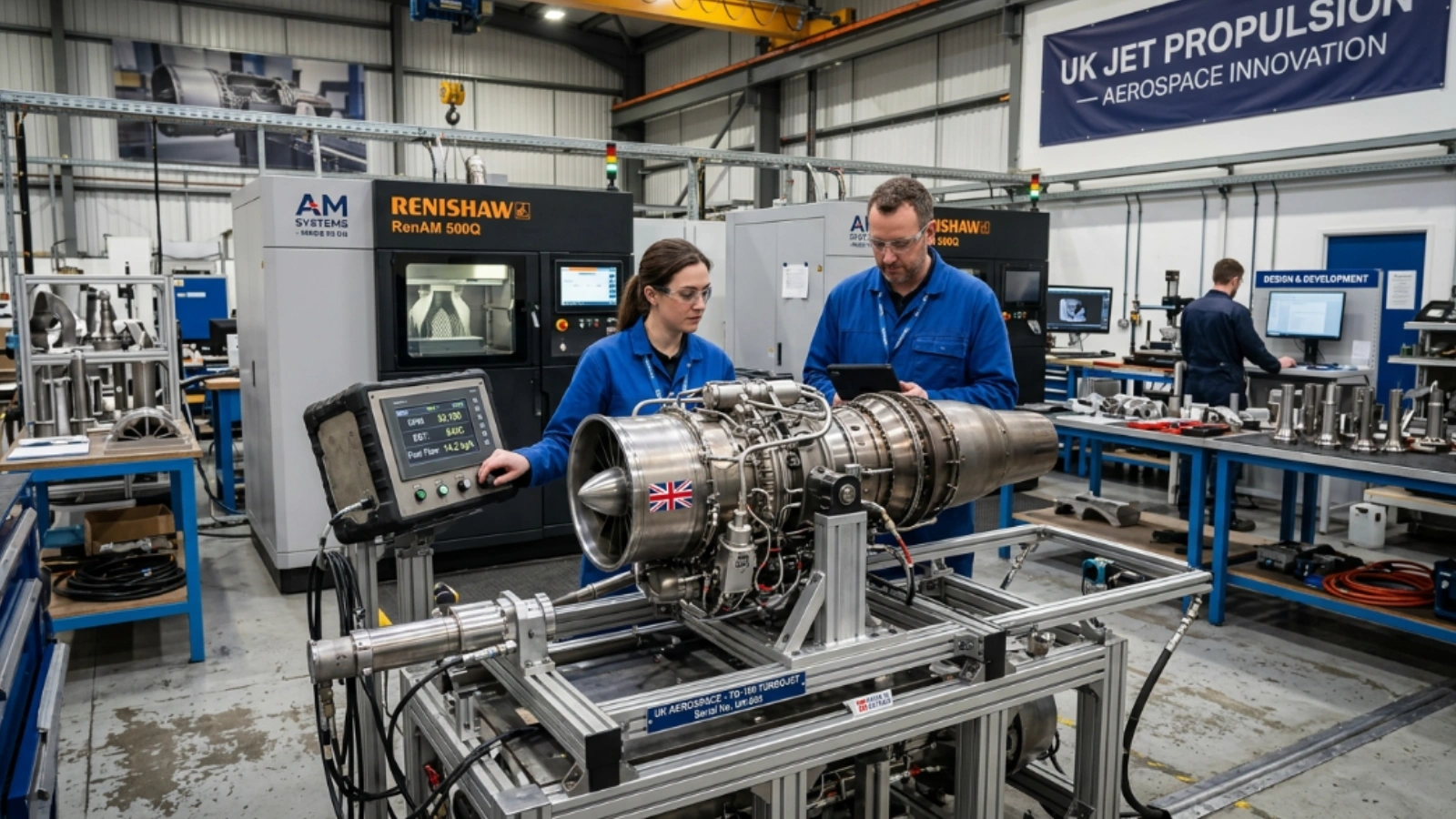
Executive Summary: The UK Ministry of Defence and British technology company Alloyed have developed a family of digitally manufactured turbojet engines intended to strengthen the country’s sovereign propulsion capacity. The program covers engines from 30N to 2,000N of thrust, with a 300N-class engine having completed flight testing and entered serial production in Britain. A larger 1,100N-class engine reached flight-ready status less than seven months after its initial concept, demonstrating how digital engineering, modular architecture and advanced manufacturing can shorten propulsion development cycles. The effort also involves more than 40 UK suppliers and has created more than 60 engineering and advanced manufacturing jobs, with another 45 positions expected as production expands.
UK Sovereign Turbojet Program Moves From Development to Production
The UK sovereign turbojet engine initiative has reached a significant production milestone, with the Ministry of Defence and British start-up Alloyed developing a family of engines designed, built and tested in Britain.
The MOD said on September 15 that the program, led by its Strategic Capabilities Office, has produced engines covering a thrust range from 30N to 2,000N. The range is intended to support applications extending from small drones to larger aircraft.
Two engines have already reached advanced stages. A 300N-class engine has completed flight testing and entered serial production in the UK, while an 1,100N-class engine progressed from initial concept to flight-ready status in less than seven months.
The announcement does not disclose a specific production contract value or identify an operational aircraft or drone program that has adopted the engines. The immediate significance is therefore the establishment of domestic propulsion development and manufacturing capacity rather than the fielding of a named weapon system.
Digital Engineering Is Central to the Approach
The program combines digital design, engineering, manufacturing and testing with a modular engine architecture.
According to the MOD, the digital design and modeling approach is intended to allow new propulsion systems and variants to be designed, assessed and moved into production in months rather than years. The modular architecture is also intended to allow upgrades without requiring extensive redesign of the overall engine.
That approach addresses a longstanding challenge in propulsion development. Engine programs normally require extensive design work, specialist materials, manufacturing processes, testing and qualification before production can begin. Compressing those stages requires more than faster machining or additive manufacturing. It requires digital continuity between design, materials, manufacturing and validation.
Alloyed’s broader technology platform is built around computational alloy design, optimized component geometry, engineered laser processing and digital production controls. Its propulsion business, branded Argive, describes its approach as mission-optimized and scalable propulsion intended for lower-cost production.
Engine Range Covers Multiple Aircraft Classes
The program’s published thrust range provides an indication of its intended flexibility.
| Engine Class | Thrust | Program Status |
|---|---|---|
| Family range | 30N to 2,000N | Development family |
| A300 class | 300N | Flight tested, serial production |
| A1100 class | 1,100N | Flight-ready in under seven months |
The 300N-class engine is particularly important from an industrial perspective because it has moved beyond development into serial production in Britain. The 1,100N-class engine demonstrates the program’s ability to apply the same development model to a substantially larger propulsion requirement.
The range also gives the UK a potential common engineering base for different classes of unmanned and small aircraft. However, the MOD has not announced that every engine in the 30N to 2,000N range has reached production or flight testing.
Why Domestic Propulsion Capacity Matters
Propulsion is one of the most technically demanding elements of aerospace manufacturing. Control over engine design, materials, manufacturing and sustainment can influence how quickly a country can modify or replace an aircraft or unmanned system.
For the UK, the issue is closely connected to its broader defense industrial strategy. The 2025 Strategic Defence Review called for a more resilient defense industrial base capable of scaling production and innovation at speed. It also emphasized faster acquisition, closer cooperation with industry and greater use of modular and rapidly developed technologies.
The government’s Defence Industrial Strategy 2025 similarly identifies resilient domestic industry, advanced innovation and faster procurement as major objectives.
The Alloyed program fits that policy direction because it focuses on an enabling technology rather than a single platform. A propulsion architecture that can be adapted across different aircraft classes could potentially support several future programs without requiring a completely new industrial base for each application.
Supply Chain Extends Beyond Alloyed
The effort is also designed to build a wider British manufacturing network.
The MOD said more than 60 engineering and advanced manufacturing jobs have already been created through the program, with another 45 positions expected during the following 12 months as production expands. More than 40 UK suppliers, primarily small and medium-sized businesses, are involved in the wider supply chain.
This matters because sovereign production is not simply a question of assembling a finished engine domestically. A durable propulsion capability requires access to materials, precision manufacturing, testing, quality control and specialist engineering skills.
A distributed supplier base can also provide greater resilience than relying on a single manufacturing location or imported component chain. At the same time, maintaining that capability at production scale requires sustained demand, qualification and investment beyond an initial technology demonstration.
Implications for Drones and Future Air Systems
The program’s timing is relevant to the rapid expansion of unmanned aircraft and other relatively low-cost air systems.
The UK Strategic Defence Review specifically identified autonomy, artificial intelligence and rapidly delivered technology as important parts of future military capability. It also called for closer links between Defence and private-sector technology companies.
Small turbojets can provide propulsion for aircraft that require greater speed or endurance than many electrically powered systems can deliver. A domestic supply of such engines could therefore support future unmanned systems while giving designers more freedom to tailor propulsion to mission requirements.
The main technical challenge will be scaling production while maintaining engine reliability, consistency and qualification standards. Moving quickly from a successful prototype to a repeatable production process is a different industrial problem from demonstrating that an individual engine can fly.
Potential Allied Relevance
The UK also views the capability through an allied industrial lens.
The MOD said the program could contribute to future defense exports and provide potential propulsion solutions for allies seeking resilient and sovereign supply chains.
That objective is consistent with the Strategic Defence Review’s emphasis on international capability partnerships and stronger allied defense-industrial capacity. The review specifically identifies cooperation with the United States and other partners as an important part of strengthening collective defense industrial capacity.
For the United States and other NATO members, the broader lesson is that propulsion can become a bottleneck when demand for drones and other aircraft increases rapidly. Distributed production of smaller engines could provide another industrial pathway alongside traditional large aerospace engine manufacturers.
What Comes Next
The immediate milestone is the transition of the 300N-class engine into serial production and the continued maturation of the larger 1,100N-class design.
The next test for the program will be whether its digital engineering and modular manufacturing model can maintain its development speed as production volumes increase. Cost, reliability, qualification, supply-chain resilience and sustained customer demand will ultimately determine how significant the capability becomes.
For now, the program establishes a new British source of domestically designed and manufactured turbojet propulsion, while demonstrating a development model centered on rapid digital engineering rather than the longer timelines traditionally associated with new aerospace engines.
Key Facts
| Metric | Reported Detail |
|---|---|
| Program partners | UK Ministry of Defence and Alloyed |
| Lead MOD organization | Strategic Capabilities Office |
| Engine family | 30N to 2,000N thrust |
| 300N-class engine | Flight tested and in UK serial production |
| 1,100N-class engine | Flight-ready in less than seven months |
| UK suppliers | More than 40 |
| Jobs created | More than 60 |
| Additional jobs expected | 45 over the next 12 months |
| Manufacturing location | United Kingdom |
| Development approach | Digital engineering, modular architecture and advanced manufacturing |
