UK Explores Ground-Based Role for DragonFire Laser Weapon After Naval Trials
The United Kingdom is examining whether its DragonFire high-energy laser weapon could support ground-based military operations, potentially extending the technology beyond its planned Royal Navy deployment.
The Ministry of Defence confirmed the exploration in a written parliamentary answer published on November 23, 2026. Responding to Conservative MP Ben Obese-Jecty’s question about the feasibility of using DragonFire on land, Defence Minister Luke Pollard said the department was considering applications across different operational environments, including the land domain.
The response signals interest in a broader role for British directed-energy weapons, but it does not establish that the government has approved a land-based DragonFire programme. No procurement decision, deployment schedule, vehicle configuration or specific Army requirement was announced.
For now, the Royal Navy remains the confirmed first customer, with DragonFire scheduled to enter service aboard a Type 45 destroyer from 2027.
Parliamentary Answer Opens the Door to Land Applications
The November 23 response followed an earlier parliamentary question submitted by Obese-Jecty on November 2, 2026.
In that earlier exchange, Pollard said the Ministry of Defence was exploring how DragonFire could be used across a range of operational environments as part of the transition towards a Hybrid Navy and wider armed forces modernisation.
The latest answer specifically addressed the feasibility of land applications, but provided no technical assessment or details of potential configurations.
That distinction matters. Exploring a possible operational role is not the same as approving a new weapon system for the British Army.
A ground-based version could eventually support protection of military installations, deployed formations or other critical assets against unmanned aerial systems. However, these are potential applications, not confirmed Ministry of Defence requirements.
DragonFire’s Development and Naval Milestones
DragonFire is a high-energy laser directed-energy weapon developed by the UK’s Defence Science and Technology Laboratory (Dstl) with industry partners MBDA UK, Leonardo and QinetiQ.
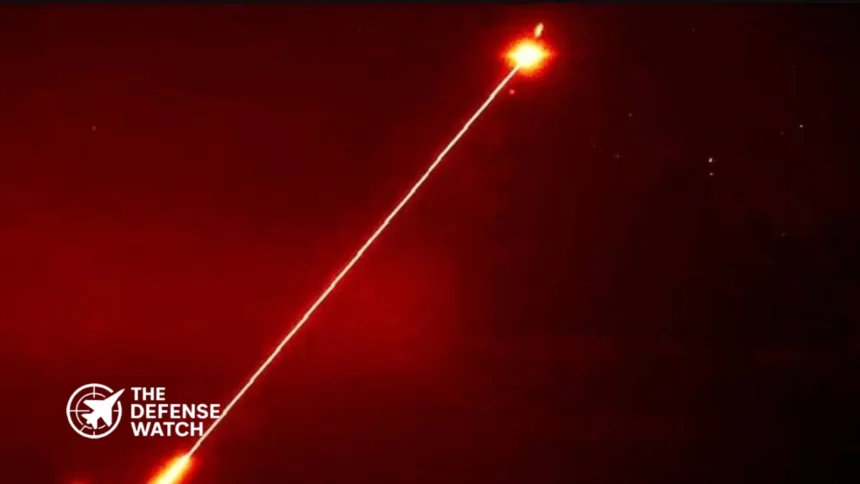
Its intended role is to engage aerial threats using a concentrated laser beam rather than conventional ammunition.
The programme achieved an important milestone in January 2024, when the Ministry of Defence announced the first UK high-power laser firing against aerial targets at the Hebrides Range.
The government described DragonFire as a line-of-sight weapon, meaning it must have a clear path to its target. Its engagement range remains classified.
Further testing demonstrated its ability to engage faster-moving aerial targets.
On November 20, 2025, the Ministry of Defence announced that DragonFire had successfully engaged high-speed drones during trials. The target aircraft were capable of speeds up to 650 kilometres per hour.
The government also reported above-the-horizon tracking, targeting and engagement during the trials. This was a notable test result, although it does not mean the weapon can engage targets without a direct line of sight.
The same announcement confirmed a £316 million contract awarded to MBDA UK to deliver two DragonFire systems for the Royal Navy. The first installation is planned for a Type 45 destroyer from 2027.
Why a Ground-Based Version Could Matter
Drone warfare has increased demand for air defense systems capable of dealing with relatively inexpensive unmanned aircraft without exhausting stocks of costly interceptor missiles.
A laser weapon offers a different approach. Instead of launching a missile or firing a conventional projectile, it directs concentrated energy onto a target. Once the system has acquired and maintained the target, the beam can deliver energy continuously while the engagement lasts.
The potential advantages include:
- Lower engagement costs: The UK government has cited an estimated firing cost of approximately £10 per shot for DragonFire.
- Reduced ammunition dependence: The weapon does not rely on conventional missile stocks for each engagement.
- Rapid engagement: Laser energy travels at the speed of light, although target acquisition and the time required to damage a target still matter.
- Repeated engagements: Electrical power and thermal management, rather than a conventional ammunition magazine, determine important aspects of sustained operation.
These characteristics could make DragonFire useful against selected drone threats, particularly where defenders face repeated engagements.
However, the quoted £10 figure refers to the cost of firing, not the total cost of acquiring, installing, operating and maintaining a complete weapon system.
Britain Already Has a Separate Army Laser Demonstrator
The potential land application of DragonFire should not be confused with the British Army’s existing vehicle-mounted laser programme.
In December 2024, the Ministry of Defence confirmed that soldiers from 16 Royal Artillery had tested a laser directed-energy weapon mounted on a Wolfhound protected vehicle at Radnor Range in Wales.
That demonstrator was developed through Team Hersa, involving the Defence Science and Technology Laboratory, Defence Equipment and Support and an industry consortium led by Raytheon UK.
The trials demonstrated the ability to track and engage hovering drones. The programme was supported by a £16.8 million contract involving several British technology companies.
This is a separate development effort from DragonFire.
The distinction is important because Britain is pursuing multiple directed-energy technologies rather than simply adapting one naval weapon for every military environment.
The Army’s Wolfhound demonstrator also provides an existing basis for understanding how vehicle-mounted lasers could operate alongside ground forces.
Technical Challenges Remain for Land Deployment
A land-based DragonFire would face different operational requirements from a system installed aboard a destroyer.
Warships provide a relatively stable platform with established electrical generation, cooling and combat-management infrastructure. A mobile ground system would need to operate within the constraints of a vehicle or deployable installation.
Several factors would influence its practical usefulness:
Power and cooling: High-energy lasers require substantial electrical power and thermal management. A mobile configuration would need to accommodate these requirements without compromising vehicle mobility or endurance.
Line-of-sight restrictions: Buildings, terrain, vegetation and other obstacles can prevent the laser from engaging an approaching drone. This limits the areas a ground-based system could protect.
Weather and atmospheric conditions: Rain, fog, dust and other atmospheric effects can interfere with laser transmission and reduce engagement effectiveness.
Target tracking: Small drones, low-altitude flight paths and multiple simultaneous targets can complicate detection, tracking and engagement.
Integration: A land-based system would need suitable sensors, command-and-control connections, power supplies and protection for its operators and equipment.
These constraints mean DragonFire would be more likely to complement conventional air-defense weapons than replace them.
Britain’s Wider Directed-Energy Investment
The exploration of DragonFire’s land role comes as the UK increases investment in directed-energy weapons.
In its October 6, 2026 parliamentary response, the government confirmed that £490 million had been allocated within the Defence Investment Plan for directed-energy weapons, covering both laser systems, including DragonFire, and radio-frequency weapons.
The same answer confirmed that the £316 million DragonFire contract covers the procurement of two systems, excluding VAT. The government did not disclose the precise funding breakdown between individual technologies.
This wider investment provides a financial and policy framework for further development, but it does not mean that the entire allocation is intended for DragonFire or a future land-based version.
For the British Army, the immediate priority remains developing and evaluating directed-energy capabilities against the growing range of drone threats.
Whether DragonFire eventually joins that effort will depend on technical assessments, operational requirements and future procurement decisions.
The Ministry of Defence has confirmed that land applications are under consideration. It has not yet committed to delivering a ground-based DragonFire weapon.
Enjoying our coverage?
Make The Defense Watch a preferred source on Google to see more of our geopolitical and defense insights when relevant to you.