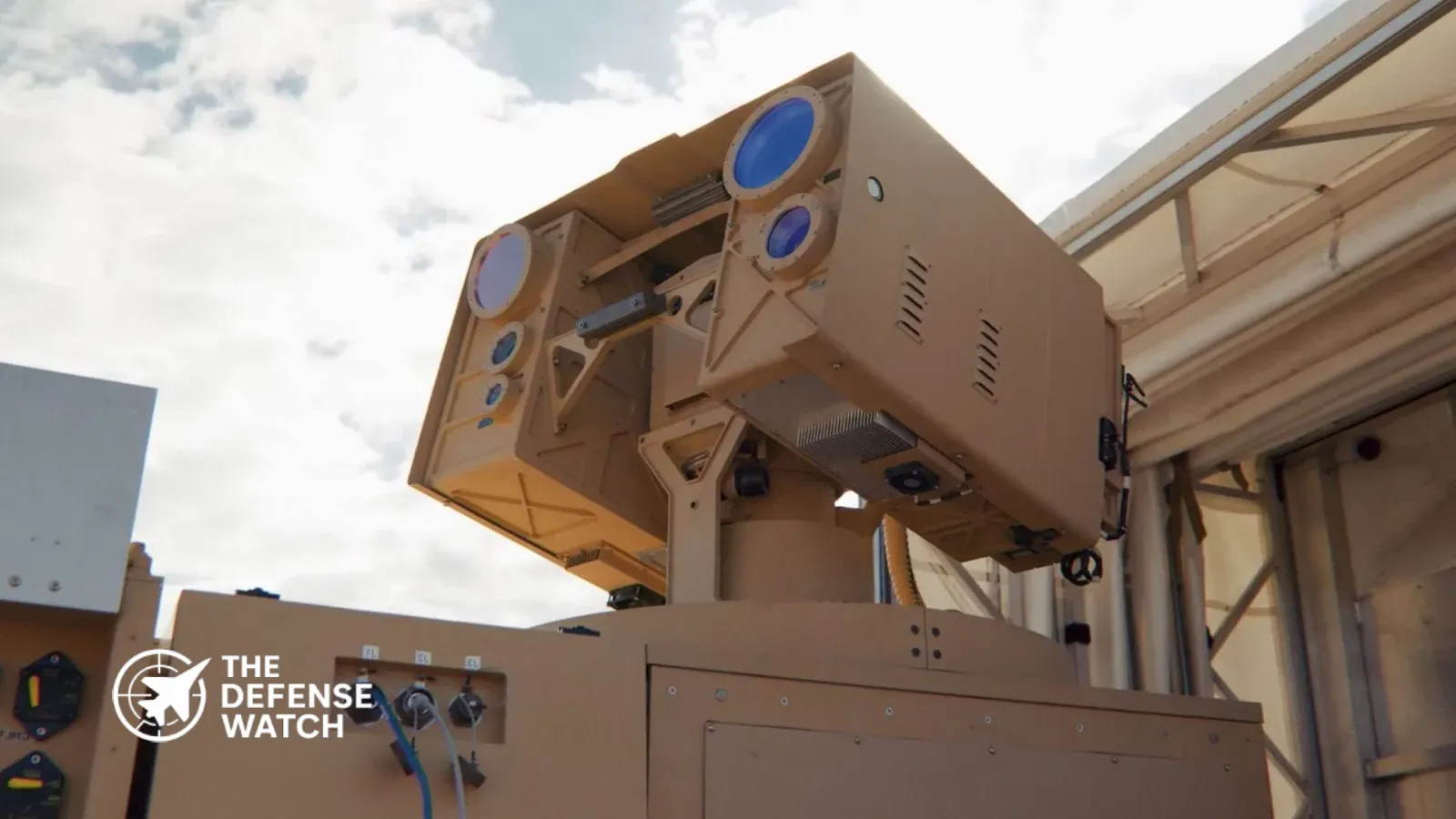
China has demonstrated a new application of its Guangjian directed-energy weapons, using ground-based laser systems to engage multiple waves of incoming drones during a field test in the Gobi Desert. The reported trial focused on low-altitude aerial threats approaching from different directions, a scenario intended to simulate the challenges posed by coordinated unmanned aircraft attacks.
The test offers a look at China’s efforts to develop laser-based counter-unmanned aircraft systems (C-UAS), particularly technologies intended to reduce the cost and response time associated with defending against relatively inexpensive drones.
According to a November 4 report by China’s Science and Technology Daily, cited by the Global Times, the Guangjian series was developed by the AVIC Manufacturing Technology Institute. During the reported exercise, incoming drones were struck by laser beams, caught fire and crashed before reaching their simulated target.
However, the report does not disclose the number of drones involved, laser output power, engagement distances or the precise configuration of the weapon system. Those omissions make it difficult to assess the system’s performance against operationally representative drone attacks.
Guangjian’s Development Focuses on More Than Laser Power
The reported development work addresses several engineering challenges that affect the practical use of high-energy laser weapons.
Zhou Shuiliang, a laboratory director at the AVIC Manufacturing Technology Institute, told Science and Technology Daily that the research team had worked on optical fiber manufacturing, heat dissipation, temperature control and precision targeting.
These components are important because a military laser requires more than a powerful energy source. Its effectiveness depends on maintaining beam quality, accurately tracking a moving target and delivering sufficient energy to a vulnerable part of the aircraft.
One area of development involves specialized optical fibers used to transmit and amplify laser energy. According to the report, these fibers incorporate rare-earth elements and require carefully controlled manufacturing processes.
Previously, technicians relied on manual adjustments to manage multiple production parameters during fiber drawing. Small variations could affect fiber quality and manufacturing consistency.
The research team subsequently introduced an intelligent multivariable control system that uses algorithms to coordinate adjustments during production. The reported objective is to improve manufacturing efficiency and increase the proportion of fibers meeting required quality standards.
This is an important industrial consideration. Producing a successful laboratory laser does not automatically establish the ability to manufacture consistent components for a larger number of operational systems.
Thermal Management Is a Critical Part of the Program
Heat management is another challenge identified in the Guangjian development effort.
High-energy laser systems generate substantial heat during operation. If that heat cannot be removed effectively, temperatures can affect equipment reliability, optical performance and the length of time a weapon can remain available for engagements.
The Chinese research team reportedly developed a phase-change cooling material using paraffin as its base. The material absorbs heat as it melts, providing a means of managing temperature inside a relatively confined system.
Bai Zhen, a member of the research team, told Science and Technology Daily that adjustments to the material’s formulation and packaging were followed by a test in which the laser operated continuously for 30 minutes while maintaining stable temperatures.
The 30-minute result is potentially relevant to sustained operation, but it should not be interpreted as proof that the complete weapon can continuously engage drones for that duration. The published account does not provide sufficient information about the test configuration, power level, environmental conditions or whether the measurement covered the entire operational system.
For military users, thermal management affects more than firing duration. It can influence the number of engagements available during an attack, maintenance requirements and the physical size of a weapon platform.
Why China Is Interested in Laser-Based Counter-Drone Defense
The growing use of inexpensive unmanned aircraft has created a difficult economic problem for conventional air defense systems.
A defender may need to use a relatively expensive interceptor missile against a drone that costs considerably less to manufacture. Repeated engagements can consume limited missile inventories and place additional pressure on logistics and resupply.
High-energy lasers offer a different approach.
Unlike conventional interceptors, laser weapons deliver energy directly to a target rather than launching a physical projectile. Their beams travel at the speed of light, making the energy transfer effectively instantaneous once a target has been acquired and the beam is properly aligned.
The engagement itself is not instantaneous, however. The weapon must detect and track the aircraft, maintain accurate pointing and hold sufficient energy on a vulnerable area long enough to cause the required damage.
The Global Times quoted military affairs expert Song Zhongping as saying that laser weapons could complement short-range air defense and missile systems because of their rapid response and potentially lower interception costs.
For China, the potential application extends beyond defending individual military installations. Ground-based laser systems could eventually support the protection of airfields, command facilities, logistics hubs and other important infrastructure against small unmanned aircraft, provided they meet operational requirements.
That remains a potential role rather than a confirmed deployment capability for Guangjian.
The Drone-Swarm Challenge Remains Difficult
The reported Gobi Desert exercise is particularly relevant because it involved multiple waves of drones approaching from different directions.
Such scenarios place additional demands on target detection, tracking and engagement management. A weapon that performs well against an isolated drone may face substantially different challenges when several aircraft arrive within a short period.
A laser system must acquire each target, maintain a sufficiently stable beam and deliver the required energy. Depending on the weapon’s power and the vulnerability of the target, this process can take several seconds or longer.
The Congressional Research Service has identified saturation attacks as one of the limitations of high-energy laser weapons. A laser generally engages one target at a time, and the time needed to damage one aircraft and redirect the beam can limit the number of targets a single system can defeat within a given period.
This limitation is particularly important when considering coordinated attacks involving numerous low-cost drones.
Multiple laser emitters, improved tracking systems and integrated air-defense networks could help address the problem. However, these solutions introduce additional requirements involving electrical power, cooling, sensors, communications and system integration.
The Chinese report does not establish how Guangjian performed against a large-scale saturation attack or whether several independent laser units participated in the exercise.
Operational Limitations That China Must Address
Laser weapons have advantages, but they are not universal replacements for conventional air defense.
Atmospheric conditions can affect their performance. Rain, fog, dust, smoke and other airborne particles can absorb or scatter laser energy, reducing beam quality and effective engagement distance.
Line-of-sight restrictions also limit their usefulness against aircraft flying behind terrain or other obstacles.
The U.S. Government Accountability Office identified atmospheric conditions, cooling requirements and declining effectiveness over distance as important challenges for directed-energy weapons in its Science and Technology Spotlight on the technology.
The Congressional Research Service’s January 2026 defense primer also identifies technological maturity, power requirements, cooling and platform integration as continuing issues for high-energy laser development.
These limitations matter in real military environments, where a counter-drone system must function under changing weather conditions, electronic interference and potentially simultaneous attacks from different directions.
For that reason, laser weapons are generally better understood as one layer of an integrated air-defense network rather than a standalone solution.
A practical counter-UAS architecture may combine radar, electro-optical sensors, electronic warfare, guns, conventional missiles and directed-energy weapons. Different systems can address different target types and engagement conditions.
What the Guangjian Test Establishes, and What Remains Unknown
The reported exercise provides evidence of progress in China’s laser manufacturing and thermal-management research, alongside a claimed demonstration against multiple incoming drones.
However, several important performance indicators remain undisclosed.
| Performance area | Publicly reported information |
|---|---|
| Developer | AVIC Manufacturing Technology Institute |
| System family | Guangjian |
| Weapon type | Laser-based directed energy |
| Test location | Gobi Desert, Northwest China |
| Target profile | Low-altitude unmanned aircraft |
| Engagement scenario | Multiple waves approaching from different directions |
| Cooling development | Paraffin-based phase-change material |
| Reported thermal test | 30 minutes of continuous laser operation |
| Laser output power | Not disclosed |
| Engagement distance | Not disclosed |
| Number of targets | Not disclosed |
| Operational deployment | Not established |
The distinction between a successful demonstration and a field-ready weapon is important. The published account does not provide independent test results, operational reliability data or evidence of deployment with Chinese military units.
China’s reported progress nevertheless adds to the wider international effort to develop directed-energy weapons for counter-drone missions.
The United States and other countries are also pursuing high-energy lasers and high-powered microwave systems as alternatives or complements to conventional air-defense weapons. Their appeal lies partly in the possibility of reducing the cost of repeated engagements against inexpensive aerial threats.
For Guangjian, the next meaningful indicators will be evidence of reliable operation under varied environmental conditions, demonstrated performance against larger numbers of targets, and integration with operational air-defense networks.
Until those details become available, the Gobi Desert exercise should be viewed as a reported technology demonstration, not proof that China has fielded a mature laser-based solution to the drone-swarm threat.