The U.S. Navy aircraft carrier USS Nimitz (CVN 68) has completed its first East Coast training deployment focused on qualifying new and returning naval aviators, recording 103 aircraft sorties and 442 arrested landings during the underway.
The carrier returned to Naval Station Norfolk, Virginia, on November 9, 2026, after supporting flight qualification activities for Carrier Air Wing 1 (CVW-1), Strike Fighter Squadron 106 (VFA-106) and student naval aviators from two Navy training air wings.
The training involved different stages of naval aviation development, from pilots preparing for their first fleet assignments to experienced aviators returning to carrier operations after serving in non-flying sea assignments.
According to the U.S. Navy’s November 9 report, the ship also supported 152 touch-and-go landings during the overall training period. These activities formed part of a broader effort to maintain the Navy’s pipeline of carrier-qualified aircrew.
Super Hornet Pilots Prepare for Fleet Assignments
One of the principal training activities involved VFA-106, known as the Gladiators, which operates as a Fleet Replacement Squadron (FRS).
Fleet Replacement Squadrons prepare naval aviators to operate specific aircraft types before they join operational fleet units. In this case, the training focused on F/A-18E/F Super Hornet strike fighters.
For some pilots, the underway provided their first experience conducting catapult launches and arrested recoveries aboard an operational aircraft carrier.
Other aviators were returning to carrier-based flying after completing disassociated sea tours. These assignments involve serving at sea in positions that do not require regular flying, making renewed carrier qualification necessary before returning to operational aviation duties.
The distinction is important because carrier aviation requires more than proficiency in flying a particular aircraft. Pilots must demonstrate that they can operate safely within the demanding conditions of a moving flight deck, including launch procedures, recovery approaches and coordination with flight deck personnel.
The Navy said the qualification activities were intended to prepare both groups for their next fleet assignments.
T-45C Goshawk Students Complete Initial Carrier Operations
Following the air wing and fleet replacement squadron qualifications, Nimitz supported student naval aviators assigned to Chief of Naval Air Training (CNATRA) Training Air Wings 1 and 2.
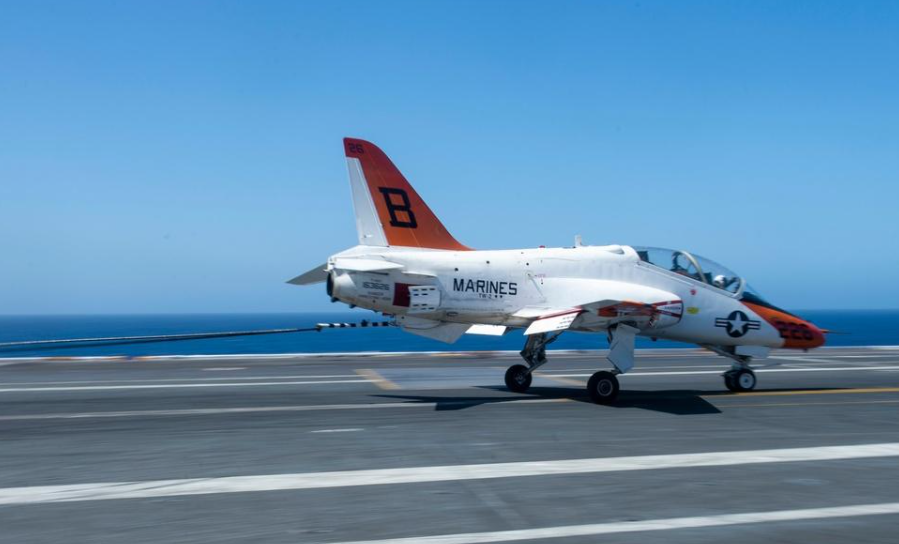
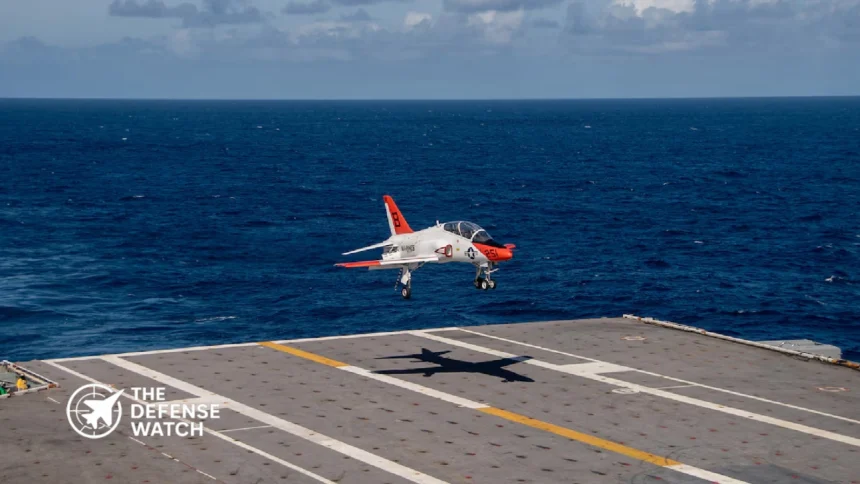
The students used T-45C Goshawk training aircraft to practice carrier launches and recoveries for the first time.

A T-45C Goshhawk Makes An Arrested Gear Landing The T-45C is a carrier-capable jet trainer used in the Navy’s advanced flight training pipeline. Its role includes preparing student pilots for the procedures and operational demands associated with naval aviation.
Carrier qualification is a particularly important stage because landing on an aircraft carrier presents challenges that are not encountered during conventional runway operations.
The flight deck is relatively short and constantly moving, while pilots must coordinate their approaches with the ship’s landing signal officers and flight control personnel. Arrested landings require precise aircraft handling and timing to engage the carrier’s arresting system.
The training also gives students experience operating alongside the sailors responsible for aircraft launches, recoveries and flight deck safety.
What the 442 Arrested Landings Tell Us
The training figures provide an indication of the amount of flight activity supported by Nimitz during the underway.
USS Nimitz training activity
103Aircraft sorties442Arrested landings152Touch-and-goesNov. 9Return to Norfolk, 2026Arrested landings involve aircraft catching an arresting wire on the flight deck to stop within the available landing area. Touch-and-go training involves an aircraft making contact with the deck before taking off again, rather than completing a full arrested recovery.
The Navy did not provide a breakdown of the figures by aircraft type, squadron or individual pilot. The totals therefore should be treated as an overall measure of the carrier’s training activity rather than a count of completed qualifications.
The volume of activity nevertheless demonstrates the flight deck’s ability to support several aviation training requirements during a single underway period.
Nimitz Uses Its Remaining Service Life to Support Navy Readiness
The training mission has added importance because Nimitz is approaching the end of its service life.
The Navy extended the carrier’s service period into March 2027, approximately 10 months beyond its previously planned May 2026 retirement. The extension allows the ship to continue supporting training and readiness activities while the service prepares for its eventual inactivation.
The timing is also connected to the arrival of the future USS John F. Kennedy (CVN 79), the second Gerald R. Ford-class aircraft carrier. The Navy took preliminary acceptance of Kennedy in September 2026, with formal delivery expected in spring 2027.
Rather than leaving Nimitz alongside the pier during its final months, the Navy is using the carrier to provide additional opportunities for pilots and sailors to maintain their qualifications.
This approach also gives the Navy an opportunity to use an experienced carrier crew and an operational flight deck for training without relying exclusively on carriers assigned to deployment preparation or other fleet requirements.
The ship had previously completed two deployments covering three areas of responsibility in less than two years, according to its commanding officer, Capt. Joseph Furco. That experience provides an established operational environment for personnel training aboard the carrier.
More Carrier Qualification Periods Planned Before Inactivation
The November underway is not expected to be Nimitz’s final training assignment.
The Navy says the carrier is scheduled to conduct multiple additional carrier qualification underways before its eventual deactivation. However, the service has not disclosed the dates or detailed training schedules for those activities. Nimitz Trains New, Returning Naval Aviators
For the Navy, the remaining training periods offer a practical way to sustain carrier aviation proficiency while preparing for the transition away from one of its longest-serving aircraft carriers.
The latest qualification period demonstrates that Nimitz continues to contribute to naval aviation readiness beyond its traditional role as a deployed carrier. Its remaining service time is being used to prepare the next generation of naval aviators and help experienced pilots return to operational carrier flying.