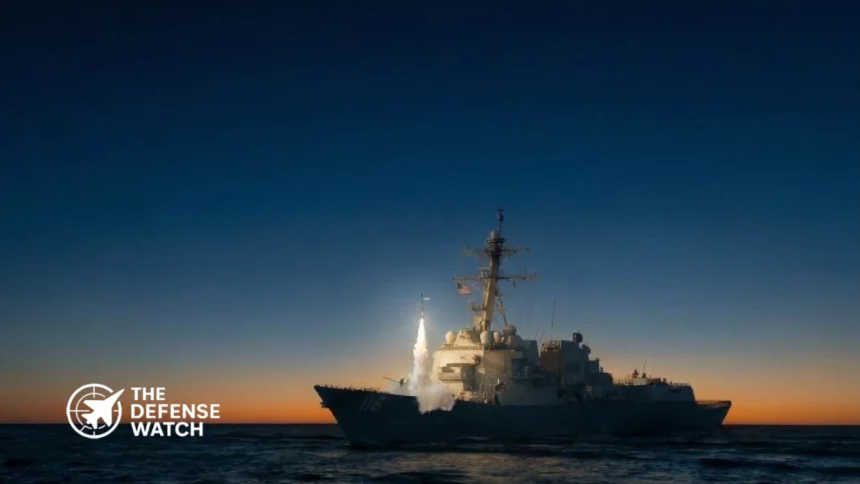
The U.S. Navy is moving forward with efforts to integrate the Patriot Advanced Capability-3 Missile Segment Enhancement (PAC-3 MSE) interceptor into its Aegis combat architecture, potentially giving American warships another option for defending against ballistic and other aerial threats.
Lockheed Martin received a second-phase development contract in late September 2026 to continue work on the naval variant, according to a company update published November 5. The effort involves adapting the land-based interceptor for use with the Navy’s Aegis Combat System and MK 41 Vertical Launching System (VLS).
The program has moved beyond initial feasibility work, but operational deployment remains several years away. Lockheed Martin identifies a land-based flight test in 2027, ship-based flight testing in 2028 and a targeted fielding date in 2029.
The integration is intended to expand the range of interceptors available to the Navy without requiring the development of an entirely new missile.
A New Interceptor Option for Aegis Warships
PAC-3 MSE was originally developed for the U.S. Army’s Patriot air and missile defense system. It uses hit-to-kill technology, destroying an incoming threat through direct impact rather than relying primarily on an explosive fragmentation warhead.
The interceptor is designed to engage tactical ballistic missiles, cruise missiles and aircraft. Its extended-range configuration incorporates a larger, more powerful rocket motor and other improvements over earlier PAC-3 variants.
Bringing the missile into the Navy’s Aegis architecture would extend its use beyond ground-based air defense.
Aegis is the combat management system used aboard major U.S. Navy surface combatants, including Arleigh Burke-class guided-missile destroyers. It combines radar sensors, command-and-control functions and weapon systems to detect, track and engage incoming threats.
The proposed integration would allow PAC-3 MSE to operate within this existing naval architecture rather than requiring a separate shipboard combat system.
However, the Navy has not publicly identified the specific ships that would receive the interceptor or disclosed its eventual operational configuration.
The Engineering Challenge Is More Than a Launcher Change
One of the central challenges is making a missile designed for Patriot launchers compatible with the Navy’s MK 41 VLS.
The MK 41 is a widely deployed shipboard launch system capable of accommodating different missile types, including Standard Missile variants, Tomahawk cruise missiles and Evolved Sea Sparrow missiles. Its modular design provides flexibility, but it does not make every missile automatically compatible.
According to Lockheed Martin, the PAC-3 MSE naval integration requires several changes to both missile hardware and supporting software.
The company has identified four major engineering areas:
- Data-link architecture: Development of a new communications architecture incorporating S-band and X-band capabilities.
- Launch sequencing: Modification of missile launch timing software to accommodate the naval launch environment.
- Fire-control software: Development of containerized fire-control software for integration with Aegis.
- Launch canister: Development of a new canister compatible with both the MK 41 VLS and PAC-3 MSE.
These modifications are important because a successful naval interceptor must operate within the ship’s sensor, command, fire-control and launch architecture.
The missile must receive the appropriate engagement information, communicate with the combat system and execute its launch sequence safely. Compatibility therefore extends well beyond fitting the interceptor inside a vertical launch cell.
Lockheed Martin says it has invested approximately $120 million in internally funded research and development for the integration effort. This is a company-reported investment, not the disclosed value of the Navy’s Phase II contract.
Development Has Passed an Early Launcher Compatibility Milestone
The program has already completed several preliminary integration activities.
In 2024, Lockheed Martin and participating U.S. Department of Defense organizations launched a PAC-3 MSE interceptor vertically from an MK 70 containerized launch system while using a virtualized Aegis Weapon System.
The test engaged a live cruise missile target. It demonstrated that the interceptor could operate in a vertically launched configuration while integrated with the virtualized Aegis architecture.
However, the MK 70 test should not be confused with a shipboard launch from an operational MK 41 installation.
More recently, Lockheed Martin reported completing a push-through test involving the PAC-3 MSE interceptor and an MK 41 VLS canister.
The purpose was to verify that the missile could pass through the canister without sustaining damage. This represents an important mechanical compatibility milestone, but it does not demonstrate a successful powered launch or an operational interception from a Navy vessel.
The next major milestones are expected to provide more substantial evidence of the system’s readiness.
| Development milestone | Status or target |
|---|---|
| Aegis integration demonstration using MK 70 | Completed in 2024 |
| Initial Navy program contract | April 2026 |
| Phase II development contract | September 2026 |
| MK 41 push-through test | Reported completed in 2026 |
| Land-based flight testing | Planned for 2027 |
| Ship-based flight testing | Planned for 2028 |
| Targeted fielding | 2029 |
Source: Lockheed Martin’s November 5, 2026 program update. Future milestones are company-reported targets, not confirmed completion dates.
Why the Navy Wants PAC-3 MSE at Sea
The proposed integration addresses two related requirements: increasing the number of available interceptor options aboard warships and improving the Navy’s ability to respond to different types of missile threats.
U.S. Navy destroyers already carry several missile-defense weapons. The Standard Missile family provides important capabilities against aircraft and missiles, while the SM-3 is a central component of the Navy’s ballistic missile defense architecture.
PAC-3 MSE would add another interceptor option within this layered defensive structure.
Its hit-to-kill approach is particularly relevant against threats that require direct interception. However, its addition should not be interpreted as a replacement for SM-3 or SM-6. These weapons have different designs, engagement roles and operational requirements.
The Navy has not publicly released a detailed comparison of PAC-3 MSE’s planned shipboard performance against its existing interceptors.
There is also an important operational question involving the number of available launch cells. Every missile loaded into an MK 41 VLS occupies space that could otherwise accommodate another weapon.
Introducing PAC-3 MSE would therefore require decisions about missile loadouts, mission priorities and the allocation of limited shipboard magazine capacity.
For destroyers operating in areas exposed to ballistic missiles, cruise missiles and other aerial threats, having additional interceptor options could provide greater flexibility. The actual benefit will depend on demonstrated performance, integration costs and the number of missiles available for deployment.
Production Capacity Will Influence Naval Fielding
The Navy’s integration effort is progressing alongside a broader U.S. initiative to expand PAC-3 MSE production.
On January 6, 2026, the Department of War announced a seven-year framework agreement with Lockheed Martin intended to increase annual PAC-3 MSE production from approximately 600 to 2,000 interceptors.
The agreement establishes a production-capacity objective rather than representing an immediate delivery of 2,000 missiles annually. The department also identified congressional authorization and appropriations as conditions affecting the planned multiyear procurement arrangement.
The production expansion matters because PAC-3 MSE already supports Army requirements and international customers.
Adding a naval customer creates another potential source of demand for the same interceptor family. This could increase pressure on manufacturing capacity, component suppliers and delivery schedules if Navy requirements grow.
Lockheed Martin plans to produce the naval variant alongside Army versions at its All-Up Round III facility in Camden, Arkansas.
Using the existing production infrastructure could reduce the need to establish a completely separate manufacturing line. Nevertheless, the naval configuration’s additional hardware and software requirements will need to be incorporated into production and qualification processes.
The Navy’s eventual procurement quantities and delivery schedule have not been publicly established in the November 5 announcement.
What Remains Before Deployment?
The program’s most important remaining challenge is demonstrating that the interceptor can operate reliably as part of an actual naval combat system.
A successful land-based flight test would provide evidence that the modified missile can execute its flight and engagement functions under the intended integration architecture.
Ship-based testing would then assess the system in its intended maritime environment, including its interaction with shipboard launch equipment and Aegis combat-system components.
Several questions remain unanswered:
- How many PAC-3 MSE interceptors will individual Navy ships carry?
- Which Aegis-equipped vessels will receive the capability first?
- What will be the final shipboard engagement envelope?
- How will PAC-3 MSE be allocated alongside existing Standard Missile weapons?
- What will be the final procurement cost and operational support requirement?
The planned 2029 fielding target will depend on the results of testing, software integration, qualification and Navy acceptance.
For now, the program remains a development and integration effort rather than an operational shipboard missile-defense capability.
The move gives the Navy another potential route to expand its interceptor inventory using an existing missile family. Whether that translates into a meaningful improvement in fleet defense will become clearer as the program progresses through its 2027 and 2028 flight-test milestones.