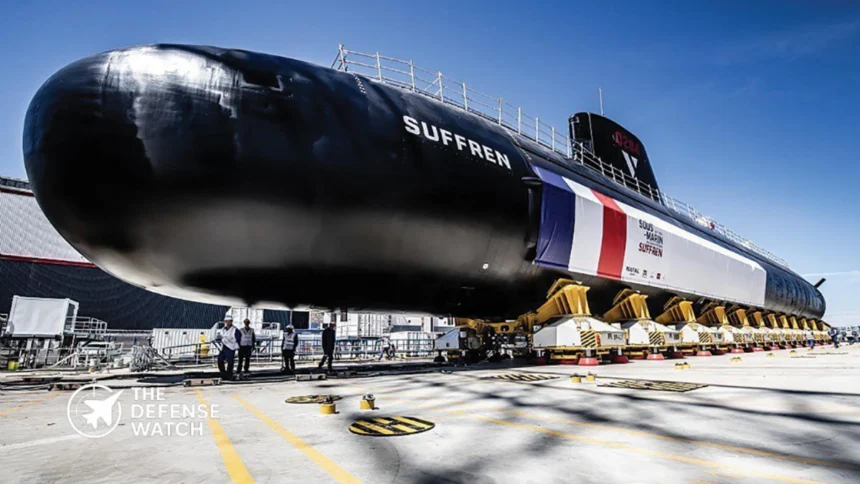
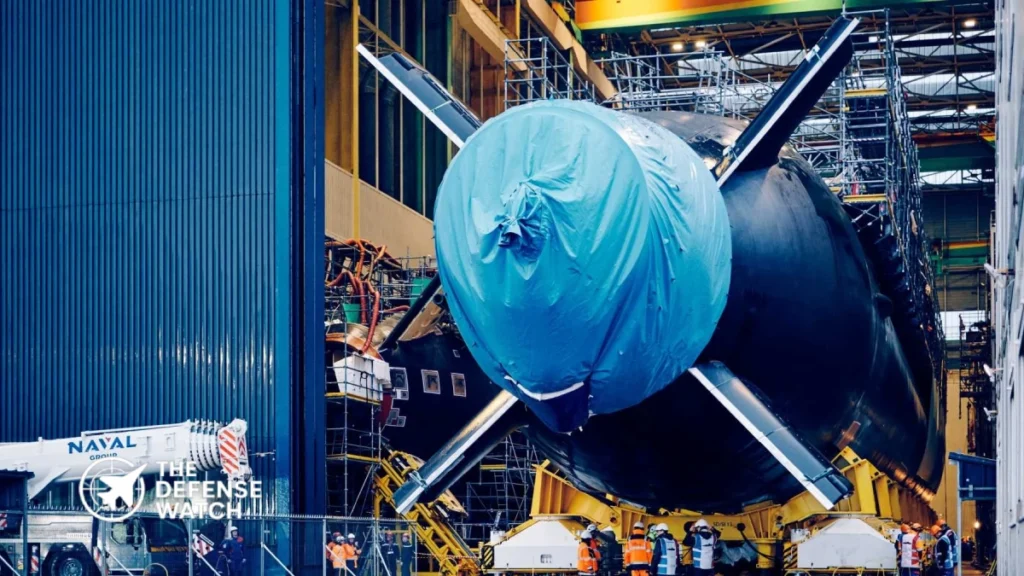
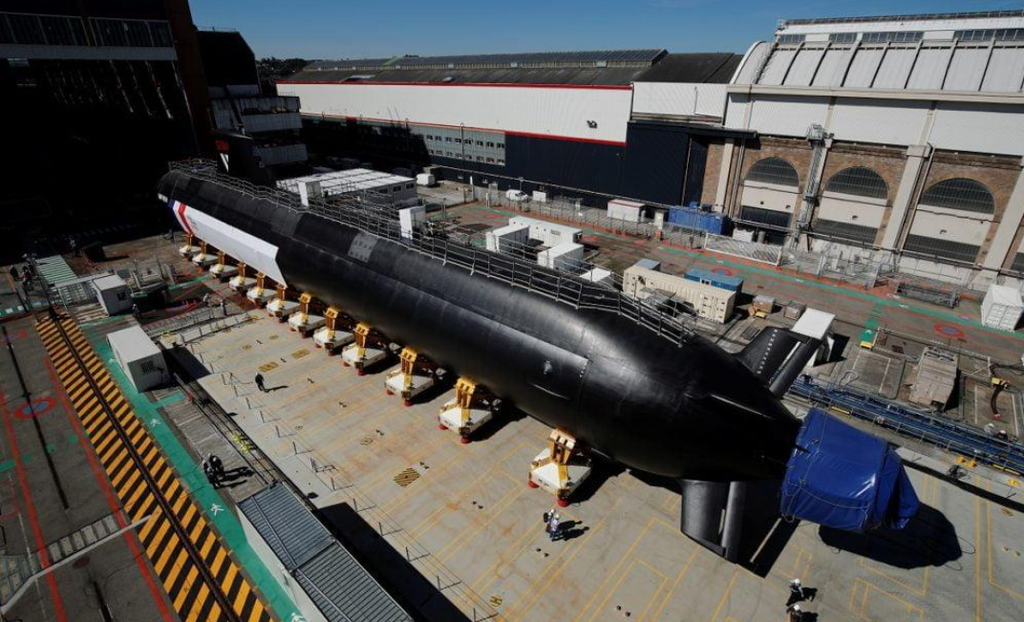
France has moved its fifth Suffren-class nuclear-powered attack submarine, Rubis, from its construction hall to a launch preparation facility at Cherbourg, Normandy. The transfer took place on October 16, 2026, according to France’s Ministry of the Armed Forces and Naval Group. It brings the submarine closer to launch, but it does not mean the vessel is ready for operational service.
Rubis is part of the Barracuda program, which is replacing France’s older Rubis-class attack submarines with a newer generation of nuclear-powered boats. The program is intended to improve the French Navy’s ability to conduct undersea warfare, gather intelligence, protect naval formations and strike land targets with submarine-launched cruise missiles.
The immediate milestone is industrial rather than operational. After the transfer, the submarine must undergo further completion work and testing before it can be delivered to the French Navy.
From construction hall to launch preparations
The French Ministry of the Armed Forces announced the transfer of Rubis to the launch installation on October 16. Naval Group, the program’s principal submarine builder, also described the move as a step toward completion and subsequent testing.
The distinction matters because moving a submarine out of its construction hall is not the same as launching it into the water, completing sea trials or declaring it operational. Those stages involve separate technical checks and acceptance procedures.
The next steps include completion work, trials alongside the quay and sea trials, according to Naval Group. Delivery to the French Navy will follow those stages, although the precise schedule for each milestone has not been established in the information reviewed.
Rubis is the fifth of six submarines planned under the Barracuda program. The sixth, Casabianca, is also under construction, according to reporting published by French naval specialist publication Mer et Marine in June 2026.
The program’s production sequence shows why individual milestones need to be viewed in the context of the overall fleet replacement effort. France is not simply adding a new submarine. It is transitioning from an older design to a more capable class while maintaining the availability of its attack-submarine force.
What the Suffren class brings to the French Navy
The Suffren class, also known as the Barracuda class, is designed to perform several missions that extend beyond hunting enemy submarines. France’s Ministry of the Armed Forces identifies anti-submarine warfare, anti-surface warfare, intelligence collection, protection of major naval units and support for special operations among the class’s roles.
The submarines use nuclear propulsion, allowing them to remain at sea for extended periods without needing to surface to replenish propulsion fuel. Their endurance is still constrained by provisions, crew requirements, maintenance and operational conditions.
According to the French defense ministry, the class has a submerged displacement of approximately 5,100 metric tons and a length of 99.5 meters. Its published armament includes F21 heavyweight torpedoes, SM39 Exocet anti-ship missiles and Naval Cruise Missiles, known by the French abbreviation MdCN.
The MdCN gives the submarine a land-attack role. It allows a suitably equipped boat to strike selected targets ashore without relying solely on aircraft or surface combatants to deliver conventional long-range attacks.
That capability is relevant to France’s ability to operate independently during a crisis, including when access to forward air bases is restricted. A submarine can approach an operational area covertly, although mission success depends on intelligence quality, target location, weapon availability and the threat environment.
The class also supports the deployment of special operations personnel. Its mission set therefore combines undersea combat, intelligence gathering and selected land-attack tasks in a single platform.
These are class-level capabilities, however. Their inclusion in the design does not establish that Rubis has completed the testing and certification needed to employ every weapon or mission system operationally.
Why France is replacing the older Rubis class
The new submarine’s name can cause confusion. France’s original Rubis-class submarines and the new submarine named Rubis belong to different generations of attack submarines.
The older Rubis class entered service beginning in the 1980s. The Barracuda program was established to replace that fleet with six newer nuclear-powered attack submarines, according to French government defense material.
The first new-generation boat, Suffren, entered active service in June 2022. The second, Duguay-Trouin, followed in April 2024. The third, Tourville, entered service in July 2025, according to the French Ministry of the Armed Forces.
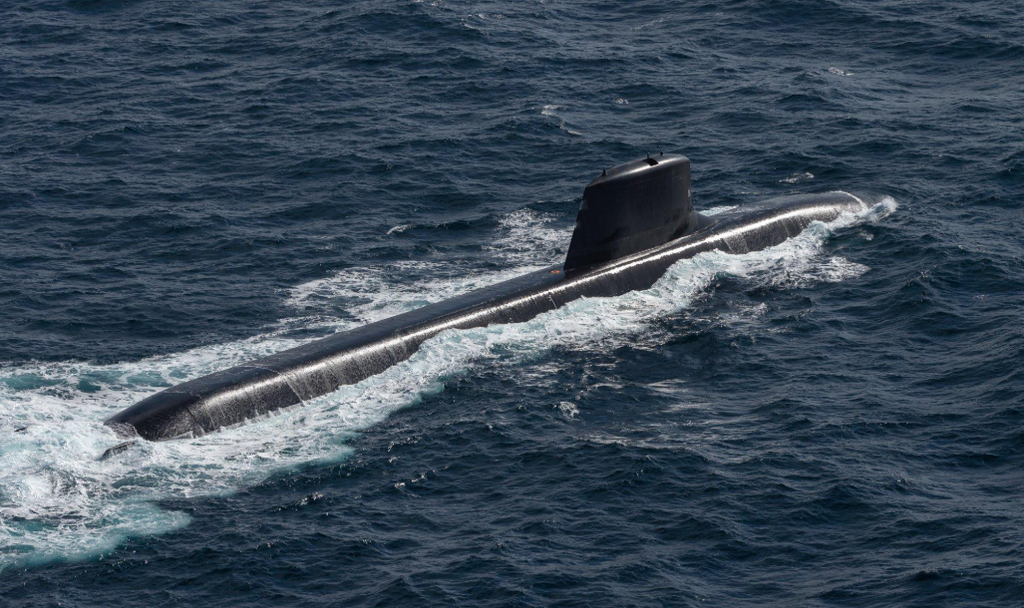
The fourth submarine, De Grasse, was delivered to the French Navy in June 2026, according to the French defense procurement agency’s announcement reported by Mer et Marine. Delivery and formal admission to active service are distinct milestones, so the two should not be treated as interchangeable.
With Rubis moving toward launch and Casabianca still under construction, the final two boats remain important to the program’s completion.
The French government has identified 2030 as the target for renewing the six-boat attack-submarine force with the Suffren class. That target is a program objective, not confirmation that every submarine will be operational by a specific date.
The operational importance of the fleet transition
France operates both nuclear-powered attack submarines and nuclear-powered ballistic missile submarines. The two types serve different strategic purposes.
Ballistic missile submarines provide the sea-based component of France’s nuclear deterrent. Attack submarines such as the Suffren class conduct conventional naval warfare, intelligence missions, escort duties and land attack. Their roles can support the wider nuclear deterrent by protecting strategic forces and complicating an adversary’s planning, but they are not substitutes for ballistic missile submarines.
For the French Navy, the challenge is to replace older boats without creating gaps in undersea availability. Submarines require periodic maintenance, crew training and technical support, so a fleet of six does not mean six boats will be deployable at the same time.
The transition also depends on more than the delivery of hulls. The Navy must qualify crews, validate combat systems, establish maintenance arrangements and integrate the new boats into operational planning.
The program’s industrial base is central to that effort. Naval Group builds the submarines, while TechnicAtome contributes to the nuclear propulsion systems. The French defense procurement agency, Direction générale de l’armement, oversees key aspects of procurement and testing, with the French Alternative Energies and Atomic Energy Commission involved in nuclear-related work.
That combination of industrial and government responsibilities means a delay in one part of the process can affect the wider delivery schedule. The October transfer is evidence of progress on Rubis, but it does not by itself establish whether the remaining boats will meet every planned milestone.
What remains before Rubis enters service
The immediate priority is to complete the submarine and demonstrate that its systems function as required. Quayside tests allow equipment and systems to be checked before the boat proceeds through sea trials. Sea trials then provide opportunities to evaluate performance under operating conditions.
The French Navy must also receive the submarine and complete the steps required before it can be declared operational. The public information reviewed does not establish a confirmed date for Rubis’s delivery or entry into active service.
Nor does the transfer announcement disclose a new program cost, a change to the submarine’s planned armament or a change in the six-boat procurement objective.
The significance of the milestone is therefore specific: France has advanced the fifth Suffren-class submarine beyond its construction hall and toward launch preparations. Its eventual entry into service will be a more consequential measure of progress in the replacement of the country’s aging attack-submarine fleet.