Executive Summary
- NASA has moved SR-71A 61-7980, tail 844, from its long-standing outdoor display at Armstrong Flight Research Center into an Edwards Air Force Base hangar, according to Aviation Week and reporting reviewed by The Defense Watch.
- Former SR-71 personnel have reportedly been approached about supporting a potential return-to-flight effort. NASA, however, has not publicly confirmed that a formal SR-71 reactivation program exists.
- The move comes as NASA places renewed emphasis on experimental aircraft and X-plane research. Restoring tail 844 would involve major challenges involving its aging titanium structure, J58 engines, specialized fuel and ground equipment, crew training, and airworthiness.
NASA SR-71 Tail 844 Return-to-Flight Assessment
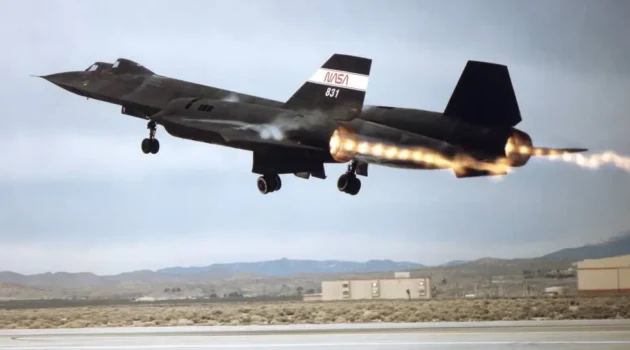
NASA has moved an SR-71A Blackbird that made the final flight of the Blackbird family into a hangar at Edwards Air Force Base, California, amid indications that the aircraft is being examined for a possible return to flight.
The aircraft, NASA tail number 844, is formally identified as SR-71A 61-7980. It last flew on October 9, 1999, during NASA’s high-speed flight research activities at Edwards. Aviation Week reported in September that NASA had removed the aircraft from its outdoor display position and that former SR-71 personnel had subsequently been approached about a possible restoration effort.
NASA has not confirmed that a return-to-flight program is underway. A NASA spokesperson told Aviation Week that the agency had no additional information to share about the aircraft beyond acknowledging interest in the SR-71’s history.
The distinction is important. Moving an aircraft into a hangar and evaluating its condition is not the same as clearing it for flight. In the case of a Blackbird that has been grounded for nearly 27 years, the engineering and logistics requirements are substantial.
Why NASA Is Looking at the SR-71 Again
The reported activity surrounding tail 844 coincides with a broader change in NASA’s aeronautics priorities.
In May 2026, NASA Administrator Jared Isaacman directed the agency to strengthen its aviation portfolio and pursue additional X-plane activity, including research into advanced airframes and propulsion technologies. NASA’s directive specifically called for additional X-planes focused on radical airframe and engine propulsion designs with potential civil, commercial, or national security applications.
That policy provides useful context for the SR-71 activity.
The Blackbird is not a practical replacement for a modern reconnaissance aircraft. Its relevance would instead come from its value as an existing high-speed flight-test platform.
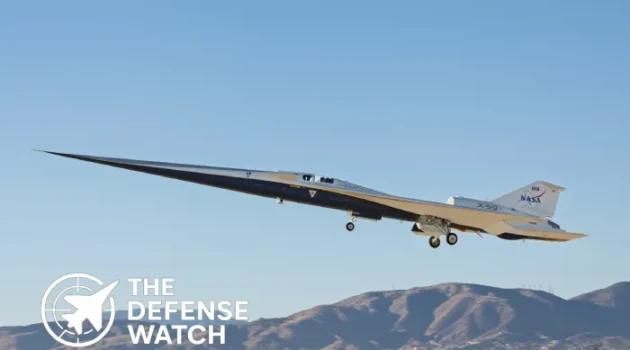
NASA has already demonstrated the value of specialized aircraft for experimental research. The agency’s X-59, for example, is being used to study low-boom supersonic flight, with NASA targeting data that could support future changes to the regulatory environment surrounding supersonic aircraft over land.
The SR-71 would address a very different portion of the flight-test envelope.
What Makes Tail 844 Significant
NASA records identify 844 as SR-71A 61-7980. The aircraft arrived at NASA’s Dryden Flight Research Center in February 1990 and entered research service after a period of storage. Its final flight took place on October 9, 1999.
During its NASA career, the aircraft supported research involving aerodynamics, propulsion, structures, thermal protection, high-speed instrumentation and atmospheric studies.
One of the most unusual experiments was the Linear Aerospike SR-71 Experiment, or LASRE. NASA mounted the experimental hardware on the upper fuselage of the aircraft, turning the Blackbird into a carrier for high-speed propulsion and aerodynamic research.
That history matters because the aircraft’s potential value in 2026 would not simply be its ability to fly fast.
It is the combination of speed, altitude, endurance and the ability to carry experimental hardware that made the SR-71 useful as a research platform.
NASA SR-71 844 Research Baseline
Parameter NASA-documented baseline Aircraft SR-71A NASA tail number 844 Military serial 61-7980 Final flight October 9, 1999 Gross takeoff weight About 140,000 lb Fuel capacity cited by NASA About 80,000 lb Structure Titanium and titanium alloys Research role High-speed, high-altitude flight research NASA’s historical material provides these figures for the SR-71 fleet and identifies 61-7980 as NASA 844.
These numbers describe the historical aircraft. They should not be interpreted as evidence that tail 844 currently retains those flight capabilities.
The J58 Engine Is a Major Restoration Challenge
The biggest technical question is not whether an SR-71 can theoretically fly again. The question is whether an individual aircraft, its engines and its supporting systems can be returned to an acceptable airworthiness condition after decades without operational use.
The SR-71’s propulsion system was highly specialized.
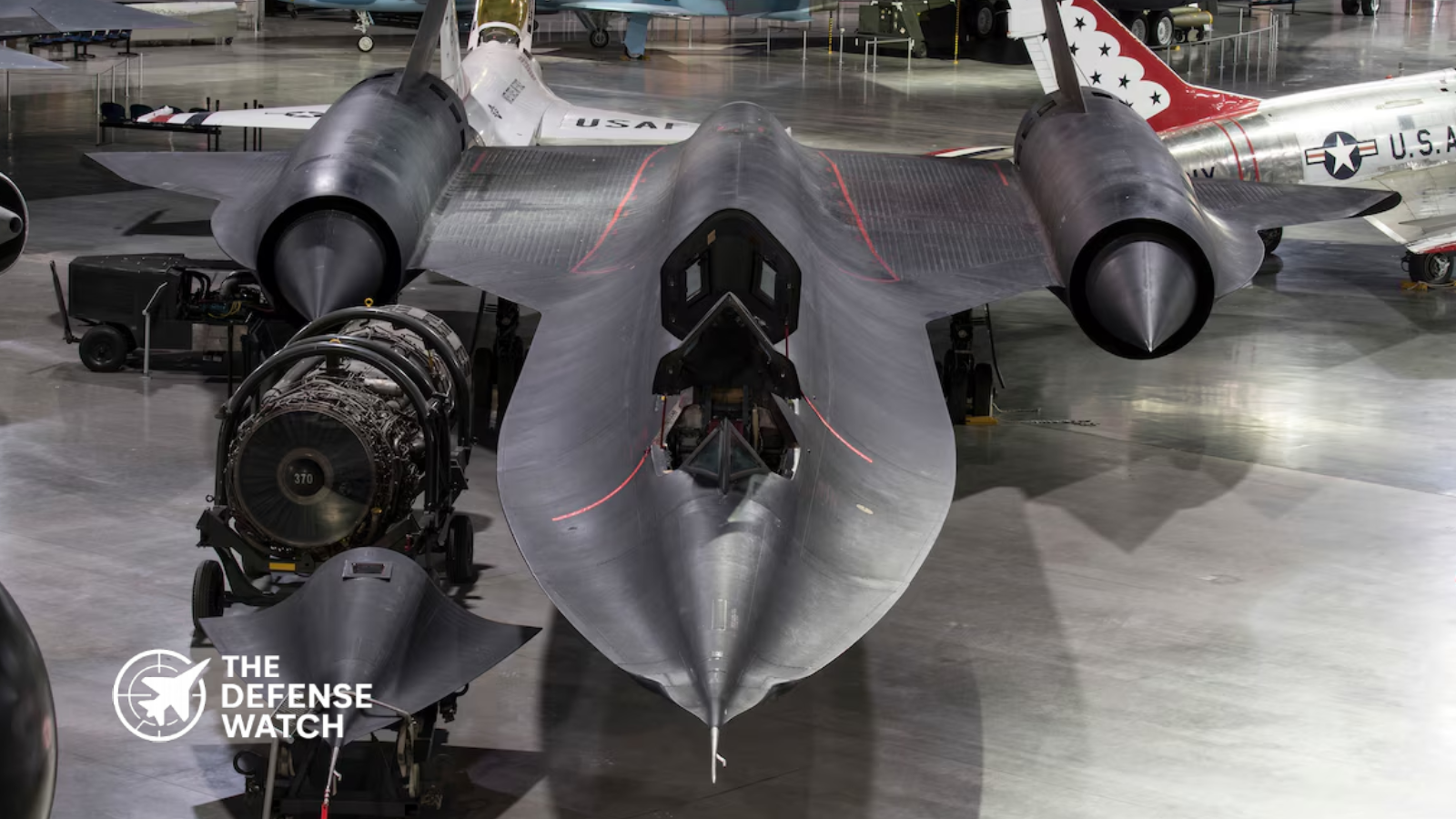
Each aircraft used two Pratt & Whitney J58 engines integrated with variable-geometry inlet systems and specialized exhaust arrangements. The propulsion system was designed around the unusual aerodynamic and thermal conditions encountered during sustained high-speed flight.
That creates a very different restoration problem from returning a conventional museum aircraft to the air.
A dormant J58 cannot simply be inspected, fueled and started. NASA would need to establish the condition of the engines and associated systems before meaningful flight testing could begin.
Former SR-71 personnel cited by Aviation Week have highlighted the lack of active maintenance infrastructure, spare parts and trained personnel as major obstacles. One former test engineer also described the difficulty of maintaining engines that have been inactive for decades.
The Supply Chain May Be Harder Than the Airframe
The SR-71’s retirement removed much of the industrial ecosystem that supported it.
The aircraft depended on specialized maintenance equipment, unique components, trained personnel and procedures developed during decades of operation. Some original tooling and support equipment no longer exists, while surviving components may themselves require inspection before they can be considered suitable for flight.
Fuel presents another unusual problem.
The Blackbird was designed around JP-7, a specialized fuel developed for the aircraft’s operating environment. NASA documentation identifies the aircraft’s large fuel requirement and its unusual propulsion architecture.
A restored aircraft therefore needs more than an airframe and two functioning engines. NASA would need an entire support chain capable of preparing, servicing and safely operating the aircraft.
This is one reason why the question of whether tail 844 can fly again cannot be separated from the question of whether the United States can recreate enough of the Blackbird’s support infrastructure to make flight testing practical.
Training Presents a Separate Problem
The original SR-71 force also had a training architecture that no longer exists in operational form.
NASA operated SR-71 aircraft for research and training, including the two-seat SR-71B. The agency’s historical records identify SR-71B 61-7956, NASA 831, as a trainer and research aircraft used during the 1990s.
That aircraft is no longer an operational trainer.
Consequently, any new flight program involving 844 would have to rebuild pilot and crew training around an aircraft type that has not been operated routinely for decades.
Simulation could reduce some of that burden, but it would not remove the requirement for aircraft-specific qualification, maintenance training and flight-test procedures.
SR-71 Versus the New X-Plane Approach
The reported effort also highlights a change in how NASA approaches high-speed research.
The SR-71 represents an earlier generation of flight-test engineering. Its performance came from a combination of specialized propulsion, high-temperature materials, aerodynamic design and operational procedures.
Today’s X-plane programs increasingly emphasize digital design, advanced materials, integrated sensors and new propulsion concepts.
NASA’s X-59 illustrates this shift. It is designed specifically to investigate low-boom supersonic flight rather than simply maximize speed. NASA says the aircraft is intended to produce a quieter sonic thump and generate data that can support future regulatory decisions concerning supersonic flight over land.
A revived SR-71 would therefore serve a different purpose.
Research platform Primary research relevance SR-71A 844 Very-high-speed and high-altitude flight research X-59 Low-boom supersonic flight Modern experimental aircraft Advanced airframes, propulsion, autonomy and new flight-test concepts The comparison shows why NASA could consider an old Blackbird without treating it as a substitute for a new-generation X-plane.
The Strategic Value Is in Flight-Test Access
The strongest case for restoring 844 would be research that requires an aircraft capable of operating at speeds and altitudes beyond the envelope of NASA’s newer supersonic demonstrators.
NASA’s historical SR-71 research included experiments in propulsion, aerodynamics, materials and high-temperature environments.
Such a platform could theoretically support research into high-temperature structures, advanced propulsion components, sensors and other technologies where ground testing alone does not fully reproduce the flight environment.
But the economics would be difficult.
A restoration program would have to spread the cost of structural inspection, engine restoration, specialized fuel, ground equipment, spare parts, training and flight-test infrastructure across a sufficient number of research missions.
If the aircraft flew only a small number of missions, the fixed cost of recreating the operational ecosystem would be difficult to justify. A sustained research campaign would provide a stronger basis for such an investment.
That makes the research portfolio, rather than the aircraft’s historical status, the key question.
What Has Been Confirmed and What Has Not
The available evidence supports several facts, but it does not establish that NASA has formally authorized an operational return of the SR-71.
Confirmed or publicly reported:
- Tail 844 has been removed from its long-standing outdoor display position.
- The aircraft has been moved into an Edwards AFB hangar.
- Former SR-71 personnel have reportedly been approached regarding the aircraft.
- NASA is pursuing a broader expansion of experimental aircraft and X-plane research.
- Tail 844 made its final flight in October 1999.
Not publicly confirmed:
- A first-flight date.
- A formal NASA return-to-flight program budget.
- A flight certification timeline.
- A decision to restore 844 to operational status.
- A new operational mission for the SR-71.
- A replacement for the Blackbird’s former strategic reconnaissance role.
That distinction is critical. Current reporting points to an assessment and possible restoration effort, not a confirmed return to operational service.
What to Watch Next
The next meaningful indicators will be technical rather than ceremonial.
Evidence of engine inspection or overhaul would provide a clearer indication of NASA’s intentions. The same applies to structural nondestructive testing, restoration of aircraft systems, procurement of specialized support equipment and development of an appropriate training architecture.
A formal NASA announcement establishing a project office, funding line, flight-test objectives or schedule would provide a much stronger basis for describing the effort as an actual return-to-flight program.
Until then, tail 844’s movement should be understood as a significant development in NASA’s renewed interest in high-speed flight research, but not as confirmation that the Blackbird is returning to routine flight.
The SR-71’s legacy is valuable precisely because it demonstrated what can be achieved when aircraft design, propulsion, materials and flight-test infrastructure are developed as a single system. If NASA ultimately decides to fly 844 again, the most important outcome would not be the return of a historic aircraft. It would be the research that NASA could extract from putting an exceptionally demanding flight-test platform back into the air.