• Home
  • About
  • Defense Systems
  • Manufacturer
  • Comparisons
  • Compare 
  • Tools
TheDefenseWatch.com
  • Aerospace & Aviation
  • Military & Ordnance
  • Naval & Maritime
  • Cyber & Space Defense
  • Policy & Strategy
  • Global News
  • Tools Library
    • Smart Calculator
    • Drone Flight Time Calculator
    • Drone Range Calculator
    • Counter-Drone Jammer Effective Range Calculator
    • Counter-Battery Radar Detection Calculator
    • Artillery Fire Correction Calculator
    • Thermal Camera Detection Range Calculator
    • Missile Range & Time-of-Flight Calculator
    • Radar Detection Range Calculator
    • FPV Strike Drone Payload vs Range Calculator
    • Loitering Munition Endurance Calculator
    • Sniper Ballistic Drop & Windage Calculator
    • Bullet Drop Calculator
    • U.S. Army Combat Fitness Test (ACFT) Calculator
    • Military Pension Calculator
    • Military Retirement Calculator
    • Military Pension Calculator
    • Large Number Calculator
Font ResizerAa

TheDefenseWatch.com

The Defense Watch | U.S. & Global Defense News, Analysis & Military Updates

Search
  • Home
  • About
  • Defense Systems
  • Manufacturer
  • Comparisons
  • Compare 
  • Tools

Stay Updated

Get the latest update

Subscribe

Explore

  • Drone
  • Fighter Jets & Military Aircraft
  • Hypersonic Weapons
  • Aircraft Carriers
  • Strategic History & Missions
  • Tools Library
Home » US Government Moves To Expand Tomahawk And Patriot Missile Production With Ford And GM
Defense Budgets & PolicyPolicy & Strategy

US Government Moves To Expand Tomahawk And Patriot Missile Production With Ford And GM

Samuel Drake | Defense Analyst
Last updated: September 7, 2026 5:20 am
Samuel Drake | Defense Analyst
Share
2 Min Read
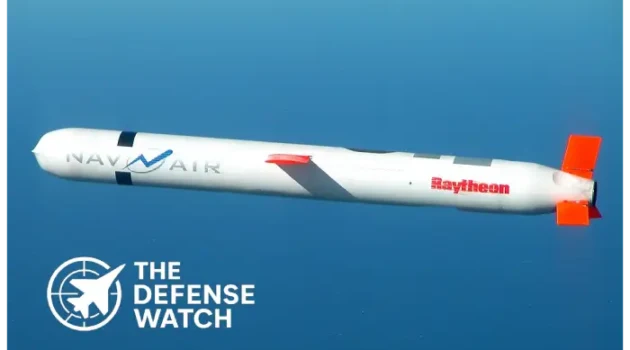
US Tomahawk strike options Iran
SHARE
Follow The Defense Watch on Google:

Executive Summary:

The U.S. government is holding discussions with Ford Motor and General Motors on supporting production of Tomahawk cruise missiles and Patriot air defense missiles. The initiative reflects a broader effort to expand America’s defense industrial base, replenish missile stockpiles, and increase manufacturing capacity through commercial industry partnerships.

U.S. Government Explores Ford And GM Support For Tomahawk And Patriot Missile Production

The Tomahawk missile production effort could soon receive support from two of America’s largest automakers as the U.S. government explores ways to rapidly expand defense manufacturing capacity.

Contents
U.S. Government Explores Ford And GM Support For Tomahawk And Patriot Missile ProductionExpanding America’s Defense Industrial BaseWhy Missile Production Is Becoming A National PriorityExisting Defense Contractors Remain CentralManufacturing Expertise Could Accelerate OutputStrategic Implications

Citing recent developments and government discussions, officials are in talks with Ford Motor Company and General Motors about leveraging commercial manufacturing expertise to help increase production of critical missile systems, including the Tomahawk land attack cruise missile and Patriot air defense interceptors.

The discussions come as Washington seeks to rebuild missile inventories after years of sustained weapons deliveries to allies and increased operational demands across multiple theaters. Reuters previously reported that senior Pentagon officials have been meeting with executives from major manufacturers to determine whether commercial production capacity could supplement traditional defense contractors.

(adsbygoogle = window.adsbygoogle || []).push({});

Expanding America’s Defense Industrial Base

The initiative reflects a broader shift in U.S. defense acquisition strategy that emphasizes industrial capacity as a strategic asset.

- Advertisement -

Rather than relying solely on traditional defense primes, the Pentagon is examining whether established automotive manufacturers can contribute advanced manufacturing expertise, supply chain management, robotics, and high-volume production methods to missile programs.

President Donald Trump recently stated that automakers with available factory capacity could potentially participate in producing Patriot missiles and Tomahawk cruise missiles through partnerships with defense companies. Both Ford and General Motors have confirmed discussions regarding defense opportunities, although neither company has announced finalized missile production agreements.

  • Tomahawk Cruise Missile

    Tomahawk Cruise Missile

    • Guidance System: GPS / INS / Terrain Contour Matching
    • Maximum Speed: Mach 0.74–0.85 (subsonic)
    • Launch Compatibility: Surface Ships, Submarines
    • Warhead Technology: High Explosive, Penetrator
    • View Details →
    8.3

    This approach mirrors historic examples in which U.S. industry rapidly expanded military production during periods of heightened national security demand, although today’s requirements involve highly specialized components, precision manufacturing, and extensive certification processes.

    Why Missile Production Is Becoming A National Priority

    Demand for long-range precision strike weapons and integrated air defense systems has risen sharply in recent years.

    The Tomahawk missile production program supports U.S. Navy surface combatants, submarines, and newer land-based launch systems, providing long-range precision strike capability against high-value targets.

    Meanwhile, Patriot PAC-3 interceptors remain among the world’s most sought-after air defense missiles, protecting against ballistic missiles, cruise missiles, and aircraft. The system has become increasingly important for both U.S. forces and allied nations facing evolving missile threats.

    (adsbygoogle = window.adsbygoogle || []).push({});

    Growing operational requirements, combined with foreign military sales and support for allies, have placed considerable pressure on existing production lines. Defense analysts have repeatedly identified missile manufacturing capacity as one of the principal constraints on sustaining long-term military readiness.

    Existing Defense Contractors Remain Central

    Although Ford and GM may contribute manufacturing capacity, primary responsibility for missile design, integration, and final production remains with established defense companies.

    RTX’s Raytheon business manufactures the Tomahawk cruise missile, while Lockheed Martin produces the Patriot PAC-3 Missile Segment Enhancement interceptor. These companies have already signed long-term agreements with the Pentagon to significantly increase annual missile output over the coming years.

    The potential role of automakers would likely focus on manufacturing components, subassemblies, production tooling, logistics support, or other industrial processes rather than complete missile integration.

    Such collaboration could help reduce production bottlenecks while allowing defense contractors to concentrate on sensitive technologies and final system assembly.

    Manufacturing Expertise Could Accelerate Output

    Modern automotive manufacturing offers capabilities that could benefit defense production, including automated assembly lines, digital quality control, advanced robotics, and efficient supply chain management.

    Ford and General Motors already possess extensive experience with precision manufacturing, large-scale procurement networks, and lean production techniques.

    General Motors also operates GM Defense, which has expanded its military business in recent years through tactical vehicle programs and partnerships with the Department of Defense. Leveraging commercial production practices may enable faster scaling of selected missile components without compromising military quality standards.

    • Tomahawk Cruise Missile

      Tomahawk Cruise Missile

      • Guidance System: GPS / INS / Terrain Contour Matching
      • Maximum Speed: Mach 0.74–0.85 (subsonic)
      • Launch Compatibility: Surface Ships, Submarines
      • Warhead Technology: High Explosive, Penetrator
      • View Details →
      8.3

      However, adapting automotive facilities for missile-related work would still require significant investment, security measures, workforce certification, and compliance with stringent defense manufacturing regulations.

      Strategic Implications

      The proposed collaboration highlights a broader evolution in U.S. defense industrial policy.

      Rather than treating defense production as the exclusive domain of traditional contractors, policymakers increasingly view the wider American manufacturing sector as a reserve industrial capability that can strengthen resilience during periods of elevated demand.

      This strategy also seeks to reduce supply chain vulnerabilities, shorten production timelines, and improve surge capacity for critical munitions.

      If agreements ultimately move forward, they could represent one of the most significant integrations of commercial automotive manufacturing into advanced missile production in decades.

      While discussions remain preliminary, the initiative underscores the Pentagon’s determination to ensure sufficient production capacity for some of America’s most strategically important precision weapons.
Enjoying our coverage?

Make The Defense Watch a preferred source on Google to see more of our geopolitical and defense insights when relevant to you.


TAGGED:Artillery & Missile SystemsDefense Budgets & PolicyDefense contracts
Share This Article
Facebook Copy Link Print
BySamuel Drake | Defense Analyst
Follow:
Samuel Drake is a defense analyst at TheDefenseWatch.com covering naval warfare, military ordnance, maritime technology, fleet modernization, and defense procurement. His reporting focuses on documented capabilities, procurement programs, and military technology.
Leave a Comment

Leave a Reply Cancel reply

Your email address will not be published. Required fields are marked *

Search Defense Systems

Latest Defense Systems

  • F-104 Starfighter F-104 Starfighter
  • F-15J Eagle Fighter Jet F-15J Eagle Fighter Jet
  • China’s GJ-21 Stealth Drone China’s GJ-21 Stealth Drone
  • China’s GJ-11 Stealth Drone China’s GJ-11 Stealth Drone
  • F-15EX Eagle Fighter Jet F-15EX Eagle Fighter Jet
  • TRML-4D Radar TRML-4D Radar
  • F-47A Fighter Jet F-47A Fighter Jet
  • China DF-61 Missile China DF-61 Missile
  • B61 Nuclear Bomb B61 Nuclear Bomb

Recent Compares

  • J-10C vs JF-17 Thunder: Which Fighter Is More Capable? J-10C vs JF-17 Thunder: Which Fighter Is More Capable? View Comparison →
  • Tejas vs Gripen: Key Differences and Capabilities Tejas vs Gripen: Key Differences and Capabilities View Comparison →
  • Tejas vs MiG-21 Bison: How India Replaced Its Iconic Supersonic Fighter Tejas vs MiG-21 Bison: How India Replaced Its Iconic Supersonic Fighter View Comparison →
  • F-35 vs F-16: Stealth, Sensors and Combat Roles F-35 vs F-16: Stealth, Sensors and Combat Roles View Comparison →
  • Tejas Fighter Jet vs F-16 Fighting Falcon: Capability Compared Tejas Fighter Jet vs F-16 Fighting Falcon: Capability Compared View Comparison →
  • Rafale Fighter Jet vs F-16 Fighting Falcon : Which Fighter Has the Edge? Rafale Fighter Jet vs F-16 Fighting Falcon : Which Fighter Has the Edge? View Comparison →
  • Su-57 Fighter Jet vs J-20 Fighter Jet: Stealth and Air Combat Compared Su-57 Fighter Jet vs J-20 Fighter Jet: Stealth and Air Combat Compared View Comparison →
  • Mirage 2000 vs Tejas Mk1A: Legacy Combat Power vs Indigenous Modernization Mirage 2000 vs Tejas Mk1A: Legacy Combat Power vs Indigenous Modernization View Comparison →
  • Rafale Fighter Jet vs F-22 Raptor: Which Air Dominance Fighter Has the Edge? Rafale Fighter Jet vs F-22 Raptor: Which Air Dominance Fighter Has the Edge? View Comparison →
  • Tejas Fighter Jet vs. Rafale Fighter Jet: India’s Indigenous Fighter Meets France’s Proven Multirole Combat Aircraft Tejas Fighter Jet vs. Rafale Fighter Jet: India’s Indigenous Fighter Meets France’s Proven Multirole Combat Aircraft View Comparison →

Recent Posts

  • U.S. Army Certifies First Operational Patriot Battery on IBCS Network
  • Google Selects Blue Origin to Launch AI Computing Satellites in 2029
  • Starfighters Aerospace Repurposes F-104 Starfighters for High-Speed Flight Research
  • New York Air Guard Deploys Five Ski-Equipped LC-130s for Antarctic Operation Deep Freeze
  • Pentagon Reports Audit Progress as 2028 Clean Financial Audit Deadline Approaches

You Might Also Like

UK NATO capability burden
Alliances & DoctrinesPolicy & Strategy

UK Rising NATO Burden, London Eyes Larger Role in Alliance Capability Plans

September 7, 2026
General Dynamics KIV-78A military cryptographic system supporting secure allied communications and data encryption operations
Defense Contracts

General Dynamics Secures $69.7M Deal For KIV-78A Crypto Systems

September 7, 2026
North Korea Russia alliance
Geopolitical & Strategic DoctrinesPolicy & Strategy

North Korea Moves To Deepen Alliance With Russia As Kim Reaffirms Full Support For Putin

September 7, 2026
Iran war economic impact
Geopolitical & Strategic DoctrinesPolicy & Strategy

Iran War Leaves More Than 7,000 Dead As Global Economy Faces $2.2 Trillion Shock

September 17, 2026

Logo

Copyright © 2026 TheDefenseWatch.com

Helpful Links

  • Home
  • About Us
  • Privacy Policy
  • Terms of Use / Disclaimer
  • U.S. Privacy Notice – CCPA Compliance

Defense Systems

  • Defense Systems
  • Comparisons 
  • Manufacturer
  • Tactical Calculators

Popuplar

Which 5 Air Forces Possess the Costliest Fighter Jet Fleets in the World
Evolving Strategic Value: Carrier Strike Groups in the Indo-Pacific’s Future Security Architecture
Autonomous Weapon Systems Spark U.S. Ethics Debate Amid Rapid Military AI Integration

We report on developments involving military forces, governments, defense companies, research organizations, and security institutions around the world. 

Welcome Back!

Sign in to your account

Username or Email Address
Password

Lost your password?

Enjoying our coverage?

Make The Defense Watch a preferred source on Google to see more insights.