• Home
  • About
  • Defense Systems
  • Manufacturer
  • Comparisons
  • Compare 
  • Tools
TheDefenseWatch.com
  • Aerospace & Aviation
  • Military & Ordnance
  • Naval & Maritime
  • Cyber & Space Defense
  • Policy & Strategy
  • Global News
  • Tools Library
    • Smart Calculator
    • Drone Flight Time Calculator
    • Drone Range Calculator
    • Counter-Drone Jammer Effective Range Calculator
    • Counter-Battery Radar Detection Calculator
    • Artillery Fire Correction Calculator
    • Thermal Camera Detection Range Calculator
    • Missile Range & Time-of-Flight Calculator
    • Radar Detection Range Calculator
    • FPV Strike Drone Payload vs Range Calculator
    • Loitering Munition Endurance Calculator
    • Sniper Ballistic Drop & Windage Calculator
    • Bullet Drop Calculator
    • U.S. Army Combat Fitness Test (ACFT) Calculator
    • Military Pension Calculator
    • Military Retirement Calculator
    • Military Pension Calculator
    • Large Number Calculator
Font ResizerAa

TheDefenseWatch.com

The Defense Watch | U.S. & Global Defense News, Analysis & Military Updates

Search
  • Home
  • About
  • Defense Systems
  • Manufacturer
  • Comparisons
  • Compare 
  • Tools

Stay Updated

Get the latest update

Subscribe

Explore

  • Drone
  • Fighter Jets & Military Aircraft
  • Hypersonic Weapons
  • Aircraft Carriers
  • Strategic History & Missions
  • Tools Library
Home » U.S. Navy Races To Expand Fleet As $65.8 Billion Shipbuilding Plan Unveiled
Defense Budgets & PolicyPolicy & Strategy

U.S. Navy Races To Expand Fleet As $65.8 Billion Shipbuilding Plan Unveiled

Samuel Drake | Defense Analyst
Last updated: April 5, 2026 11:28 am
Samuel Drake | Defense Analyst
Share
2 Min Read
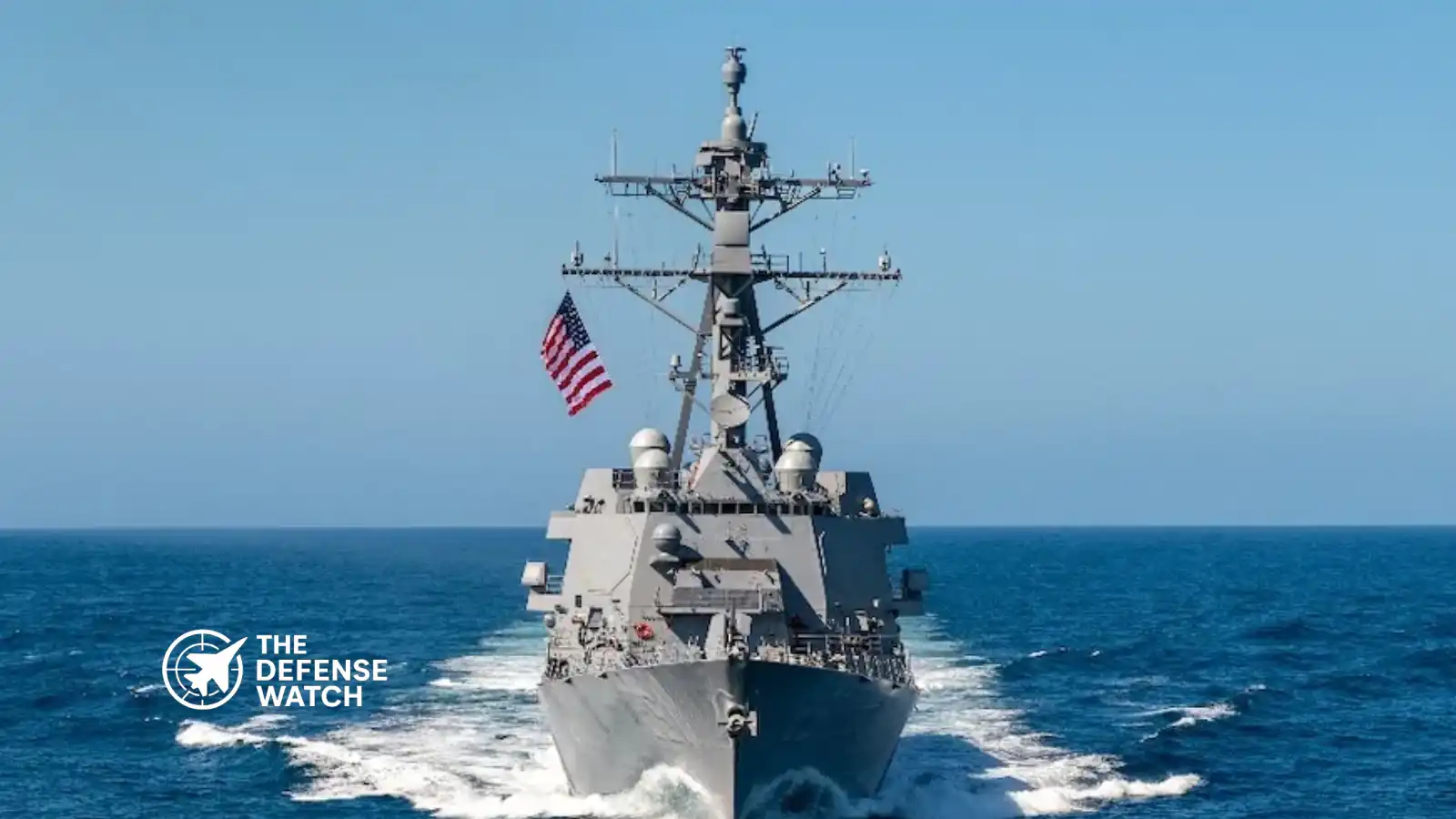
U.S. shipbuilding budget 2027
Image: U.S. Navy.
SHARE
Follow The Defense Watch on Google:

U.S. Shipbuilding Budget 2027 Signals Strategic Naval Expansion

The U.S. shipbuilding budget 2027 proposal, set at $65.8 billion, marks a decisive shift in American naval strategy, reflecting a renewed focus on fleet expansion and industrial capacity. The proposal, reported by Defence Industry Europe, represents the highest level of shipbuilding investment in decades.

Contents
U.S. Shipbuilding Budget 2027 Signals Strategic Naval ExpansionLargest Investment In Decades Targets Fleet GrowthIndustrial Base And Production Capacity Under PressureStrategic Drivers: Indo-Pacific And Great Power CompetitionBalancing Quantity And CapabilityBudget Signals Long-Term Strategic CommitmentOutlook: Execution Will Define Impact

This funding surge comes at a time when the U.S. Navy faces increasing pressure to maintain maritime superiority, particularly against rapidly modernizing naval forces in the Indo-Pacific.

¦ KEY FACTS AT A GLANCE
  • The U.S. Department of Defense has proposed a $65.8 billion shipbuilding budget for fiscal year 2027.
  • The funding represents the largest U.S. naval shipbuilding investment in decades.
  • The plan focuses on expanding fleet size and accelerating construction of key surface combatants and submarines.
  • The proposal reflects growing concerns over peer naval competitors, particularly in the Indo-Pacific region.
  • The budget aligns with long-term U.S. Navy goals to maintain maritime dominance and global deterrence.

Largest Investment In Decades Targets Fleet Growth

The proposed U.S. shipbuilding budget 2027 significantly exceeds recent annual allocations, signaling urgency in rebuilding fleet size and readiness. The funding is expected to support the procurement of new destroyers, submarines, and potentially next-generation platforms.

A key priority remains the expansion of the submarine fleet, widely viewed as a critical advantage in contested maritime environments. Attack submarines and ballistic missile submarines continue to anchor U.S. deterrence strategy.

- Advertisement -

Surface combatants, including guided missile destroyers, are also expected to receive increased funding. These vessels play a central role in air defense, missile interception, and power projection.

Industrial Base And Production Capacity Under Pressure

One of the central challenges tied to the U.S. shipbuilding budget 2027 is the capacity of the American shipbuilding industrial base. While funding levels are rising, production constraints remain a limiting factor.

Shipyards have struggled in recent years with workforce shortages, supply chain disruptions, and delays in major programs. Increasing funding alone does not immediately translate into faster ship delivery.

This raises a key strategic question. Whether the U.S. can effectively convert budget growth into operational fleet expansion within required timelines.

The proposed budget appears to address this by not only funding ship procurement but also supporting infrastructure and workforce development across shipyards.

Strategic Drivers: Indo-Pacific And Great Power Competition

The timing of the U.S. shipbuilding budget 2027 reflects intensifying geopolitical competition, particularly in the Indo-Pacific. The U.S. Navy is under pressure to maintain a credible presence across vast maritime regions where potential adversaries are expanding their naval capabilities.

China’s naval growth, including its expanding fleet of surface ships and submarines, remains a primary driver behind U.S. planning. The scale and pace of Chinese shipbuilding have prompted concerns in Washington about long-term balance of power at sea.

In this context, the proposed budget is not just about modernization. It is about maintaining numerical and technological parity, or advantage, in future maritime conflict scenarios.

- Advertisement -

Balancing Quantity And Capability

While increasing fleet size is a clear objective, the U.S. shipbuilding budget 2027 also reflects a balance between quantity and advanced capability.

Next-generation systems, including unmanned surface and underwater vessels, are expected to play a growing role. These platforms offer the potential to extend reach and reduce operational risk.

However, integrating these emerging technologies alongside traditional shipbuilding programs adds complexity. Budget allocation decisions must balance near-term readiness with long-term innovation.

This dual-track approach highlights a broader shift in naval doctrine. One that blends conventional fleet expansion with distributed and networked maritime operations.

Budget Signals Long-Term Strategic Commitment

The scale of the U.S. shipbuilding budget 2027 underscores a long-term commitment to naval power as a cornerstone of U.S. defense strategy.

Sustained investment at this level would reshape the future fleet, but it also raises questions about affordability and budget sustainability. Shipbuilding remains one of the most capital-intensive areas of defense spending.

Congressional approval will be a critical next step. Lawmakers are expected to scrutinize program timelines, cost controls, and industrial readiness before finalizing the budget.

Outlook: Execution Will Define Impact

The proposed U.S. shipbuilding budget 2027 sets an ambitious target. Its success will depend less on funding levels and more on execution.

If effectively implemented, the plan could reverse years of fleet stagnation and strengthen U.S. maritime dominance. If not, structural challenges in shipbuilding capacity could limit its impact.

In either case, the proposal signals a clear strategic direction. The United States is preparing for sustained naval competition in an increasingly contested global maritime environment.

Enjoying our coverage?

Make The Defense Watch a preferred source on Google to see more of our geopolitical and defense insights when relevant to you.


TAGGED:defense spendingNaval ExpansionPentagon StrategyShipbuilding BudgetU.S. Navy
Share This Article
Facebook Copy Link Print
BySamuel Drake | Defense Analyst
Follow:
Samuel Drake is a defense analyst at TheDefenseWatch.com covering naval warfare, military ordnance, maritime technology, fleet modernization, and defense procurement. His reporting focuses on documented capabilities, procurement programs, and military technology.
Leave a Comment

Leave a Reply Cancel reply

Your email address will not be published. Required fields are marked *

Search Defense Systems

Latest Defense Systems

  • F-104 Starfighter F-104 Starfighter
  • F-15J Eagle Fighter Jet F-15J Eagle Fighter Jet
  • China’s GJ-21 Stealth Drone China’s GJ-21 Stealth Drone
  • China’s GJ-11 Stealth Drone China’s GJ-11 Stealth Drone
  • F-15EX Eagle Fighter Jet F-15EX Eagle Fighter Jet
  • TRML-4D Radar TRML-4D Radar
  • F-47A Fighter Jet F-47A Fighter Jet
  • China DF-61 Missile China DF-61 Missile
  • B61 Nuclear Bomb B61 Nuclear Bomb

Recent Compares

  • J-10C vs JF-17 Thunder: Which Fighter Is More Capable? J-10C vs JF-17 Thunder: Which Fighter Is More Capable? View Comparison →
  • Tejas vs Gripen: Key Differences and Capabilities Tejas vs Gripen: Key Differences and Capabilities View Comparison →
  • Tejas vs MiG-21 Bison: How India Replaced Its Iconic Supersonic Fighter Tejas vs MiG-21 Bison: How India Replaced Its Iconic Supersonic Fighter View Comparison →
  • F-35 vs F-16: Stealth, Sensors and Combat Roles F-35 vs F-16: Stealth, Sensors and Combat Roles View Comparison →
  • Tejas Fighter Jet vs F-16 Fighting Falcon: Capability Compared Tejas Fighter Jet vs F-16 Fighting Falcon: Capability Compared View Comparison →
  • Rafale Fighter Jet vs F-16 Fighting Falcon : Which Fighter Has the Edge? Rafale Fighter Jet vs F-16 Fighting Falcon : Which Fighter Has the Edge? View Comparison →
  • Su-57 Fighter Jet vs J-20 Fighter Jet: Stealth and Air Combat Compared Su-57 Fighter Jet vs J-20 Fighter Jet: Stealth and Air Combat Compared View Comparison →
  • Mirage 2000 vs Tejas Mk1A: Legacy Combat Power vs Indigenous Modernization Mirage 2000 vs Tejas Mk1A: Legacy Combat Power vs Indigenous Modernization View Comparison →
  • Rafale Fighter Jet vs F-22 Raptor: Which Air Dominance Fighter Has the Edge? Rafale Fighter Jet vs F-22 Raptor: Which Air Dominance Fighter Has the Edge? View Comparison →
  • Tejas Fighter Jet vs. Rafale Fighter Jet: India’s Indigenous Fighter Meets France’s Proven Multirole Combat Aircraft Tejas Fighter Jet vs. Rafale Fighter Jet: India’s Indigenous Fighter Meets France’s Proven Multirole Combat Aircraft View Comparison →

Recent Posts

  • Saab and Poland’s Dezamet Sign MAPAM Mortar Ammunition Production Deal
  • Nordic Air Defence to Send K200 Drone Interceptor to Ukraine for Trials
  • Türkiye Inducts First Three Bayraktar Kızılelma Unmanned Fighter Aircraft
  • U.S. Army Tests SIG Sauer M7 Rifle in Indo-Pacific Jungle Training
  • India’s Rafale Fleet Listed at 32 Aircraft After 2025 Pakistan Conflict

You Might Also Like

UK-built helicopters Leonardo Yeovil
Defense Budgets & PolicyPolicy & Strategy

Unite Presses UK to Buy British-Built Helicopters at Leonardo Yeovil

January 20, 2026
U.S.-Australia alliance
Alliances & DoctrinesPolicy & Strategy

Hegseth And Marles Reinforce U.S.-Australia Alliance As ANZUS Marks 75 Years

September 7, 2026
Advanced Lightweight Torpedo U.S. Navy
Naval & MaritimeNaval Strategy & Maritime Security

Northrop Grumman Wins 233 Million Dollar Contract to Build Advanced Lightweight Torpedo for U.S. Navy

January 13, 2026
US may strike Iran again
Policy & Strategy

Trump Signals United States Could Strike Iran Again Over Nuclear Program

December 13, 2025

Logo

Copyright © 2026 TheDefenseWatch.com

Helpful Links

  • Home
  • About Us
  • Privacy Policy
  • Terms of Use / Disclaimer
  • U.S. Privacy Notice – CCPA Compliance

Defense Systems

  • Defense Systems
  • Comparisons 
  • Manufacturer
  • Tactical Calculators

Popuplar

Which 5 Air Forces Possess the Costliest Fighter Jet Fleets in the World
Evolving Strategic Value: Carrier Strike Groups in the Indo-Pacific’s Future Security Architecture
Autonomous Weapon Systems Spark U.S. Ethics Debate Amid Rapid Military AI Integration

We report on developments involving military forces, governments, defense companies, research organizations, and security institutions around the world. 

Welcome Back!

Sign in to your account

Username or Email Address
Password

Lost your password?

Enjoying our coverage?

Make The Defense Watch a preferred source on Google to see more insights.