• Home
  • About
  • Defense Systems
  • Manufacturer
  • Comparisons
  • Compare 
  • Tools
TheDefenseWatch.com
  • Aerospace & Aviation
  • Military & Ordnance
  • Naval & Maritime
  • Cyber & Space Defense
  • Policy & Strategy
  • Global News
  • Tools Library
    • Smart Calculator
    • Drone Flight Time Calculator
    • Drone Range Calculator
    • Counter-Drone Jammer Effective Range Calculator
    • Counter-Battery Radar Detection Calculator
    • Artillery Fire Correction Calculator
    • Thermal Camera Detection Range Calculator
    • Missile Range & Time-of-Flight Calculator
    • Radar Detection Range Calculator
    • FPV Strike Drone Payload vs Range Calculator
    • Loitering Munition Endurance Calculator
    • Sniper Ballistic Drop & Windage Calculator
    • Bullet Drop Calculator
    • U.S. Army Combat Fitness Test (ACFT) Calculator
    • Military Pension Calculator
    • Military Retirement Calculator
    • Military Pension Calculator
    • Large Number Calculator
Font ResizerAa

TheDefenseWatch.com

The Defense Watch | U.S. & Global Defense News, Analysis & Military Updates

Search
  • Home
  • About
  • Defense Systems
  • Manufacturer
  • Comparisons
  • Compare 
  • Tools

Stay Updated

Get the latest update

Subscribe

Explore

  • Drone
  • Fighter Jets & Military Aircraft
  • Hypersonic Weapons
  • Aircraft Carriers
  • Strategic History & Missions
  • Tools Library
Home » AeroVironment wins 24M Navy contract for AI driven autonomous systems
Defense Contracts

AeroVironment wins 24M Navy contract for AI driven autonomous systems

Daniel Mercer / Defense & Aerospace Analyst
Last updated: February 5, 2026 1:05 am
Daniel Mercer / Defense & Aerospace Analyst
Share
2 Min Read
AeroVironment Navy AI contract
illustration
SHARE

AeroVironment Navy AI contract expands long term research into autonomous and swarming technologies for U.S. naval and joint unmanned systems. The U.S. Navy has awarded AeroVironment Inc. a firm fixed price order worth nearly 24 million dollars to advance computer vision, machine learning, and imagery processing software with direct pathways into operational use.

Contents
Contract scope and valueFocus on autonomy and swarmingMulti site execution across the U.S.Role of Naval Air Systems CommandAeroVironment’s position in defense autonomyStrategic context

Announced by Naval Air Systems Command, the award supports applied research, advanced technology development, and sustainment of deployed artificial intelligence tools across multiple Navy and Department of Defense programs. The work will run through February 2031 and is funded under Fiscal Year 2025 research, development, test, and evaluation accounts.

Contract scope and value

The contract, valued at 23,956,873 dollars, was issued as order N6833526F0005 under a previously established basic ordering agreement. It was awarded on February 3, 2026, and was not competed, reflecting the Navy’s continued reliance on AeroVironment for specialized autonomy and perception technologies.

At the time of award, the Navy obligated 2,812,074 dollars in FY2025 RDT and E funds. These funds will expire at the end of the current fiscal year, in line with standard defense research funding rules.

- Advertisement -

According to the contract notice, the effort covers applied research and development of computer vision and machine learning algorithms, video and imagery processing software, and the transition of these technologies into operational systems. The work also includes maintenance and support for already deployed AI enabled capabilities.

Focus on autonomy and swarming

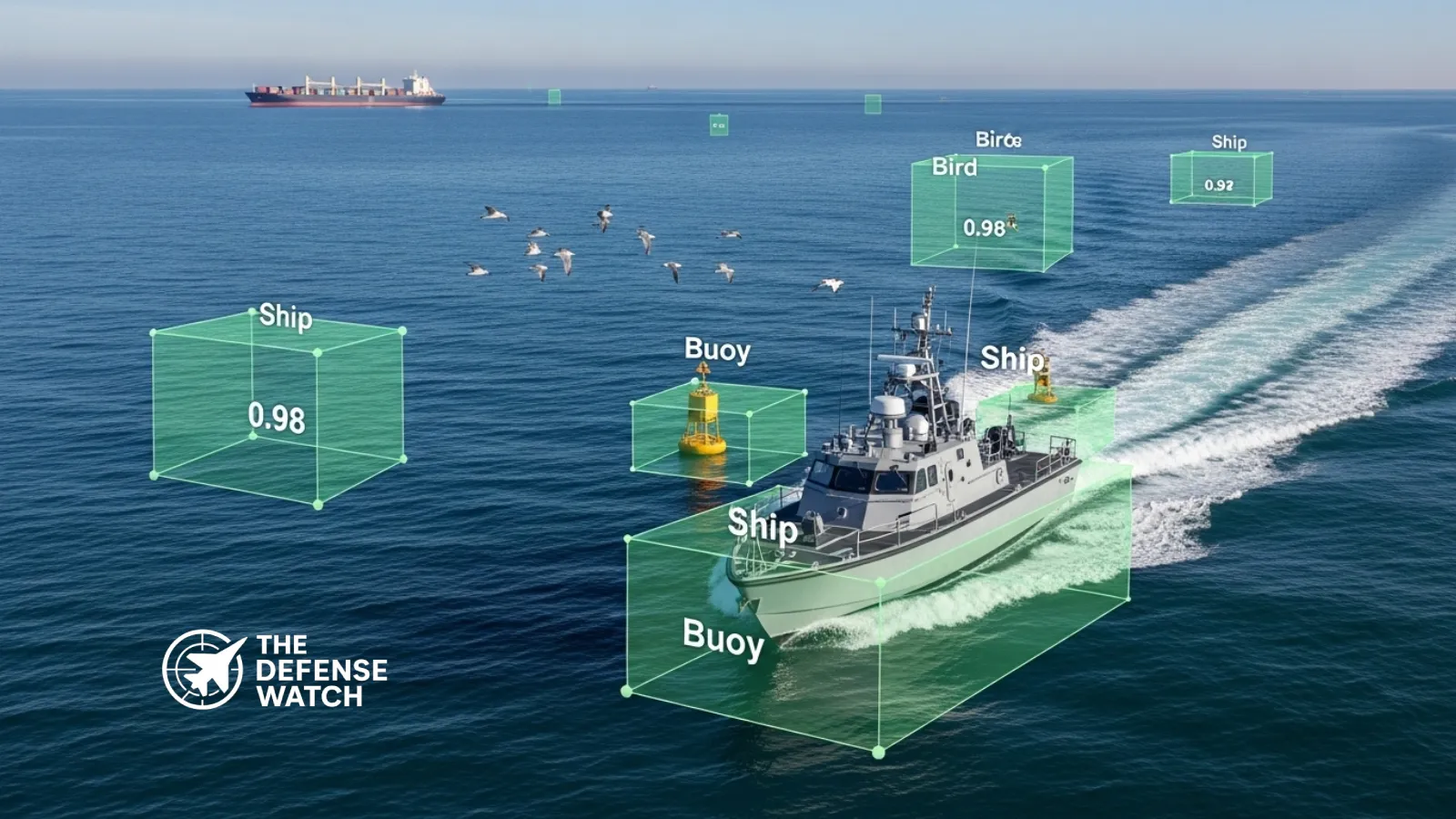
A central element of the AeroVironment Navy AI contract is the integration of computer vision technologies with uncrewed surface vessels and other unmanned platforms. The Navy aims to enable advanced autonomous behaviors, including coordinated swarming, distributed sensing, and improved decision making at the tactical edge.

These capabilities are increasingly important as the U.S. Navy pursues distributed maritime operations and seeks to reduce risk to crewed platforms. AI enabled perception allows unmanned systems to detect, classify, and track objects in complex maritime and littoral environments with limited human input.

Defense officials have repeatedly highlighted autonomy and machine learning as force multipliers, particularly for persistent surveillance, reconnaissance, and contested operations. This contract supports those priorities by moving beyond laboratory research toward fielded and sustained systems.

Multi site execution across the U.S.

Work under the contract will be performed across nine locations in the United States, reflecting the distributed nature of Navy research and testing infrastructure. Locations and approximate shares of work include

Simi Valley, California, 11 percent
Port Hueneme, California, 11 percent
San Diego, California, 11 percent
Norfolk, Virginia, 11 percent
Dahlgren, Virginia, 11 percent
Centreville, Virginia, 11 percent
Dugway Proving Ground, Utah, 11 percent
Atlanta, Georgia, 11 percent
Baltimore, Maryland, 12 percent

The inclusion of Dugway Proving Ground and naval centers such as Dahlgren and Port Hueneme suggests testing in realistic operational environments, including electronic warfare and contested sensing conditions.

Role of Naval Air Systems Command

Naval Air Systems Command in Lakehurst, New Jersey, is the contracting activity. NAVAIR oversees a broad portfolio of aviation, weapons, and unmanned systems, and has increasingly taken a lead role in autonomy, artificial intelligence, and manned unmanned teaming initiatives.

- Advertisement -

Although traditionally associated with aircraft, NAVAIR plays a key role in cross domain autonomy efforts that span air, surface, and subsurface platforms. The AeroVironment Navy AI contract aligns with this broader mandate.

AeroVironment’s position in defense autonomy

AeroVironment is best known for its small unmanned aircraft systems and loitering munitions used by U.S. and allied forces. In recent years, the company has expanded its focus on software, autonomy, and AI enabled capabilities to complement its hardware portfolio.

This contract reinforces AeroVironment’s role as a trusted supplier of advanced autonomy solutions rather than just platforms. By supporting both development and sustainment of deployed systems, the Navy signals confidence in the maturity and operational relevance of the company’s technology.

Industry analysts note that long duration research contracts, particularly those extending beyond five years, provide stable funding and opportunities to shape future operational concepts. The completion date of February 2031 positions this effort to influence next generation unmanned programs.

Strategic context

The AeroVironment Navy AI contract comes as the Department of Defense accelerates adoption of artificial intelligence under initiatives such as the Replicator program and the Chief Digital and Artificial Intelligence Office’s enterprise AI strategy.

Autonomous swarming, resilient perception, and machine speed decision support are seen as essential to countering peer competitors in contested maritime regions. Investment in software centric capabilities also allows faster upgrades compared to traditional hardware focused programs.

While the contract notice does not specify particular platforms or theaters, its emphasis on uncrewed surface vessels and unmanned systems aligns with Navy experimentation in the Indo Pacific and other high priority regions.


TAGGED:AeroVironmentAutonomous systemsmilitary machine learningNavy AI contractunmanned platforms
Share This Article
Facebook Copy Link Print
ByDaniel Mercer / Defense & Aerospace Analyst
Follow:
Daniel Mercer is a defense and aerospace analyst at TheDefenseWatch.com covering military aviation, aerospace technology, unmanned systems, air warfare, and defense procurement. His reporting uses official documents, government and military statements, company announcements, and other public sources.
Leave a Comment

Leave a Reply Cancel reply

Your email address will not be published. Required fields are marked *

Search Defense Systems

Latest Defense Systems

  • F-47A Fighter Jet F-47A Fighter Jet
  • China DF-61 Missile China DF-61 Missile
  • B61 Nuclear Bomb B61 Nuclear Bomb
  • Japan E-767 Airborne Japan E-767 Airborne
  • Remington 870 Shotgun Remington 870 Shotgun
  • RUTA B1 Cruise Missile RUTA B1 Cruise Missile
  • XQ-67A Drone XQ-67A Drone
  • B-25 Mitchell Bomber B-25 Mitchell Bomber
  • F-100 Super Sabre F-100 Super Sabre

Recent Compares

  • J-10C vs JF-17 Thunder: Which Fighter Is More Capable? J-10C vs JF-17 Thunder: Which Fighter Is More Capable? View Comparison →
  • Tejas vs Gripen: Key Differences and Capabilities Tejas vs Gripen: Key Differences and Capabilities View Comparison →
  • Tejas vs MiG-21 Bison: How India Replaced Its Iconic Supersonic Fighter Tejas vs MiG-21 Bison: How India Replaced Its Iconic Supersonic Fighter View Comparison →
  • F-35 vs F-16: Stealth, Sensors and Combat Roles F-35 vs F-16: Stealth, Sensors and Combat Roles View Comparison →
  • Tejas Fighter Jet vs F-16 Fighting Falcon: Capability Compared Tejas Fighter Jet vs F-16 Fighting Falcon: Capability Compared View Comparison →
  • Rafale Fighter Jet vs F-16 Fighting Falcon : Which Fighter Has the Edge? Rafale Fighter Jet vs F-16 Fighting Falcon : Which Fighter Has the Edge? View Comparison →
  • Su-57 Fighter Jet vs J-20 Fighter Jet: Stealth and Air Combat Compared Su-57 Fighter Jet vs J-20 Fighter Jet: Stealth and Air Combat Compared View Comparison →
  • Mirage 2000 vs Tejas Mk1A: Legacy Combat Power vs Indigenous Modernization Mirage 2000 vs Tejas Mk1A: Legacy Combat Power vs Indigenous Modernization View Comparison →
  • Rafale Fighter Jet vs F-22 Raptor: Which Air Dominance Fighter Has the Edge? Rafale Fighter Jet vs F-22 Raptor: Which Air Dominance Fighter Has the Edge? View Comparison →
  • Tejas Fighter Jet vs. Rafale Fighter Jet: India’s Indigenous Fighter Meets France’s Proven Multirole Combat Aircraft Tejas Fighter Jet vs. Rafale Fighter Jet: India’s Indigenous Fighter Meets France’s Proven Multirole Combat Aircraft View Comparison →

Recent Posts

  • Lockheed Martin Introduces C-130J Trainer to Expand Aircrew Training Capacity
  • Royal Navy Launches First Autonomous Squadron for Uncrewed Boat Operations
  • Raytheon Completes Third DeepStrike JR3 Rocket Flight Test for U.S. Army
  • Acting Navy Secretary Tours Blount Island Marine Logistics Hub
  • Defense Logistics Agency Commits $2 Billion to Critical Materials Stockpile

You Might Also Like

MS-110 reconnaissance system
Defense Contracts

RTX Raytheon Secures 197 Million Dollar MS-110 Reconnaissance Contract for Poland

September 7, 2026
Iron Legion JV USSOCOM contract
Defense Contracts

Iron Legion JV wins $265M USSOCOM intelligence support contract through 2036

February 5, 2026
UK sonobuoy contract
Defense Contracts

UK Awards 40-Million-Pound Sonobuoy Contract to Boost Royal Navy Merlin ASW Capability

September 7, 2026
UK Precision Strike Missile program
Defense Contracts

United Kingdom Moves To Expand Precision Strike Missile Program As NATO Pushes For Stronger Long Range Deterrence

September 7, 2026

Logo

Copyright © 2026 TheDefenseWatch.com

Helpful Links

  • Home
  • About Us
  • Privacy Policy
  • Terms of Use / Disclaimer
  • U.S. Privacy Notice – CCPA Compliance

Defense Systems

  • Defense Systems
  • Comparisons 
  • Manufacturer
  • Tactical Calculators

Popuplar

Which 5 Air Forces Possess the Costliest Fighter Jet Fleets in the World
Evolving Strategic Value: Carrier Strike Groups in the Indo-Pacific’s Future Security Architecture
Autonomous Weapon Systems Spark U.S. Ethics Debate Amid Rapid Military AI Integration

We report on developments involving military forces, governments, defense companies, research organizations, and security institutions around the world. 

Welcome Back!

Sign in to your account

Username or Email Address
Password

Lost your password?