• Home
  • About
  • Defense Systems
  • Manufacturer
  • Comparisons
  • Compare 
  • Tools
TheDefenseWatch.com
  • Aerospace & Aviation
  • Military & Ordnance
  • Naval & Maritime
  • Cyber & Space Defense
  • Policy & Strategy
  • Global News
  • Tools Library
    • Smart Calculator
    • Drone Flight Time Calculator
    • Drone Range Calculator
    • Counter-Drone Jammer Effective Range Calculator
    • Counter-Battery Radar Detection Calculator
    • Artillery Fire Correction Calculator
    • Thermal Camera Detection Range Calculator
    • Missile Range & Time-of-Flight Calculator
    • Radar Detection Range Calculator
    • FPV Strike Drone Payload vs Range Calculator
    • Loitering Munition Endurance Calculator
    • Sniper Ballistic Drop & Windage Calculator
    • Bullet Drop Calculator
    • U.S. Army Combat Fitness Test (ACFT) Calculator
    • Military Pension Calculator
    • Military Retirement Calculator
    • Military Pension Calculator
    • Large Number Calculator
Font ResizerAa

TheDefenseWatch.com

The Defense Watch | U.S. & Global Defense News, Analysis & Military Updates

Search
  • Home
  • About
  • Defense Systems
  • Manufacturer
  • Comparisons
  • Compare 
  • Tools

Stay Updated

Get the latest update

Subscribe

Explore

  • Drone
  • Fighter Jets & Military Aircraft
  • Hypersonic Weapons
  • Aircraft Carriers
  • Strategic History & Missions
  • Tools Library
Home » UK Confirms Limits on Military Access to Irish Airspace in Defence Response
Policy & Strategy

UK Confirms Limits on Military Access to Irish Airspace in Defence Response

Daniel Mercer / Defense & Aerospace Analyst
Last updated: September 7, 2026 11:30 pm
Daniel Mercer / Defense & Aerospace Analyst
Share
6 Min Read
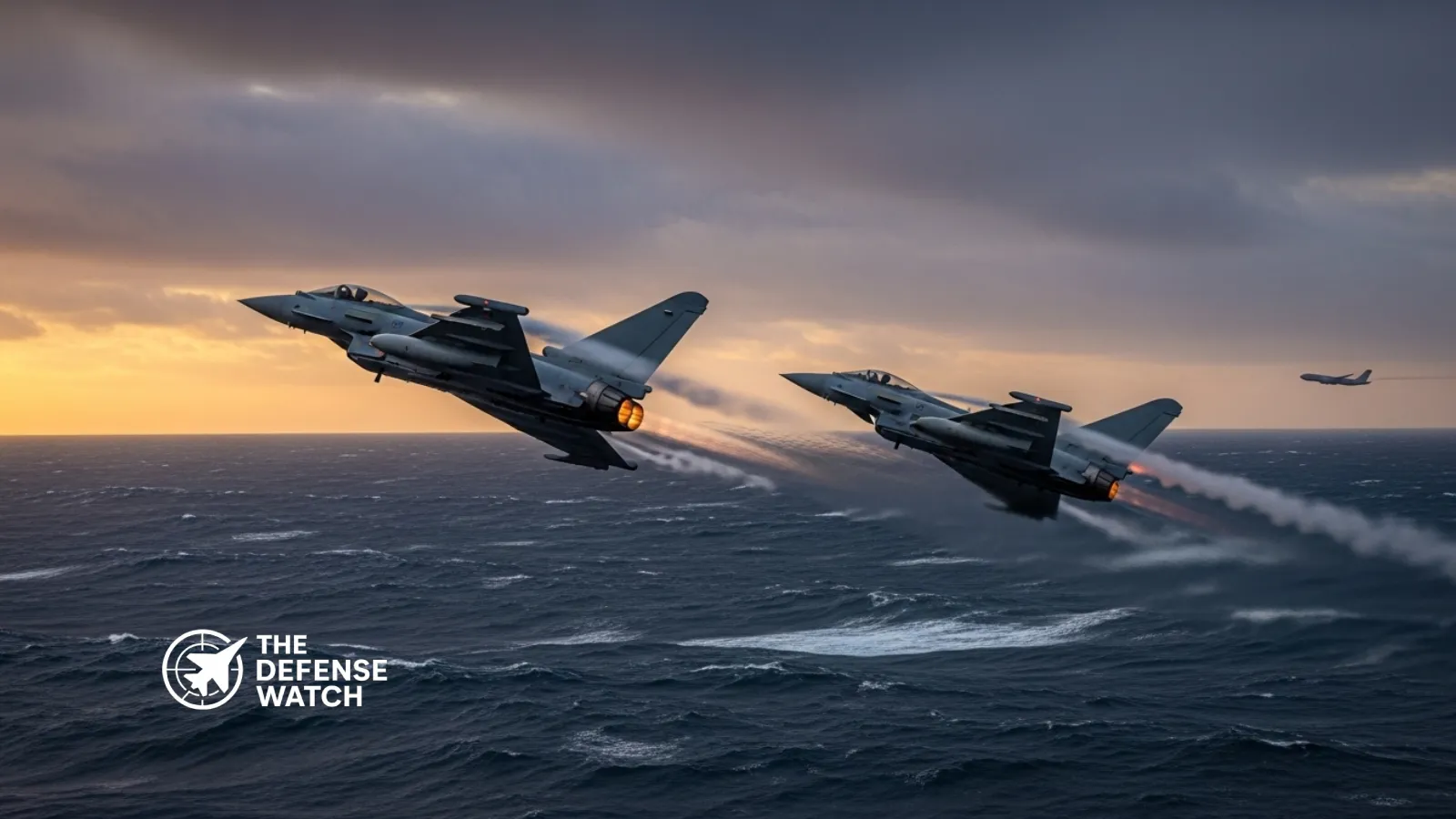
UK military access Irish airspace
SHARE

UK Confirms Limits on Military Access to Irish Airspace

The United Kingdom Ministry of Defence has confirmed that UK military aircraft do not enter the sovereign airspace of Ireland for operational purposes without the express prior agreement of the Irish Government, officials said during a UK parliamentary session on January 20, 2026.

Contents
  • UK Confirms Limits on Military Access to Irish Airspace
  • Background on Airspace Cooperation
  • Details of the Defence Ministry Response
  • Longstanding Interception Role
  • Diplomatic and Legal Framework
  • Policy and Strategic Implications
  • What’s Next
(adsbygoogle = window.adsbygoogle || []).push({});

In response to a question in the House of Commons, Defence Minister Al Carns outlined the formal arrangements governing access to Irish airspace and reiterated that all military flights are subject to diplomatic clearance and international norms.

Background on Airspace Cooperation

Ireland’s sovereign airspace extends over its territory and surrounding waters and remains under the control of the Irish Government, consistent with international law on state airspace rights. The Republic’s longstanding policy of military neutrality means it is not part of formal defence alliances and maintains a limited air defence capability.

Historically, Dublin has relied on informal arrangements with London that date back to the early 1950s, when Ireland permitted the Royal Air Force to assist with intercepting unidentified aircraft due to the Irish Air Corps’ lack of fast-jet interception capability. These arrangements have been periodically renewed through bilateral engagement, though they are not regarded as formal defence treaties.

- Advertisement -

Details of the Defence Ministry Response

The issue was raised in the UK parliament by Carla Lockhart, a Member of Parliament for the Democratic Unionist Party, who asked officials to clarify arrangements for intercepting unidentified or potentially hostile aircraft in Irish airspace.

Minister Carns said that access to Irish airspace by UK military aircraft is managed through established diplomatic processes, with clearances requested and granted under set conditions. He emphasized that the UK does not conduct operational flights within Ireland’s sovereign airspace without prior political approval from Dublin.

(adsbygoogle = window.adsbygoogle || []).push({});

Carns made a point that matters relating to sovereign airspace access ultimately rest with the individual states involved, and suggested that questions about Irish regulations be directed to Irish authorities.

Longstanding Interception Role

The UK’s role in responding to unidentified aircraft near Irish airspace stems from practical considerations. Ireland has not operated dedicated interceptor fighters since it retired its sole air combat aircraft in 1999, leaving it without the ability to rapidly identify or intercept high-speed aircraft on its own.

Under past arrangements, RAF jets have been dispatched to visually identify aircraft that enter the Irish Flight Information Region (FIR) and fail to establish contact with civil air traffic control. The UK position has been that these missions are focused on aviation safety, helping to re-route civilian flights and maintain safe airspace around one of Europe’s busiest transatlantic corridors, rather than taking responsibility for Irish air defence.

Diplomatic and Legal Framework

According to international norms, military aircraft, including warplanes, require permission from the sovereign state to enter its airspace. That permission typically comes through diplomatic channels and formal clearance requests. The UK Defence Ministry’s statement underlines this principle and confirms that routine access is not assumed based on past cooperative arrangements.

Ireland’s constitution and aviation regulations reinforce state control over foreign military flights. Previous reporting has noted that foreign military aircraft must receive express invitation or permission from Irish authorities to fly over or land in the state, and must meet specified conditions related to armament and purpose.

The longstanding cooperation between the UK and Ireland around air traffic safety and airspace monitoring does not equate to a formal defence pact. Instead it is framed within mutual interest in civil aviation safety and shared operational risks.

- Advertisement -
(adsbygoogle = window.adsbygoogle || []).push({});

Policy and Strategic Implications

The reaffirmation of diplomatic clearance requirements comes amid ongoing discussion in Ireland about its defence posture and the nature of its cooperation with the UK. Some Irish officials and analysts have in the past called for greater transparency regarding airspace arrangements, reflecting concerns about sovereignty and Dublin’s neutral stance.

For the UK, clarifying the limits on military access to Irish airspace helps define the scope of bilateral defence cooperation and reaffirms respect for Irish sovereignty. It also reflects broader efforts to maintain clear international norms governing military flights and state airspace rights.

What’s Next

Looking ahead, the UK and Ireland are expected to continue dialogue on defence cooperation, including air and maritime security. Both governments have engaged in periodic reviews of existing arrangements, and Dublin may consider adjustments to its own air defence capabilities.

The confirmation that UK military aircraft require explicit Irish government approval for operational flights into Irish airspace underscores the importance of diplomatic channels in managing shared security challenges, particularly in the context of neutral defence policies and evolving regional threats.


TAGGED:air defence cooperationdiplomatic clearanceIrish airspaceRAFUK military
Share This Article
Facebook Copy Link Print
ByDaniel Mercer / Defense & Aerospace Analyst
Follow:
Daniel Mercer is a defense and aerospace analyst at TheDefenseWatch.com covering military aviation, aerospace technology, unmanned systems, air warfare, and defense procurement. His reporting uses official documents, government and military statements, company announcements, and other public sources.
Leave a Comment

Leave a Reply Cancel reply

Your email address will not be published. Required fields are marked *

Latest Defense Systems

  • B-25 Mitchell Bomber B-25 Mitchell Bomber
  • F-100 Super Sabre F-100 Super Sabre
  • North American F-86 Sabre North American F-86 Sabre
  • North American XB-70 Valkyrie North American XB-70 Valkyrie
  • Northrop YF-23 Fighter Northrop YF-23 Fighter
  • P-51 Mustang Fighter Aircraft P-51 Mustang Fighter Aircraft
  • Rafale F5 Fighter Rafale F5 Fighter
  • Tomahawk Block V Missile Tomahawk Block V Missile
  • Tomahawk Block IV Missile Tomahawk Block IV Missile

Recent Compares

  • J-10C vs JF-17 Thunder: Which Fighter Is More Capable? J-10C vs JF-17 Thunder: Which Fighter Is More Capable? View Comparison →
  • Tejas vs Gripen: Key Differences and Capabilities Tejas vs Gripen: Key Differences and Capabilities View Comparison →
  • Tejas vs MiG-21 Bison: How India Replaced Its Iconic Supersonic Fighter Tejas vs MiG-21 Bison: How India Replaced Its Iconic Supersonic Fighter View Comparison →
  • F-35 vs F-16: Stealth, Sensors and Combat Roles F-35 vs F-16: Stealth, Sensors and Combat Roles View Comparison →
  • Tejas Fighter Jet vs F-16 Fighting Falcon: Capability Compared Tejas Fighter Jet vs F-16 Fighting Falcon: Capability Compared View Comparison →
  • Rafale Fighter Jet vs F-16 Fighting Falcon : Which Fighter Has the Edge? Rafale Fighter Jet vs F-16 Fighting Falcon : Which Fighter Has the Edge? View Comparison →
  • Su-57 Fighter Jet vs J-20 Fighter Jet: Stealth and Air Combat Compared Su-57 Fighter Jet vs J-20 Fighter Jet: Stealth and Air Combat Compared View Comparison →
  • Mirage 2000 vs Tejas Mk1A: Legacy Combat Power vs Indigenous Modernization Mirage 2000 vs Tejas Mk1A: Legacy Combat Power vs Indigenous Modernization View Comparison →
  • Rafale Fighter Jet vs F-22 Raptor: Which Air Dominance Fighter Has the Edge? Rafale Fighter Jet vs F-22 Raptor: Which Air Dominance Fighter Has the Edge? View Comparison →
  • Tejas Fighter Jet vs. Rafale Fighter Jet: India’s Indigenous Fighter Meets France’s Proven Multirole Combat Aircraft Tejas Fighter Jet vs. Rafale Fighter Jet: India’s Indigenous Fighter Meets France’s Proven Multirole Combat Aircraft View Comparison →

Recent Posts

  • Pratt & Whitney Begins $100 Million Polish Expansion for F-35 Engine Parts
  • Northrop Grumman Wins $43.9 Million Contract for Trident II Rocket Motor Facilities
  • Ukraine Drone Strikes Disrupt Russian Data Centers, Raising Questions About AI Infrastructure Security
  • Lockheed Martin Wins $114.6 Million Contract to Redesign F-35 Navigation Systems
  • Project Agincourt Pushes Pentagon to Speed Up Autonomous Weapons Fielding

You Might Also Like

UAE airspace military operations Iran
Geopolitical & Strategic DoctrinesPolicy & Strategy

UAE Bars Airspace for Military Strikes Against Iran Amid Rising US-Tehran Tensions

September 7, 2026
U.S. and Philippine Army soldiers conduct joint training during Exercise Salaknib 2026 at Fort Magsaysay in the Philippines.
Alliances & DoctrinesPolicy & Strategy

U.S. Army Expands Indo-Pacific Readiness With Salaknib 2026 Exercise In Philippines

June 1, 2026
Iran nuclear deal negotiations 2026
Geopolitical & Strategic DoctrinesPolicy & Strategy

Iran Signals Openness To Nuclear Deal Compromises If US Lifts Sanctions

September 7, 2026
U.S. Autonomous Warfare Command
Alliances & DoctrinesPolicy & Strategy

Hegseth Says Autonomous Warfare Has Long Been the Pentagon’s End Goal

October 15, 2026

Logo

Copyright © 2026 TheDefenseWatch.com

Helpful Links

  • Home
  • About Us
  • Privacy Policy
  • Terms of Use / Disclaimer
  • U.S. Privacy Notice – CCPA Compliance

Defense Systems

  • Defense Systems
  • Comparisons 
  • Manufacturer
  • Tactical Calculators

Popuplar

Which 5 Air Forces Possess the Costliest Fighter Jet Fleets in the World
Evolving Strategic Value: Carrier Strike Groups in the Indo-Pacific’s Future Security Architecture
Autonomous Weapon Systems Spark U.S. Ethics Debate Amid Rapid Military AI Integration

We report on developments involving military forces, governments, defense companies, research organizations, and security institutions around the world. 

Welcome Back!

Sign in to your account

Username or Email Address
Password

Lost your password?