The U.S. Army’s 25th Infantry Division has conducted a long-range maritime air assault across hundreds of miles of the Pacific Ocean, testing its ability to move infantry forces between island positions during a multinational military exercise in Hawaii.
The operation took place on November 8, 2026, as part of Joint Pacific Multinational Readiness Center (JPMRC) Rotation 27-01. Elements of the division’s 2nd Mobile Brigade were transported by the 25th Combat Aviation Brigade into simulated contested island terrain, followed by heavy resupply operations conducted by the 8th Theater Sustainment Command.
The exercise focused on a central operational challenge for U.S. forces in the Indo-Pacific: moving combat formations across widely separated islands while maintaining the logistical support needed to sustain ground operations after arrival.
According to the U.S. Army account published through the Defense Visual Information Distribution Service (DVIDS), the assault involved helicopter movements over open water, advance logistical preparations and coordinated resupply. The operation formed part of a broader force-on-force training rotation involving U.S. forces and six international partners.
Moving Infantry Across the Pacific
The long-range maritime air assault involved soldiers from the 2nd Mobile Brigade, 25th Infantry Division, who were transported into simulated contested terrain by the division’s aviation brigade.
U.S. Army photographs identified CH-47 Chinook helicopters as part of the operation. The aircraft provided the transport capability required to move infantry forces over maritime distances and insert them into the exercise area.
The insertion was followed by heavy equipment and supply drops conducted by the 8th Theater Sustainment Command.
The Army said aviation and sustainment units had established distributed refueling locations across the island chain before the assault. These forward logistics arrangements were intended to support aircraft operations and maintain the force’s ability to continue operating across geographically separated positions.
This logistical element is particularly important in Pacific operations. Helicopter mobility can provide access to islands and locations that lack suitable airfields or established transportation infrastructure. However, moving troops is only one part of the mission. Fuel, ammunition, food, medical supplies and equipment must also reach deployed formations.
The exercise therefore tested more than the ability to conduct a long-distance helicopter insertion. It incorporated the coordination between aviation, ground forces and sustainment units needed to maintain operational effectiveness after landing.
Why Maritime Mobility Matters in Indo-Pacific Operations
The geography of the Indo-Pacific creates significant challenges for conventional land-force operations.
Unlike continental theaters, where ground formations can often rely on connected road and rail networks, military forces operating across the Pacific must move between islands separated by large stretches of water.
This creates additional demands on airlift, maritime transportation, aviation support and forward logistics.
Long-range maritime air assault offers one way to move infantry forces without depending entirely on port facilities or conventional ground transportation. Helicopters can insert troops into locations where fixed infrastructure is limited, provided that aircraft have suitable staging, refueling and support arrangements.
For the U.S. Army, the ability to operate across this environment is closely connected to its wider Indo-Pacific modernization and readiness priorities.
The 25th Infantry Division, headquartered at Schofield Barracks in Hawaii, has a regional mission that places it in a position to train for operations across the Pacific island chain.
JPMRC provides a training environment for this requirement by combining live, virtual and constructive exercises across archipelagic, jungle and other demanding terrain.
The November operation demonstrated an important training requirement, but it should not be interpreted as proof that the Army has established a permanently sustainable long-range assault capability under combat conditions. The publicly available account does not disclose the complete aircraft numbers, precise route, fuel consumption or operational limitations encountered during the exercise.
Multinational Forces Train for Island Warfare
JPMRC Rotation 27-01 brought together U.S. military personnel and forces from six partner countries:
- Republic of Korea
- Singapore
- France
- New Zealand
- Japan
- Maldives
The multinational participation provided opportunities to practice coordination between forces that may need to operate together during a regional contingency.
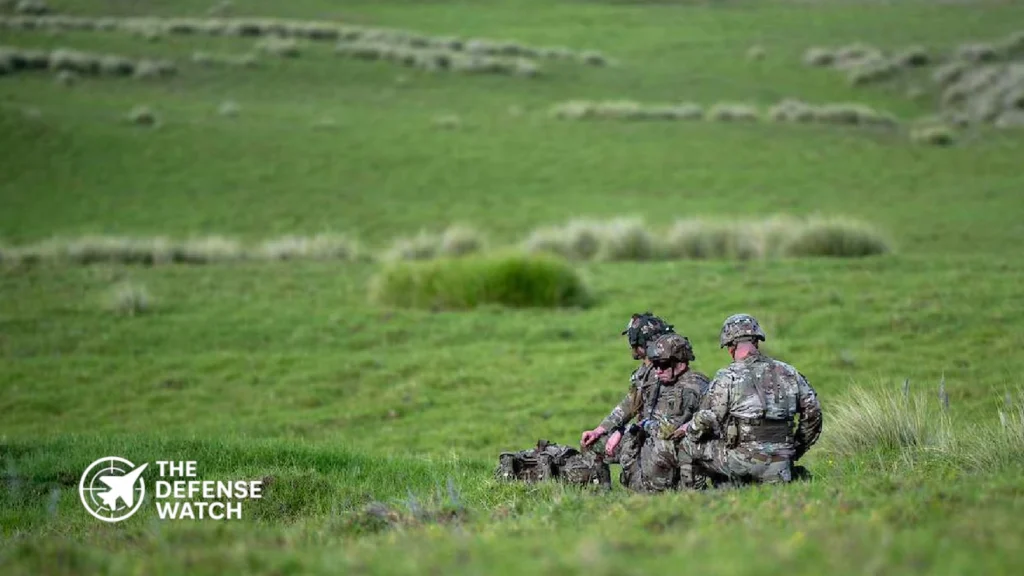
The exercise also included simulated ground combat operations on Oahu and the Island of Hawaii. Elements of the 2nd Mobile Brigade conducted offensive operations against an opposing force, with troops training to seize and hold key terrain in challenging environments.
U.S. Army reporting also documented Singaporean personnel participating alongside American soldiers during ground operations at Kahuku Training Area on November 10.
The training moved beyond the initial assault phase as the exercise entered its second battle period. Following offensive operations, participating forces were required to transition to defensive positions and prepare to hold previously captured terrain.
This progression matters because island operations require forces to conduct multiple missions after an initial landing. Securing terrain, protecting supply routes, maintaining communications and responding to counterattacks all place demands on deployed formations.
Multinational training helps identify practical challenges involving command arrangements, communications, movement procedures and sustainment before forces are required to operate together in a real crisis.
The Exercise Also Tested Airborne Deployment From Alaska
The maritime air assault was one part of a larger exercise designed to test the movement and employment of forces across long distances.
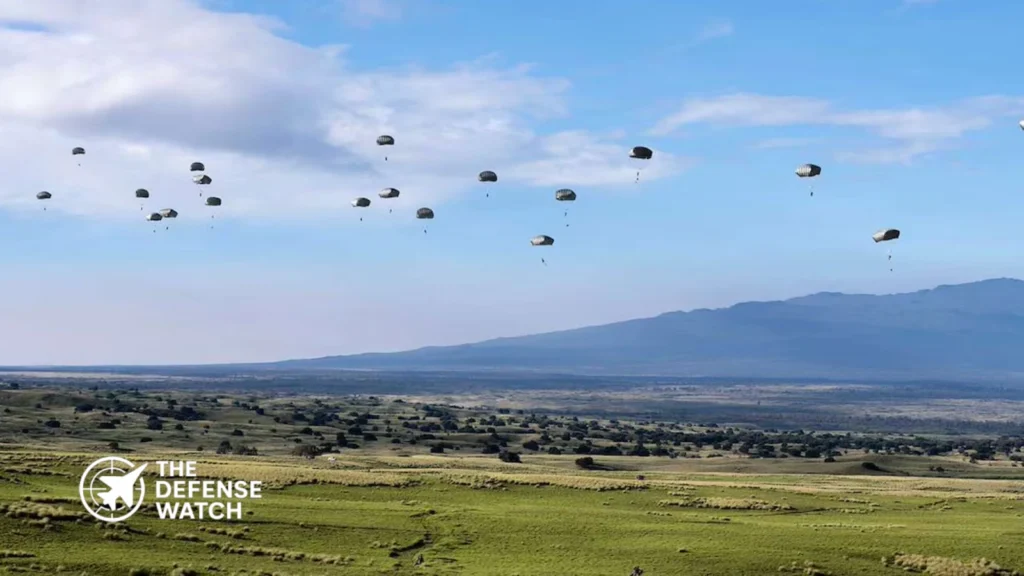
Earlier in November, the Army’s 11th Airborne Division conducted a joint forcible entry operation into Hawaii under the exercise name Arctic Aloha.
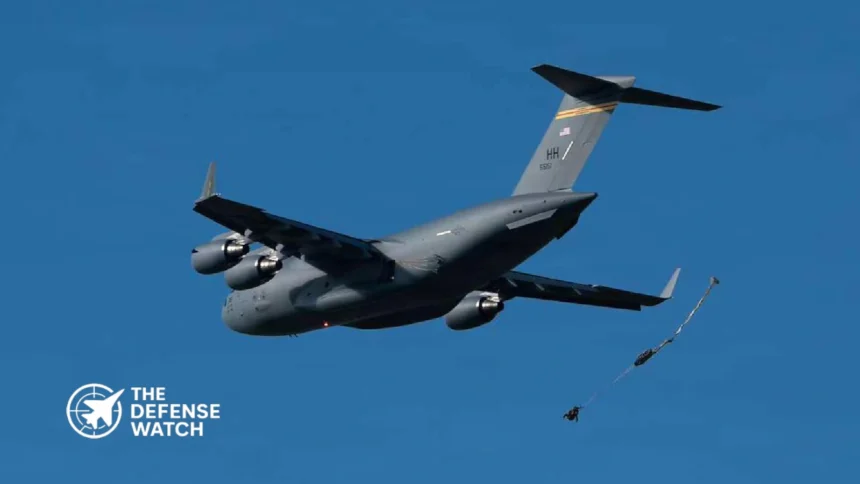
According to the Army, paratroopers departed Joint Base Elmendorf-Richardson in Alaska and conducted an airborne insertion after a flight of nearly 3,000 miles.
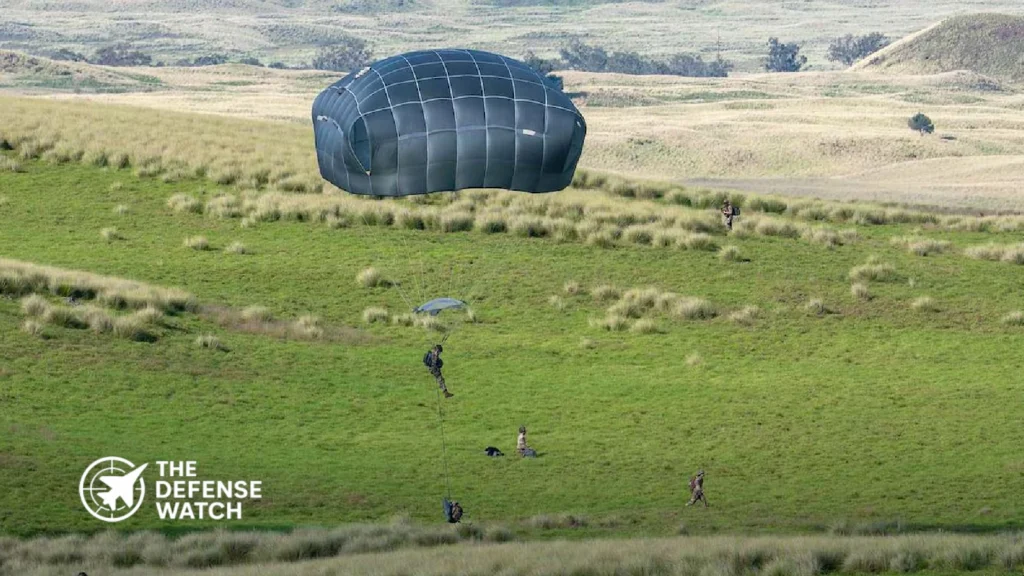
The operation included an in-flight link-up with an infantry company arriving from Japan after its participation in Operation Keen Sword. The forces then conducted a parachute insertion as a unified battalion task force.
The Army described the operation as a test of long-distance deployment, airborne readiness and coordination between geographically separated formations.
It also involved in-flight rigging, allowing paratroopers to prepare their parachutes and equipment during the flight rather than carrying the full combat load throughout the journey.
Together, the airborne insertion and subsequent maritime air assault provided different approaches to moving ground forces into an island environment.
Fixed-wing aircraft can rapidly transport airborne forces over long distances, while helicopters provide the ability to move infantry into more localized landing areas. Both methods require coordination with supporting forces and a functioning logistical network.
Logistics Remains a Major Operational Constraint
The November 8 assault highlights an important limitation of long-range air mobility: aircraft reach does not automatically translate into sustained ground combat capability.
Helicopter operations over long maritime distances require careful management of fuel, aircraft availability, maintenance and forward support. The need to maintain distributed refueling locations can also create additional planning and security requirements.
The Army’s account identified advance logistical staging as an important part of the operation. It did not, however, publish enough information to assess the precise endurance of the helicopter force or the volume of supplies delivered.
This distinction is important when evaluating the exercise.
A successful training insertion demonstrates that participating units completed a planned movement under exercise conditions. It does not establish how the same operation would perform against an adversary employing advanced air defenses, electronic warfare, surveillance systems or long-range precision weapons.
The Army also described the use of secure tactical networks and Next-Generation Command and Control capabilities during the exercise. These systems are intended to help commanders exchange operational information and coordinate dispersed forces.
Their effectiveness in a real conflict would depend on network resilience, communications security and the ability to operate when satellite and other communications services are disrupted.
What JPMRC 27-01 Shows About Army Readiness
JPMRC 27-01 provides a practical setting for testing how U.S. forces and international partners can coordinate operations across an island environment.
The combination of airborne deployment, helicopter insertion, distributed refueling, heavy resupply and ground maneuver reflects the different requirements involved in projecting and sustaining land forces across the Pacific.
The exercise also places emphasis on interoperability. Partner forces must be able to coordinate movement, exchange information and support shared operational objectives despite differences in equipment, procedures and military structures.
For the 25th Infantry Division, these activities are directly relevant to its regional responsibilities and its role in supporting U.S. Army Pacific operations.
However, the publicly released information remains focused on exercise activity rather than a detailed operational assessment. The Army has not disclosed comprehensive performance data, including aircraft participation figures, exact flight distances, fuel requirements or the results of any simulated adversary air-defense engagements.
The long-range maritime air assault therefore provides evidence of a training capability being exercised, rather than a complete measure of how effectively the force could operate in a contested Pacific conflict.
The central challenge remains the same: U.S. forces must be able to move quickly between islands, establish positions and sustain operations after arriving. JPMRC 27-01 is designed to test those requirements with American forces and regional partners operating together.