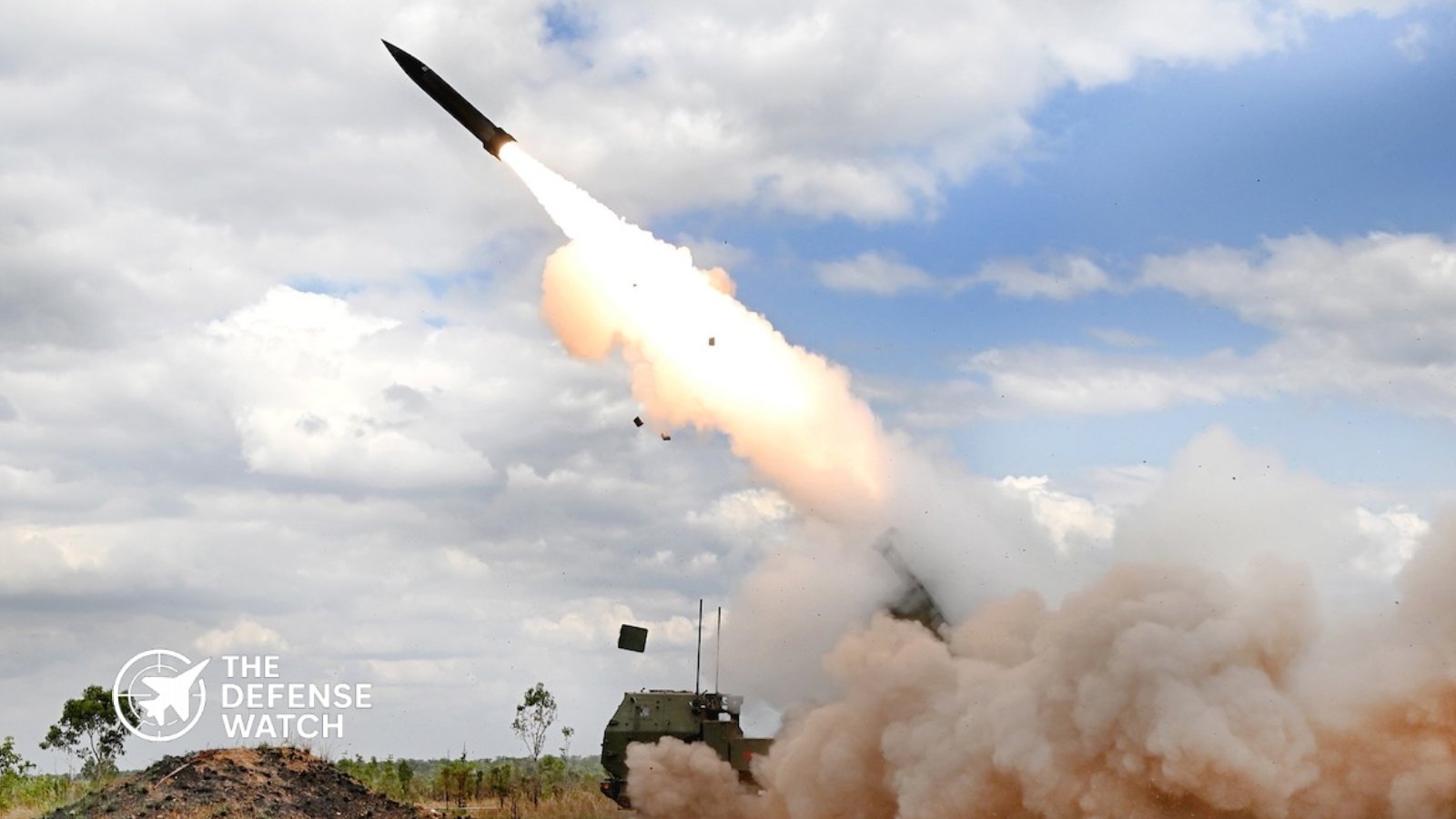
Australia has received a second tranche of High Mobility Artillery Rocket System launchers from the United States, with the delivery arriving two years earlier than the schedule previously set for the capability.
The Australian Department of Defence confirmed the delivery on October 7, saying it came roughly one year after the Army received its first HIMARS tranche. The new launchers are being added to the Army’s long range fires capability within the 10th Fires Brigade.
The government has not disclosed how many launchers were included in the second tranche. That distinction matters because Australia’s overall HIMARS fleet is still being built through multiple procurement decisions rather than a single delivery.
From 42 launchers to a larger force
Australia originally accelerated its HIMARS acquisition as part of a broader effort to establish land based long range precision strike. The 2024 Australian Guided Weapons and Explosive Ordnance Plan said the acquisition had been moved forward from the early 2030s to 2026 to 2027 and increased the planned fleet from 20 launchers to 42.
That plan was subsequently expanded. In April 2026, the Australian government selected HIMARS and the Precision Strike Missile for a second long range fires regiment, committing A$2.3 billion over the decade for the additional capability. The government said the second regiment would be established at the Edinburgh Defence Precinct in South Australia.
The October announcement now describes a future force of up to 90 HIMARS launchers across the Army’s first and second long range fires regiments within the 10th Fires Brigade. The figure is therefore a planned maximum rather than the number currently in Australian service.
Why the accelerated delivery matters
The significance of the latest delivery is less about the launcher itself than about how quickly Australia is assembling the wider strike architecture around it.
The Australian Army previously relied on artillery with a much shorter reach. Canberra’s 2024 weapons plan described a transition from a maximum artillery range of about 40 kilometers toward land and maritime strike capabilities reaching much farther through HIMARS, GMLRS and later versions of PrSM.
Australia has already demonstrated the intended direction of the program. During Exercise Talisman Sabre 2025, an Australian HIMARS launched a Precision Strike Missile. The government described that firing as occurring two years earlier than originally planned.
The second HIMARS regiment is intended to give the Army greater capacity to contribute to Australia’s long range strike and maritime denial architecture. Canberra says the initial PrSM capability will provide a range of up to 500 kilometers, while future increments are intended to extend beyond 1,000 kilometers and include maritime strike applications. Those future capabilities should not be confused with the current operational range of every missile available to Australian HIMARS units.
The launcher is only one part of the capability
The other important element is ammunition supply.
Australia fired its first Australian manufactured GMLRS missile from a HIMARS earlier in 2026 at the Woomera Test Range. The government said the test followed the opening of a dedicated facility at Port Wakefield in South Australia in December 2025.
This creates a link between the accelerated launcher deliveries and Canberra’s longer term effort to establish a domestic guided weapons industry. Australian industry is expected to manufacture GMLRS and progressively participate in the supply chain for more advanced weapons, including PrSM.
The 2024 Australian weapons plan identified domestic GMLRS production as an early step toward a broader sovereign guided weapons capability. It also stated that Lockheed Martin Australia would initially manufacture GMLRS in Australia and that the government was investing in facilities and Australian suppliers to expand production capacity.
For Australia, this matters because launcher numbers alone do not determine the effectiveness of a long range fires force. Missile stocks, reload availability, targeting networks, training, maintenance, transport and the ability to disperse launchers are equally important.
Range, mobility and targeting remain constraints
Australian Army research has also cautioned against treating HIMARS as a standalone strategic solution.
An Australian Army Research Centre analysis identified range, mass and mobility as key issues for the future force. It noted that the effectiveness of land based long range fires depends not only on missile range, but also on where launchers can be positioned, how quickly they can move and whether the Army has the targeting architecture required to generate accurate effects.
That assessment is particularly relevant to the Indo Pacific environment. Australia’s geography creates opportunities for mobile land based fires, but it also creates substantial distances between potential operating areas. A launcher with long range ammunition still depends on intelligence, surveillance, reconnaissance and communications systems capable of finding and maintaining suitable targets.
The Army Research Centre has also noted that long range strike capabilities can contribute to deterrence without being decisive on their own. Their military value depends on integration with the wider Australian Defence Force and allied capabilities.
A faster path to a two regiment force
The immediate result of the latest delivery is therefore straightforward: Australia has accelerated the physical buildup of its HIMARS fleet.
The longer term change is more significant. Canberra is combining additional launchers with PrSM procurement, domestic GMLRS manufacturing and plans for further Australian participation in the guided weapons supply chain. The government says HIMARS is now on track to become fully operational four years earlier than previously scheduled.
That acceleration gives the Australian Army a land based strike capability earlier than originally planned, but the ultimate military value of the force will depend on how successfully Australia combines launchers, missiles, targeting systems, logistics and survivability measures into an integrated long range fires network.
The October delivery is therefore best understood as another step in that larger force development program, rather than as a standalone increase in launcher numbers.