• Home
  • About
  • Defense Systems
  • Manufacturer
  • Comparisons
  • Compare 
  • Tools
TheDefenseWatch.com
  • Aerospace & Aviation
  • Military & Ordnance
  • Naval & Maritime
  • Cyber & Space Defense
  • Policy & Strategy
  • Global News
  • Tools Library
    • Smart Calculator
    • Drone Flight Time Calculator
    • Drone Range Calculator
    • Counter-Drone Jammer Effective Range Calculator
    • Counter-Battery Radar Detection Calculator
    • Artillery Fire Correction Calculator
    • Thermal Camera Detection Range Calculator
    • Missile Range & Time-of-Flight Calculator
    • Radar Detection Range Calculator
    • FPV Strike Drone Payload vs Range Calculator
    • Loitering Munition Endurance Calculator
    • Sniper Ballistic Drop & Windage Calculator
    • Bullet Drop Calculator
    • U.S. Army Combat Fitness Test (ACFT) Calculator
    • Military Pension Calculator
    • Military Retirement Calculator
    • Military Pension Calculator
    • Large Number Calculator
Font ResizerAa

TheDefenseWatch.com

The Defense Watch | U.S. & Global Defense News, Analysis & Military Updates

Search
  • Home
  • About
  • Defense Systems
  • Manufacturer
  • Comparisons
  • Compare 
  • Tools

Stay Updated

Get the latest update

Subscribe

Explore

  • Drone
  • Fighter Jets & Military Aircraft
  • Hypersonic Weapons
  • Aircraft Carriers
  • Strategic History & Missions
  • Tools Library
Home » Shield AI and HII Integrate Autonomous Technology to Advance U.S. Navy’s Unmanned Surface Vessel Capabilities
Global News

Shield AI and HII Integrate Autonomous Technology to Advance U.S. Navy’s Unmanned Surface Vessel Capabilities

TeamDefenseWatch
Last updated: November 3, 2025 11:56 pm
TeamDefenseWatch
Share
2 Min Read
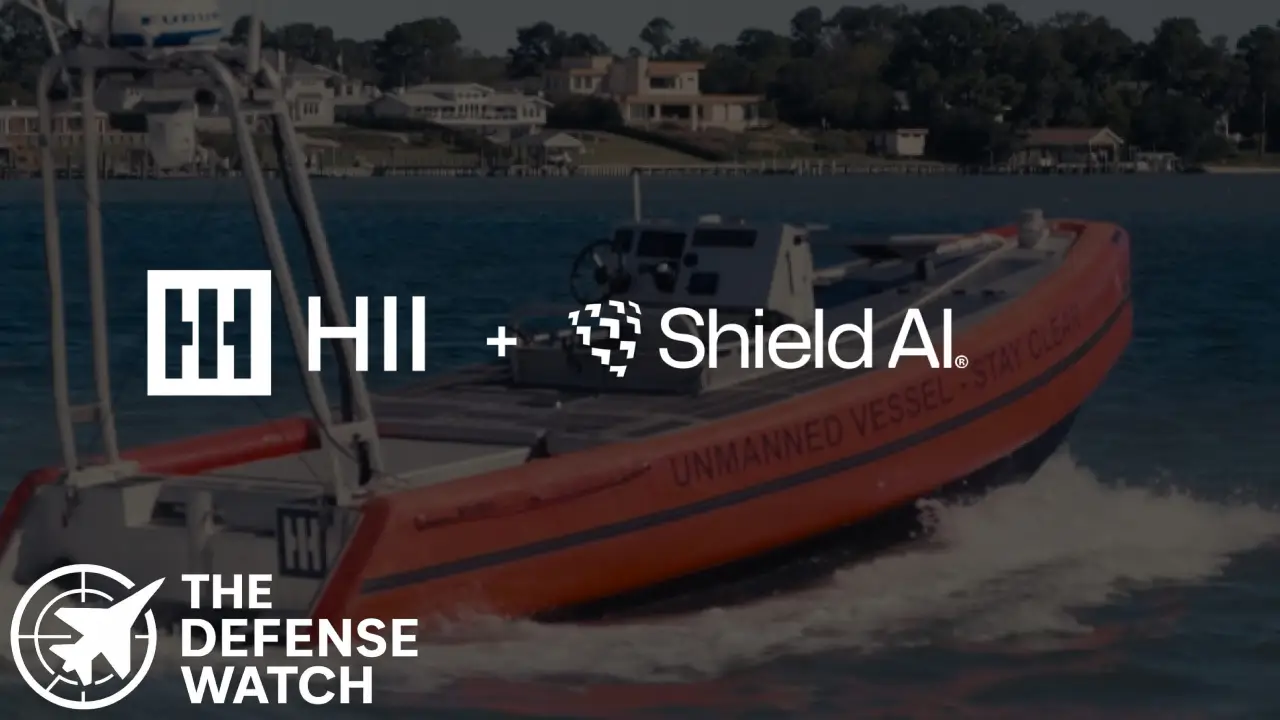
Shield AI USV
Image Credit: Shield AI
SHARE

Shield AI and HII Demonstrate Seamless AI Integration in Unmanned Surface Vessels

Shield AI and Huntington Ingalls Industries (HII) have announced a significant milestone in autonomous naval technology: the successful integration of Shield AI’s artificial intelligence software into HII’s unmanned surface vessel (USV) platform. The demonstration showcased how AI-driven autonomy can enhance mission execution, navigation, and operational safety across the U.S. Navy’s growing fleet of unmanned systems.

Contents
Shield AI and HII Demonstrate Seamless AI Integration in Unmanned Surface VesselsAdvancing Autonomous Maritime OperationsStrategic Importance for the U.S. NavyAnalysis: What This Means for U.S. Defense and Global SecurityConclusion: Charting the Future of Naval Autonomy

The collaboration builds on the U.S. Navy’s push toward greater autonomy at sea—part of its Unmanned Campaign Framework designed to integrate artificial intelligence, data fusion, and machine learning into distributed maritime operations.

Advancing Autonomous Maritime Operations

According to Shield AI, the test proved that its AI pilot software, known for powering autonomous flight in unmanned aircraft like the MQ-35A V-BAT, can now enable similar autonomous behaviors in maritime environments. The system allows a vessel to perceive surroundings, make navigational decisions, and execute missions with minimal human oversight.

HII, one of America’s largest shipbuilders and defense contractors, provided the USV platform for integration. The successful trial underscores HII’s strategic investment in autonomous and robotic technologies as the Navy accelerates its shift toward manned-unmanned teaming.

- Advertisement -

“The integration demonstrates the scalability of AI autonomy across domains—air, land, and sea,” said a Shield AI representative. “It’s a step toward a fully networked fleet capable of operating intelligently and collaboratively.”

Strategic Importance for the U.S. Navy

The U.S. Navy has increasingly prioritized unmanned surface vessels as part of its modernization strategy. Programs such as the Medium Unmanned Surface Vessel (MUSV) and Large Unmanned Surface Vessel (LUSV) are aimed at extending naval reach, improving situational awareness, and reducing risks to human crews.

By incorporating Shield AI’s autonomy suite, future naval operations could see a reduction in crewed missions in high-threat environments and expanded operational endurance for unmanned assets. The technology also supports the Navy’s “Distributed Maritime Operations” concept—leveraging autonomous systems to create flexible, resilient battle networks.

HII’s involvement reinforces the company’s commitment to emerging naval technologies. Through its Mission Technologies division, HII has been developing advanced C5ISR (Command, Control, Communications, Computers, Combat Systems, Intelligence, Surveillance, and Reconnaissance) solutions and has partnered with the Navy on several unmanned and AI-enabled projects.

Analysis: What This Means for U.S. Defense and Global Security

The integration of Shield AI’s autonomy into HII’s surface platforms marks a pivotal step toward AI-enabled naval warfare. It reflects the Pentagon’s broader objective of maintaining technological superiority over peer competitors such as China and Russia, both of which are advancing their own autonomous maritime systems.

For the U.S., the ability to deploy unmanned vessels that can operate independently for extended periods could transform naval strategy—shifting from manpower-heavy operations to data-driven, adaptive fleets. Such systems could conduct surveillance, electronic warfare, or logistics missions autonomously, freeing manned warships for higher-priority combat roles.

Globally, this development underscores the growing role of artificial intelligence in defense innovation. It may also signal increased collaboration between U.S. defense contractors and AI startups, aligning commercial technology advancements with military needs.

Conclusion: Charting the Future of Naval Autonomy

The successful integration between Shield AI and HII highlights the convergence of shipbuilding expertise and cutting-edge artificial intelligence. As the U.S. Navy continues to invest in autonomous maritime operations, partnerships like this one could accelerate the deployment of intelligent, unmanned systems across its global fleet.

- Advertisement -

Looking forward, autonomous surface vessels—empowered by AI pilots—could become key components of future naval task forces, capable of executing missions beyond human endurance or communication limits. The development marks a decisive move toward a more connected, autonomous, and resilient U.S. Navy.


TAGGED:AutonomousVesselsDefenseTechnologyHIIShieldAIUSNavy
Share This Article
Facebook Copy Link Print
ByTeamDefenseWatch
TeamDefenseWatch is the official editorial byline of TheDefenseWatch.com. Working under one umbrella, TheDefenseWatch.com, the team delivers verified, factual reporting on global defense, military technology, aerospace systems, and security developments. Articles are sourced from official statements, defense industry releases, and trusted media, with editorial review to ensure accuracy and clarity.Contact: info@TheDefenseWtach.com
26 Comments
  • Pingback: China Unveils YJ-1000 Precision-Guided 1-Ton Bomb for Advanced Fighter Fleet
  • Pingback: China Advances Concept of 120-Tonne Strategic Airlifter With Global Reach
  • Pingback: Pentagon Unveils New Warfighting Acquisition System to Accelerate Defense Procurement
  • Pingback: Pentagon Overhauls Acquisition System: Hegseth Launches “Warfighting Acquisition System” to Prioritize Speed
  • Pingback: Top 10 Most Powerful Navies in the World 2025: Gauging Maritime Dominance Through Aggregate Displacement
  • Pingback: What Is a Fighter Jet? Role, Importance, and How Modern Airpower Depends on Them
  • Pingback: Aircraft: Definition, Types, Military Roles, Technology Evolution, and Global Aviation Trends
  • Pingback: Israel Forms New Elite Base-Defense Unit to Prevent Another October 7-Style Attack on Air Force Bases
  • Pingback: Chinese Unmanned Marine Survey Craft Debuts in Latin America at Expodefensa 2025
  • Pingback: Japan Deploys Laser Weapons on Warships, Joining U.S. and U.K. Navies | TheDefenseWatch.com
  • Pingback: US Navy Demonstrates AN/AQS-24 Minehunting System on Drone Vessel | TheDefenseWatch.com
  • Pingback: Lockheed Martin Completes First Flight Test of NGSRI Missile for US Army Air Defense | TheDefenseWatch.com
  • Pingback: New Zealand Navy Enforces UN Sanctions in East Asia Amid Chinese Shadowing | TheDefenseWatch.com
  • Pingback: Italy’s GCAP Warplane Costs Surge Above 21 Billion Euros in Major Budget Shift | TheDefenseWatch.com
  • Pingback: US Approves 2.3 Billion P 8A Poseidon Sale for Singapore Maritime Patrol Fleet | TheDefenseWatch.com
  • Pingback: Kongsberg Joins Norway Navy Vessel Bid, Targets P1118 Standardised Fleet | TheDefenseWatch.com
  • Pingback: Lockheed Martin-Fujitsu Partnership Accelerates Dual-Use Defense Technology Development | TheDefenseWatch.com
  • Pingback: US Navy Selects L3Harris Red Wolf Loitering Munition for Marine Corps Precision Strike | TheDefenseWatch.com
  • Pingback: Sweden and Denmark Fund Tridon Mk2 Air Defense Guns for Ukraine | TheDefenseWatch.com
  • Pingback: BAE Systems Awarded $195M Contract for Advanced Amphibious Combat Vehicles | TheDefenseWatch.com
  • Pingback: AUKUS Nations Expand Autonomous Maritime Trials And Exercises In 2026 | TheDefenseWatch.com
  • Pingback: Su-57 Redefined: Russia’s Fifth-Generation Fighter Now a Tactical Aviation Complex | TheDefenseWatch.com
  • Pingback: BAE Systems Wins $23.7 Million US Navy Contract For Propulsor Demonstration Hardware | TheDefenseWatch.com
  • Pingback: U.S. Navy Launches Lightfish Unmanned Vessel From Partner Ship In Historic Indian Ocean Deployment | TheDefenseWatch.com
  • Pingback: Blue Water Autonomy Launches Liberty Class Autonomous Ship For U.S. Navy Operations | TheDefenseWatch.com
  • Pingback: UK Carrier Drone Plan Advances Without Catapults, MoD Confirms Future RN Drone Strategy | TheDefenseWatch.com

Leave a Reply Cancel reply

Your email address will not be published. Required fields are marked *

Search Defense Systems

Latest Defense Systems

  • F-47A Fighter Jet F-47A Fighter Jet
  • China DF-61 Missile China DF-61 Missile
  • B61 Nuclear Bomb B61 Nuclear Bomb
  • Japan E-767 Airborne Japan E-767 Airborne
  • Remington 870 Shotgun Remington 870 Shotgun
  • RUTA B1 Cruise Missile RUTA B1 Cruise Missile
  • XQ-67A Drone XQ-67A Drone
  • B-25 Mitchell Bomber B-25 Mitchell Bomber
  • F-100 Super Sabre F-100 Super Sabre

Recent Compares

  • J-10C vs JF-17 Thunder: Which Fighter Is More Capable? J-10C vs JF-17 Thunder: Which Fighter Is More Capable? View Comparison →
  • Tejas vs Gripen: Key Differences and Capabilities Tejas vs Gripen: Key Differences and Capabilities View Comparison →
  • Tejas vs MiG-21 Bison: How India Replaced Its Iconic Supersonic Fighter Tejas vs MiG-21 Bison: How India Replaced Its Iconic Supersonic Fighter View Comparison →
  • F-35 vs F-16: Stealth, Sensors and Combat Roles F-35 vs F-16: Stealth, Sensors and Combat Roles View Comparison →
  • Tejas Fighter Jet vs F-16 Fighting Falcon: Capability Compared Tejas Fighter Jet vs F-16 Fighting Falcon: Capability Compared View Comparison →
  • Rafale Fighter Jet vs F-16 Fighting Falcon : Which Fighter Has the Edge? Rafale Fighter Jet vs F-16 Fighting Falcon : Which Fighter Has the Edge? View Comparison →
  • Su-57 Fighter Jet vs J-20 Fighter Jet: Stealth and Air Combat Compared Su-57 Fighter Jet vs J-20 Fighter Jet: Stealth and Air Combat Compared View Comparison →
  • Mirage 2000 vs Tejas Mk1A: Legacy Combat Power vs Indigenous Modernization Mirage 2000 vs Tejas Mk1A: Legacy Combat Power vs Indigenous Modernization View Comparison →
  • Rafale Fighter Jet vs F-22 Raptor: Which Air Dominance Fighter Has the Edge? Rafale Fighter Jet vs F-22 Raptor: Which Air Dominance Fighter Has the Edge? View Comparison →
  • Tejas Fighter Jet vs. Rafale Fighter Jet: India’s Indigenous Fighter Meets France’s Proven Multirole Combat Aircraft Tejas Fighter Jet vs. Rafale Fighter Jet: India’s Indigenous Fighter Meets France’s Proven Multirole Combat Aircraft View Comparison →

Recent Posts

  • Marine One Explained: The Presidential Helicopter, Its Fleet and the VH-92A Transition
  • Sikorsky Wins South Korea Contract for Four S-92A+ Presidential Helicopters
  • Saudi Arabia Intercepts Missiles Targeting Riyadh as Aramco Building Is Damaged
  • US Approves Potential $1.08 Billion Black Hawk Helicopter Sale to Mexico
  • NASA Completes Final ISS Solar Array Installation, Raising Station Power Capacity by 30%

You Might Also Like

US Lithuanian HIMARS live fire
Global News

US Army Deploys HIMARS in Lithuania with Live Fires to Strengthen NATO Eastern Flank

February 5, 2026
Thales TopOwl digital display
Global News

Thales Awarded NAHEMA Contract to Fit NH90 Helicopter Pilots With TopOwl Digital Display Helmet

January 15, 2026
UK defence SME role reform
Global News

UK Report Calls for Defence Procurement Reform to Boost SME Role

September 7, 2026
US ATACMS missile strike
Global News

US ATACMS Missile Strike Destroys Iran Shahed-129 Drone And Sayyad-2 Air Defense System

September 8, 2026

Logo

Copyright © 2026 TheDefenseWatch.com

Helpful Links

  • Home
  • About Us
  • Privacy Policy
  • Terms of Use / Disclaimer
  • U.S. Privacy Notice – CCPA Compliance

Defense Systems

  • Defense Systems
  • Comparisons 
  • Manufacturer
  • Tactical Calculators

Popuplar

Which 5 Air Forces Possess the Costliest Fighter Jet Fleets in the World
Evolving Strategic Value: Carrier Strike Groups in the Indo-Pacific’s Future Security Architecture
Autonomous Weapon Systems Spark U.S. Ethics Debate Amid Rapid Military AI Integration

We report on developments involving military forces, governments, defense companies, research organizations, and security institutions around the world. 

Welcome Back!

Sign in to your account

Username or Email Address
Password

Lost your password?