Raytheon Secures $120.3 Million RAM Block 2B Missile Contract for U.S. Navy and Japan
Raytheon has received a $120.3 million U.S. Navy contract modification to manufacture and deliver Rolling Airframe Missile (RAM) Block 2B guided missile round packs, supporting American naval requirements and a Foreign Military Sales order for Japan.
The award, issued to Raytheon Co. of Tucson, Arizona, exercises options under an existing contract and covers fiscal year 2027 production. Deliveries and associated work are expected to continue through February 2030.
The November 20 contract announcement identifies $105.64 million in U.S. Navy weapons procurement funding and another $14.7 million in Foreign Military Sales funding for Japan. Both amounts will be obligated at the time of the award.
The modification has a total value of $120,336,322 and is structured as a firm-fixed-price agreement.
A multinational production effort
Although Raytheon is the prime contractor, RAM production relies on an established industrial partnership involving facilities in the United States, Germany and the United Kingdom.
The Pentagon’s contract announcement identifies the following distribution of work:
| Production location | Share of work |
|---|---|
| Ottobrunn, Germany | 42% |
| Tucson, Arizona | 31% |
| Keyser, West Virginia | 11% |
| Glenrothes, Fife, Great Britain | 10% |
| Cincinnati, Ohio | 1% |
| Other U.S. locations | 5% |
Germany accounts for the largest portion of the production effort, reflecting the international industrial arrangements behind the RAM program.
The U.S. and German governments have maintained a cooperative development, production and support agreement for the missile. German industry participates alongside Raytheon in manufacturing and supporting the system.
The contract also demonstrates how allied missile procurement can involve several countries within one production network, even when the weapons are purchased through separate national funding arrangements.
What the RAM Block 2B brings to naval defense
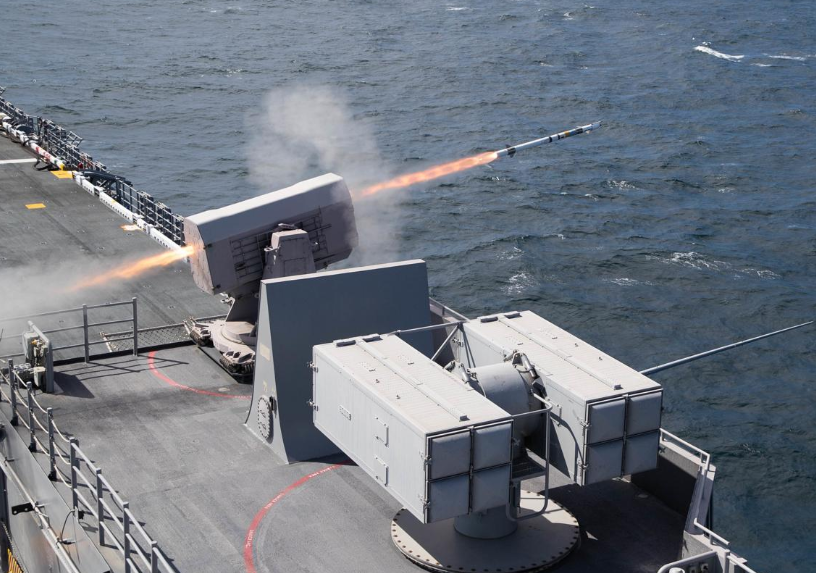
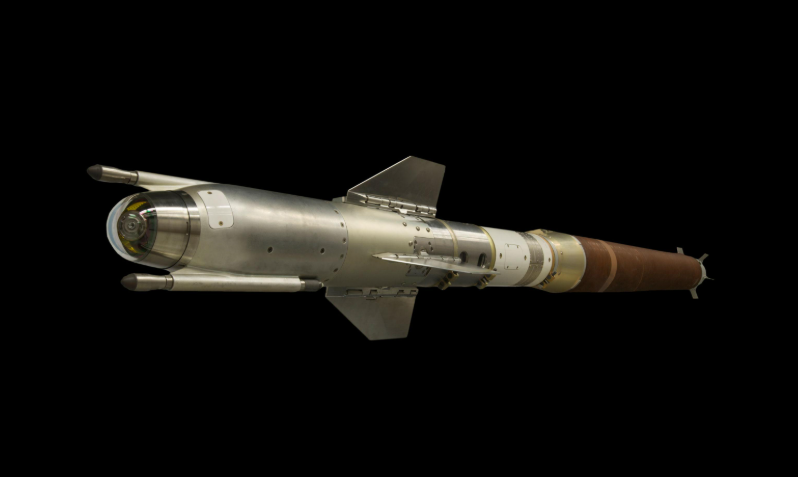
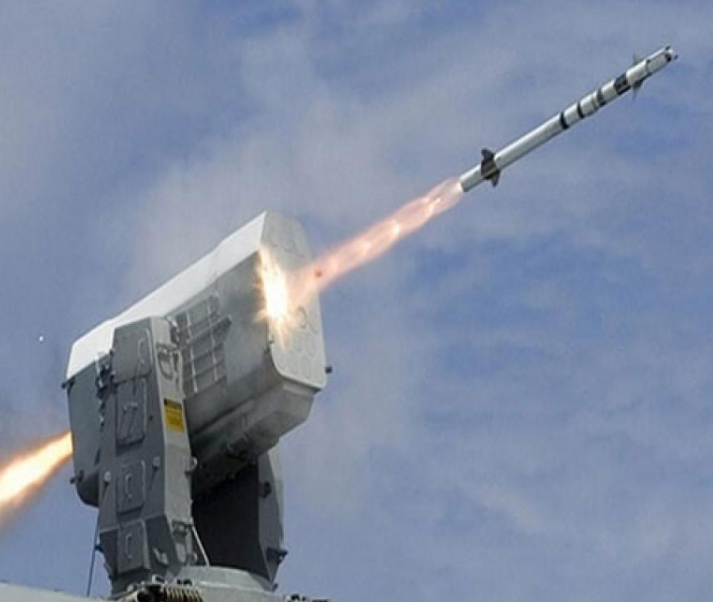
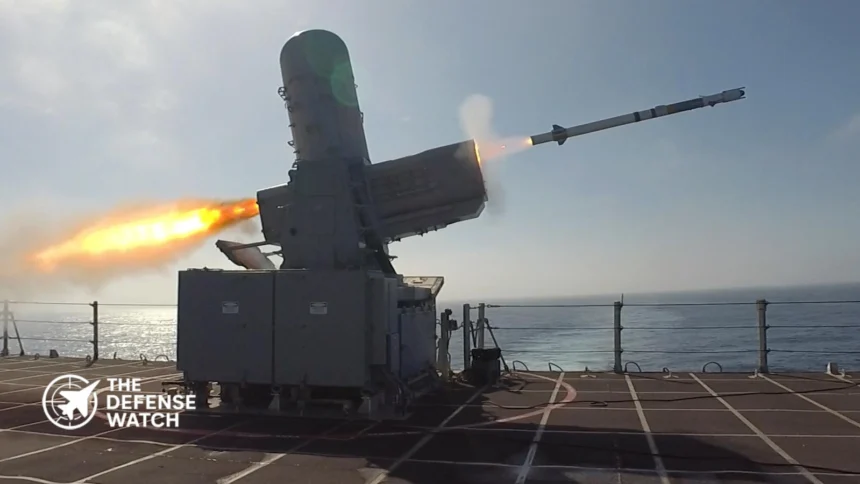
The Rolling Airframe Missile is a short-range naval air-defense weapon designed to protect warships against incoming anti-ship cruise missiles and other airborne threats.
It provides a final defensive layer against threats that penetrate longer-range shipboard air-defense systems.
The missile uses passive radio-frequency and infrared guidance. Its autonomous engagement design allows it to operate without continuous illumination from shipboard fire-control equipment after launch.
The U.S. Navy identifies several improvements introduced with the Block 2 configuration, including:
- Improved maneuverability against highly maneuverable targets.
- An upgraded propulsion section with a larger composite-case rocket motor.
- An improved control section with four canards.
- An evolved radio-frequency receiver for improved threat detection.
The Navy achieved initial operational capability for RAM Block 2 in May 2015, with full-rate production approval following in November 2018.
Block 2B is a further development within the RAM family. The Pentagon’s FY2025 weapons acquisition documentation identifies an upgraded seeker and missile-to-missile link as features associated with Block 2B.
These improvements are relevant to naval defense against increasingly complex aerial threats, particularly attacks involving multiple incoming weapons.
However, the latest contract announcement does not disclose the number of Block 2B round packs being purchased, their individual prices or detailed delivery schedules.
Why the Japan order matters
Japan’s participation is an important part of the award.
The $14.7 million allocated through Foreign Military Sales indicates that the contract supports both U.S. Navy procurement and an allied requirement.
Japan operates advanced naval platforms that require layered air-defense capabilities to protect against aircraft, anti-ship missiles and other aerial threats.
The RAM system offers a close-in defensive option that complements longer-range weapons carried by modern warships.
For Japan, continued access to the jointly produced missile family supports interoperability with the United States and other allied navies operating the same weapon system.
The contract does not identify the Japanese vessels that will receive the missiles or specify whether the FMS order is intended for new ship construction, replenishment or existing fleet requirements.
Production continuity and the Block 2B supply chain
The latest award also fits into the Navy’s broader effort to sustain and improve RAM production.
The U.S. Navy’s FY2027 Weapons Procurement budget justification, published in April 2026, identifies RAM as a continuing procurement priority.
The document plans procurement of 116 RAM missiles during FY2027, alongside 70 Block 2-to-2A ordnance alteration upgrades. It lists approximately $119.17 million in FY2027 base procurement funding for the RAM program.
A separate part of the budget documentation identifies investment in equipment to establish a domestic seeker-head production line for RAM Block 2B.
That investment is particularly relevant because the seeker is a critical component of the missile’s guidance system. Establishing additional domestic production capability could help strengthen the U.S. supply chain and reduce reliance on external manufacturing sources for selected components.
The budget documents also confirm that the U.S.-German cooperative production arrangement remains central to the program. An amendment to the Block 2 production memorandum of understanding was signed in June 2025.
Industry reporting has also pointed to continued development of the Block 2B configuration. In 2024, Janes reported that Raytheon had been working on upgraded software and missile communication capabilities, with company representatives describing opportunities for further improvements to the weapon’s guidance and control sections.
The reporting provides useful development context, although it does not establish the full operational capability or deployment status of every Block 2B configuration.
Contract details and delivery timeline
The $120.3 million modification is being administered by Portfolio Acquisition Executive Munitions in Washington, D.C.
Key award details include:
- Contractor: Raytheon Co., Tucson, Arizona
- Contract number: N0002426C5403
- Modification: P00002
- Contract value: $120,336,322
- Contract type: Firm-fixed-price
- U.S. Navy funding: $105,636,322
- Japan FMS funding: $14,700,000
- Expected completion: February 2030
The contract was not competitively procured under 10 U.S. Code 3204(a)(4), which provides an exception to full and open competition for international agreements.
The award does not disclose the exact missile quantities, individual delivery dates or the expected distribution of completed round packs between the U.S. Navy and Japan.
With production extending into 2030, the contract provides a multiyear manufacturing commitment for a naval point-defense weapon already used by several allied fleets.
For the U.S. Navy, the immediate priority remains maintaining shipboard defensive missile inventories while advancing the RAM family through successive upgrades. Japan’s participation adds an allied procurement requirement to the same production effort.
The award therefore supports more than a single national purchase. It sustains a cooperative missile production arrangement serving two major Indo-Pacific security partners.
Enjoying our coverage?
Make The Defense Watch a preferred source on Google to see more of our geopolitical and defense insights when relevant to you.