Lockheed Martin is increasing production capacity for NASA’s Orion spacecraft as the United States prepares for a new sequence of crewed missions around the Moon and a planned return to the lunar surface.
The company announced on November 5, 2026, that it is expanding its spacecraft assembly workforce, increasing supplier capacity and changing manufacturing and testing procedures to accelerate delivery of Orion vehicles for the Artemis III, Artemis IV and Artemis V missions.
The effort follows NASA’s revised Artemis architecture, which places greater emphasis on increasing mission frequency, testing commercial lunar landing systems and establishing the infrastructure needed for a sustained human presence on the Moon.
For Lockheed Martin, the immediate challenge is not simply building additional spacecraft. It is maintaining a reliable production sequence while meeting the stringent safety, integration and certification requirements associated with human spaceflight.
Orion moves toward a production-focused manufacturing model
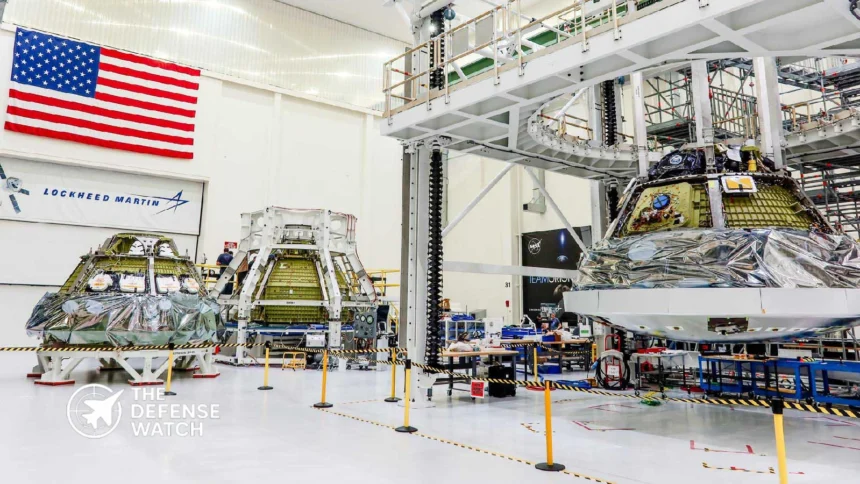
Three Orion spacecraft were already in assembly and testing when NASA introduced its updated Artemis direction, according to Lockheed Martin.
The company is now shifting more of its manufacturing approach from spacecraft development toward repeatable production. This includes applying lessons from earlier missions, preparing components and materials ahead of assembly requirements, and reducing duplicated testing where previous qualification work has already established that a design meets its requirements.
The distinction between qualification and acceptance testing is important.
Qualification testing establishes whether a design can meet its technical requirements. Acceptance testing checks whether an individual production unit has been manufactured correctly and meets the applicable standards.
Lockheed Martin says it is using previous flight experience to reduce the time and scope of selected tests without eliminating the checks required to establish flight readiness and protect astronauts.
The company is also refurbishing previously qualified hardware where appropriate, allowing selected components to be reused rather than manufactured again for every mission.
This approach could reduce recurring manufacturing costs and shorten assembly schedules, although the company has not published a consolidated figure showing the expected savings or the number of production days eliminated.
More workers and higher manufacturing output
Workforce expansion is another part of the acceleration plan.
Lockheed Martin is adding more than 100 positions to its Orion assembly operation at NASA’s Kennedy Space Center in Florida. The expanded workforce will support hands-on spacecraft assembly and associated technical and support activities.
The company also says its Kennedy teams are operating three shifts a day, seven days a week, to maintain continuous progress on spacecraft integration.
A separate manufacturing expansion is taking place at NASA’s Michoud Assembly Facility in Louisiana, where Lockheed Martin produces Avcoat heat shield material for Orion.
According to Lockheed Martin, improvements to Avcoat production increased output from approximately four billets per week to more than 20. The company has also invested in facility expansion and additional production equipment to support upcoming Orion vehicles.
Avcoat is a critical part of Orion’s thermal protection system. During lunar-return trajectories, the spacecraft encounters extremely high temperatures as it reenters Earth’s atmosphere at high velocity.
NASA’s Artemis II mission provided an important operational demonstration of Orion’s ability to return astronauts from lunar distances. The spacecraft completed its crewed lunar flight and safely splashed down in the Pacific Ocean on April 10, 2026.
Increasing Avcoat output is therefore directly relevant to the manufacturing schedule. However, higher material production alone does not establish that complete spacecraft production or certification can proceed at the same rate.
Faster engineering decisions and supplier coordination
Lockheed Martin is also attempting to reduce delays caused by engineering problems and supply chain constraints.
The company has established a rapid response team consisting of experienced engineers and technical specialists who can address urgent production issues without diverting the main assembly teams from scheduled integration and certification activities.
This arrangement is intended to shorten decision-making cycles when technical problems emerge.
The supply chain is another area receiving attention. Lockheed Martin says it is working with suppliers to increase manufacturing capacity through targeted incentives, investments in tooling and equipment, and alternative sourcing arrangements for selected components.
Where necessary, the company is also considering expanding internal manufacturing capabilities.
These measures address a common challenge in complex aerospace programs: increasing final assembly capacity does not automatically increase the availability of specialized components. A delay involving a single critical part can affect the integration schedule for an entire spacecraft.
For Orion, maintaining a steady supply of qualified hardware will be important as multiple spacecraft move through production simultaneously.
NASA’s revised Artemis schedule changes the role of Orion
The production acceleration is taking place alongside significant changes to NASA’s lunar exploration plans.
Under the updated architecture announced in February 2026, Artemis III is no longer planned as the first crewed lunar landing mission. Instead, NASA intends to use the 2027 flight to test rendezvous and docking operations between Orion and commercial lunar landers in low Earth orbit.
The agency plans to use Artemis IV for the next crewed lunar landing attempt, currently targeted for 2028. Artemis V is part of the subsequent lunar exploration campaign.
This distinction matters when assessing Lockheed Martin’s production schedule. Orion remains the crew transportation spacecraft across these missions, but its role will vary depending on the mission architecture.
NASA’s November 4 update describes Artemis III as a planned 14-day orbital mission involving four astronauts. The flight is intended to test docking, communications, life-support and operational procedures involving the commercial landers developed by SpaceX and Blue Origin.
Artemis IV is intended to take astronauts to the lunar surface, with the selected landing system depending on the readiness of the commercial providers.
For Lockheed Martin, delivering Orion vehicles on schedule is therefore only one part of a larger mission-readiness challenge. NASA must also coordinate the Space Launch System, lunar landers, spacesuits, ground infrastructure and mission operations.
What Artemis II demonstrated
Orion’s development program has already passed an important milestone with the successful Artemis II mission.
NASA launched four astronauts aboard Orion on April 1, 2026, for a crewed flight around the Moon. The spacecraft traveled approximately 252,756 miles from Earth at its maximum distance, establishing a new record for human spaceflight.
The mission concluded with a successful Pacific Ocean splashdown on April 10.
Artemis II provided operational experience with Orion’s life-support systems, navigation, communications, crew operations and atmospheric reentry. It also supplied valuable information for preparing subsequent spacecraft.
However, a successful test flight does not eliminate the need for further verification. Each upcoming vehicle must still complete its own integration, testing and certification process before NASA can approve it for a crewed mission.
Production capacity remains a key challenge
Lockheed Martin’s latest measures address several manufacturing constraints, but the company has not disclosed a complete revised delivery schedule for all three spacecraft.
It has also not provided a consolidated estimate of the additional investment required for the workforce expansion, supplier incentives and manufacturing upgrades.
The production contract provides a longer-term framework. Lockheed Martin says its existing arrangement covers six Orion spacecraft, with options for up to six additional vehicles.
That arrangement gives the program a potential production horizon beyond the next three Artemis missions. It also makes manufacturing repeatability and supplier stability increasingly important.
For NASA, a more consistent Orion production process could help support a higher mission cadence. But spacecraft availability alone cannot determine the pace of lunar exploration. Launch vehicle readiness, lander development, spacesuit certification and mission infrastructure remain equally important.
Lockheed Martin’s November announcement provides evidence of increased manufacturing activity, particularly at Kennedy and Michoud. Whether these changes translate into earlier spacecraft deliveries will become clearer as Orion vehicles progress through assembly and certification.