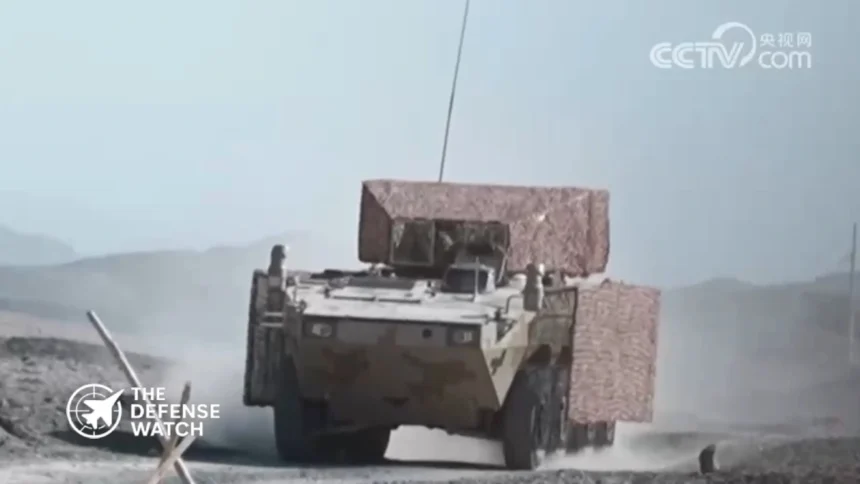
China’s Karakoram 2026 joint army exercise with Pakistan is showcasing how drone warfare is changing ground combat, with Chinese forces deploying a Type 08 infantry fighting vehicle fitted with metal roof and side grilles during simulated counter-terrorism operations in Xinjiang.
Footage published by China’s state broadcaster CCTV on October 22 shows the modified vehicle operating alongside drone swarms, armored assault teams and robotic ground systems. The exercise also incorporates reconnaissance, concentrated fire and building-clearance operations.
The visible modifications are consistent with efforts to protect armored vehicles against attacks from small unmanned aircraft. However, the footage does not establish how much protection the grilles provide or whether the configuration has been adopted as a standard modification across China’s armored fleet.
Why the Type 08’s protective grilles matter
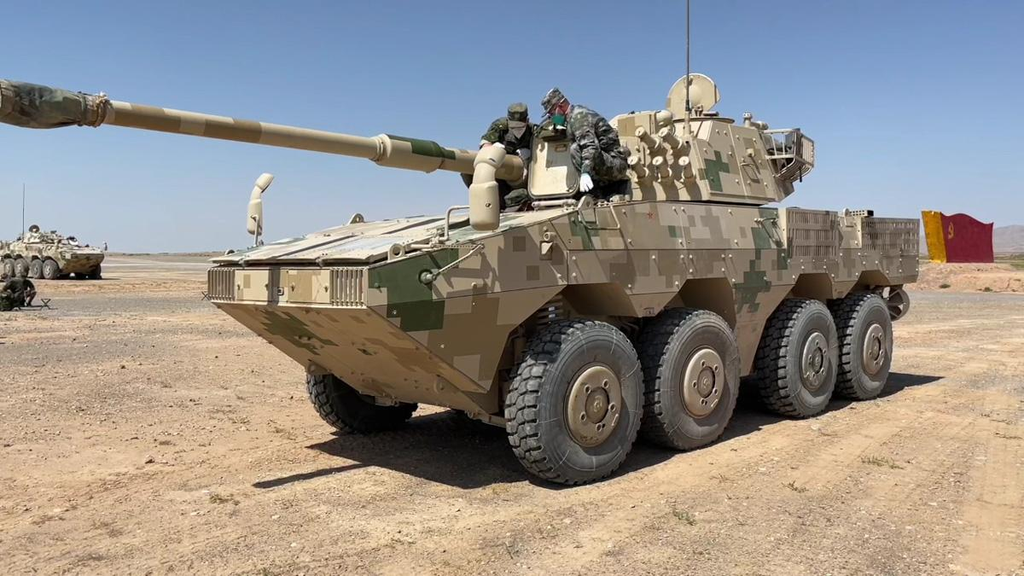
The Type 08, also known as the ZBL-08, is an eight-wheeled Chinese armored vehicle family. Its infantry fighting vehicle variant supports mechanized infantry by transporting troops while providing protected mobility and fire support.
The vehicle shown during Karakoram 2026 has a metal structure above its roof and additional grilles along its sides. According to the Global Times, a Chinese military commentator described the arrangement as a tactical response to the growing threat from drones.
Such structures are commonly intended to interfere with the way an incoming munition reaches an armored vehicle’s underlying structure. Depending on their design, they may obstruct a drone’s approach, alter the point of contact or create additional separation between a warhead and the vehicle’s armor.
Their effectiveness depends on several factors, including the type of drone, the munition used, the angle of attack and the strength and placement of the protective structure. A cage cannot be assumed to defeat every drone or munition, and the available footage does not provide controlled test results for this particular configuration.
The distinction matters because adding external protection can also increase a vehicle’s overall dimensions and complicate access to hatches, sensors or other equipment. The available report does not quantify any such effects on the modified Type 08.
Karakoram 2026 combines drones with armored assaults
The exercise is taking place in Korla, in China’s northwestern Xinjiang Uygur Autonomous Region. China’s Ministry of National Defense announced the training on October 10, describing it as a joint counter-terrorism exercise focused on operations in high-altitude environments.
The official announcement identified several training areas:
- Unmanned aerial vehicle operation.
- Target search and firing while moving.
- Long-range sniping.
- Joint command and live-force exercises.
The exercise is the first joint army training activity between China and Pakistan, according to the Chinese defense ministry. Its stated purpose is to improve cooperation and interoperability in counter-terrorism operations.
CCTV’s account of the exercise describes a sequence in which reconnaissance elements and drones locate simulated hostile positions before assault teams move in. Drone attacks are followed by supporting fire from ground forces, with Type 08 vehicles transporting troops toward the training objective.
The report also describes robotic ground systems, including robot dogs, supporting building-clearance activities. These systems were shown working alongside dismounted troops during the simulated operation.
The training sequence illustrates an important tactical relationship: unmanned systems can help identify threats, while armored vehicles provide mobility and troops conduct the assault. Ground robots may also help troops inspect areas where personnel face potential danger.
However, footage of a scripted exercise cannot establish how effectively these systems would perform against a capable opponent using electronic warfare, camouflage, air defenses or other countermeasures.
Drone warfare is changing armored vehicle protection
The Type 08’s added grilles reflect a wider problem facing ground forces. Small drones, including first-person-view systems carrying explosive payloads, can threaten vehicles from directions that conventional armor arrangements may not adequately protect.
Traditional armored vehicle design places substantial emphasis on frontal protection, while roof and other less heavily protected surfaces can present different vulnerabilities. A drone approaching from above may exploit these areas, depending on its weapon and the vehicle’s configuration.
The war in Ukraine has provided extensive examples of both sides adapting vehicles to counter small drones. Field modifications have included overhead cages, screens and other external structures. Militaries have also pursued electronic warfare, camouflage, detection systems and dedicated counter-drone weapons.
These measures address different parts of the problem. Physical barriers may interfere with an attack, while electronic warfare can disrupt certain control or navigation links. Neither approach is universally effective, particularly against drones with different guidance methods or attack profiles.
For China, displaying a protected Type 08 during a joint exercise offers evidence that drone-related vehicle protection is receiving attention in training. It does not, by itself, establish a new production standard, a fleet-wide retrofit program or a measurable improvement in battlefield survivability.
The broader operational challenge is to combine vehicle protection with early detection, active countermeasures and tactics that limit the time vehicles remain exposed to observation and attack.
What the exercise reveals about China-Pakistan military cooperation
Karakoram 2026 adds an army-training dimension to the established China-Pakistan defense relationship. The two countries have cooperated in other military fields, including aircraft development, arms procurement and naval programs, but their defense ministry’s description of this activity identifies it as their first joint army training exercise.
The use of mixed teams is relevant because interoperability involves more than operating similar equipment. Troops must coordinate reconnaissance, communications, command decisions, supporting fires and movement under shared procedures.
China’s defense ministry reported on October 19 that participating troops had completed the skills-exchange phase, which included tactical climbing, close-quarters combat, drone operation, moving-target engagement and long-range sniping. On October 21, the ministry said the exercise had entered a multi-subject live-force training phase involving mixed teams and coordinated assault activities.
These official updates confirm that the exercise progressed beyond initial familiarization into more integrated training. They do not provide independent performance assessments, detailed results or evidence of how the lessons will affect future operational planning.
The exercise also gives the two armies an opportunity to exchange practices in a demanding environment. High-altitude operations place additional demands on personnel, mobility, logistics and communications, although the published accounts do not provide enough information to quantify the conditions or assess their effect on equipment performance.
The limits of what the footage proves
The Type 08’s protective grilles are a visible adaptation, but several important questions remain unanswered.
Public reporting has not established whether the configuration is an experimental field modification, a locally fitted measure for the exercise or part of a wider protection effort. No verified testing data have been released showing its performance against specific drone types or explosive payloads.
The reports also do not identify the precise design specifications of the grilles or disclose whether the vehicle carries additional electronic warfare or drone-detection equipment as part of the displayed configuration.
Those details would be needed to assess the modification’s practical value. The image alone cannot establish the level of protection offered, and it should not be interpreted as proof that the vehicle is resistant to drone attack.
For now, the clearest conclusion is narrower: China and Pakistan are incorporating unmanned systems into joint ground-force training, while China’s displayed armored vehicle includes an apparent physical response to the threat posed by drones.
The operational value of that combination will depend on how well reconnaissance, counter-drone measures, armored mobility and dismounted troops work together under conditions more complex than a planned training scenario.