

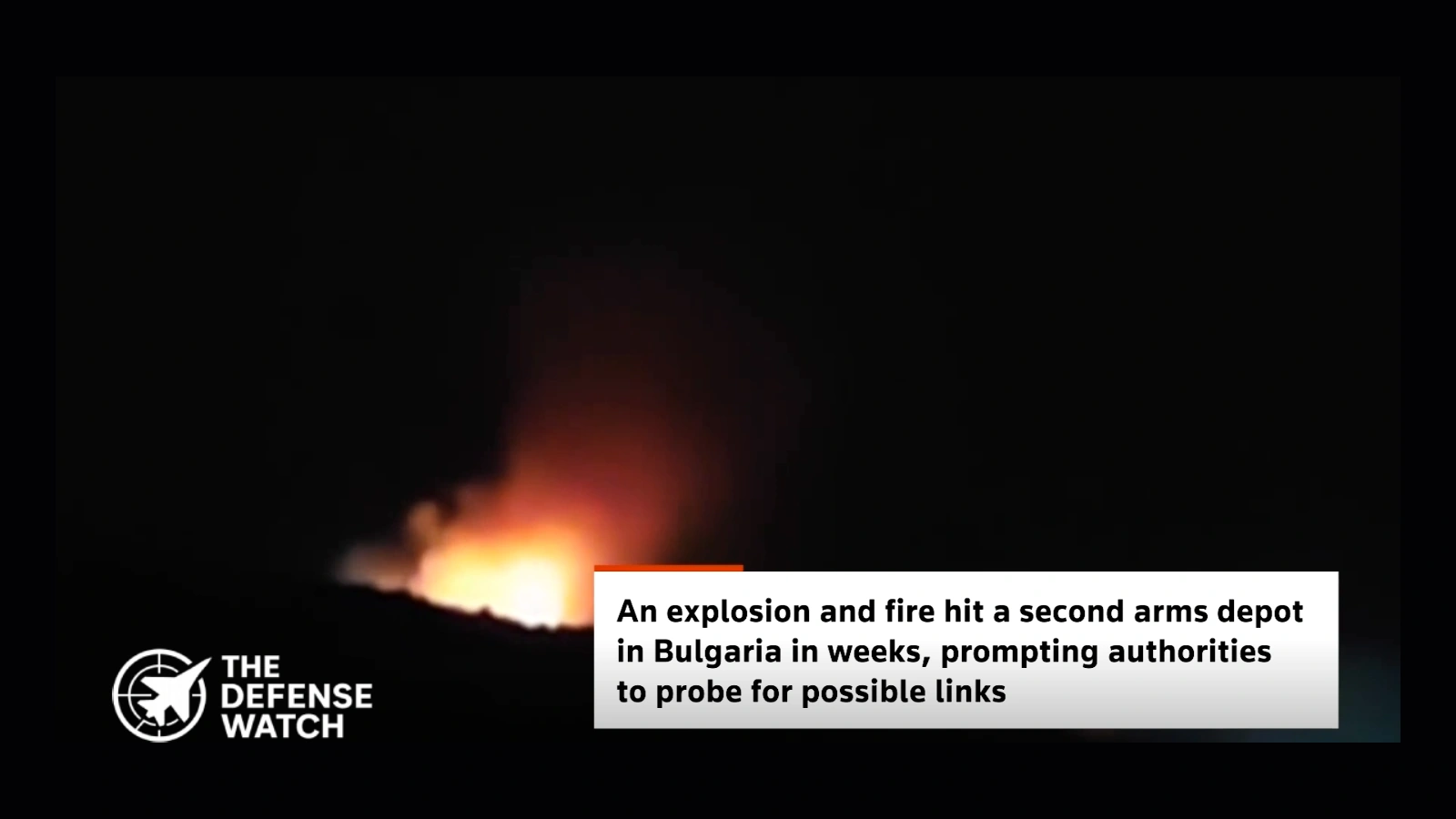
Bulgarian authorities are investigating an overnight explosion and fire at a weapons storage facility near Tsareva Livada, with possible sabotage among the issues being examined.
Takeaways
Bulgaria is investigating an explosion and fire at an EMCO weapons storage facility near Tsareva Livada, the second incident involving an EMCO site in recent weeks.
Bulgaria Investigates EMCO Weapons Site Explosion
The Bulgaria EMCO weapons site explosion has prompted a new investigation after a fire broke out overnight at a weapons storage facility near the village of Tsareva Livada in central Bulgaria. The incident occurred on September 12 and became the second reported fire at an EMCO munitions facility in recent weeks. No injuries were reported.
Gabrovo regional governor Kristina Sidorova said during the early hours of Saturday that the fire was inside the storage area and was spreading from one warehouse to another. Local video footage showed the fire illuminating the night sky.
The facility was identified by local media as an EMCO site. Reuters reported that it was not immediately able to reach the company for comment at the time of publication.
Fire Under Investigation
Bulgarian authorities are investigating what caused the incident. Interior Minister Ivan Demerdzhiev said the fire had been brought under control and that an investigation was underway. Authorities are also examining whether the latest incident could be connected to the previous fire at another EMCO facility in western Bulgaria.
At this stage, the cause has not been established publicly.
That distinction is important. Although sabotage is being considered, there is no confirmed finding that the September 12 incident was caused by an external attack. The investigation must determine whether the fire resulted from an accident, a technical or safety issue, deliberate action, or another cause.
The lack of reported casualties also distinguishes the incident from some previous ammunition-storage accidents and explosions in Europe.
Second EMCO Facility Incident In Weeks
The latest EMCO weapons storage facility fire follows an earlier explosion and fire at another facility operated by the company in western Bulgaria.
The recurrence has increased scrutiny of security and safety at Bulgarian ammunition-storage sites. Reuters reported that EMCO has previously argued that its facilities have been targeted in attacks and has raised concerns about the protection of strategic defense-industry infrastructure.
The timing is also significant for Bulgaria’s defense industry. The country has a large legacy ammunition manufacturing and export sector, and its factories and storage facilities have become strategically relevant as European countries expand ammunition production and replenish stocks.
For NATO members, the security of defense-industrial infrastructure is increasingly important because ammunition production, storage and transportation form part of the broader military supply chain.
EMCO’s Previous Security Cases
The current Bulgaria ammunition depot explosion also has a longer security background.
EMCO is operated by Bulgarian arms trader Emilian Gebrev. Bulgarian prosecutors have previously alleged that Russian operatives were involved in attacks against EMCO facilities.
In 2024, Bulgaria issued arrest warrants for six Russian citizens accused of involvement in the destruction of EMCO arms depots between 2011 and 2020. Prosecutors said the facilities had stored munitions intended for export to Ukraine and Georgia.
Bulgarian prosecutors also said at the time that they could reasonably assume connections between those explosions, an attempted poisoning of Gebrev in 2015, and explosions at ammunition depots in the Czech Republic in 2014.
Moscow has rejected the allegations.
These earlier cases provide important context, but they do not establish the cause of the September 12 fire.
Why The Incident Matters For Europe’s Defense Industry
The Tsareva Livada weapons facility incident comes as European countries are placing greater emphasis on ammunition availability and industrial capacity.
Bulgaria has long maintained an established defense manufacturing base, including companies involved in ammunition and weapons production. The country is also part of NATO’s eastern flank, making the protection of defense infrastructure a broader security concern.
An ammunition storage facility presents different risks from a conventional industrial site. Fires can trigger secondary explosions, damage nearby structures and complicate emergency response. Effective separation of storage areas, fire suppression systems, access control and monitoring are therefore important elements of ammunition safety.
The latest incident also illustrates why authorities need to distinguish between industrial accidents and deliberate attacks through forensic investigation rather than relying on circumstantial links.
That will be particularly important in this case because EMCO has experienced previous incidents and because Bulgarian authorities have previously investigated alleged Russian involvement in attacks on the company’s facilities.
Investigation Remains The Key Issue
The immediate priority for Bulgarian authorities is establishing how the fire began and whether ammunition or other military materials were affected.
Authorities have not publicly established that the explosion was sabotage. Until investigators release additional evidence, claims about responsibility should therefore be treated cautiously.
The fact that the fire occurred at a second EMCO facility within several weeks will likely receive close attention during the investigation. Investigators will need to determine whether the incidents share any common characteristics or whether the apparent pattern is coincidental.
For now, the confirmed facts are limited: an explosion caused a fire at an EMCO weapons storage site near Tsareva Livada, no injuries were reported, the fire was brought under control, and Bulgarian authorities are investigating its cause.
What Comes Next
Further findings from Bulgarian investigators will determine whether the Bulgaria EMCO weapons site explosion is classified as an industrial accident, a security incident or a deliberate act.
The investigation could also influence how Bulgaria approaches security at ammunition depots and other defense-industrial facilities.
For European defense planners, the episode highlights a wider issue beyond the individual facility: protecting ammunition production and storage infrastructure is becoming increasingly important as NATO members expand defense output and strengthen military supply chains.
Until investigators establish the cause, however, the September 12 incident should not be treated as confirmed sabotage.
