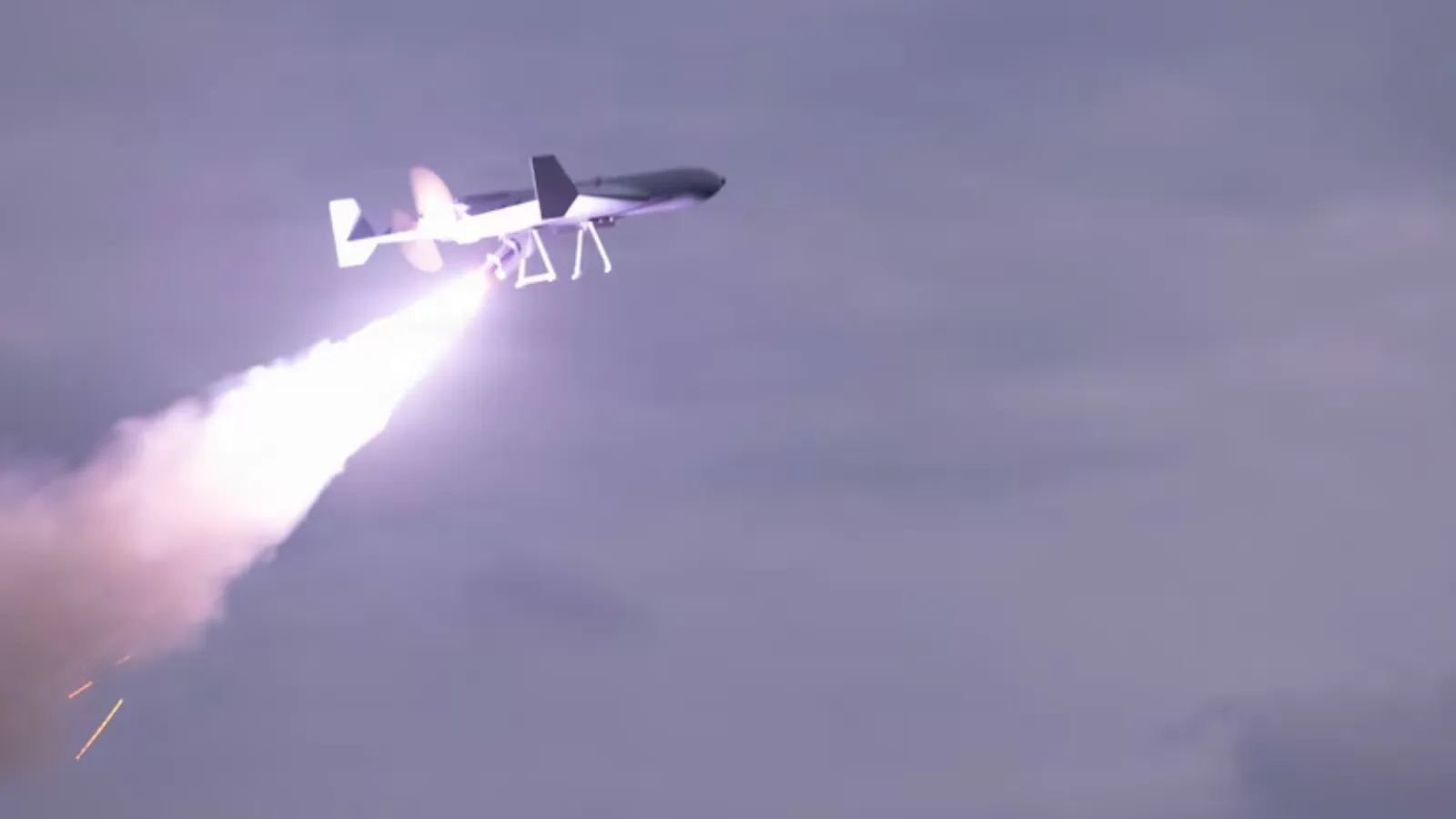
For years, drone warfare was something Europe watched from a distance — a defining feature of the Russia-Ukraine front line, thousands of miles from Brussels, Berlin, and London. That distance collapsed in August 2026, when a quadcopter carrying plastic explosives slipped past air defenses at Germany’s Leipzig/Halle Airport, struck a Ukrainian cargo plane, and failed to detonate. It was found four hours later — by a bus driver who stepped on it.
That single incident, layered on top of a string of drone sightings over German military bases, Baltic energy infrastructure, and NATO airspace more broadly, has turned “drone wall” from a policy slogan into an urgent operational requirement. At the same time, a separate and arguably more alarming story has emerged out of London: Britain’s own drone stockpile is reportedly so thin it would be exhausted within a week of a shooting war with Russia.
Together, these threads describe the same underlying problem — Europe spent three decades treating small, cheap, autonomous aircraft as a footnote to modern warfare, and Russia’s hybrid campaign is now exploiting that blind spot in real time.
The Incursions: A Pattern, Not an Accident
The Leipzig/Halle incident on August 4, 2026, was not an isolated event. German authorities linked DNA traces on the drone to a firebomb mailed to the same airport in a 2024 attack, suggesting a sustained campaign rather than a one-off provocation. Germany’s interior minister called it a “new level of danger” for the country, while stopping short of naming Russia directly.
U.S. intelligence assessments reportedly pointed toward a Russian origin, with explosive components consistent with a military manufacturer. The Wall Street Journal characterized the failed strike as a deliberate test of NATO’s collective defensive resolve — a way to probe reaction times and detection gaps without crossing into unambiguous act-of-war territory.
Lithuania has raised a related but distinct concern: that Moscow may be preparing a false-flag drone attack on Baltic critical infrastructure, using captured Ukrainian hardware to muddy attribution. Whether or not that specific scenario materializes, the broader trend is unmistakable. Drone sightings have prompted temporary airport closures in Denmark, tightened security around energy sites in Poland, and a wave of emergency defense-ministerial meetings across the alliance.
Britain’s Stockpile Problem
While Germany and the Baltics deal with active incursions, the UK is confronting a more structural vulnerability. Reporting this year revealed that the British Army’s drone inventory sits at roughly 6,000 units — a fraction of what a sustained conflict would require. For comparison, Ukraine reportedly expends around 9,000 drones a day defending against Russian forces and claims to destroy some 30,000 Russian drones a month.
If the UK were forced into a NATO-Article-5 scenario and had to sustain drone operations at anywhere near that tempo, defense analysts estimate its current stock would be depleted within days — not weeks. That assessment has added urgency to a British government pledge of billions of pounds toward drone and counter-drone procurement, part of a broader effort to close the gap before, as some UK defense officials have put it, “Putin is ready to invade Europe by the end of the decade” if a Ukraine peace settlement is reached first.
The EU’s Answer: A “Drone Wall” by 2027
The European Commission’s response has centered on what’s been branded, somewhat informally, a “drone wall” — a networked system of detection, tracking, and interception capability stretching along NATO’s eastern flank. The EU’s Defence Readiness Roadmap sets a target of a functional system by the end of 2027, built around secure communications, AI-assisted battle management software, satellite-based sensing, and layered electronic warfare.
The funding mechanism behind this is substantial: the European Commission has extended roughly €150 billion ($171 billion) in low-cost loans to encourage joint military procurement across member states, alongside relaxed fiscal rules that let governments spend more on defense without breaching EU budget constraints. Most European NATO members are now working toward a defense-spending target of 3.5% of GDP, up from as little as 1% in the recent past.
Germany has emerged as the anchor of this buildup, launching a weapons procurement and production spree worth hundreds of billions of dollars — including a move to acquire 50,000 drones for Ukraine as part of the broader effort. Finland, meanwhile, has quietly become one of Europe’s largest buyers of U.S. military equipment, according to procurement data reported by Finnish broadcaster Yle.
Industry Is Already Repricing the Shift
Markets have registered the shift faster than most public debate has. Thales has reported a surge in government orders as European defense budgets expand. German drone-tech startup Helsing secured an $18 billion valuation on the back of investor expectations that autonomy, AI, and electronic warfare will define the next decade of European procurement. Analysts increasingly favor companies with both physical manufacturing scale and software/AI exposure — a combination that didn’t matter nearly as much five years ago.
Comparing the Three Flashpoints
| Country/Region | Core Problem | Response | Target Timeline |
|---|---|---|---|
| Germany | Repeated drone incursions at NATO-linked airports and military sites | Enhanced airport/base detection, NATO coordination | Ongoing |
| United Kingdom | Drone stockpile insufficient for sustained conflict (~6,000 units) | Billions of pounds committed to procurement | Multi-year buildup |
| Baltic States (Lithuania, Poland, Denmark) | Suspected false-flag risk, energy infrastructure exposure | Tightened site security, NATO ministerial coordination | Immediate/ongoing |
| EU (collective) | No unified detection/interception network along eastern flank | “Drone wall” — AI, sensors, EW, secure comms | Functional by end of 2027 |
Why This Matters Beyond Europe
The pattern emerging in Europe mirrors a lesson NATO planners have drawn from Ukraine for over three years now: drone warfare rewards volume, speed of iteration, and layered detection far more than it rewards a handful of exquisite, expensive platforms. Europe’s militaries were built around the opposite assumption — small numbers of highly capable manned systems — and are now racing to retrofit a doctrine built for mass, attritable, autonomous warfare onto force structures that were never designed for it.
That’s a problem shared well beyond Europe. Taiwan, the Gulf states, and even U.S. Indo-Pacific planners are watching how quickly — and how expensively — Europe closes this gap, because the underlying threat calculus (cheap drones overwhelming legacy air defense) doesn’t respect regional boundaries.
FAQ
It’s a planned NATO/EU-coordinated network of drone detection, tracking, and interception systems along the alliance’s eastern flank, integrating radar, AI-assisted battle management, secure communications, and electronic warfare. The EU’s target for a functional system is the end of 2027.
Reporting from 2026 puts the UK’s drone inventory at approximately 6,000 units — far below what analysts say would be needed to sustain operations in a prolonged conflict with a peer adversary.
German officials have not officially named Russia, but U.S. intelligence assessments reportedly linked the drone to a Russian-manufactured explosive device, and the incident has been described by Western officials as a test of NATO’s collective response.
The European Commission has extended roughly €150 billion in low-cost loans for joint procurement, and most NATO members in Europe are working toward a 3.5% of GDP defense-spending target, up from historical norms closer to 1-2%.
Germany has taken the most visible role, both through domestic procurement and a pledge to supply 50,000 drones to Ukraine. Finland has also emerged as a major buyer of U.S. defense equipment, and the Baltic states are driving urgency around detection and attribution.
The Squad-Level Stakes
If you’ve spent time in a modern military shooter or strategy title — think the drone-swarm mechanics in recent Arma mods or the attrition-based resupply pressure in Squad — you already have some intuition for what Europe is grappling with. In those games, running out of cheap, expendable units mid-engagement isn’t a minor inconvenience; it’s the difference between holding a line and losing it, no matter how good your best-equipped squad is. Europe’s militaries spent decades optimizing for the equivalent of a small roster of elite, expensive units. The drone era is forcing a shift toward mass — toward treating attrition and resupply rate as the actual metric of readiness, not just top-line capability. The continent’s 2026 procurement race is, in effect, an attempt to refill a magazine that’s been running dangerously low for a very long time.