• Home
  • About
  • Defense Systems
  • Manufacturer
  • Comparisons
  • Compare 
  • Tools
TheDefenseWatch.com
  • Aerospace & Aviation
  • Military & Ordnance
  • Naval & Maritime
  • Cyber & Space Defense
  • Policy & Strategy
  • Global News
  • Tools Library
    • Smart Calculator
    • Drone Flight Time Calculator
    • Drone Range Calculator
    • Counter-Drone Jammer Effective Range Calculator
    • Counter-Battery Radar Detection Calculator
    • Artillery Fire Correction Calculator
    • Thermal Camera Detection Range Calculator
    • Missile Range & Time-of-Flight Calculator
    • Radar Detection Range Calculator
    • FPV Strike Drone Payload vs Range Calculator
    • Loitering Munition Endurance Calculator
    • Sniper Ballistic Drop & Windage Calculator
    • Bullet Drop Calculator
    • U.S. Army Combat Fitness Test (ACFT) Calculator
    • Military Pension Calculator
    • Military Retirement Calculator
    • Military Pension Calculator
    • Large Number Calculator
Font ResizerAa

TheDefenseWatch.com

The Defense Watch | U.S. & Global Defense News, Analysis & Military Updates

Search
  • Home
  • About
  • Defense Systems
  • Manufacturer
  • Comparisons
  • Compare 
  • Tools

Stay Updated

Get the latest update

Subscribe

Explore

  • Drone
  • Fighter Jets & Military Aircraft
  • Hypersonic Weapons
  • Aircraft Carriers
  • Strategic History & Missions
  • Tools Library
Home » IAG Unveils Next Generation Armored Vehicles To Strengthen Battlefield Protection Against Modern Combat Threats
Military & OrdnanceTanks & Armored Vehicles

IAG Unveils Next Generation Armored Vehicles To Strengthen Battlefield Protection Against Modern Combat Threats

Daniel Mercer / Defense & Aerospace Analyst
Last updated: July 1, 2026 10:19 am
Daniel Mercer / Defense & Aerospace Analyst
Share
2 Min Read
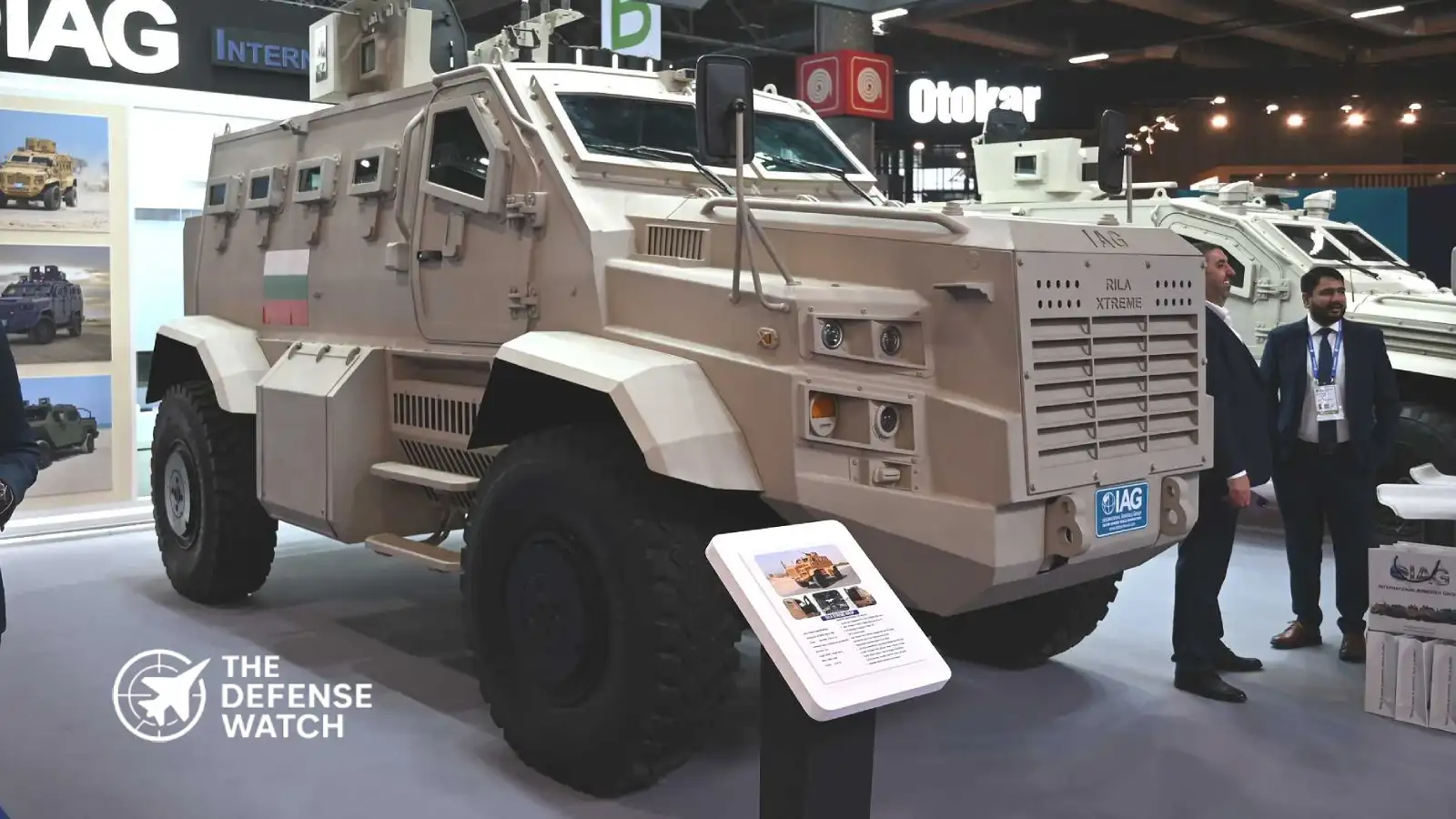
IAG armored vehicles
Image Source: Army Recognition
SHARE
Follow The Defense Watch on Google:

Executive Summary:

International Armored Group (IAG) has introduced a new generation of armored vehicle solutions aimed at improving battlefield survivability against mines, improvised explosive devices, ambushes, and evolving battlefield threats. The latest platforms emphasize modular protection, operational mobility, and mission adaptability as armed forces worldwide continue investing in protected mobility modernization.

IAG Expands Armored Vehicle Portfolio With New Battlefield Protection Solutions

International Armored Group (IAG) has unveiled its latest generation of armored vehicle solutions designed to enhance battlefield protection and operational flexibility for military customers worldwide. The company announced the new platforms as part of its continued investment in protected mobility technologies, highlighting improvements in survivability, modularity, and mission adaptability for modern combat environments.

Contents
IAG Expands Armored Vehicle Portfolio With New Battlefield Protection SolutionsFocus on Survivability and Protected MobilityBuilding on Earlier Vehicle ProgramsWhy Protected Mobility Is Becoming More ImportantAnalysis: A Shift Toward Adaptable Combat PlatformsLooking Ahead

The announcement reflects a broader shift across the global defense industry as armies adapt to increasingly complex operational environments shaped by widespread drone use, precision-guided weapons, mines, and improvised explosive devices. Modern armored vehicles are now expected to combine high levels of protection with digital connectivity, mobility, and rapid mission reconfiguration.

Focus on Survivability and Protected Mobility

The newest IAG platforms build on the company’s experience developing Mine Resistant Ambush Protected (MRAP) vehicles, armored personnel carriers, and tactical mobility platforms.

Among the highlighted vehicles are the Rila Xtreme and Guardian Xtreme, both engineered to provide enhanced crew protection while maintaining high mobility across challenging terrain. According to the company, the vehicles incorporate improved ballistic protection, blast-resistant hull designs, and modular armor packages that can be tailored to mission requirements.

- Advertisement -

Key design priorities include:

CapabilityOperational Benefit
Modular armor architectureAdaptable protection for different missions
Blast-resistant hullImproved survivability against mines and IEDs
High off-road mobilityBetter performance across varied terrain
Multi-role configurationsSupports troop transport, command, reconnaissance, and security missions
NATO-compatible standardsGreater interoperability with allied forces

Building on Earlier Vehicle Programs

The latest announcement continues IAG’s expansion beyond traditional armored patrol vehicles.

Earlier this year, the company revealed new 6×6 and 8×8 Infantry Fighting Vehicle (IFV) concepts at World Defense Show 2026, representing its entry into the medium-weight combat vehicle segment. Those platforms were designed as purpose-built infantry fighting vehicles rather than modified armored personnel carriers, featuring independent suspension systems, modular armor, and capacity for future electronic and weapons upgrades.

The company has also demonstrated the Pirin 4×4 APC and Balkan MRAP, reinforcing its strategy of offering a complete family of protected mobility solutions spanning internal security, peacekeeping, border protection, and high-intensity combat operations.

Why Protected Mobility Is Becoming More Important

The demand for modern armored vehicles has increased significantly since recent conflicts demonstrated the vulnerability of legacy platforms to inexpensive yet highly effective battlefield threats.

Commercial drones modified for reconnaissance and strike missions, loitering munitions, anti-tank guided missiles, and precision artillery have fundamentally changed vehicle survivability requirements. Passive armor alone is no longer sufficient.

As a result, military procurement increasingly emphasizes:

  • Higher blast protection
  • Modular armor upgrades
  • Digital battlefield integration
  • Counter-drone compatibility
  • Improved crew survivability
  • Easier maintenance and lifecycle support

These trends are influencing vehicle acquisition programs across NATO members, Middle Eastern operators, and emerging defense markets.

- Advertisement -

Analysis: A Shift Toward Adaptable Combat Platforms

IAG’s latest vehicle family illustrates a wider transformation taking place throughout the global armored vehicle market.

Rather than designing vehicles for a single operational role, manufacturers are increasingly developing common platforms that can support multiple missions through interchangeable mission modules and scalable protection packages. This approach reduces logistics burdens while allowing armed forces to adapt platforms as operational requirements evolve.

Equally important is the growing expectation that armored vehicles will function as networked battlefield assets rather than isolated platforms. Future combat vehicles are expected to integrate sensors, communications systems, electronic warfare capabilities, and autonomous technologies that improve situational awareness and accelerate decision making.

For medium-sized manufacturers like IAG, this strategy offers an opportunity to compete by providing customizable solutions for customers seeking alternatives to larger Western defense primes. Modular vehicle architectures also make it easier for nations to integrate domestically produced weapons, communications equipment, and mission systems, supporting local industrial participation and reducing long-term sustainment costs.

As modernization programs continue worldwide, demand is likely to remain strongest for armored platforms that balance protection, mobility, affordability, and upgrade potential instead of relying solely on heavier armor or larger vehicle designs.

Looking Ahead

IAG’s latest armored vehicle developments reinforce the growing emphasis on survivability, flexibility, and modular design within the global defense industry. While the company continues expanding its portfolio into increasingly capable combat vehicle segments, its newest platforms reflect broader military priorities centered on protecting personnel while maintaining operational agility across diverse mission environments.

As armed forces adapt to evolving battlefield conditions, protected mobility platforms equipped for future upgrades are expected to remain a central component of ground force modernization efforts.

Enjoying our coverage?

Make The Defense Watch a preferred source on Google to see more of our geopolitical and defense insights when relevant to you.

TAGGED:Armored VehiclesIAG
Share This Article
Facebook Copy Link Print
ByDaniel Mercer / Defense & Aerospace Analyst
Follow:
Daniel Mercer is a defense and aerospace analyst at TheDefenseWatch.com covering military aviation, aerospace technology, unmanned systems, air warfare, and defense procurement. His reporting uses official documents, government and military statements, company announcements, and other public sources.
Leave a Comment

Leave a Reply Cancel reply

Your email address will not be published. Required fields are marked *

Search Defense Systems

Latest Defense Systems

  • F-104 Starfighter F-104 Starfighter
  • F-15J Eagle Fighter Jet F-15J Eagle Fighter Jet
  • China’s GJ-21 Stealth Drone China’s GJ-21 Stealth Drone
  • China’s GJ-11 Stealth Drone China’s GJ-11 Stealth Drone
  • F-15EX Eagle Fighter Jet F-15EX Eagle Fighter Jet
  • TRML-4D Radar TRML-4D Radar
  • F-47A Fighter Jet F-47A Fighter Jet
  • China DF-61 Missile China DF-61 Missile
  • B61 Nuclear Bomb B61 Nuclear Bomb

Recent Compares

  • J-10C vs JF-17 Thunder: Which Fighter Is More Capable? J-10C vs JF-17 Thunder: Which Fighter Is More Capable? View Comparison →
  • Tejas vs Gripen: Key Differences and Capabilities Tejas vs Gripen: Key Differences and Capabilities View Comparison →
  • Tejas vs MiG-21 Bison: How India Replaced Its Iconic Supersonic Fighter Tejas vs MiG-21 Bison: How India Replaced Its Iconic Supersonic Fighter View Comparison →
  • F-35 vs F-16: Stealth, Sensors and Combat Roles F-35 vs F-16: Stealth, Sensors and Combat Roles View Comparison →
  • Tejas Fighter Jet vs F-16 Fighting Falcon: Capability Compared Tejas Fighter Jet vs F-16 Fighting Falcon: Capability Compared View Comparison →
  • Rafale Fighter Jet vs F-16 Fighting Falcon : Which Fighter Has the Edge? Rafale Fighter Jet vs F-16 Fighting Falcon : Which Fighter Has the Edge? View Comparison →
  • Su-57 Fighter Jet vs J-20 Fighter Jet: Stealth and Air Combat Compared Su-57 Fighter Jet vs J-20 Fighter Jet: Stealth and Air Combat Compared View Comparison →
  • Mirage 2000 vs Tejas Mk1A: Legacy Combat Power vs Indigenous Modernization Mirage 2000 vs Tejas Mk1A: Legacy Combat Power vs Indigenous Modernization View Comparison →
  • Rafale Fighter Jet vs F-22 Raptor: Which Air Dominance Fighter Has the Edge? Rafale Fighter Jet vs F-22 Raptor: Which Air Dominance Fighter Has the Edge? View Comparison →
  • Tejas Fighter Jet vs. Rafale Fighter Jet: India’s Indigenous Fighter Meets France’s Proven Multirole Combat Aircraft Tejas Fighter Jet vs. Rafale Fighter Jet: India’s Indigenous Fighter Meets France’s Proven Multirole Combat Aircraft View Comparison →

Recent Posts

  • NASA’s Voyager 1 Reaches One Light-Day From Earth After 49 Years in Space
  • Russian Missiles Enter Polish Airspace During European Military Exercises
  • L3Harris Wins $28 Million Australian Defence Contract for Advanced Capability System
  • F-35C Completes First Launch and Recovery Trials Aboard Ford-Class Carrier
  • Northrop Grumman Declares $2.47 Per-Share Dividend for Fourth Quarter 2026

You Might Also Like

U.S. Army personnel inspect smoke grenade production equipment at Pine Bluff Arsenal in Arkansas.
Defense ContractsMilitary & Ordnance

U.S. Department Of War Invests Nearly $19 Million To Modernize Pine Bluff Smoke Munitions Production

September 7, 2026
The system is part of the British Army’s Mobile Fires Platform (MFP) program, which aims to replace the aging AS90 self-propelled howitzers while restoring artillery capability following equipment transfers to Ukraine.
Artillery & Missile SystemsMilitary & Ordnance

UK Begins Production Of 37 RCH155 Self-Propelled Howitzers For British Army Modernization

September 12, 2026
Northrop Grumman solid rocket motor
Artillery & Missile SystemsMilitary & Ordnance

Northrop Grumman Tests Second Advanced Solid Rocket Motor in Two Months Under Rapid Development Program

January 31, 2026
CSG AUSA 2026
Military & OrdnanceTanks & Armored Vehicles

CSG Targets U.S. Land Systems Market With AUSA 2026 Debut

October 6, 2026

Logo

Copyright © 2026 TheDefenseWatch.com

Helpful Links

  • Home
  • About Us
  • Privacy Policy
  • Terms of Use / Disclaimer
  • U.S. Privacy Notice – CCPA Compliance

Defense Systems

  • Defense Systems
  • Comparisons 
  • Manufacturer
  • Tactical Calculators

Popuplar

Which 5 Air Forces Possess the Costliest Fighter Jet Fleets in the World
Evolving Strategic Value: Carrier Strike Groups in the Indo-Pacific’s Future Security Architecture
Autonomous Weapon Systems Spark U.S. Ethics Debate Amid Rapid Military AI Integration

We report on developments involving military forces, governments, defense companies, research organizations, and security institutions around the world. 

Welcome Back!

Sign in to your account

Username or Email Address
Password

Lost your password?

Enjoying our coverage?

Make The Defense Watch a preferred source on Google to see more insights.