• Home
  • About
  • Defense Systems
  • Manufacturer
  • Comparisons
  • Compare 
  • Tools
TheDefenseWatch.com
  • Aerospace & Aviation
  • Military & Ordnance
  • Naval & Maritime
  • Cyber & Space Defense
  • Policy & Strategy
  • Global News
  • Tools Library
    • Smart Calculator
    • Drone Flight Time Calculator
    • Drone Range Calculator
    • Counter-Drone Jammer Effective Range Calculator
    • Counter-Battery Radar Detection Calculator
    • Artillery Fire Correction Calculator
    • Thermal Camera Detection Range Calculator
    • Missile Range & Time-of-Flight Calculator
    • Radar Detection Range Calculator
    • FPV Strike Drone Payload vs Range Calculator
    • Loitering Munition Endurance Calculator
    • Sniper Ballistic Drop & Windage Calculator
    • Bullet Drop Calculator
    • U.S. Army Combat Fitness Test (ACFT) Calculator
    • Military Pension Calculator
    • Military Retirement Calculator
    • Military Pension Calculator
    • Large Number Calculator
Font ResizerAa

TheDefenseWatch.com

The Defense Watch | U.S. & Global Defense News, Analysis & Military Updates

Search
  • Home
  • About
  • Defense Systems
  • Manufacturer
  • Comparisons
  • Compare 
  • Tools

Stay Updated

Get the latest update

Subscribe

Explore

  • Drone
  • Fighter Jets & Military Aircraft
  • Hypersonic Weapons
  • Aircraft Carriers
  • Strategic History & Missions
  • Tools Library
Home » Pakistan Unveils RAAST Drone Detection Radar At PIMEC 2025 To Boost Counter UAS Capability
Asian Defense & Security

Pakistan Unveils RAAST Drone Detection Radar At PIMEC 2025 To Boost Counter UAS Capability

Daniel Mercer / Defense & Aerospace Analyst
Last updated: February 25, 2026 11:43 am
Daniel Mercer / Defense & Aerospace Analyst
Share
7 Min Read
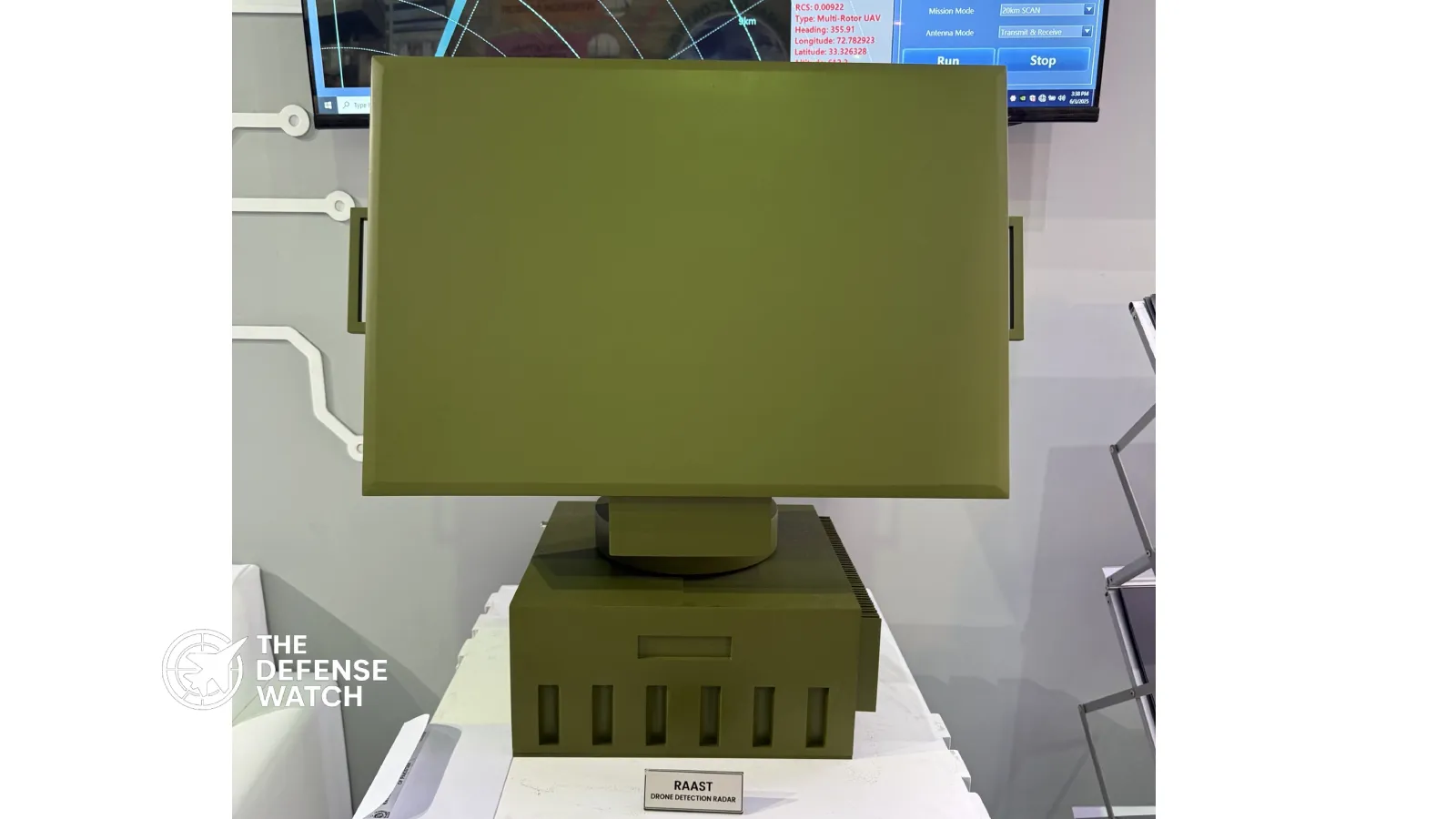
RAAST Drone Detection Radar
SHARE
■ KEY FACTS AT A GLANCE
  • ► Pakistan’s GIDS unveiled the RAAST Drone Detection Radar at PIMEC 2025.
  • ► Ku band AESA Pulse Doppler radar designed to detect small UAVs with RCS as low as 0.01 m².
  • ► Offers 360 degree azimuth coverage and up to 30 degree electronic elevation.
  • ► Optimized for force protection, border security, coastal defense, and battlefield surveillance.
  • ► Reflects Pakistan’s push for indigenous counter UAS and radar modernization capabilities.

Pakistan Unveils RAAST Drone Detection Radar At PIMEC 2025

The RAAST Drone Detection Radar was unveiled by Global Industrial & Defense Solutions at Pakistan International Maritime Expo and Conference 2025, marking a new step in Pakistan’s effort to strengthen its counter unmanned aerial systems architecture.

Contents
  • Pakistan Unveils RAAST Drone Detection Radar At PIMEC 2025
    • Technical Overview And Operational Envelope
    • Addressing The Small Drone Threat
    • Operational Roles And Deployment Scenarios
    • Indigenous Development And Strategic Significance
    • Market And Regional Context

RAAST is described as an all weather Ku band active electronically scanned array, or AESA, Pulse Doppler radar. It is designed to detect and track small, low radar cross section unmanned aerial vehicles operating in cluttered and complex environments.

The system is positioned as a domestically developed solution aimed at closing gaps in low altitude air surveillance, particularly against commercial off the shelf drones and small tactical UAVs.

Technical Overview And Operational Envelope

According to specifications released at PIMEC 2025, the RAAST Drone Detection Radar provides 360 degree azimuth coverage. It electronically scans up to 30 degrees in elevation with an approximate scan cycle of around two seconds.

- Advertisement -

The radar is capable of detecting targets with a radar cross section as small as 0.01 square meters at ranges up to 10 kilometers. The minimum detection range is approximately 150 meters.

The use of a Ku band AESA configuration is significant. Ku band frequencies are often selected for high resolution tracking and improved detection of small objects. AESA technology allows rapid beam steering without mechanical movement, increasing reliability and enabling faster revisit rates.

Pulse Doppler processing further enhances the system’s ability to filter out ground clutter and focus on moving aerial targets, a critical feature in urban, coastal, and mountainous terrain.

Addressing The Small Drone Threat

The RAAST Drone Detection Radar enters service discussions at a time when small UAVs are reshaping modern conflict. From the war in Ukraine to Middle East security operations, low cost drones have demonstrated their ability to conduct reconnaissance, precision strikes, and swarm attacks.

The proliferation of small UAVs has challenged traditional air defense systems, which were designed primarily for larger aircraft or missile threats. As noted in multiple assessments by the International Institute for Strategic Studies, small drones present a detection and tracking challenge due to their limited radar signature and low altitude flight profiles.

Pakistan faces similar risks across its borders and coastal approaches. A radar such as RAAST, optimized specifically for low RCS targets, is tailored to this evolving threat environment.

Operational Roles And Deployment Scenarios

GIDS states that the RAAST Drone Detection Radar is optimized for force protection, border security, coastal defense, battlefield surveillance, and counterterrorism missions.

For fixed site protection, the system could be deployed to guard military bases, airfields, critical infrastructure, and naval facilities. Its 360 degree coverage supports perimeter defense without requiring multiple mechanically rotating sensors.

- Advertisement -

In border and coastal roles, the radar may help close low altitude surveillance gaps. Small drones are increasingly used for cross border reconnaissance and smuggling. A dedicated detection layer enhances early warning and cueing for kinetic or electronic countermeasures.

On the battlefield, integration with command and control networks could enable rapid handoff to short range air defense systems or electronic warfare assets.

Indigenous Development And Strategic Significance

The RAAST Drone Detection Radar reflects Pakistan’s broader drive to expand indigenous defense manufacturing under the umbrella of GIDS. Developing a domestic AESA based counter UAS radar reduces reliance on foreign suppliers and offers export potential to partner states facing similar drone threats.

From a strategic standpoint, layered air defense is no longer limited to high end missile shields. Modern force protection requires dedicated sensors that specialize in small target detection at low altitude.

By investing in a Ku band AESA solution, Pakistan aligns with a global trend. The United States, Israel, and several European nations have fielded similar short range drone detection radars to protect bases and critical infrastructure.

However, effectiveness will depend on integration. A radar alone does not neutralize a drone. It must be linked to electronic warfare systems, directed energy weapons, or short range interceptors. The long term value of RAAST will hinge on how it is incorporated into a broader counter UAS ecosystem.

Market And Regional Context

South Asia remains a region where drone use is expanding rapidly, both for military and non state actors. India and Pakistan have both reported incidents involving small UAVs along contested borders.

In this context, RAAST positions Pakistan to address persistent low altitude surveillance challenges while potentially offering a cost competitive system for export.

PIMEC 2025 provided a platform to showcase domestic maritime and security technologies to regional and international delegations. The unveiling of RAAST at a maritime focused exhibition also underscores its potential coastal defense applications.


TAGGED:AESA radar technologyCounter UAS systemsPakistan defense industryPIMEC 2025RAAST radar
Share This Article
Facebook Copy Link Print
ByDaniel Mercer / Defense & Aerospace Analyst
Follow:
Daniel Mercer is a defense and aerospace analyst at TheDefenseWatch.com covering military aviation, aerospace technology, unmanned systems, air warfare, and defense procurement. His reporting uses official documents, government and military statements, company announcements, and other public sources.
Leave a Comment

Leave a Reply Cancel reply

Your email address will not be published. Required fields are marked *

Latest Defense Systems

  • John F. Kennedy Aircraft Carrier John F. Kennedy Aircraft Carrier
  • Voyager Tanker Voyager Tanker
  • YU-20 Tanker YU-20 Tanker
  • China KJ-500 Aircraft China KJ-500 Aircraft
  • SPY-6 Radar SPY-6 Radar
  • Boeing VC-25B Presidential Aircraft Boeing VC-25B Presidential Aircraft
  • SM-3 Block IB Missile SM-3 Block IB Missile
  • USS Abraham Lincoln Aircraft Carrier USS Abraham Lincoln Aircraft Carrier
  • M142 HIMARS M142 HIMARS

Recent Compares

  • Tejas vs Gripen: Key Differences and Capabilities Tejas vs Gripen: Key Differences and Capabilities View Comparison →
  • Tejas vs MiG-21 Bison: How India Replaced Its Iconic Supersonic Fighter Tejas vs MiG-21 Bison: How India Replaced Its Iconic Supersonic Fighter View Comparison →
  • F-35 vs F-16: Stealth, Sensors and Combat Roles F-35 vs F-16: Stealth, Sensors and Combat Roles View Comparison →
  • Tejas Fighter Jet vs F-16 Fighting Falcon: Capability Compared Tejas Fighter Jet vs F-16 Fighting Falcon: Capability Compared View Comparison →
  • Rafale Fighter Jet vs F-16 Fighting Falcon : Which Fighter Has the Edge? Rafale Fighter Jet vs F-16 Fighting Falcon : Which Fighter Has the Edge? View Comparison →
  • Su-57 Fighter Jet vs J-20 Fighter Jet: Stealth and Air Combat Compared Su-57 Fighter Jet vs J-20 Fighter Jet: Stealth and Air Combat Compared View Comparison →
  • Mirage 2000 vs Tejas Mk1A: Legacy Combat Power vs Indigenous Modernization Mirage 2000 vs Tejas Mk1A: Legacy Combat Power vs Indigenous Modernization View Comparison →
  • Rafale Fighter Jet vs F-22 Raptor: Which Air Dominance Fighter Has the Edge? Rafale Fighter Jet vs F-22 Raptor: Which Air Dominance Fighter Has the Edge? View Comparison →
  • Tejas Fighter Jet vs. Rafale Fighter Jet: India’s Indigenous Fighter Meets France’s Proven Multirole Combat Aircraft Tejas Fighter Jet vs. Rafale Fighter Jet: India’s Indigenous Fighter Meets France’s Proven Multirole Combat Aircraft View Comparison →
  • F-22 Raptor vs. F-35 Joint Strike Fighter: Which Fifth Generation Fighter Has the Edge? F-22 Raptor vs. F-35 Joint Strike Fighter: Which Fifth Generation Fighter Has the Edge? View Comparison →

Recent Posts

  • Hegseth Says Autonomous Warfare Has Long Been the Pentagon’s End Goal
  • US Rejects Automatic Body Camera Activation for ICE Officers
  • Iron Dome Architect Develops New Counter-Swarm Drone Defense System
  • U.S. Navy Conducts First F-35C Landing on USS John F. Kennedy
  • Huntington Ingalls Wins $56.2 Million Contract for Foreign Nuclear Submarine Support

You Might Also Like

Helsing HX-2 drone Japan
Asian Defense & Security

Helsing Moves To Enter Japan’s Drone Market With Rakuten As Military Deal Advances

August 17, 2026
India Su-30MKI Indian Ocean patrol
Asian Defense & Security

India’s Su-30MKI And Thai Gripen Jets Conduct Indian Ocean Patrol, Signaling Stronger Indo Pacific Alignment

September 12, 2026
Pakistan J-10C
Asian Defense & Security

Pakistan’s J-10C Induction Signals a New Era in South Asian Air Power Dynamics

September 9, 2026
ASELSAN EFES 2026
Asian Defense & Security

ASELSAN Expands Air Defense And Electronic Warfare Capabilities At EFES 2026 Exercise

September 7, 2026

Logo

Copyright © 2026 TheDefenseWatch.com

Helpful Links

  • Home
  • About Us
  • Privacy Policy
  • Terms of Use / Disclaimer
  • U.S. Privacy Notice – CCPA Compliance

Defense Systems

  • Defense Systems
  • Comparisons 
  • Manufacturer
  • Tactical Calculators

Popuplar

Which 5 Air Forces Possess the Costliest Fighter Jet Fleets in the World
Evolving Strategic Value: Carrier Strike Groups in the Indo-Pacific’s Future Security Architecture
Autonomous Weapon Systems Spark U.S. Ethics Debate Amid Rapid Military AI Integration

We report on developments involving military forces, governments, defense companies, research organizations, and security institutions around the world. 

Welcome Back!

Sign in to your account

Username or Email Address
Password

Lost your password?