America’s Nuclear Triad Modernization Enters Its Most Critical Phase Yet
The United States is preparing to execute the most sweeping overhaul of its nuclear deterrent since the Cold War arms race. The Trump administration’s fiscal year 2027 budget proposal dedicates $71.4 billion to modernizing all three legs of the U.S. nuclear triad — land-based missiles, submarine-launched ballistic missiles, and strategic bombers — along with the nuclear command, control, and communications architecture that ties them together. Secretary of War Pete Hegseth, testifying before the Senate Armed Services Committee on April 30, 2026, framed the stakes bluntly: get nuclear deterrence wrong, and everything else in the defense portfolio collapses with it.
- The FY2027 U.S. defense budget totals $1.5 trillion — the largest in American history — announced at the Pentagon on April 22, 2026.
- $71.4 billion is earmarked specifically for nuclear triad modernization and nuclear command, control, and communications (NC3) systems.
- The sea leg receives the largest share: $16.2 billion for the Columbia-class ballistic missile submarine program, including procurement of the fourth boat in class.
- The air leg receives $6.1 billion for the B-21 Raider stealth bomber and $1.5 billion for the Long-Range Standoff cruise missile (LRSO).
- The land leg receives $4.6 billion for the LGM-35 Sentinel ICBM program, which will field 400 deployed missiles across 450 hardened silos in five states.
The broader $1.5 trillion FY2027 budget request — described by the Pentagon as the largest defense spending proposal in U.S. history — was unveiled at a Pentagon briefing on April 22, 2026, and is intended to support service members and their families, secure the American homeland, modernize aging equipment, and rebuild the defense industrial base. Within that historic number, the nuclear modernization allocation stands apart for both its scale and its urgency.
Why $71 Billion — and Why Now?
The timing of this investment is not coincidental. Hegseth pointed specifically to Iran’s pursuit of nuclear weapons as a live demonstration of why the United States maintains a credible nuclear deterrent, and why that deterrent must remain modern and reliable. That argument carries fresh weight in May 2026, following a period of acute regional instability in the Middle East.
But Iran is only part of the calculus. The proposal is being framed as a response to near-peer competitors — specifically China and Russia — with the administration arguing that decades of underinvestment have left the United States’ strategic posture in need of urgent repair. Pentagon planners are not merely patching aging Cold War infrastructure; they are pursuing a near-simultaneous replacement of all three delivery systems that constitute the triad — a generational shift that no previous administration has attempted at this scale or speed.
Space Force Lt. Gen. Steven P. Whitney, the Pentagon’s joint staff director of force structure, described the request as a continuation of a “generational modernization effort” and highlighted $20.2 billion within the nuclear envelope specifically for NC3 architecture — ensuring missile warning capabilities and strengthening presidential decision-making authority over the country’s strategic forces.
The Air Leg: B-21 Raider and the Long-Range Standoff Weapon
The air component of the triad receives $6.1 billion for the B-21 Raider program. The next-generation stealth bomber, developed by Northrop Grumman, is designed as a dual-capable platform able to deliver both conventional and nuclear payloads, and the U.S. Air Force plans to procure a minimum of 100 aircraft. FY2027 funding supports continued development, testing, production readiness, and low-rate initial production.
Alongside the Raider, $1.5 billion is allocated for the Long-Range Standoff (LRSO) cruise missile, the intended replacement for the aging AGM-86B air-launched cruise missile that currently arms the B-52H bomber fleet. Lifetime procurement costs for the LRSO have climbed to $11.8 billion — up from $9.8 billion projected just two years ago — with the FY2027 request nearly doubling the previous year’s enacted funding for the program.
The B-21 and LRSO together represent a penetrating strike-plus-standoff combination designed to defeat even the most advanced integrated air defense systems that adversaries like China and Russia are fielding. The combination gives U.S. Strategic Command far more flexibility than the bomber leg has historically offered.
The Land Leg: Sentinel ICBM Faces Cost Pressure but Moves Forward
The FY2027 budget includes $4.6 billion for the LGM-35 Sentinel program, the long-overdue replacement for the Minuteman III intercontinental ballistic missile. When fully fielded, the Sentinel will deploy 400 operational warheads across 450 hardened silos in five states, requiring major infrastructure projects at each location.
The Air Force anticipates achieving Milestone B approval for the Sentinel by the end of 2026, following significant cost overruns and a program restructuring. Northrop Grumman broke ground in February 2026 on a test silo intended to validate a new modular silo launcher design. FY2027 silo construction funding of just over $1 billion is distributed across F.E. Warren Air Force Base in Wyoming ($632 million), Minot Air Force Base in North Dakota ($232 million), and Malmstrom Air Force Base in Montana ($138.5 million).
The Sentinel program has absorbed criticism for budget overruns and schedule delays, but its strategic logic remains intact. Minuteman III missiles have been in service since the early 1970s, and their guidance, propulsion, and communication systems are stretching the limits of maintainability. Delaying Sentinel further would eventually force a choice between operating an increasingly unreliable land leg or standing it down — neither of which is acceptable under current threat conditions.
The Sea Leg: Columbia-Class Submarine Leads the Pack
The nuclear sea leg receives the largest single allocation within the triad package: $16.2 billion for the Columbia-class ballistic missile submarine program. The FY2027 request funds procurement of the fourth Columbia-class boat as well as continued development work on the third submarine in the class, USS Groton, along with research, development, testing, evaluation, and investment in the submarine industrial base.
The Navy still expects to receive the first Columbia-class boat by the end of 2028, according to Vice Adm. Robert Gaucher, the service’s direct reporting portfolio manager for submarines. The Trident II ballistic missile — the sea leg’s primary weapon — is also moving from an R&D phase into full procurement in FY2027, with associated costs rising from $2.6 billion to $3.9 billion.
The Columbia program is arguably the most critical single investment in the entire nuclear enterprise. Submarines on patrol are essentially invulnerable to first-strike targeting, making the sea-based leg the ultimate guarantor of a retaliatory second strike. Any gap in Columbia deliveries as Ohio-class boats age out would create a structural vulnerability in the deterrent posture that adversaries could exploit in a crisis.
Industrial Base: The Hidden Variable in the Entire Budget
Secretary Hegseth told lawmakers that rebuilding the industrial base underpins everything else in the budget, arguing that the capacity of America’s private sector to deliver advanced weapons at speed and scale is itself a form of deterrence — and that for years, that capacity had been deliberately neglected.
The central physical constraint confronting the entire modernization effort is the eroded state of the U.S. defense industrial base. The country has only two shipyards capable of building nuclear submarines, and expanding that capacity requires new dry docks, cranes, and skilled workers — a process that takes five to seven years before the first additional hull is laid.
This is the quiet risk buried inside an otherwise impressive budget document. Money is necessary but not sufficient. The Sentinel silo construction program requires specialized contractors; the Columbia program requires a submarine workforce that has been contracting for decades. Throwing capital at a depleted industrial ecosystem does not instantly restore it, and the Pentagon’s own planners acknowledge that the timeline for full capacity restoration extends well beyond a single budget cycle.
What the Numbers Mean Strategically
The $71.4 billion nuclear allocation should be read in the context of a broader strategic signaling exercise as much as a procurement plan. The FY2027 request represents a 44 percent increase over prior defense spending levels and is structured as $1.15 trillion in base discretionary funding plus $350 billion in supplemental funding for what the administration terms “critical presidential priorities.
Peer competitors are watching. China is expanding its own land-based ICBM force at a pace that U.S. intelligence has described as alarming, while Russia continues to invest in hypersonic nuclear delivery vehicles designed to penetrate missile defense systems. The United States is not modernizing the triad in a vacuum — it is doing so in an environment where nuclear competition is actively accelerating on multiple fronts simultaneously.
The key analytical question for 2026 and beyond is not whether the budget request is bold enough — it clearly is — but whether the industrial, congressional, and fiscal conditions exist to execute it on the timelines the administration has set. History suggests that nuclear modernization programs routinely slip, cost more than projected, and encounter technical obstacles that no budget document anticipates. The Sentinel program has already demonstrated that lesson once. Whether the political will exists to sustain $71 billion in annual nuclear investment through successive budget cycles remains an open question that Capitol Hill will ultimately answer.
FAQs
What is the total nuclear triad funding in the FY2027 defense budget?The FY2027 budget allocates $71.4 billion specifically to the nuclear triad and nuclear command, control, and communications systems — the largest such investment in the current modernization cycle.
What is the B-21 Raider’s role in the nuclear triad?The B-21 Raider is the air leg of the triad. It is a dual-capable stealth bomber that can deliver both conventional and nuclear weapons, including the Long-Range Standoff cruise missile. The Air Force plans to procure a minimum of 100 aircraft.
What is the LGM-35 Sentinel and why is it significant?The Sentinel is the replacement for the Minuteman III ICBM, which has been in service since the early 1970s. The FY2027 budget includes $4.6 billion to continue its development, and the program will eventually deploy 400 operational missiles across 450 hardened silos in five states.
How does the Columbia-class submarine fit into the nuclear triad?The Columbia-class submarine is the sea leg of the triad. Submarines on patrol are considered the most survivable component of the deterrent because they are extremely difficult to detect and target. The FY2027 budget allocates $16.2 billion to the program, including procurement of the fourth boat.
Will the $1.5 trillion defense budget actually pass Congress?The proposal is a request, not an enacted appropriation. The request faces significant debate over its scale, with analysts noting industrial base constraints, competing fiscal priorities, and bipartisan concerns about the national debt. Congressional passage at the full requested level is considered unlikely, though substantial portions are expected to be approved.
China’s B-2-Sized Stealth Drone Spotted at Secret Xinjiang Base — And It’s Not Alone
China’s stealth flying-wing drone program crossed a significant milestone in the spring of 2026, when commercial satellite imagery captured two large unmanned aircraft simultaneously operating outside their hangars at a highly secretive military installation deep in the Xinjiang desert. One of those aircraft carries a wingspan that puts it in the same physical category as the United States Air Force’s B-2 Spirit stealth bomber — an aircraft that has long represented the pinnacle of long-range airpower. The images, sourced from Planet Labs and first reported by multiple defense publications, mark the most detailed public glimpse yet into a program that Beijing has worked hard to keep under wraps.
- Satellite imagery taken on March 26, 2026 shows two large stealth flying-wing drones simultaneously operating outside hangars at China’s Malan Air Base in Xinjiang — a first-of-its-kind observation.
- The larger drone, referred to by analysts as the WZ-X, carries an estimated wingspan of approximately 173 feet (52 meters) — placing it in the same size class as the U.S. Air Force’s B-2 Spirit stealth bomber.
- A second aircraft featuring a cranked-kite wing design with a roughly 137-foot (42-meter) wingspan suggests a heavier strike-oriented mission profile with a larger payload capacity.
- A third smaller tailless, fighter-like drone was also observed on the apron alongside a Xi’an Y-20 transport aircraft, indicating multi-platform parallel testing.
- China’s drone activity at Malan coincides with the U.S. Air Force’s Collaborative Combat Aircraft (CCA) program, which targets initial operational fielding around 2028.
The development is not merely a symbolic data point. It reflects a deliberate, well-funded, and accelerating push by the People’s Liberation Army Air Force (PLAAF) to field a new generation of unmanned aircraft capable of conducting long-range surveillance, deep-strike, and electronic warfare missions — with or without a human pilot in the loop. For American defense planners already grappling with the challenge of China’s manned fifth-generation fighters and expanding naval footprint, the maturation of this drone fleet adds a new and complex layer to the strategic calculus in the Pacific.
What the March 2026 Imagery Revealed
The satellite images, taken on March 26, 2026, show two previously identified large stealth drones operating simultaneously at China’s Malan test base in Xinjiang, alongside a third fighter-like unmanned aircraft. This was the first confirmed observation of both large flying-wing platforms outside their hangars at the same time, suggesting a meaningful uptick in test tempo at the facility.

The larger of the two aircraft, sometimes referred to by analysts as the WZ-X, carries an estimated wingspan of roughly 52 meters — approximately 173 feet — placing it in the same general class as the Northrop Grumman B-2 Spirit. Its long, slender wing geometry points toward high-altitude, long-endurance missions, most likely strategic intelligence, surveillance, and reconnaissance (ISR) operations. At that wingspan, the aircraft would be capable of persistent overwatch across vast stretches of ocean or contested territory.
The second aircraft features a cranked-kite wing configuration with a wingspan of approximately 42 meters, or 137 feet. Its broader fuselage and internal volume suggest it is optimized for strike missions and could carry significant weapons payloads or additional fuel for extended-range operations.
Rounding out the scene were a smaller tailless fighter-like drone, roughly comparable to a light tactical aircraft, and a Xi’an Y-20 heavy transport. The fighter-type drone has appeared in prior imagery captured over the past year, confirming it is part of an active and recurring test program rather than a one-off prototype evaluation.
Malan: China’s Most Secretive Aerospace Laboratory
The aircraft are being tested at Malan Air Base, a remote and heavily secured facility in western China that has become a central hub for advanced aerospace programs. The base’s isolated desert location provides both operational security and access to large volumes of restricted airspace, making it ideal for experimental platforms. Historically, Malan has been linked to nuclear weapons development and ballistic missile testing, which underscores the sensitivity and strategic priority attached to everything that happens within its perimeter.
Satellite imagery over the past year has shown a steady increase in activity at the site, including large-scale exercises involving multiple unmanned systems operating alongside conventional aircraft. The presence of several distinct drone types operating concurrently indicates that China is not hedging its bets on a single design but is instead running parallel programs across different mission profiles — ISR, strike, and potentially electronic warfare. That approach carries higher development costs but reduces the risk of a single program failure derailing the entire unmanned air combat agenda.
A Broader Pattern: China’s Unmanned Air Combat Push
The aircraft spotted at Malan do not exist in isolation. They are the most visible manifestations of a broader and highly deliberate Chinese effort to build a full-spectrum unmanned air force.
China has already fielded or tested several similar platforms, including the GJ-11 Sharp Sword, a flying-wing unmanned combat aircraft that was shown in semi-operational configurations only recently. The GJ-11 represents the operational leading edge of China’s stealth drone fleet, but the aircraft at Malan are significantly larger, suggesting that Beijing is not content to stop at tactical-range systems. It is reaching for a strategic unmanned capability.
Other programs — including the CH-7 flying-wing stealth drone and additional loyal wingman-type drones — reveal China’s ambition to integrate unmanned aircraft into future air combat formations, complementing fifth-generation and upcoming sixth-generation fighters by providing additional sensors and weapons capacity. China underscored this intent publicly when it displayed multiple drone concepts during its September 2025 military parade.
Analysis: Why the WZ-X Matters More Than Its Size
The natural headline angle here is the wingspan comparison to the B-2, but the real strategic significance goes deeper than physical dimensions. A drone the size of the B-2 Spirit does not automatically inherit the B-2’s mission — the Spirit carries nuclear gravity bombs and is optimized for penetrating the most sophisticated air defense environments on earth. Whether the WZ-X can replicate that level of low observability remains genuinely unknown from open-source data alone.
What the imagery does confirm, however, is that China is investing in the infrastructure and flight testing required to eventually field such a capability. Development programs of this scale — involving multiple large aircraft types testing simultaneously at a high-security facility — do not emerge overnight. The resources, engineering talent, and organizational commitment behind what is visible at Malan suggest this has been years in the making and that Beijing intends to see it through to operational status.
Equally significant is the parallel development of smaller loyal wingman-type drones at the same site. This mirrors the U.S. Air Force’s Collaborative Combat Aircraft concept almost exactly: pairing autonomous unmanned wingmen with manned or semi-manned aircraft to multiply combat effectiveness and absorb attrition in high-threat environments. China appears to be building toward the same architecture, potentially on a compressed timeline.
How the U.S. Is Responding
Washington is not standing still. The U.S. Air Force’s Collaborative Combat Aircraft program — designed to produce autonomous loyal wingman drones that operate alongside manned fighters — is expected to begin fielding operational systems before the end of the decade, with initial increments projected around 2028.
Those systems are designed to operate in concert with the Next Generation Air Dominance platform, which will provide additional sensors and electronic warfare capabilities, among other upgrades. The F-47, as the NGAD has come to be known, combined with CCA drones, represents the American answer to exactly the kind of manned-unmanned teaming concept now visible at Malan.
On the ISR side, the U.S. has been operating the highly classified Northrop Grumman RQ-180 for high-altitude, stealthy reconnaissance missions, with its existence now publicly confirmed. Earlier in 2026, the secretive platform was spotted flying over Greek airspace. Unlike many of its Chinese counterparts, the RQ-180 is understood to have completed over a decade of operational development and is likely already integrated into combatant command intelligence architecture.
The gap between the two nations’ programs is narrowing, but the United States retains meaningful advantages in operational maturity, systems integration experience, and the depth of institutional knowledge that comes from decades of running large stealth programs through full development cycles. The critical variable in the coming years will be whether China’s accelerated parallel development approach can close that experience gap before U.S. programs fully mature.
Strategic Implications for the Indo-Pacific
The emergence of B-2-class stealth drones in China’s test inventory arrives at a moment when the Indo-Pacific is already under intense strategic strain. A long-range, high-altitude stealth ISR drone operating from mainland China could extend persistent surveillance coverage deep into the Philippine Sea, the second island chain, and potentially well beyond, all without the political and diplomatic risk associated with deploying manned aircraft in contested or ambiguous airspace.
A credible long-range unmanned strike capability would compound this challenge significantly. It would complicate American force projection planning, increase the demands on allied integrated air defense networks, and potentially shift deterrence calculations in a crisis. The U.S. and its regional partners — Japan, Australia, South Korea, and the Philippines in particular — will be watching the pace of operational testing at Malan very closely in the months ahead.
The aircraft spotted in those March 26 satellite frames are not yet operational weapons systems. But they are closing in on that threshold, and the trajectory is unmistakable.
FAQs
What is the WZ-X drone and why does its wingspan matter?The WZ-X is an undesignated large Chinese stealth flying-wing drone observed at Malan Air Base. Its estimated 173-foot wingspan places it in the same physical class as the B-2 Spirit, signaling China’s ambition to develop long-range, strategic unmanned aircraft.
Where is Malan Air Base and why is it significant?Malan is a remote, heavily secured military installation in China’s Xinjiang region. It has historically hosted some of China’s most sensitive aerospace programs, including nuclear and hypersonic development, making it a primary hub for advanced experimental aircraft.
How does this compare to U.S. stealth drone programs?The U.S. operates the classified RQ-180 high-altitude stealth reconnaissance drone and is developing CCA loyal wingman systems under the Air Force’s collaborative combat aircraft program. The U.S. holds advantages in operational maturity, but China’s parallel program structure is compressing the development timeline.
Does China’s drone fleet threaten U.S. assets in the Pacific?Not immediately in operational terms, but the strategic trend is significant. Long-range stealth drones capable of persistent ISR and potential strike missions would expand China’s reach across the Indo-Pacific and complicate U.S. force projection planning considerably.
What is the Cranked-Kite wing design seen on the second drone?A cranked-kite wing is a specific flying-wing geometry that balances aerodynamic efficiency with internal volume, making it well-suited for carrying heavy payloads such as weapons or fuel. It has been used on concepts like the canceled U.S. Navy UCLASS program and is a common design choice for long-range unmanned combat aircraft.
Bell and KAI Sign MOU to Explore MV-75 Cheyenne II for South Korea’s Next-Generation Helicopter Requirement
Bell Textron and Korea Aerospace Industries signed a Memorandum of Understanding to explore solutions based on the MV-75 Cheyenne II tiltrotor for South Korea’s High Speed Medium Utility Helicopter (HSMUH) program, the two companies announced April 28, 2026. The agreement — signed at Bell’s Fort Worth, Texas, headquarters — marks the first publicly disclosed international cooperation effort tied to the MV-75 since the U.S. Army formally named the aircraft the Cheyenne II earlier in April.
¦ KEY FACTS AT A GLANCE- Bell Textron and Korea Aerospace Industries (KAI) signed an MOU on April 27–28, 2026, at Bell’s headquarters in Fort Worth, Texas, to explore MV-75 Cheyenne II solutions for South Korea’s High Speed Medium Utility Helicopter (HSMUH) program.
- The MV-75 Cheyenne II is the U.S. Army’s selected Future Long-Range Assault Aircraft (FLRAA), offering more than twice the speed and range of the UH-60 Black Hawk it is designed to replace.
- This is the first publicly disclosed international cooperation effort tied to the MV-75, signaling Washington’s intent to extend next-generation tiltrotor capability to allied forces in the Indo-Pacific.
- The exploratory work is supported under U.S. Army Contracting Command Contract No. W58RGZ-23-C-0001, tying any potential South Korean variant directly to the Army’s program of record and future U.S. export policy decisions.
- Both companies will evaluate a Modular Open Systems Approach (MOSA) to allow South Korean forces to modify and upgrade the platform affordably over time, reducing long-term dependency on a single supplier.
The Big Picture
The United States is actively working to extend its most advanced defense platforms to close allies, and vertical-lift aviation represents one of the clearest examples of this effort. As Washington deepens its focus on Indo-Pacific deterrence, ensuring that allies like South Korea operate compatible, interoperable platforms becomes strategically essential.
South Korea sits at the crossroads of one of the world’s most volatile security environments. The Korean Peninsula borders a nuclear-armed North Korea, exists within striking range of Chinese military assets, and demands a defense posture that can respond rapidly across difficult terrain — mountainous, coastal, and urban. The Republic of Korea Army relies heavily on rotary-wing aviation for troop transport, logistics, and close support, making the HSMUH program a high-priority modernization effort.
Simultaneously, the U.S. Army’s own FLRAA program is maturing rapidly. Rolls-Royce began ground testing the AE 1107F turboshaft engines that will power the MV-75 in December 2025. Collins Aerospace received contracts in April 2026 to supply five onboard systems including main power generation, the interconnect drive system, and the SmartProbe air data system. Bell opened a dedicated Wichita Assembly Center for MV-75 fuselage production on April 27, 2026 — one day before the KAI MOU was announced. The domestic program’s accelerating pace creates the conditions necessary for international offers to become credible.
What’s Happening
Bell Textron and KAI signed the MOU on April 27 (local time) at Bell’s Fort Worth headquarters. The signing was attended by KAI Rotary Wing Business Division Head Jo Jung-il and Bell Senior Vice President of Strategic Pursuits Jeff Schloesser.
Under the agreement, the two companies will assess MV-75-based solutions for South Korea’s HSMUH requirement. The scope includes evaluating a Modular Open Systems Approach (MOSA) framework to allow the Republic of Korea Armed Forces to modify the platform’s weapons systems rapidly and affordably as operational needs evolve.
Bell and KAI will also explore areas for industrial cooperation as the program matures. The press release notes the effort is “aligned with U.S. Government priorities and policies,” language that signals the partnership’s scope is bounded by Washington’s export authorization framework. Critically, the work is supported under U.S. Army Contracting Command Contract No. W58RGZ-23-C-0001 — the same FLRAA development contract that funds the domestic MV-75 program. That structure directly ties any future South Korean variant to U.S. policy decisions on technology transfer.
The MV-75 Cheyenne II is derived from Bell’s V-280 Valor demonstrator, which the U.S. Army selected for FLRAA in December 2022. The platform offers more than twice the speed and range of the UH-60 Black Hawk it is designed to replace, using tiltrotor technology to combine vertical-takeoff-and-landing capability with fixed-wing cruise efficiency.
Why It Matters
The Bell-KAI MOU carries significance on multiple levels — industrial, operational, and geopolitical.
For the ROK military, the HSMUH requirement represents a generational leap. South Korea’s current utility helicopter fleet, including aging UH-60 variants and domestically produced Surion helicopters, operates at conventional speeds and ranges. A tiltrotor-based replacement would dramatically expand the operational reach of ROK ground forces, enabling faster troop insertion, logistics support, and medical evacuation across a broader area of operations.
For Bell, the MOU represents the first concrete step toward internationalizing the MV-75 platform. Defense contractors rarely recoup development costs from a single-nation program of record. Export sales extend production runs, reduce per-unit costs, and generate revenue streams that sustain long-term program health. Establishing a partnership with KAI early — before the domestic program reaches initial operational capability — positions Bell to shape the HSMUH competition on its terms.
For the U.S.-ROK alliance, interoperability is the key operational dividend. If South Korea fields a variant of the same tiltrotor platform the U.S. Army operates, combined arms planning, logistics, and maintenance support become significantly simpler in a conflict scenario. That alignment has tangible value in a theater where American and South Korean forces train together under the Combined Forces Command structure.
Strategic Implications
The MOU carries strategic weight beyond its immediate industrial scope.
Tiltrotor technology represents a genuine capability gap relative to China’s current rotary-wing aviation inventory. The People’s Liberation Army Ground Force operates conventional helicopters — the Z-8, Z-9, and Z-20 families — none of which match the projected speed and range envelope of the MV-75. A South Korea operating tiltrotors alongside U.S. forces would widen that advantage and complicate Chinese planning assumptions about the pace at which allied forces could maneuver in a Peninsula contingency or Taiwan Strait escalation scenario.
The MOSA requirement embedded in the MOU also reflects a deliberate strategic choice. By designing a framework that allows South Korea to modify weapons systems without relying on a single supplier, the arrangement hedges against potential export control friction in a future crisis. This approach mirrors the philosophy Washington has applied to the F-35 program — providing advanced platforms while retaining control over the most sensitive subsystems through strict access agreements.
The fact that this cooperation is explicitly tied to a U.S. Army contract rather than structured as a pure foreign military sale adds another dimension. It keeps the program within the oversight architecture of U.S. defense acquisition law, ensuring Washington retains visibility and approval authority over how MV-75 technology flows to a third party — even a close treaty ally.
Competitor View
China will note this MOU as part of a broader pattern of the United States extending advanced military aviation to Indo-Pacific allies. Beijing has watched the U.S. deepen defense industrial cooperation with Japan, Australia, and South Korea through multiple channels, and the prospect of a tiltrotor-equipped ROK Army adds another layer to the military balance on the Peninsula and in the broader region.
North Korea’s military planners face a more immediate concern. The Korean People’s Army relies on a mix of Soviet-era helicopters for assault and logistics missions. A South Korean fleet equipped with tiltrotors capable of faster infiltration speeds, longer operational radii, and greater payload flexibility would significantly complicate DPRK air defense planning, particularly for high-value targets deeper inside North Korean territory.
Russia’s defense establishment, closely watching Western military technology proliferation, has tracked the MV-75 program with interest. Moscow understands the FLRAA concept and has invested in its own high-speed rotorcraft research — the Mil Mi-X1 compound helicopter program — though Russian development timelines have been substantially disrupted by the Ukraine war and associated industrial pressures.
What To Watch Next
The MOU is a framework for exploration, not a procurement commitment. Several milestones will determine whether this agreement matures into a formal program.
The MV-75’s domestic development timeline remains the first gating factor. Army Program Acquisition Executive Maj. Gen. Clair Gill stated in April 2026 that the first flight will happen “when it’s going to happen,” declining to commit to a specific date. Until the aircraft demonstrates flight performance, any South Korean variant remains conceptual.
Watch for indicators of formal South Korean government engagement. The HSMUH program has been discussed in Seoul’s defense acquisition circles for several years, but budget allocation and a formal Request for Information or Proposal have not yet been publicly announced. Korean defense budget decisions in the 2027–2028 timeframe will signal whether this program accelerates or remains in long-range planning.
Industrial cooperation terms will also shape the deal’s political viability. South Korea’s defense procurement process strongly favors domestic industrial participation — offsets, technology transfer, and co-production arrangements. How Bell and KAI structure any future workshare agreement will be a decisive factor in Korean governmental support for the MV-75 bid.
Capability Gap
South Korea’s current medium utility helicopter fleet faces several operational limitations relevant to the threat environment on the Peninsula. Conventional helicopter speeds — typically 140 to 160 knots cruise — limit rapid vertical envelopment and deep insertion operations. The Korean terrain, which combines mountainous interior regions with urbanized coastal corridors, demands aviation assets that can transition quickly between low-observable infiltration profiles and high-speed transit.
The MV-75 tiltrotor concept directly addresses this gap. Tiltrotor aircraft cruise at speeds approaching 280 knots — nearly double conventional helicopter performance — while retaining helicopter-style vertical lift capability for confined-area operations. For a military facing a threat from the north that values speed and surprise, this performance differential is operationally significant.
The MOU’s MOSA framework addresses a separate but equally important gap: long-term platform adaptability. Legacy South Korean helicopter programs have faced challenges integrating new sensors, weapons, and communications systems as technology evolved. A platform designed from the outset for modular upgrades reduces that friction and extends operational relevance without costly and time-consuming airframe redesigns.
Limitations remain. The MV-75 is still in development; first flight has not been achieved and production timelines remain unconfirmed. Any South Korean variant would follow the U.S. Army’s own procurement schedule by several years at minimum. The export authorization process adds further uncertainty, as tiltrotor technology — with its military performance implications — will require careful review under U.S. International Traffic in Arms Regulations.
The Bottom Line
The Bell-KAI MOU moves the MV-75 Cheyenne II beyond a single-nation Army program and into the broader architecture of U.S. Indo-Pacific alliance strategy — a signal that Washington intends next-generation vertical lift to become a shared capability, not a unilateral advantage.
AeroVironment Unveils Halo_Shield™ To Counter Drone Swarms And Cruise Missile Threats
AeroVironment, Inc. has introduced Halo_Shield™, a new tile-based counter-unmanned aircraft system (C-UAS) that the company says fundamentally repositions how military and critical infrastructure operators defend against massed aerial threats.
🛡 KEY FACTS AT A GLANCE- AeroVironment (NASDAQ: AVAV) announced Halo_Shield™ on April 28, 2026, at the Modern Day Marine exposition in Washington, D.C.
- The system uses a distributed, tile-based architecture comprising five domain-specific tiles: Sentinel, Terrestrial, Nautical, Aerial, and Celestial.
- Halo_Shield™ is designed to detect, track, identify, and defeat Group 1–5 UAS, coordinated drone swarms, and subsonic cruise missiles.
- The system integrates AV’s LOCUST® laser weapon, Switchblade® loitering munitions, and Titan® RF C-UAS sensors, among other OEM components.
- Powered by AV_Halo™ unified software, Halo_Shield™ is deployable as portable fly-away kits and integrates with existing C2 frameworks.
The announcement came at the Modern Day Marine exposition at the Walter E. Washington Convention Center in Washington, D.C. — a venue that signals the system’s alignment with Marine Corps and ground force priorities as the Pentagon accelerates counter-drone modernization.
The Threat That Drove the Design
The drone threat environment has changed rapidly. Conflicts in Ukraine and the Middle East have demonstrated that low-cost, mass-produced unmanned systems can overwhelm traditional point defense architectures — exposing critical assets and forward-deployed forces to sustained attrition.
AeroVironment’s Halo_Shield™ is engineered to predict, detect, track, identify, and defeat advanced airborne threats including Group 1 through 5 UAS, coordinated drone swarms, and subsonic cruise missiles, protecting critical infrastructure and deployed forces worldwide.
That breadth of coverage — from small commercial quadcopters up to full-scale cruise missiles — reflects the reality that modern adversaries do not restrict themselves to a single threat vector.
What Is the Tile-Based Architecture?
The defining feature of Halo_Shield™ is its modular, distributed tile design. Rather than deploying a single, monolithic defensive system, AV has structured the platform around five domain-specific tiles:
The tile architecture comprises Sentinel, Terrestrial, Nautical, Aerial, and Celestial tiles, each delivering a specialized combination of sensors, effectors, and command-and-control capabilities. avinc
Each tile functions as a self-contained unit but is designed to snap together with other tiles to extend coverage, accelerate engagement timelines, and adapt to evolving mission requirements without requiring full system redesign or force retraining.
Halo_Shield™ is deployable as portable fly-away kits and integrates seamlessly with existing customer sensors, effectors, and command-and-control frameworks — delivering scalable, resilient, area-wide protection with minimal training and personnel demands.
This plug-and-play approach is a deliberate break from legacy C-UAS architectures, which typically require significant infrastructure investment and dedicated operator teams.
Integrated Weapons and Sensors
Halo_Shield™ is not a sensor-only platform. The tile architecture integrates a tailored mix of sensors and effectors from AV and its trusted partners, including AV’s LOCUST® laser weapon system, Switchblade® loitering munitions, and Titan® 4 and Titan MS RF C-UAS systems, among others.
The inclusion of directed energy — specifically the LOCUST® laser — alongside kinetic options like Switchblade® gives operators a layered response menu. Directed energy offers cost-per-shot advantages against small UAS at scale, while loitering munitions address more capable threats requiring a kinetic solution.
With AV_Halo™ COMMAND, each tile can operate independently or be rapidly combined to extend detection ranges, accelerate the kill chain, and expand coverage across large geographic areas for preferential engagement.
The AV_Halo™ software backbone is significant. It positions Halo_Shield™ as a living system — one that can absorb new sensors, effectors, and algorithms as the threat environment evolves, rather than requiring costly hardware replacement cycles.
Leadership Assessment
AV’s senior leadership was direct about what is driving the system’s development.
Wahid Nawabi, Chairman, President, and CEO of AV, stated that cheap, massed, and coordinated aerial systems are stressing traditional point defenses, and that Halo_Shield™ represents a collaborative, modular approach designed to close those gaps.
Larry Lloyd, Senior Vice President of Strategic Initiatives at AV, described each tile as a self-contained capability that can operate independently or combine with others to build exactly the defense architecture a mission demands — allowing operators to scale, adapt, and reconfigure in real time as threats evolve.
That operational flexibility is increasingly non-negotiable. In contested environments, the ability to rapidly reconfigure a defensive architecture without retraining personnel or acquiring new hardware represents a measurable force multiplier.
Strategic Context: Why This Matters Now
The timing of Halo_Shield™’s debut is not coincidental. The U.S. Department of Defense has made counter-UAS modernization a top acquisition priority following lessons learned from Ukraine, Red Sea shipping lane drone attacks, and emerging swarm tactics demonstrated by near-peer adversaries.
Halo_Shield™ directly addresses the capability gaps that Pentagon planners have flagged: the inability of point-defense systems to handle simultaneous, multi-axis, low-cost drone attacks against fixed and semi-fixed assets.
The system is designed to support emerging homeland defense priorities by enabling resilient, area-wide protection of high-value U.S. and allied partner assets, including borders, military installations, and other critical infrastructure.
The reference to homeland defense and border protection is notable — it signals that AV is positioning Halo_Shield™ not just for expeditionary military use, but for domestic security applications where drone threats to infrastructure are a growing concern.
AV is currently demonstrating capabilities and has deployed Halo_Shield™ tiles at select critical sites. That language suggests field testing is already underway, though AV has not disclosed specific locations or government partners involved in the current demonstrations.
What Comes Next
More information about each tile — Sentinel, Terrestrial, Nautical, Aerial, and Celestial — will be released in upcoming announcements.
That staged disclosure approach suggests AV intends to maintain momentum around Halo_Shield™ through a series of capability reveals, likely timed to major defense exhibitions and contracting cycles.
For defense analysts, the open architecture design and OEM supplier integration model are worth watching closely. By building Halo_Shield™ as a system-of-systems platform rather than a closed proprietary solution, AV is positioning itself to compete across a broader range of government C-UAS program requirements — including those that mandate multi-vendor interoperability.
Industry Significance
The C-UAS market has become one of the most competitive segments in the defense technology sector. Rivals including Dedrone (now part of Axon), Epirus, Anduril, and Leonardo DRS are all fielding or developing scalable counter-drone architectures targeting similar mission sets.
AV’s differentiator with Halo_Shield™ is the depth of its organic effector portfolio. Unlike many C-UAS competitors that rely solely on third-party weapons integration, AV can draw on its own Switchblade® loitering munitions and LOCUST® directed energy capabilities — giving the company tighter control over system performance and sustainment.
The tile model also reduces procurement risk for customers. Operators can begin with a single tile configuration and expand coverage incrementally as budgets and requirements evolve — a significant advantage in constrained defense spending environments.
What Makes a Missile “Hypersonic”?
Understanding how hypersonic missiles work begins with a deceptively simple threshold: speed. Any vehicle traveling above Mach 5 — roughly 3,800 mph at sea level — is classified as hypersonic. But raw velocity is only part of the story. What separates the new generation of hypersonic weapons from Cold War-era ballistic missiles is their ability to maneuver throughout the entire flight path, operating in an atmospheric corridor that existing radar networks and missile defenses were never designed to cover.
▮ KEY FACTS AT A GLANCE- Hypersonic missiles travel at Mach 5 or faster — at least five times the speed of sound — and can maneuver in flight, unlike traditional ballistic missiles.
- Two primary types exist: Hypersonic Glide Vehicles (HGVs) boosted by rockets, and Hypersonic Cruise Missiles (HCMs) powered by air-breathing scramjet engines.
- The U.S. Pentagon’s FY2026 budget allocated $3.9 billion for hypersonic weapons development, reflecting maturing programs across Army, Navy, and Air Force.
- In April 2026, the U.S. Army’s Dark Eagle hypersonic missile was placed under USSTRATCOM command — on par with nuclear-capable delivery systems.
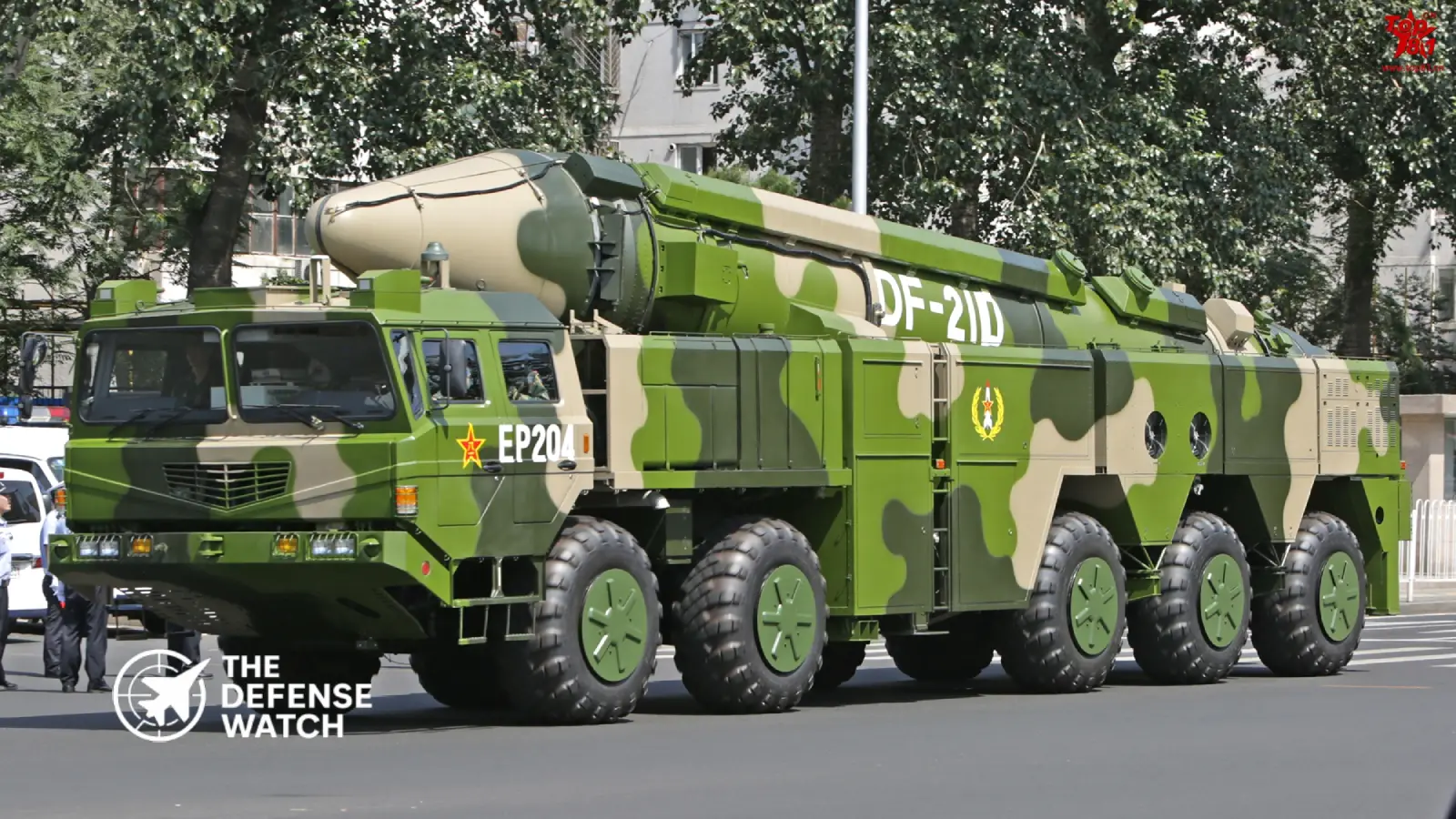
- Russia’s Avangard HGV reportedly reaches Mach 20–27; China’s DF-17 has an estimated range of 1,800–2,500 km and can strike regional targets within minutes.
Traditional intercontinental ballistic missiles (ICBMs) arc high into space and follow predictable parabolic trajectories. Ground-based radars can plot an ICBM’s path within seconds of launch and calculate an impact point with high confidence. As aerospace engineers have noted, hypersonic weapons fly much higher than subsonic cruise missiles but much lower than ICBMs — occupying a “sweet spot” in the atmosphere where neither air-defense batteries nor space-based interceptors currently operate effectively.
That combination of extreme speed and unpredictable maneuvering is what makes understanding how hypersonic missiles work so strategically important in 2026.
The Two Architectures: HGVs vs. Scramjet Cruise Missiles
Modern hypersonic weapons fall into two distinct engineering families, each with different propulsion physics, flight profiles, and operational trade-offs.
Hypersonic Glide Vehicles (HGVs)
A Hypersonic Glide Vehicle is a warhead-like payload mounted atop a conventional rocket booster. The rocket accelerates the vehicle to the upper atmosphere — sometimes briefly exiting into near-space — before releasing it. From that point, the glide vehicle uses aerodynamic lift and its own momentum to navigate toward its target, performing sharp lateral maneuvers that can defeat intercept geometry.
The physics behind HGV flight involve a technique called skip reentry: the vehicle enters and briefly exits the upper atmosphere multiple times, extending its effective range while keeping its altitude far below what missile defense tracking systems anticipate. According to defense analysts, this non-ballistic glide trajectory limits detection windows and makes impact prediction nearly impossible until the final seconds of flight.
Russia’s Avangard — mounted atop modified SS-19 ICBMs — is the most-cited example, reportedly sustaining speeds between Mach 20 and Mach 27. China’s DF-ZF glide vehicle, carried by the DF-17 ballistic missile, entered PLA Rocket Force service and was publicly unveiled at a military parade in 2019.
Hypersonic Cruise Missiles (HCMs) and Scramjet Propulsion
The second category — and the more technically demanding one — is the Hypersonic Cruise Missile. Where an HGV coasts unpowered after booster separation, an HCM sustains hypersonic flight using an air-breathing engine. That engine is a scramjet: a Supersonic Combustion Ramjet.
A conventional jet engine uses rotating compressor blades to slow incoming air before combustion. A scramjet eliminates those moving parts entirely. Instead, it relies on the vehicle’s own forward speed to compress incoming air. At Mach 5 and above, air enters the engine intake at supersonic velocity, mixes with fuel — typically liquid hydrogen or a hydrocarbon — and ignites in a combustion chamber where airflow never slows below supersonic speeds. The resulting exhaust generates thrust. Defense researchers describe scramjets as elegant in concept but extraordinarily difficult in practice: fuel and air spend mere milliseconds together before exiting the engine, demanding ultra-precise injection and ignition timing at conditions that replicate a small controlled explosion on a repeating cycle at hypersonic velocity.
Because scramjets cannot generate thrust from a standing start, HCMs must first be accelerated to near-hypersonic speeds using a rocket booster before the air-breathing engine can ignite. Once active, however, a scramjet-powered missile can sustain its speed over longer distances than an HGV can glide.
Analyst Take: The scramjet’s fundamental limitation — it must be moving fast before it can start — is also the reason scramjet HCMs are operationally complex to deploy. They require launch platforms that can themselves reach supersonic speed, such as aircraft or naval vertical-launch systems with high-energy boosters. This creates an asymmetry: nations with robust fast-launch infrastructure (carrier-based aircraft, nuclear submarines) can field HCMs more flexibly, while nations relying on ground-based launch pads face longer reaction timelines. In practice, that distinction is reshaping how navies think about hypersonic strike range and survivability.
The Physics of Surviving Hypersonic Flight
At Mach 5 and above, aerodynamic heating becomes an existential engineering challenge. Air molecules striking the vehicle’s leading edges cannot dissipate heat fast enough, generating surface temperatures that can exceed 2,000°C (3,600°F) — hotter than many metals will withstand. Managing that thermal environment is one of the primary reasons hypersonic programs take decades and billions of dollars to mature.
Modern hypersonic weapons use ultra-high-temperature ceramics (UHTCs), carbon-carbon composites, and ablative coatings to survive reentry-like heating during sustained atmospheric flight. These same materials must simultaneously remain structurally stable under the immense aerodynamic loads generated by maneuvering at hypersonic velocity — forces that can exceed hundreds of G-equivalents on structural components.
The plasma sheath that forms around a hypersonic vehicle at peak velocity also creates a secondary problem: communications blackout. Ionized gas absorbs and reflects radio frequencies, temporarily cutting the missile off from GPS signals and uplink commands. Current programs are developing frequency-selective antenna designs and alternative mid-course guidance solutions — including inertial navigation with terminal sensor updates — to maintain accuracy through this blackout window.
Global Hypersonic Race: Status in 2026
Country System Type Speed Status (2026) Russia Avangard HGV Mach 20–27 Operational (ICBM-boosted) Russia Zircon (3M22) HCM (Scramjet) Mach 8–9 Operational (frigates/submarines) China DF-17 / DF-ZF HGV Mach 5–10 Operational (PLA Rocket Force) China YJ-21 HGV (anti-ship) Mach 6+ Operational (carrier-launched) China CJ-1000 HCM (Scramjet) ~Mach 6 Unveiled 2025; development phase United States Dark Eagle (LRHW) HGV Mach 5+ STRATCOM-authorized, Apr 2026 United States HACM HCM (Scramjet) Mach 5+ Targeted deployment FY2027 United States HAVOC (Ursa Major) HCM (Liquid rocket) Mach 5+ Debuted Feb 2026; multi-platform The United States: Playing Catch-Up With New Architecture
The U.S. spent much of the early 2020s absorbing costly program setbacks. The AGM-183A ARRW suffered multiple test failures before its cancellation in 2023. The Navy’s Conventional Prompt Strike (CPS) program, pairing a solid-rocket booster with a Common Hypersonic Glide Body (C-HGB), only achieved its first full success in June 2024, followed by a second successful test in December 2024. A joint Army-Navy test in March 2026 validated a shared booster architecture — a sign that Washington is finally moving from development to fielding.
In a significant command restructuring, a congressional report dated April 7, 2026 confirmed that Dark Eagle now operates under a direct chain from national leadership through USSTRATCOM — the same oversight framework used for nuclear systems — reflecting how seriously planners view the weapon’s strategic weight despite its conventional warhead. Each Dark Eagle battery fields eight missiles, though production remains constrained to an estimated one to two missiles per month, forcing strict target prioritization.
On the industrial side, Colorado-based Ursa Major debuted the HAVOC missile system in February 2026, a liquid-rocket-powered hypersonic weapon designed for multi-platform deployment including fighter aircraft, bombers, ground launchers, and even space-based delivery. The system’s ability to alter speed mid-flight and interface with a range of propulsion options signals a deliberate push toward modular, scalable hypersonic architecture.
China: Broadening the Threat Portfolio
Beijing’s hypersonic program is characterized by diversity and operational urgency. The DF-17 and its DF-ZF glide body are already assigned to the PLA Rocket Force as conventional strike tools targeting regional military infrastructure. The YJ-21 — a carrier-launched anti-ship hypersonic missile — adds a naval dimension, with analysts warning it directly threatens U.S. carrier strike groups operating in the Western Pacific.
In 2025, China unveiled the CJ-1000, a long-range scramjet-powered cruise missile believed capable of sustaining approximately Mach 6 across thousands of kilometers. Simultaneously, Beijing completed the JF-22 hypersonic wind tunnel in Huairou District — reportedly the fastest in the world, capable of simulating speeds up to Mach 30 — signaling long-term investment in next-generation aerodynamic research that will feed future hypersonic designs.
Russia: Operational Reality and Performance Questions
Russia maintains the longest operational hypersonic track record. The Avangard HGV entered service aboard UR-100N UTTH ICBMs and represents the most mature boost-glide system in any national inventory. The Zircon scramjet cruise missile was deployed aboard the Admiral Gorshkov frigate in 2023 and has reportedly been used in strikes on Ukrainian infrastructure in 2024. Western analysts note, however, that Russian performance claims are frequently overstated and that sanctions-driven component shortages have complicated production timelines.
Strategic Analysis: The hypersonic arms race is not simply a speed competition — it is fundamentally a contest over reaction time and deterrence stability. When a hypersonic missile can close on a high-value target in under ten minutes with no predictable trajectory, the decision window for political leadership compresses to near zero. This creates a dangerous structural pressure toward launch-on-warning postures and automated response doctrines. The April 2026 U.S. decision to place Dark Eagle under STRATCOM command — typically reserved for nuclear systems — reflects an acknowledgment that hypersonic conventional weapons have crossed into strategic deterrence territory, blurring the line between conventional and nuclear escalation in ways arms control frameworks have not yet addressed.
The Interception Problem: Why Defenses Are Struggling
Current missile defense architecture was designed around two known threat profiles: slow cruise missiles (which fly low and straight) and ballistic missiles (which arc through space on predictable paths). Hypersonic weapons confound both tracking paradigms simultaneously.
Ground-based radar networks have inherent horizon limitations — a hypersonic glide vehicle flying at 40–60 km altitude is invisible to surface radar until it is dangerously close to its target. Space-based infrared satellites can detect the rocket booster at launch but typically lose track once the glide vehicle separates and its thermal signature drops. Persistent tracking through the full flight envelope requires a proliferated low-Earth orbit sensor layer — exactly what the U.S. Space Development Agency is building, but which will not be fully operational until the late 2020s.
Even with continuous tracking, intercepting a maneuvering vehicle traveling at Mach 5–10 in the near-space corridor is geometrically brutal: an interceptor would require exceptional closing speed and prediction accuracy across a rapidly shrinking engagement window.
Emerging Propulsion: Solid-Fuel Ramjets and Multi-Mode Engines
Not all hypersonic development is centered on scramjets. GE Aerospace’s ATLAS program completed the first supersonic flight tests of a solid-fuel ramjet over Kennedy Space Center in 2025, mounted to an F-104 Starfighter. Engineers consider solid-fuel ramjets more practical for near-term tactical weapons because they eliminate the plumbing complexity of liquid-fuel systems while still providing the range and speed improvements over conventional solid-rocket missiles.
Combined-cycle engines — which integrate a turbine mode for low-speed operation with a scramjet or ramjet mode at high speed — represent the next frontier. These “turbine-based combined cycle” (TBCC) concepts could eventually allow hypersonic weapons to operate from conventional runways or slow-moving ships without requiring an initial rocket boost, dramatically broadening the operational options available to military planners.
FAQs
What is the minimum speed required for a missile to be classified as hypersonic?A missile must sustain speeds greater than Mach 5 — approximately 3,800 mph at sea level — to be classified as hypersonic. The critical distinction from mere high-speed weapons is the ability to maneuver at those speeds throughout the flight path, not just briefly exceed the threshold during a terminal dive.
How does a scramjet engine differ from a conventional jet engine?A conventional jet engine uses spinning compressor blades to slow and compress incoming air before combustion. A scramjet has no moving parts — it relies entirely on the vehicle’s forward speed to compress air, and combustion takes place in a supersonic airflow environment. This makes scramjets far simpler mechanically but requires the vehicle to already be traveling at near-hypersonic speeds before the engine can ignite.
Can existing missile defense systems intercept a hypersonic missile?Not reliably with current architecture. Ground-based radars cannot track hypersonic glide vehicles until they are very close to their targets due to Earth’s curvature and the vehicles’ low flight altitude. Space-based sensors lose track after booster separation. A new proliferated satellite sensor layer combined with directed-energy or kinetic interceptors specifically designed for the near-space corridor is the most credible near-term solution — but it remains years from full deployment.
What is the U.S. Dark Eagle, and why was it placed under STRATCOM command in 2026?The Dark Eagle, formally the Long Range Hypersonic Weapon (LRHW), is the U.S. Army’s first operational hypersonic boost-glide missile system. Despite carrying a conventional (non-nuclear) warhead, it was placed under USSTRATCOM command authority in April 2026 because its speed and global reach make it a strategic asset. The new command chain requires national-level authorization for every strike, aligning it with oversight protocols previously reserved for nuclear delivery systems.
Which country currently leads the hypersonic missile race?Russia and China currently lead in terms of operational deployed systems. Russia fields the Avangard HGV and the Zircon scramjet cruise missile; China operates the DF-17/DF-ZF and YJ-21. The United States has closed the operational gap significantly through 2025–2026, with Dark Eagle achieving STRATCOM authorization and multiple new programs accelerating toward deployment, but Washington is widely assessed as trailing Beijing and Moscow in sheer numbers of fielded hypersonic weapons.
The Night the Press Dinner Became a National Security Crisis
The April 25, 2026, attack on the White House Correspondents’ Dinner marks one of the most serious security breaches at a presidential public event in modern American history — and a stark demonstration of the security stakes that now accompany the Trump administration’s every public appearance. Armed with a shotgun, a handgun, and multiple knives, a 31-year-old California man identified as Cole Tomas Allen rushed a Secret Service screening checkpoint just outside the Washington Hilton’s main ballroom, exchanging gunfire with agents while President Donald Trump, the First Lady, the Vice President, and the full Cabinet sat inside the venue.
¦ KEY FACTS AT A GLANCE- The attack occurred on the evening of April 25, 2026, at the Washington Hilton during the annual White House Correspondents’ Dinner — the first Trump attended as a sitting president.
- Suspect Cole Tomas Allen, 31, of Torrance, California, stormed a Secret Service checkpoint armed with a shotgun, a handgun, and multiple knives.
- President Trump, First Lady Melania Trump, Vice President JD Vance, and all Cabinet members were safely evacuated. No attendees were seriously injured.
- One Secret Service officer was struck in a bulletproof vest and is expected to make a full recovery. The suspect was not injured.
- Allen is expected to face multiple federal charges including use of a firearm during a crime of violence and assault on a federal officer with a dangerous weapon.
The suspect was subdued within seconds, but the incident is already prompting hard questions about presidential security protocols, the vulnerability of high-density political gatherings, and the broader trajectory of politically motivated violence in the United States.
What Happened: A Timeline of the April 25 Attack
At approximately 8:36 p.m. on April 25, the suspect, working alone and armed with a shotgun, handgun, and multiple knives, charged into the hotel lobby area and attempted to breach a Secret Service checkpoint. A member of the uniformed division of the Secret Service fired on Allen just before he was apprehended but did not strike him amid the chaos, according to a law enforcement source familiar with the investigation. Preliminary witness statements suggest Allen fired one to two rounds, followed by the Secret Service officer returning three to four rounds.
Trump was rushed offstage at the Washington Hilton hotel after gunfire broke out outside the ballroom. A Secret Service officer was shot in the attack, but he was saved by his bulletproof vest and was reported to be doing well.
Secret Service Director Sean Curran said his agents “performed admirably,” crediting their rapid response in stopping the suspect at the checkpoint. FBI Director Kash Patel said investigators are examining ballistics, a recovered long gun, and shell casings while conducting witness interviews.
Who Is Cole Tomas Allen?
Allen, 31, was an educator from Torrance, California, with an engineering degree from a prestigious university. He earned a degree in mechanical engineering from Caltech in 2017, before going on to receive a master’s degree in computer science from California State University, Dominguez Hills, in 2025.
Allen was armed with a shotgun, handgun, and knives when he rushed the security checkpoint and ran toward the ballroom. He is believed to have checked into the Washington Hilton the day before the event, and is thought to have traveled from Los Angeles to Chicago by train, then onward to Washington, D.C.
Allen identified himself in a missive sent to family members moments before the attack as a “friendly federal assassin” and railed against Trump administration policies. Authorities found anti-Trump and anti-Christian rhetoric on the suspect’s social media accounts. Allen will be charged with one count each of using a firearm during a crime of violence, and assault on a federal officer using a dangerous weapon, U.S. Attorney for D.C. Jeanine Pirro announced Saturday night. Pirro said she expects him to face more charges as the investigation unfolds.
Family members who were interviewed by investigators said that Allen “made radical statements and that he constantly referenced a plan to do ‘something’ to fix the issues with today’s world,” that he was part of a group called “The Wide Awakes,” attended No Kings protests in California, and would regularly go to a shooting range to train with firearms.
The Intelligence Failure Question
One dimension of this incident that demands serious scrutiny is whether the attack could have been prevented. The White House originally indicated that Allen’s brother notified the New London Police Department of an alleged “manifesto” Allen had sent to family members minutes before the incident. However, one source said the family did not read or report the writings to local law enforcement until after the event, though the FBI was still actively investigating the precise timeline.
Allen purchased the shotgun used in Saturday’s shooting in August 2025, according to two law enforcement sources. He also owned another semiautomatic pistol, purchased in 2023.
This gap — a legally purchased firearm, a pre-attack manifesto sent to family, and known radical tendencies — represents the exact threat profile that federal threat assessment programs are designed to detect. That Allen was able to book a room at the very hotel hosting the event, travel cross-country by train, and reach the outer perimeter of a checkpoint protecting the president and his entire Cabinet is a significant operational question that the Secret Service and FBI will need to answer publicly.
A Venue Concentration Risk Unlike Any Other
The 2026 dinner attracted approximately 2,600 attendees, including senior administration officials such as Vice President Vance, FBI director Kash Patel, Health and Human Services Secretary Robert F. Kennedy Jr., Secretary of State Marco Rubio, and Environmental Protection Agency administrator Lee Zeldin. Security at the event was described by former FBI deputy director Andrew McCabe as “almost on the level of a national security event,” given the concentration of senior government officials in one location.
From a defense and security standpoint, this event represents what analysts call a “high-value target concentration” scenario — the kind of scenario that military planners and counterterrorism officials spend considerable resources trying to prevent. Having the President, Vice President, and full Cabinet in a single civilian hotel ballroom is, by any security assessment standard, an extraordinary aggregation of risk. That the security perimeter held is a testament to Secret Service preparation; that someone reached that perimeter armed and ready to breach it is equally a signal that this format of event needs a fundamental reassessment.
Trump’s Response and the Political Fallout
At a news conference held after the incident, Trump described the suspect as a “very sick person” and a “thug” who had attacked the U.S. Constitution. He pledged to reschedule the press dinner and stated, “Today, we need levels of security that probably nobody has ever seen before.”
Trump also used the occasion to advocate for the construction of a new White House ballroom, arguing that the attack “would never have happened” with the planned security measures he intends to include. He called for the dinner to be rescheduled within 30 days with enhanced perimeter security.
The last couple of years have seen a spate of political violence, including two assassination attempts against Trump, an arson attack at the Pennsylvania governor’s mansion, the killing of a Minnesota lawmaker, and the assassination of Charlie Kirk. Against this backdrop, Saturday’s incident is not an isolated event — it is the latest data point in a deeply alarming trend.
Global Reaction: Allies and Adversaries Respond
World leaders including Indian Prime Minister Narendra Modi, Japanese Prime Minister Sanae Takaichi, and Mexican President Claudia Sheinbaum condemned the attack and expressed their relief that Trump was unharmed. “Violence has no place in a democracy and must be unequivocally condemned,” Modi said.
U.K. Prime Minister Keir Starmer said he was “shocked by the scenes” of violence and denounced the attack, stating that “any attack on democratic institutions or on the freedom of the press must be condemned in the strongest possible terms.” Canadian Prime Minister Mark Carney also expressed relief and condemned political violence in any form.
The international reaction underscores how closely allied governments are watching the security environment surrounding the U.S. executive branch — particularly at a moment when the Trump administration is engaged in an active military confrontation with Iran.
Analysis: What This Means for Presidential Security Going Forward
The April 25 attack is going to accelerate conversations that were already underway within the Secret Service and the broader U.S. security apparatus. The Washington Hilton, while a longtime host of the Correspondents’ Dinner, is a commercially operated hotel — its lobbies and stairwells remain accessible to ordinary guests during the event. The Associated Press noted that the lobby of the Washington Hilton regularly remains open to other guests during the dinner, and that security and screening is typically located closer to the ballroom itself.
Allen reportedly used an internal stairwell to position himself near the screening area. This means the outer buffer — the transition zone between the public hotel and the secured ballroom corridor — was the point of failure. It’s a reminder that Secret Service protection is only as strong as the physical environment it is asked to work within.
Expect significant policy adjustments: stricter vetting of hotel guests in the days preceding any presidential event, expanded perimeter security at all future high-density gatherings involving senior officials, and possibly a formal review of whether the Correspondents’ Dinner format — a civilian gala attended by the entire executive chain of command — remains compatible with the current threat environment.
FAQs
Was President Trump injured in the April 25, 2026 White House Correspondents’ Dinner attack?No. President Trump, First Lady Melania Trump, Vice President JD Vance, and all Cabinet members were safely evacuated and unharmed. One Secret Service officer was struck in a bulletproof vest and is expected to make a full recovery.
Who is the suspect in the White House Correspondents’ Dinner shooting?The suspect has been identified by multiple law enforcement sources as Cole Tomas Allen, 31, of Torrance, California — an educator and mechanical engineer. He is expected to face federal charges including use of a firearm during a crime of violence and assault on a federal officer.
What weapons did the suspect carry?Allen was armed with a shotgun, a handgun, and multiple knives when he charged the Secret Service checkpoint outside the Washington Hilton ballroom.
Was this considered an assassination attempt?Acting Attorney General Todd Blanche stated that authorities believe the suspect set out to target members of the Trump administration, “likely including the president.” Trump himself referred to Allen as a “would-be assassin.”
How did the Secret Service respond?Secret Service agents subdued Allen at the checkpoint. Secret Service Director Sean Curran credited the agency’s multi-layered protection protocols, saying the response demonstrated exactly what those systems are designed to do.
Will the White House Correspondents’ Dinner be held again?President Trump called for the dinner to be rescheduled within 30 days with significantly enhanced security measures, including expanded perimeter controls.
MQ-9 Reaper vs Bayraktar TB2 Payload Capacity
The MQ-9 Reaper vs Bayraktar TB2 payload capacity debate matters because armed drones now shape modern warfare. From counterterror missions in the Middle East to high-intensity conflicts in Eastern Europe, unmanned aircraft have become a core military tool. The United States built the MQ-9 Reaper as a high-end hunter-killer platform with long endurance and heavy strike capability. Turkey developed the Bayraktar TB2 as a lower-cost tactical drone designed for persistent surveillance and precision attack.
Both systems gained global attention through real combat operations. The MQ-9 became a symbol of American remote strike power. The TB2 became famous after conflicts in Libya, Nagorno-Karabakh, and Ukraine. But when comparing combat value, one key metric stands out: payload capacity.
Payload determines how many sensors, bombs, missiles, and fuel tanks a drone can carry. In simple terms, it shapes how much damage a UAV can deliver in a single sortie.
MQ-9 Reaper vs Bayraktar TB2 Specifications Table
Specification MQ-9 Reaper Bayraktar TB2 Country United States Turkey Manufacturer General Atomics Baykar Role MALE strike UAV Tactical UCAV First Service Entry 2007 2014 Max Payload 3,800 lb (1,700+ kg) 330 lb (150 kg) Max Speed 300+ mph 135 mph Endurance 27+ hours 24+ hours Wingspan 66 ft 39 ft Range Global SATCOM capable 150+ km LOS, newer SATCOM variants longer Crew Remote crew Remote crew Estimated Unit Cost $30M+ $5M to $10M (varies) MQ-9 Reaper vs Bayraktar TB2 Design and Technology
The MQ-9 Reaper is a larger and heavier aircraft built for strategic missions. It uses satellite communications, advanced electro-optical sensors, synthetic aperture radar, and multi-target tracking systems. This allows operations across continents with real-time data links.
The Bayraktar TB2 is smaller, lighter, and optimized for affordability. It focuses on battlefield surveillance and precision strikes at lower operating cost. Its smaller radar signature can help survivability, but it lacks the size and power generation of the Reaper.
In short, the Reaper is a long-range military truck in the sky. The TB2 is a lighter battlefield scout with strike capability.
MQ-9 Reaper vs Bayraktar TB2 Payload Capacity and Firepower
This is where the gap becomes clear.
MQ-9 Reaper Payload Capacity
The MQ-9 Reaper can carry roughly 3,800 pounds of payload across multiple hardpoints. That includes:
- AGM-114 Hellfire missiles
- GBU-12 Paveway II laser-guided bombs
- GBU-38 JDAM
- ISR sensor packages
- Fuel tanks and mixed loads
A Reaper can conduct surveillance and strike multiple targets in one mission.
Bayraktar TB2 Payload Capacity
The TB2 carries around 150 kilograms (330 pounds) total. Typical weapons include:
- MAM-L smart micro munition
- MAM-C lightweight guided bomb
- EO/IR sensors
This means the TB2 usually carries four small precision munitions rather than heavy bombs.
Verdict on Payload
In pure carrying capacity, the MQ-9 Reaper dominates. It can haul more than ten times the payload of the TB2.
Operational Range and Mobility
The Reaper benefits from U.S. satellite network integration. It can operate at long distances and remain on station for many hours. This gives commanders strategic reach.
The TB2 was originally line-of-sight controlled, which limited distance. Newer export variants added SATCOM options, improving range. Still, it is generally better suited for regional operations rather than global expeditionary warfare.
Combat Effectiveness in Real Conflicts
MQ-9 Reaper Combat Record
The MQ-9 has seen extensive use in:
- Afghanistan
- Iraq
- Syria
- Horn of Africa
- Maritime surveillance missions
It proved effective in ISR and precision strike roles against insurgent and terrorist targets.
Bayraktar TB2 Combat Record
The TB2 gained fame in:
- Libya
- Syria
- Nagorno-Karabakh War
- Ukraine (early conflict phase)
It helped destroy tanks, artillery, and air defense systems when enemy defenses were weak or poorly coordinated.
Battlefield Reality
Against advanced integrated air defense systems, both drones face risk. Neither is stealthy. But the larger Reaper is a higher-value target, while the cheaper TB2 is easier to replace.
Cost and Export Value
The MQ-9 Reaper is expensive and tightly controlled under U.S. export rules. Buyers include close partners such as the UK, Italy, India, and others.
The Bayraktar TB2 became a major export success because it offers lower cost and proven combat performance. Countries in Europe, Africa, the Middle East, and Asia bought it.
Turkey used TB2 exports to grow influence abroad. The United States uses Reaper sales more selectively with trusted allies.
MQ-9 Reaper vs Bayraktar TB2 Who Wins?
It depends on mission type.
MQ-9 Reaper Wins If You Need:
- Heavy payload capacity
- Long-range strategic operations
- Multi-target strike missions
- Advanced sensors and networking
- Integration with U.S./NATO systems
Bayraktar TB2 Wins If You Need:
- Lower purchase price
- Affordable operating costs
- Tactical battlefield strikes
- Rapid export delivery
- Easier fleet scaling
U.S. Defense View
The U.S. military sees the Reaper as a premium ISR-strike platform. It is not just a drone, it is part of a larger networked warfare system. The TB2 is respected as a disruptive low-cost combat UAV, but it serves a different market segment.
Conclusion
The MQ-9 Reaper vs Bayraktar TB2 payload capacity comparison is not close on raw numbers. The MQ-9 Reaper carries far more weapons, sensors, and mission equipment. It is built for strategic reach and sustained combat power.
The Bayraktar TB2, however, wins on affordability, accessibility, and export success. It offers many countries armed drone capability without U.S.-level costs.
So which system has the edge?
- For major military powers, the MQ-9 Reaper is stronger.
- For budget-conscious buyers, the TB2 is highly effective.
- For payload capacity alone, the MQ-9 Reaper is the clear leader.
FAQ: MQ-9 Reaper vs Bayraktar TB2
Which drone has higher payload capacity, MQ-9 Reaper or Bayraktar TB2?The MQ-9 Reaper by a wide margin. It carries over 3,800 pounds versus about 330 pounds for the TB2.
Is the Bayraktar TB2 cheaper than the MQ-9 Reaper?Yes. The TB2 is significantly cheaper to buy and operate.
Can the Bayraktar TB2 defeat the MQ-9 Reaper?They are not designed for direct dogfights. They serve different mission roles.
Why is the MQ-9 Reaper important to the U.S. military?It provides long-range surveillance and precision strike capability with global reach.
Why did the TB2 become famous?Its combat use in Ukraine, Libya, and Nagorno-Karabakh made it globally recognized.
The race between hypersonic missile speed and ballistic missile defense has become the defining arms competition of the 2020s — and U.S. strategists are watching closely, because the outcome could reshape deterrence across every major theater of war.
For decades, American ballistic missile defense (BMD) systems were architected around a predictable threat: missiles that arc through space on fixed, calculable trajectories. Intercept the arc, and you win. But adversaries studied that logic — and engineered around it. Today, China’s DF-17 hypersonic glide vehicle and Russia’s Avangard system maneuver unpredictably at speeds exceeding Mach 20, operating in an altitude band that existing sensors and interceptors were never designed to cover. The question facing the Pentagon, NATO partners, and U.S. allies in the Indo-Pacific is blunt: can the shield hold?
Specifications: Hypersonic Threats vs. BMD Systems
Specification Hypersonic Glide Vehicles
(e.g., DF-17 / Avangard)U.S. Ballistic Missile Defense
(GMD / THAAD / SM-3)Speed Mach 5–27 (varies by system) Interceptors: Mach 8–10+ Flight Altitude 25–100 km (near-space glide) GMD: 1,000+ km; THAAD: 40–150 km Maneuverability High — lateral, pull-up maneuvers Limited — fire-solution depends on predicted path Range 1,800–15,000+ km THAAD: ~200 km; GMD: intercontinental Radar Signature Small; plasma sheath disrupts radar Relies on early-warning satellites + ground radar Warhead Options Conventional / nuclear capable Hit-to-kill (kinetic); no explosive warhead Unit Cost (est.) $50–100M+ per missile SM-3: ~$24M; GBI: ~$75M per interceptor Reaction Window Minutes to impact from launch GMD: 30+ min lead time needed; THAAD: 5–8 min Service Entry DF-17: 2019; Avangard: 2019 GMD: 2004; THAAD: 2008; SM-3 IIA: 2018 Test Success Rate China/Russia: Classified GMD: ~55%; THAAD: ~100% (17/17 tests) Design & Technology: A Fundamental Mismatch
How Hypersonic Glide Vehicles Work
Hypersonic glide vehicles (HGVs) are launched atop ballistic missiles but separate before the terminal phase. Instead of following a predictable parabolic arc, they re-enter the atmosphere and glide at sustained hypersonic speeds — generating intense plasma that partially blinds radar. The DF-17’s warhead, designated the DF-ZF, reportedly pulls lateral maneuvers up to several Gs, making fire-control solutions exponentially harder to compute in real time.
How U.S. Ballistic Missile Defense Is Architected
The U.S. BMD architecture is layered. The Ground-Based Midcourse Defense (GMD) system — based at Fort Greely, Alaska — targets ICBMs in their midcourse phase, relying on long-range X-band radars and kill vehicles (EKVs) that collide with warheads at closing speeds above Mach 15. THAAD (Terminal High Altitude Area Defense) handles shorter-range threats in the terminal phase. Aegis SM-3 provides ship-based midcourse intercept capability and is the most mobile layer. The gap: none of these systems was designed to track and intercept a vehicle flying at 40–80 km altitude, maneuvering unpredictably at Mach 10+.
“You can’t intercept what you can’t track. Hypersonic glide vehicles exploit the seam between what our radars see and what our interceptors can reach.”
Firepower & Performance: Speed Is the Weapon
At Mach 20, the Russian Avangard travels roughly 6.8 kilometers per second. From a launch site in western Russia, it can reach the U.S. East Coast in under 15 minutes — far less than the 25–30 minutes a traditional ICBM requires. That compression of decision time is itself the weapon. It does not need to be nuclear to be destabilizing; a conventional HGV strike on a carrier strike group or command node collapses the window in which defensive responses — diplomatic, kinetic, or otherwise — can be organized.
U.S. BMD interceptors are fast, but the geometry is unforgiving. THAAD’s kill vehicle closes at approximately Mach 8. Against a target that maneuvers after radar track, the fire-control algorithm must predict where the threat will be at intercept — and HGVs are specifically designed to defeat that prediction.
Operational Range & Mobility
Range asymmetry compounds the problem. China’s DF-17, with a reported range of 1,800–2,500 km, can target U.S. bases in Guam, Japan, and South Korea from launch sites deep inside Chinese territory — well outside the effective defensive perimeter of sea-based SM-3 batteries. Avangard, boosted by Russia’s heavy RS-28 Sarmat ICBM, is essentially global in range.
On the U.S. side, THAAD batteries are mobile and deployable — as demonstrated by rotational deployments to South Korea and Guam — but they cover relatively small areas. Aegis-equipped destroyers offer flexibility, but repositioning ships takes hours to days. The Missile Defense Agency’s Next Generation Interceptor (NGI), currently in development, is intended to replace aging GMD kill vehicles, but it addresses ballistic threats primarily, not HGVs in their glide phase.
Combat Effectiveness: Real World & Doctrine
Hypersonic Offense BMD Defense Strengths in Combat Strengths in Defense Near-unpredictable terminal trajectory THAAD: 17/17 intercept test success Exploits “midcourse gap” in BMD layers Aegis SM-3: proven at sea, widely exported Compresses adversary decision time Layered architecture — multiple intercept opportunities Dual-use (conventional + nuclear ambiguity) Hypersonic Defense Architecture (HDA) in development China showcased the DF-17 at its 2019 National Day parade; Russia confirmed Avangard operational in December 2019. Neither system has been used in live combat — but Russia’s reported use of the Kinzhal quasi-ballistic missile in Ukraine has offered real-world data on radar evasion under combat conditions. The U.S. Missile Defense Agency acknowledged the HGV gap explicitly in its 2022 and 2024 budget requests, funding the Glide Phase Interceptor (GPI) program to address the near-space threat. The GPI aims for a first intercept demonstration in the late 2020s — a timeline that leaves a window of vulnerability. Cost & Export Value: Economics of the Arms Race
One overlooked dimension is cost asymmetry. A single GBI interceptor costs roughly $75 million. If an adversary saturates defenses with cheaper HGVs — or even conventional ballistic decoys — the economics of defense become unsustainable at scale. Each THAAD battery costs approximately $800 million; the missiles themselves run $11 million apiece. Against a $50–100 million HGV, the exchange ratio is problematic but not catastrophic — yet.
On the export front, Aegis and THAAD are critical U.S. alliance tools. Japan operates advanced Aegis destroyers and is integrating SM-3 Block IIA. South Korea hosts THAAD. Romania and Poland host Aegis Ashore sites. These deployments extend deterrence — but also extend the attack surface that adversary HGVs must be able to defeat, driving their development further. It is a feedback loop baked into the system. For more on U.S. BMD export posture.
Analysis: Where the Balance Sits in 2026
The honest assessment, drawn from open-source MDA documentation and think-tank analyses from CSIS and RAND, is that the United States currently lacks a fielded system capable of reliably intercepting a maneuvering HGV in its glide phase. The GPI program addresses this, but it will not reach operational capability before 2030 at the earliest. Space-based sensors — the Hypersonic and Ballistic Tracking Space Sensor (HBTSS) constellation, now in early orbit testing — are the most promising near-term enabler; they can track HGVs from above the plasma sheath that blinds ground radar.
That said, framing this purely as a “defense loses” story misses strategic context. Deterrence does not require perfect defense. It requires that any adversary calculate that a hypersonic first strike cannot disarm U.S. retaliatory capability entirely. The U.S. nuclear triad — submarines, ICBMs, and bombers — is survivable against a hypersonic strike, which limits the strategic utility of HGVs to coercive or conventional-strike scenarios. The more acute danger is conventional: hypersonic precision strikes on carriers, airfields, or command nodes in a Taiwan or Baltic crisis could create facts on the ground before a U.S. conventional response could organize.
Conclusion: Which System Has the Edge?
In a direct comparison of hypersonic missile speed vs. ballistic missile defense today, the offense holds a meaningful but not absolute advantage. Existing U.S. BMD layers were not designed for the HGV threat. The GPI and HBTSS programs are credible responses, but they are years away from operational readiness. In the near term, the U.S. relies on deterrence-by-punishment rather than deterrence-by-denial against hypersonic threats.
The edge shifts under different conditions. In a theater defense scenario — protecting a fixed asset like Guam — THAAD’s proven kill chain and potential GPI augmentation provide a meaningful layered defense by the early 2030s. In an ICBM-exchange scenario, Avangard’s glide phase still outpaces current GMD. The race is not over. But the United States is, for now, playing catch-up in the glide phase — and speed, in this contest, is everything.
While current U.S. Ballistic Missile Defense systems like THAAD and Aegis are highly effective against traditional arcs, they face a ‘capability gap’ against hypersonic glide vehicles. The Pentagon is currently closing this gap by developing the Glide Phase Interceptor (GPI) and satellite-based tracking layers.
FAQs
Can U.S. missile defense systems currently intercept hypersonic missiles?No current U.S. system is specifically fielded to intercept a maneuvering hypersonic glide vehicle in its glide phase. THAAD and GMD were designed for ballistic trajectories. The Glide Phase Interceptor (GPI), under MDA development, aims to close this gap but is not expected to reach operational status before 2030.
How fast are hypersonic missiles compared to traditional ballistic missiles?Traditional ICBMs re-enter at roughly Mach 20–23 at terminal phase, but follow predictable arcs. Hypersonic glide vehicles sustain speeds of Mach 5–27 across most of their flight and maneuver laterally — making speed and unpredictability a dual threat rather than speed alone.
What is the Glide Phase Interceptor and when will it be ready?The GPI is a Missile Defense Agency program to develop an interceptor capable of engaging HGVs during their extended glide phase, before terminal descent. It is being developed in partnership with Raytheon and Northrop Grumman. A first intercept flight test is targeted for the late 2020s, with initial operational capability potentially in the early 2030s.
Which countries pose the greatest hypersonic missile threat to the United States?China and Russia are the primary concerns. China has operationally deployed the DF-17 HGV and is developing additional hypersonic systems. Russia’s Avangard, boosted by the Sarmat ICBM, is declared operational.
Boeing’s F-47 accelerates under a $4.4B budget while Edgewing consolidates three nations into a unified GCAP design authority — two programs, two strategies, one race for post-F-35 air dominance.
¦ KEY FACTS AT A GLANCE- On March 21, 2025, Boeing was awarded the NGAD Penetrating Combat Aircraft contract worth more than $20 billion, with the aircraft formally designated the F-47 — the first U.S. fighter designation beyond the F-35.
- The USAF FY2026 budget commits approximately $4.4 billion to the F-47 program — $3.5 billion in base funding plus $900 million in reconciliation spending — the largest single-year investment in a U.S. crewed tactical aircraft in over two decades.
- On April 1, 2026, the GCAP Agency awarded a £686 million ($905 million) contract to Edgewing — the tri-national joint venture of BAE Systems, Leonardo, and Japan Aircraft Industrial Enhancement Co. Ltd. (JAIEC) — marking the first unified international contract in the program’s history.
- GCAP Agency CEO Masami Oka confirmed the contract transitions activities “previously conducted under three nations’ contracts” into a single, fully-fledged international program for the first time.
- The F-47 requires a 1,200+ nautical mile unrefueled combat radius — nearly three times the F-22 Raptor’s 410 nm range — driven by the Pacific theater requirement to penetrate China’s A2/AD envelope from Guam or Japan.
- GCAP targets a 2035 operational service date, confirmed by the Japan Ministry of Defense in its FY2026 budget cycle. The F-47 targets service entry before 2029, with first flight estimated at 2028.
- Europe’s rival FCAS program (France, Germany, Spain) has no confirmed prime contractor, no firm first-flight timeline, and a slipping 2040 target date — trailing both NGAD and GCAP by a significant programmatic margin as of April 2026.
2026 Status Check: Two Programs, Two Turning Points
The global sixth-generation fighter competition has reached a decisive inflection point in the first quarter of 2026. Two programs have separated themselves from the field: the United States Air Force’s Next Generation Air Dominance (NGAD) program, now formally designated the Boeing F-47, and the trilateral Global Combat Air Programme (GCAP), operated by the United Kingdom, Italy, and Japan. Both have crossed significant programmatic milestones within weeks of each other — marking what analysts are calling the most consequential month in post-Cold War air power acquisition.
The F-47 Designation and FY2026 Budget Acceleration
On March 21, 2025, the Air Force formally announced that Boeing had won the NGAD Penetrating Combat Aircraft (PCA) competition, designating the aircraft the F-47 — the first new fighter designation beyond the F-35 in the U.S. inventory. The contract was valued at more than $20 billion. Boeing will design and produce a fleet of approximately 185 to 200 aircraft, intended to enter service before the end of this decade.
In the FY2026 budget request submitted to Congress, the Trump administration committed approximately $3.5 billion in base funding plus $900 million in reconciliation spending — a combined $4.4 billion — to accelerate the F-47’s Engineering and Manufacturing Development (EMD) phase. This represents the largest single-year investment in a U.S. crewed tactical aircraft program in at least two decades. The FY2026 National Defense Authorization Act (NDAA) reinforced this commitment, and the One Big Beautiful Bill Act (P.L. 119-21) added a further $400 million specifically to accelerate production timelines.
Complementing the F-47, the Air Force also doubled its investment in Collaborative Combat Aircraft (CCA) — autonomous loyal wingmen — from approximately $494 million in the prior cycle to $807 million in FY2026. The Air Force’s doctrine explicitly defines NGAD as a “family of systems,” with the F-47 serving as the crewed apex node of a broader manned-unmanned teaming architecture.
GCAP: The Edgewing Contract and the Shift to a Unified International Program
On April 1, 2026, the GCAP International Government Organisation (GIGO) awarded a £686 million (approximately $905 million) contract to Edgewing — the UK-headquartered industrial joint venture formed on June 20, 2025, by BAE Systems, Leonardo, and Japan Aircraft Industrial Enhancement Co. Ltd. (JAIEC). Each nation holds an equal 33.3 percent stake. Edgewing serves as the program’s prime contractor and unified design authority for the full service life of the aircraft, expected to extend beyond 2070.
GCAP Agency Chief Executive Masami Oka was unambiguous about the contract’s significance: “This contract is an important moment for GCAP, as activities previously conducted under three nations’ contracts will now be carried out as part of a fully-fledged international program.”
The transition from parallel national efforts into a single unified development framework is precisely the kind of governance consolidation that the FCAS program — the rival European sixth-gen effort — has conspicuously failed to achieve. Major industrial partners beneath the Edgewing prime include Rolls-Royce, Italy’s Avio Aero, and Japan’s IHI on propulsion; MBDA on weapons integration; and a trilateral sensor consortium led by Leonardo UK, Leonardo Italy, ELT, and Mitsubishi Electric.
Technical Comparison: F-47 NGAD vs. GCAP — Where the Programs Diverge
Surface-level comparisons of sixth-generation fighters inevitably focus on specifications that remain classified or unconfirmed. The more analytically useful approach is to examine what each program has chosen to optimize — and why those choices reflect different threat assessments, industrial capabilities, and operational doctrines.
Program Comparison Matrix — April 2026
Attribute F-47 NGAD — United States GCAP — UK / Italy / Japan Program Designation Boeing F-47 (NGAD Penetrating Combat Aircraft) GCAP — developed by Edgewing JV Partner Nations United States (USAF sole operator) UK, Italy, Japan — equal 33.3% each Primary Strategic Focus Long-range stealth penetration + sensor-shooter dominance in A2/AD environments Sovereign air superiority + multi-domain integration beyond US ITAR constraints Engine Technology XA-103 adaptive cycle engine (GE Aerospace/P&W NGAP); variable-cycle for cruise efficiency and combat thrust; advanced thermal management for IR signature reduction Advanced Power and Propulsion program; adaptive cycle demonstrators under Rolls-Royce, IHI, Avio Aero — optimized to support directed-energy system loads Crewing Model Human-in-the-loop crewed fighter; designed to operate with multiple CCA autonomous wingmen per sortie Optionally manned architecture under evaluation; autonomous wingmen integral to Combat Cloud concept Range Priority 1,200+ nm unrefueled combat radius for Pacific theater; large internal payload bay Broadly comparable range requirement; modular payload architecture for multi-role flexibility Target Entry to Service Late 2020s to early 2030s; administration has cited before 2029 aspirationally 2035 — confirmed by Japan MoD and GCAP Agency First Flight (Estimated) 2028 target widely cited; classified demonstrators may have already flown Demonstrator flight testing through late 2020s; prototype first flight targeting early 2030s Industrial Prime Boeing — sole-source, $20B+ contract Edgewing (BAE Systems, Leonardo, JAIEC) — equal national shares Multi-Domain Integration Integrated with JADC2; CCA swarms as distributed sensor-shooters GCAP Combat Cloud: satellites, ships, ground sensors, allied platforms in real-time shared data environment FY2026 Budget Commitment ~$4.4B (base + reconciliation) + $807M CCA £686M ($905M) Edgewing contract; Japan MoD FY2026 allocations separate The Collaborative Combat Aircraft Factor: Sixth-Gen as a System of Systems
The defining architectural shift of the sixth-generation era is the formal abandonment of the platform-centric paradigm. Neither the F-47 nor GCAP is designed primarily as a superior individual aircraft. Both are engineered as command nodes within a distributed, multi-domain kill chain — a concept that fundamentally changes how analysts should evaluate these programs.
F-47 and the Loyal Wingman Doctrine
The USAF’s CCA investment — now at $807 million annually — reflects a doctrine in which each F-47 sortie deploys multiple autonomous wingmen acting as sensor extensions, electronic warfare platforms, or expendable strike assets. The Air Force has publicly stated a goal of purchasing more than 1,000 CCAs — roughly two per F-47 and two per F-35A in the force structure. Current CCA competition entrants include designs from General Atomics and Anduril Industries.
The human pilot in the F-47 retains decision authority — a deliberate design choice in response to rules-of-engagement doctrine around lethal autonomous systems — but tactical workload is increasingly offloaded to AI-managed drone networks. A single F-47 sortie entering a contested environment could simultaneously present multiple radar returns, distribute electronic jamming across a wider aperture, and execute distributed strike options while the crewed aircraft remains at range. This is the operational logic that justifies the F-47’s projected unit cost — estimated at several hundred million dollars per airframe — as an acceptable premium for a low-density, high-demand platform that rarely needs to be placed at direct risk.
GCAP and the Combat Cloud Concept
GCAP’s equivalent architecture is the Combat Cloud — a networked operational environment linking the crewed fighter to satellites, surface ships, ground-based sensors, and allied aircraft in a persistent, real-time shared data environment. Where the USAF’s CCA concept emphasizes organic drone wingmen under direct pilot supervision, GCAP’s Combat Cloud is designed for interoperability across a broader joint and coalition force.
Japan’s Self-Defense Force will operate GCAP in an environment where it routinely integrates with U.S. Navy surface combatants, Aegis-capable destroyers, and E-2D Hawkeye airborne early-warning aircraft. The Combat Cloud architecture is therefore designed for seamless multi-domain integration across allied platforms — not merely within a single air wing. The trilateral sensor consortium of Leonardo, ELT, and Mitsubishi Electric is specifically tasked with ensuring GCAP’s data links remain interoperable with NATO and U.S. joint force architecture, while maintaining ITAR-independent design pathways for sovereign industrial capability.
Geopolitical and Industrial Context: Why Both Programs Matter in 2026
The Pacific Theater and the 1,200 Nautical Mile Benchmark
The F-47’s strategic rationale is anchored almost entirely in the Pacific theater and the requirement to operate within China’s expanding Anti-Access/Area-Denial (A2/AD) envelope. The PLA Air Force and Rocket Force have invested heavily in long-range surface-to-air missile systems, over-the-horizon radar networks, and anti-satellite capabilities specifically designed to deny U.S. air power the sanctuary from which it currently operates.
The USAF planning requirement for the F-47 centers on a 1,200+ nautical mile unrefueled combat radius — sufficient to reach targets deep inside Chinese-controlled airspace from bases in Guam or Japan without relying on forward bases vulnerable to ballistic missile strikes. For context, the F-22 Raptor — which the F-47 is designed to replace — has an unrefueled combat radius of approximately 410 nautical miles. The generational leap in required range reflects the honest operational assessment within Air Force planning circles that the threat environment of 2030 will look nothing like the one for which the F-22 was optimized.
Adaptive engine technology — specifically the XA-103 and its program siblings from GE Aerospace and Pratt & Whitney — is the enabling technology for this range requirement. Adaptive cycle engines dynamically reconfigure their thermodynamic cycle, providing maximum thrust for supersonic sprint or combat maneuvering while reverting to a highly fuel-efficient cruise mode for long transit legs. The thermal management benefits also reduce infrared signature — a vulnerability highlighted by recent operational experience in the Gulf region, where fourth-generation aircraft faced heat-seeking missile threats in contested airspace.
GCAP and Sovereign Capability: The ITAR Calculus
For the United Kingdom, Italy, and Japan, GCAP carries a strategic dimension that transcends the aircraft’s technical specifications. All three nations currently operate the F-35, a platform whose entire support chain — software updates, sensor packages, and certain maintenance activities — runs through ITAR-controlled U.S. systems. While manageable in peacetime, this dependency creates real operational constraints in scenarios where U.S. and partner-nation interests may diverge, or where operational tempo demands immediate capability changes that cannot wait for U.S. government approval cycles.
GCAP is explicitly designed to give its three partner nations a sovereign 6th-generation combat air capability that operates outside the ITAR constraint. Design authority resides with Edgewing, headquartered in the UK. Mission system architecture is developed by the trilateral sensor consortium. Weapons integration is managed by MBDA — a European firm. This is not an accident; it is the foundational industrial-policy rationale for why Japan, despite its deep alliance with the United States, chose GCAP over a U.S.-led program. Tokyo’s defense industrial strategy demands domestic content, sovereign sustainment capability, and technology transfer that the classified, sole-source F-47 program cannot provide.
Canada’s decision to join GCAP as an informal observer in March 2026 — with a formal announcement anticipated by June 2026 — further validates the program’s expanding geopolitical footprint. Germany’s reported February 2026 examination of GCAP as a fallback to the troubled FCAS program is another indicator of its credibility as the most viable non-U.S. sixth-generation option in the Western alliance.
FCAS in 2026: A Cautionary Contrast
The Future Combat Air System (FCAS) — the Franco-German-Spanish sixth-generation program — remains a relevant reference point precisely because its difficulties illustrate what GCAP and NGAD have managed to avoid. As of early 2026, FCAS has not selected an industrial prime contractor, does not have a firm first-flight timeline, and continues to navigate deep structural disagreements between Dassault Aviation and Airbus Defence and Space over work-share, intellectual property control, and system architecture authority.
Germany missed its end-of-2025 decision milestone without resolution, and reporting in February 2026 indicated Berlin was actively examining GCAP membership as a fallback. France has signaled continued commitment, but the program’s 2040 target date — already five years behind GCAP’s 2035 goal — has slipped further in credibility with each missed governance milestone. For defense analysts evaluating the Western sixth-generation landscape in 2026, FCAS occupies the cautionary position: a technically ambitious program whose governance architecture has proven unable to match its industrial ambition.
Key Question: Which Sixth-Gen Fighter Will Fly First?
This question requires separating two distinct metrics: first flight of a prototype and first operational deployment.
F-47 — Leading in Flight Testing Maturity
The F-47 is almost certainly ahead in flight testing. The USAF’s classified X-plane demonstration program produced prototype aircraft that have been flying at classified facilities for several years. When former Air Force Secretary Frank Kendall noted that “X-planes had been built and were successful” prior to the NGAD PCA competition, he confirmed that subsystem and configuration flight testing had already occurred. The F-47’s formal EMD first flight is publicly estimated at 2028 — though it is plausible that demonstrator variants have already exceeded this milestone under classification. The administration’s stated aspiration to field the F-47 before 2029 and the $4.4 billion FY2026 investment are explicitly structured to compress the traditional EMD timeline.
GCAP — Leading in International Industrial Consolidation
GCAP’s measurable lead is not in flight hardware but in governance and industrial architecture. The April 2026 Edgewing contract represents the kind of organizational consolidation — a single prime contractor with unified design authority, a co-located program office in Reading, and equal-share tri-national industrial structure — that FCAS has attempted for years without success. Engine demonstrator activity under the trilateral propulsion consortium is planned through the late 2020s, with prototype first flight targeting the early 2030s. The 2035 operational target, reaffirmed by Japan’s Ministry of Defense in its FY2026 budget cycle, remains credible.
The bottom line: the F-47 leads in flight testing maturity and production timeline ambition. GCAP leads in international industrial consolidation, governance robustness, and the ability to sustain program coherence across three sovereign governments with different procurement calendars and defense budgets. Whether either achieves its target decade will depend less on engineering and more on budget continuity across administration changes in Washington, Westminster, Rome, and Tokyo.
Analytical Conclusion: Complementary Programs, Not Competitors
A recurring misconception in sixth-generation analysis is that GCAP and the F-47 are competing programs. They are not. The F-47 is a U.S. sovereign capability optimized for the Pacific theater and USAF doctrine. GCAP is a trilateral sovereign capability optimized for post-ITAR independence, allied interoperability, and the specific political economies of UK, Italian, and Japanese defense industrial policy.
What makes 2026 analytically significant is that both programs have simultaneously reached the point of irreversibility. The F-47’s $20 billion-plus Boeing contract and $4.4 billion FY2026 budget commitment make program cancellation politically and industrially catastrophic. The Edgewing contract and unified GCAP governance structure make a similar reversal unthinkable for three allied governments that have invested years of political capital in the program’s architecture.
For U.S. defense analysts, the operational question is straightforward: the F-47 and its CCA ecosystem will define USAF air dominance doctrine through the 2040s. For analysts in London, Rome, and Tokyo, the April 2026 Edgewing contract marks the moment GCAP became real — not as a concept or political commitment, but as a funded, governed, internationally integrated program with a named contractor, a named CEO, and a named deadline.
Both programs represent the correct strategic answer to the same question: how does a first-tier air power maintain dominance in a world where F-35-generation stealth is no longer sufficient? The fact that they have chosen different architectures, different industrial models, and different timelines is not a weakness. It is the resilience of an alliance that retains multiple paths to the same objective.
U.S. Navy Deploys Drones and Robotic Systems for Strait of Hormuz Mine Clearance
The U.S. Navy has launched a mine clearance operation in the Strait of Hormuz, deploying unmanned surface vehicles, undersea drones, and remotely operated neutralization systems to address Iranian mines that have choked one of the world’s most critical maritime energy corridors. The operation, confirmed by U.S. military officials over the weekend of April 12–13, represents one of the most operationally complex mine countermeasure efforts the Navy has undertaken in decades.
¦ KEY FACTS AT A GLANCE- The U.S. military launched a mine-clearing operation in the Strait of Hormuz after Iran deployed approximately a dozen mines, severely disrupting global energy supplies.
- The Navy is deploying unmanned surface and undersea vehicles, BAE Systems‘ Archerfish torpedo-shaped neutralization devices, and MH-53 helicopters to locate and destroy mines remotely.
- The Strait of Hormuz handles roughly 20 percent of the world’s oil supply — even the threat of mines is sufficient to halt commercial shipping traffic.
- Two U.S. Littoral Combat Ships equipped with mine-hunting modules were undergoing maintenance in Singapore at the time the operation began, limiting initial capacity.
- Senior naval experts estimate the full clearance operation could take two to three weeks, with Iranian counterattack remaining a persistent threat throughout.
The Big Picture
The Strait of Hormuz — the narrow waterway between Iran and Oman — handles an estimated 20 percent of global oil supply. Its disruption since U.S. and Israeli strikes against Iran in late February 2026 has triggered significant global energy market volatility. Mine warfare, long considered a low-cost asymmetric weapon of choice for Iran’s Islamic Revolutionary Guard Corps Navy, has proven devastatingly effective at this strategic chokepoint.
Iran’s investment in sea mines is not new. Tehran has historically maintained one of the largest and most diverse mine inventories in the Middle East, developed specifically to threaten tanker traffic and U.S. naval assets in the Gulf. The current crisis has brought that threat from theoretical to operational reality.
What’s Happening
The U.S. military confirmed over the weekend it had started the mine-clearing operation, sending two warships through the strait, but offered few details about the equipment involved. It said additional forces, including underwater drones, would join the effort in the coming days.
Iran had recently deployed about a dozen mines in the Strait of Hormuz, Reuters reported, citing sources familiar with the matter. It is not publicly known where the mines may have been laid.

U.S. President Donald Trump said over the weekend that all of Iran’s minelaying ships had been sunk, though specialists noted there is a risk Tehran could deploy additional devices.
At the time the operation began, U.S. minesweeping capacity in the Middle East included unmanned undersea vehicles, four traditional Avenger-class vessels, helicopters, and divers, according to a senior U.S. official. Two Littoral Combat Ships with mine-hunting equipment were undergoing maintenance in Singapore.
U.S. Central Command declined to provide further operational details, and the Navy did not respond to requests for comment on its current mine-clearing capabilities in theater.
Iran’s Mine Arsenal: What the Navy Is Up Against
Tehran is believed to possess several types of maritime mines. These include bottom mines that rest on the seabed and detonate when ships pass above, tethered mines that are anchored but float closer to the surface, drifting mines that move freely on the water, and limpet mines that attach directly to a ship’s hull.
This diversity of mine types significantly complicates the U.S. clearance effort. Each category demands a different detection profile, different sensor configurations, and a different neutralization approach. Bottom mines in particular are difficult to distinguish from natural seabed debris using conventional sonar. Drifting and limpet mines introduce unpredictable threat vectors that cannot be resolved by a fixed search pattern alone.
The shallow, cluttered waters of the strait — with depths ranging from 35 to 100 meters in the navigable shipping lanes — add further acoustic and sonar complexity that degrades detection performance compared to open-ocean environments.
The Technology: How the Navy Clears Mines
Traditionally, the U.S. Navy relied on manned minesweeping ships that physically entered minefields, using sonars to locate the devices and mechanical gear dragged behind the vessel to clear explosives. Much of that aging fleet has been retired.

They are being replaced by Littoral Combat Ships, which carry modern mine-hunting equipment including semi-autonomous surface and underwater drones and remote-controlled robots that allow crews to maintain distance from the minefield. The Navy has three of these ships in deployment.
To destroy mines, the Navy can deploy systems such as the torpedo-shaped Archerfish — a remotely operated device about 2 meters long that carries an explosive charge and transmits video back to operators via cable, manufactured by BAE Systems. Designed to be expendable, it costs tens of thousands of dollars.
The U.S. could also deploy unmanned boats towing mine-sweeping sleds that trigger detonations or gather mines, according to Bryan Clark, a retired U.S. naval officer and senior fellow at the Hudson Institute. Human divers are also sometimes used, including for intelligence gathering.
The Archerfish system exemplifies the broader shift in mine countermeasures philosophy — away from placing sailors in harm’s way and toward expendable robotic platforms that absorb risk. At tens of thousands of dollars per unit, the cost-exchange ratio still strongly favors the mine (which can cost a few thousand dollars) over the neutralizer, but the reduction in human exposure is operationally significant.
Why It Matters
Mine warfare is effective because the devices are cheap, costly to clear, and “even the threat of a minefield is enough to stop ships, especially commercial ships,” according to Jon Pentreath, a retired British navy rear admiral and current consultant.
That deterrent effect is the strategic weapon. Iran does not need to sink a supertanker to win this phase of the campaign — it only needs to maintain uncertainty about which sea lanes are safe. Commercial operators and their insurers, applying standard risk calculus, will route around the strait entirely as long as any plausible mine threat persists.
This dynamic gives Iran a strategic multiplier well beyond the physical mines themselves: even a partial, unconfirmed minefield exerts maximum economic pressure on global energy markets while requiring minimum ongoing investment from Tehran.
Strategic Implications
The mine clearance operation carries implications that extend beyond the immediate tactical situation in the Gulf. A prolonged clearance timeline — measured in weeks rather than days — prolongs energy market disruption and tests the credibility of U.S. freedom-of-navigation commitments to regional partners including Saudi Arabia, the UAE, and Kuwait.
A successful and swift clearance would demonstrate the operational maturity of the Navy’s unmanned mine countermeasure systems and validate years of investment in platforms like the Remote Minehunting System and the Knifefish Unmanned Undersea Vehicle. Conversely, a prolonged or contested operation could expose gaps in fleet readiness — particularly given that two LCS mine-hunting-configured ships were sidelined in Singapore at the outset.
Competitor View
China’s People’s Liberation Army Navy strategists are almost certainly conducting detailed analysis of this operation. Beijing has studied Iranian mine warfare doctrine for decades, and the current Hormuz scenario provides a live operational case study in how a technologically inferior naval force can impose asymmetric costs on a superior power through mining.
For Chinese naval planners, the Taiwan Strait and South China Sea — both shallow, constrained water spaces with significant commercial traffic — offer analogous geography. Any lessons drawn from Iran’s success in temporarily disrupting Hormuz will likely inform PLA-N mine warfare doctrine and procurement priorities for constrained water operations.
Russia, too, maintains an interest: its own experience with drone-enabled maritime mining in the Black Sea during the Ukraine conflict has elevated the profile of mine warfare across multiple militaries.
What To Watch Next
Clearing the strait could take two or three weeks, according to Bryan Clark, with Iranian attacks on mine-clearing crews posing a risk of slowing the process. Clark noted the U.S. military may deploy defensive measures such as ships and airborne drones to protect crews and equipment.
New technologies are being developed to accelerate mine clearance, particularly through advances in sensors. French defense and technology group Thales says its latest sonar can scan a suspected mine from three different angles in a single pass — a process that typically requires multiple sweeps.

Advances in artificial intelligence are also enabling more onboard data analysis aboard unmanned vessels. Longer term, the ambition is to deploy groups of unmanned systems that can search for, identify, and destroy mines autonomously rather than through a multi-step crewed process. That doesn’t exist today,” said Mark Bock, a retired U.S. Navy captain and vice president at Thales’ U.S. Navy business, “but it is what all nations are trying to achieve now.
The deployment of additional unmanned underwater vehicles in the coming days will be the first major operational test of the Navy’s mine countermeasure modernization program under real-world combat conditions. Watch for how quickly the shipping lanes reopen to commercial traffic — that timeline will serve as the most credible public measure of the operation’s success.
Capability Gap
The Hormuz operation has exposed a structural readiness gap in U.S. mine countermeasure forces. The legacy Avenger-class fleet, commissioned in the 1980s and 1990s, is aging and was never designed for the intensity of operations now required. The transition to LCS-based mine hunting, while technologically sound in concept, has been marked by procurement delays, maintenance shortfalls, and an insufficient number of hulls in the right theaters at the right time.
U.S. Admiral Daryl Caudle, chief of naval operations, acknowledged in March that “finding and destroying mines is very time consuming,” leaving mine-clearing capability “vulnerable.”
That admission from the Navy’s top officer underscores a hard institutional reality: despite decades of investment in unmanned systems and new mine countermeasure concepts, the fleet entered this crisis with fewer ready assets than the mission demands. The gap between aspiration — fully autonomous multi-vehicle mine clearance — and current operational capability is real, and the Hormuz operation will quantify it in ways no exercise ever could.
The Bottom Line
The U.S. Navy’s Strait of Hormuz mine clearance operation is both an urgent tactical necessity and a high-visibility test of whether its unmanned mine countermeasure modernization program is ready for contested, real-world combat operations — with the credibility of American sea control hanging on the result.