Executive Summary:
General Atomics AeroTec Systems has officially unveiled the Do228 NXT, a next-generation evolution of the Dornier 228 aircraft built in Germany. The platform combines updated avionics, mission systems integration, and proven short takeoff and landing performance to serve military, government, and civilian operators worldwide. The rollout marks a significant milestone for German aircraft manufacturing and the revival of series production of a well-established utility aircraft.
Do228 NXT Marks New Chapter For German Aircraft Production
The Do228 NXT aircraft was officially unveiled by General Atomics AeroTec Systems (GA-ATS) during a rollout ceremony at the company’s Oberpfaffenhofen facility in Germany, presenting the next-generation version of the long-serving Dornier 228 platform to international customers and industry stakeholders.
According to GA-ATS, the event represents one of the few recent introductions of a newly manufactured aircraft series produced in Germany. The company positions the aircraft as a versatile platform capable of supporting civilian, military, government, and special mission requirements.
The unveiling follows the successful first flight of the Do228 NXT demonstrator on May 2, 2026, a milestone achieved nearly 45 years after the original Do228 first entered service. The aircraft’s development also reflects the re-establishment of aircraft production capabilities at the Oberpfaffenhofen site following General Atomics’ acquisition and modernization efforts over the past several years.
Designed For Military, Government, And Commercial Missions
The Do228 NXT aircraft builds upon the operational reputation of the original Dornier 228, which earned widespread adoption for utility transport, surveillance, maritime patrol, and special mission operations.
The latest variant incorporates a modernized cockpit, upgraded avionics architecture, expanded communications capabilities, and enhanced mission equipment integration options. Operators can configure the aircraft with surveillance sensors, radar systems, electro-optical payloads, and other specialized mission equipment depending on operational requirements.
GA-ATS has emphasized the aircraft’s flexibility across a broad range of missions, including:
- Maritime surveillance
- Border security operations
- Environmental monitoring
- Disaster response
- Passenger transport
- Cargo transport
- Medical evacuation
- Paratrooper operations
The platform’s ability to support both civilian and defense missions makes it attractive for nations seeking cost-effective multi-role aviation assets rather than dedicated fleets for individual tasks.
STOL Capability Remains A Key Advantage
One of the most important features retained in the Do228 NXT is the aircraft’s short takeoff and landing (STOL) capability.
Powered by twin Honeywell TPE331-10 turboprop engines, each producing approximately 776 shaft horsepower, the aircraft is designed to operate from short and austere airstrips, including unprepared surfaces where larger aircraft may face restrictions.
This capability remains highly relevant for military and government operators conducting missions in remote regions, island territories, Arctic environments, or areas with limited aviation infrastructure.
In an era when many nations are focusing on distributed operations and resilient logistics networks, aircraft capable of operating from small forward locations offer practical advantages. The Do228 NXT enters a market where flexibility and operating efficiency often outweigh the need for larger, more expensive platforms.
Strategic Importance Beyond The Aircraft
Beyond the technical aspects of the program, the Do228 NXT carries broader significance for Europe’s aerospace sector.
The rollout demonstrates the continuation of aircraft manufacturing in Germany and highlights ongoing investment in specialized aviation platforms despite increasing competition from larger aerospace programs. The project also reflects General Atomics’ growing industrial footprint in Europe through its German subsidiary.
For defense customers, the aircraft fills a niche between light utility aircraft and larger maritime patrol or intelligence platforms. Many governments continue to seek affordable solutions for surveillance, transport, and homeland security missions, areas where the Do228 family has historically performed well.
The timing of the unveiling is also notable as European governments continue investing in defense modernization, border security, maritime domain awareness, and disaster response capabilities. Multi-role aircraft that can be adapted across several mission sets may become increasingly attractive amid budget pressures and evolving operational demands.
International Debut Ahead
The Do228 NXT demonstrator is scheduled to make its global public debut at the ILA Berlin Air Show 2026, where military, government, and commercial customers will have an opportunity to evaluate the aircraft firsthand. The company is also expected to showcase the platform internationally during upcoming industry events, including the Farnborough Airshow.
As flight testing continues, GA-ATS aims to demonstrate the aircraft’s performance characteristics and mission adaptability to potential customers worldwide.
Executive Summary:
THAAD and Patriot PAC-3 represent the two most combat-tested layers of U.S. ballistic missile defense — but the emergence of maneuvering hypersonic glide vehicles is stress-testing both systems in ways their original architects never designed for. Real-world expenditure data from the June 2025 Israel-Iran conflict, where over 150 THAAD interceptors were fired in twelve days, has exposed a production crisis that no amount of technical capability can paper over. Understanding what these systems can and cannot do against hypersonic threats is no longer an academic exercise — it is the defining strategic question of the 2020s.
Thirty-nine THAAD interceptors, at $12.7 million each, were fired in a single twelve-day window during June 2025. That figure — a minimum estimate from CSIS and Arms Control Wonk analysis — consumed more than a full year’s production run of the entire system. The question of whether these interceptors actually work against the newest category of hypersonic threats is not rhetorical. It now has budget line items, operational after-action reports, and documented failures attached to it.
The layered air defense problem comes down to geometry, physics, and time windows measured in seconds. THAAD and Patriot PAC-3 MSE are complementary systems that occupy different altitude bands in U.S. missile defense architecture. Neither was designed primarily to defeat maneuvering hypersonic glide vehicles. Both are being asked to do exactly that.
The Architecture of Layered Defense: What THAAD and PAC-3 Are Actually Built to Do
THAAD — Terminal High Altitude Area Defense — is a hit-to-kill system produced by Lockheed Martin. It is designed to defeat short- and medium-range ballistic missiles in the terminal phase of flight, engaging targets both inside and outside the atmosphere using kinetic impact technology. The system’s operational altitude band runs from approximately 40 km to 150 km, sitting above Patriot but below the exoatmospheric intercept envelope of the Navy’s SM-3.
A complete THAAD battery deploys with six M1120 HEMTT-based launchers, each carrying eight interceptors, for a total capacity of 48 missiles, requiring a 95-soldier crew for full operations. The AN/TPY-2 radar — which received a Gallium Nitride (GaN) upgrade delivered in May 2025 that doubles detection range and provides enhanced sensitivity for hypersonic threat tracking — is the system’s most strategically valuable component. The radar alone runs $400–500 million per unit.
Patriot PAC-3 MSE (Missile Segment Enhanced) operates at the lower tier, handling threats in the 10–40 km altitude band that THAAD either overshoots or cannot engage cost-effectively. PAC-3 MSE features a dual-pulse motor, improved guidance, and the ability to counter ballistic missiles, cruise missiles, and aircraft, with an extended range of 60-plus kilometers. In 2022, Lockheed Martin integrated PAC-3 MSE with the THAAD system, allowing the Army to engage targets across both altitude bands without co-locating the two weapon systems — a significant reduction in logistics and ground equipment requirements.

The cost differential between the two systems is stark. THAAD interceptors cost $12.7 million per unit, while Patriot PAC-3 MSE interceptors run $3.7–4.2 million each — roughly 71 percent less expensive. That gap matters enormously when both systems are firing at volume.
The Hypersonic Problem: Physics That Neither System Was Designed For
A conventional ballistic missile follows a predictable arc. Radar tracks the trajectory; fire control calculates the intercept point; the interceptor flies to that geometry. The physics are difficult, but deterministic. THAAD has achieved a 100% success rate in controlled operational testing against ballistic threats with this profile.
Hypersonic glide vehicles break that determinism. They operate in the 20–80 km altitude band — precisely the seam between THAAD’s lower engagement floor and Patriot’s upper ceiling — and they maneuver laterally throughout terminal approach. If a hypersonic weapon is maneuvering aggressively while traveling at speeds exceeding Mach 6, interceptors may struggle to match its lateral acceleration and speed. A study modeled a scenario involving PAC-3 MSE attempting to destroy a hypersonic glide vehicle similar to the experimental HTV-2, with results suggesting successful interception becomes unlikely if the target maintains speeds above Mach 6 during its terminal dive.
The engagement timeline is the critical constraint. At Mach 10 — roughly 3.4 km per second — a target descending through THAAD’s engagement envelope gives a fire control system roughly 20–30 seconds to detect, track, compute, and launch. Some interceptors, such as Aegis SM-2 and SM-6 missiles, travel at around Mach 4, making them potentially less effective against hypersonic threats. THAAD’s own interceptor reaches approximately Mach 8 in boost phase, but that speed advantage narrows dangerously against a maneuvering target.
Real-world data confirmed the gap. In May 2025, THAAD failed to intercept a hypersonic missile targeting Ben Gurion Airport, followed by a second failure against a Houthi missile within one week — highlighting challenges against maneuvering threats that operate below THAAD’s optimal engagement envelope.
Comparative Data: THAAD vs. Patriot PAC-3 MSE
Parameter THAAD Patriot PAC-3 MSE Interceptor Unit Cost ~$12.7 million ~$3.7–4.2 million Engagement Altitude 40–150 km ~10–40 km Engagement Range ~200 km ~60 km Intercept Mode Hit-to-kill, endo- & exo-atmospheric Hit-to-kill, endoatmospheric Interceptors Per Battery 48 (6 launchers × 8) 16 (4 launchers × 4) Radar System AN/TPY-2 (GaN-upgraded 2025) AN/MPQ-65 / LTAMDS (new) FY2025 Annual Production ~12–32 interceptors ~600–620 interceptors Target Threat Profile MRBMs, IRBMs, limited HGVs SRBMs, cruise missiles, aircraft Battery Acquisition Cost ~$3 billion ~$1 billion Combat Deployment Israel (2025), UAE (2022) Saudi Arabia, Israel, Qatar (2025) Sources: FY2025 MDA Budget, CSIS Missile Defense Report, JINSA cost analysis
The Magazine Problem: Why Production Numbers Are the Real Strategic Vulnerability
Technical performance is only half the equation. During the June 2025 Israel-Iran conflict, a minimum of 39 THAAD interceptors were fired in twelve days, at $12.7 million each — more than an entire year’s FY2026 production quota of 32 missiles, with FY2025 production running at only 12 interceptors total.
The broader inventory picture is more alarming. The United States reportedly engaged Iranian ballistic missile attacks with over 150 THAAD interceptors and approximately 80 SM-3s during the 12-day conflict, following a year of defending against Houthi attacks in the Red Sea that consumed roughly 200 SM-2 and SM-6 interceptors.
The Pentagon, in partnership with Lockheed Martin and Boeing, is now executing a seven-year plan to triple PAC-3 MSE production from roughly 600 annually to 2,000 by 2030. THAAD production will also be increased. But seven-year production ramps offer zero relief for a conflict that could exhaust stockpiles in weeks.
“The strategic math is already alarming. More than an entire year’s worth of THAAD interceptors were fired in twelve days. The production rate in FY2025 was only 12 missiles.” — Arms Control Wonk, June 2025
This is the defining asymmetry in modern layered defense: adversaries can manufacture hypersonic glide vehicles — and the ballistic missiles used to saturate defense systems — at a fraction of the cost of the interceptors fired to stop them. The U.S. used up roughly 14 percent of all its THAAD interceptors during the twelve-day conflict, with replenishment estimated to take three to eight years at prior production rates.
The Layered Defense Doctrine: What Game Theory Teaches Us About Saturation
This is where the operational parallels to competitive strategy become analytically useful — not as decoration, but as structural insight. Any competitive system with high-value, limited-magazine assets faces the same core problem: when your opponent can force you to expend premium resources against low-cost probes, they shift the exchange ratio in their favor.
Iran’s June 2025 campaign sent approximately 550 ballistic missiles at Israel. The saturation logic is explicit — force the defender to shoot expensive interceptors at cheap threats, then route the actual priority payloads through degraded coverage. During periods when THAAD represented over 60 percent of interceptors used, Iran increased its successful hit rate by one to four percent. That marginal increase, compounded across a sustained campaign, compounds into strategic effect.
Layered defense doctrine is the counter: force the adversary to penetrate multiple overlapping systems, each with different engagement geometries, rather than concentrating all intercept burden on one tier. THAAD handles the high-altitude midcourse threats; PAC-3 MSE takes the low-end leakers and cruise missiles; the Aegis SM-3 provides midcourse engagement at sea. The seam, however, is the hypersonic glide vehicle — which threads the 20–80 km band between these tiers and maneuvers to avoid the intercept geometry each system is optimized for.
Traditional systems like Patriot and THAAD can engage ballistic missiles traveling at hypersonic speeds along predictable trajectories, but maneuvering hypersonic glide vehicles present significantly greater challenges due to their ability to change course during flight. No fielded U.S. system has a confirmed intercept of a maneuvering HGV under real combat conditions. That gap remains open.
The Next Step: LTAMDS, THAAD-ER, and the Future of the Kill Chain
The path forward has three vectors. First, sensor modernization: the Lower Tier Air and Missile Defense Sensor (LTAMDS) is a next-generation AESA radar replacing the AN/MPQ-65, providing 360-degree coverage and simultaneous multi-mission capability, while IBCS (Integrated Battle Command System) enables a network-centric architecture allowing distributed sensors and shooters — breaking the “one radar, one battery” limitation.
Second, interceptor upgrades: THAAD-ER (Extended Range) is a future variant with a larger booster for increased velocity, enabling extended engagement range and higher intercept altitude. Higher terminal velocity on the interceptor is the most direct kinematic response to the HGV speed problem.
Third, directed energy. Israel’s Iron Beam delivered confirmed operational use against drone and rocket threats in limited engagement on the Lebanon front in March 2026, with per-shot costs estimated at approximately two dollars. Directed-energy systems cannot yet engage maneuvering ballistic threats at altitude — but against the low-end saturation threats that drain Patriot and THAAD magazines, they represent an asymmetric cost equalizer.
Conclusion: The Exchange Ratio Is the War
THAAD and Patriot PAC-3 MSE are, by any objective metric, the most combat-capable mobile air defense systems currently deployed. The PAC-3 MSE’s documented intercept of Russian Kinzhal missiles over Ukraine validated hit-to-kill technology against a real hypersonic weapon. THAAD’s performance defending Israel — even while burning through annual production in less than two weeks — confirmed the system’s lethality under sustained attack.
But the hypersonic glide vehicle remains a fundamentally different problem. It exploits the altitude seam between tiers, combines ballistic speed with aerodynamic maneuverability, and degrades the fire control geometry that both systems depend on. The GaN radar upgrades and LTAMDS modernization improve tracking. THAAD-ER improves terminal kinematics. Neither fully closes the intercept gap against a Mach 8+ maneuvering target at 40 km.
The deeper issue is economic. At $12.7 million per THAAD shot versus the estimated $3–10 million cost of an advanced hypersonic missile, the attacker holds the exchange ratio advantage. No amount of technical performance closes that gap if the magazine runs empty first.
The strategic lesson from the June 2025 data is unambiguous: production capacity is now as operationally decisive as intercept probability. Until annual THAAD production scales from dozens to hundreds, the most technically advanced air defense system in U.S. inventory remains a finite resource in an era of potentially unlimited threats.
From Tank Killer to Surgical Assassin: The Complete Evolution of the AGM-114 Hellfire Missile Family
Executive Summary:
The AGM-114 Hellfire began in 1971 as a Cold War contingency weapon — a laser-guided tank killer designed to stop Soviet armor from rolling through the Fulda Gap. Over five decades, it evolved into the primary precision munition of the drone age, carried by MQ-9 Reapers, AH-64 Apaches, and a dozen allied platforms across the globe. Its most classified variant, the R9X, carries no explosive at all — just kinetic mass and six deployable steel blades, making it arguably the most surgically precise lethal weapon in any nation’s inventory.
Between 1998 and 2018 alone, the U.S. Department of Defense procured over 71,500 AGM-114 Hellfire missiles at a total cost of $7.2 billion. That volume tells only part of the story. The Hellfire is not merely a munition — it is a doctrine written in aluminum and laser light, one that has fundamentally reordered how the United States, and by extension NATO, thinks about air-to-ground precision strike.
No other single weapons system has undergone as dramatic a strategic reinvention. It was born to kill tanks. Today, one of its variants kills individual human beings from 30,000 feet, leaving behind a car with a surgically punctured roof and no blast crater.
The Origin: Soviet Tanks and a 1971 Army Requirement
The development program began in 1971 under a brutally literal name: Heliborne Laser, Fire and Forget Missile — an acronym that collapsed naturally into “Hellfire.” The U.S. Army needed a tank-busting weapon for its AH-64 Apache attack helicopters, purpose-built to counter the Warsaw Pact’s armored columns in a potential European land war.
Rockwell International received the first development contract in October 1976. Martin Marietta entered as an equal partner after offering a cheaper guidance seeker. By late 1978, prototype YAGM-114A test firings had begun. Operational testing completed in 1981; the missile entered service with the Army in 1984.
The Cold War threat it was designed to answer never materialized. Instead, the Hellfire went to war in the Persian Gulf.
Technical Architecture and the Multi-Variant Family
The Core Airframe
The AGM-114’s base specifications have remained remarkably consistent across its family tree. The missile is 163 cm long, 17.8 cm in diameter, and weighs approximately 49 kg depending on warhead configuration. Its solid-fuel rocket motor propels it to speeds exceeding Mach 1.3, with a maximum operational range of roughly 8–11 km from rotary-wing platforms and potentially further from high-altitude UAV launch profiles.
Guidance, however, is where the variants diverge dramatically.
The Variant Spectrum
The early AGM-114A/B/C series used semi-active laser (SAL) homing — a laser designator paints the target, the seeker rides the reflected beam. Effective, but it tethers the launching platform to the target until impact. Not ideal when the platform is a helicopter at low altitude over a contested battlespace.

The AGM-114K “Hellfire II”, entering service in 1996, refined the SAL seeker with a digital autopilot and anti-jamming improvements. The AGM-114L “Longbow Hellfire” broke the mold entirely: a millimeter-wave (MMW) active radar seeker enables true fire-and-forget engagement. Launch, maneuver, hide — the missile finds the tank on its own.
The AGM-114R “Romeo”, introduced in 2010, was the unification variant. It merged the capabilities of every preceding model — blast fragmentation, anti-armor HEAT, and enclosed-space engagement — into a single multipurpose warhead. One missile, previously four. A logistical and operational simplification with significant cost implications.
Then came the variant the Pentagon refused to confirm existed for years.
The R9X: Kinetic Assassination Without Explosives
The AGM-114R9X — colloquially the “Ninja Bomb” or “Flying Ginsu” — does not carry an explosive warhead. In its place: approximately 45 kg of dense kinetic mass and six razor-sharp steel blades that deploy from the missile body seconds before impact, extending roughly 1–2 meters outward.
-
The operational logic is precise and ruthless. Against a target in a vehicle or an exposed position, the R9X punches through the roof or canopy with kinetic force, and the blades shred whatever is in the immediate strike zone. The explosive blast radius — which can kill or injure civilians 30–50 meters away in a standard warhead detonation — drops to near zero.
The Wall Street Journal first reported the weapon’s existence in 2019. The U.S. first used it operationally in 2017. Its confirmed high-profile uses include:
- 2019: Killing of Abu al-Khayr al-Masri, al-Qaeda’s deputy leader, in Idlib, Syria
- 2022: The elimination of Ayman al-Zawahiri in Kabul, Afghanistan — struck on a balcony while his family remained unharmed inside the building
- March 2025: Elimination of Muhammed Yusuf Ziya Talay, a senior Hurras al-Din commander, confirmed by CENTCOM video showing a pickup truck with only the driver’s side roof perforated
That last point deserves emphasis: a weapon that can kill one person in the front seat of a car without injuring the passenger beside them represents a categorical leap in targeted lethality.
Data Block: AGM-114 Hellfire Variant Comparison
Variant Guidance Type Primary Role Warhead Type Approx. Unit Cost Key Platform AGM-114A/B/C Semi-Active Laser Anti-Armor (Cold War) HEAT (shaped charge) ~$40,000–$60,000 AH-64 Apache (early) AGM-114K (Hellfire II) Semi-Active Laser (digital) Anti-Armor / Multi-Target HEAT w/ anti-jamming ~$60,000–$120,000 AH-64, AH-1, MQ-1 Predator AGM-114L (Longbow) MMW Active Radar Fire-and-Forget Armor HEAT ~$100,000–$150,000 AH-64D/E Apache Longbow AGM-114M Semi-Active Laser Soft/Urban Targets Blast-Fragmentation ~$70,000–$120,000 AH-1Z, AH-64, MQ-9 AGM-114N Semi-Active Laser Enclosed Structures Metal Augmented Charge ~$80,000–$130,000 Multi-platform AGM-114R (Romeo) Semi-Active Laser Multi-Mission Universal Multi-Purpose ~$150,000–$200,000 MQ-9 Reaper, AH-64E AGM-114R9X Semi-Active Laser HVT Surgical Strike Kinetic/Blade (No Explosive) Classified (~$200,000+) MQ-9 Reaper Cost figures reflect open-source contract reporting and DoD procurement data. R9X costs remain officially classified.
The UAV Pivot — How the Reaper Redefined the Hellfire’s Mission
The Predator/Hellfire marriage in 2001 was not planned doctrine — it was improvised urgency.
The Air Force had operated the MQ-1 Predator as a pure surveillance asset. After the USS Cole bombing and the escalating al-Qaeda threat, CIA and USAF planners began evaluating whether the Predator could carry a weapon. The Predator first flight-tested a Hellfire in January 2001 and fired one in combat in October 2001 — weeks after the September 11 attacks, over Afghanistan.

That improvisation became the template for the next two decades of U.S. counterterrorism operations.
The MQ-9 Reaper, entering service in 2007, was built from the ground up to do what the Predator could only partially accomplish. With over 27 hours of endurance, a payload capacity approaching 1,700 kg, and a ceiling of 50,000 feet, the Reaper could loiter over a target for a full day, confirm identification, establish pattern-of-life intelligence, and strike — all without a pilot risking exposure. It carries up to four AGM-114 Hellfires per sortie, with mixed loadouts common (Romeos for armored targets, R9X rounds for individual HVTs).
The doctrine shift this enabled was profound. The Hellfire was no longer a weapon of maneuver warfare. It became an instrument of deliberate, intelligence-driven targeted killing — a strategic tool dressed in tactical hardware.
“We’ve moved from using UAVs primarily in intelligence, surveillance, and reconnaissance roles before, to a true hunter-killer role with the Reaper.” — General T. Michael Moseley, Chief of Staff, United States Air Force, 2006
This transition fundamentally altered the calculus of counterterrorism. A ground raid requires insertion, extraction, rules of engagement compliance under fire, and risk to personnel. A Reaper orbit requires a sensor operator in Nevada and a weapons release authority in a command center. The Hellfire — specifically its later variants — made the logic of drone warfare economically and operationally irresistible.
The Strategic Irony — A $150,000 Round Replacing a $150 Million Ground Raid
The cost arithmetic of Hellfire employment is rarely discussed with full transparency. A single AGM-114R Romeo costs approximately $150,000–$200,000 per unit. A full MQ-9 sortie with fuel, personnel, satellite bandwidth, and infrastructure is estimated in the range of $5,000–$10,000 per flight hour. Against the cost of a special operations ground raid — aircraft, personnel risk, diplomatic exposure, potential hostage scenarios — the drone-and-Hellfire combination is not just cheaper. It’s structurally safer for the state deploying it.
This is the embedded logic behind over 100,000 Hellfire deliveries by Lockheed Martin by 2020. The weapon’s proliferation is not simply about military effectiveness. It’s about political economy: the Hellfire enabled the United States to conduct lethal operations at industrial scale, across multiple theaters simultaneously, with reduced political liability.
That scale has attracted serious scrutiny. Documented civilian casualty incidents across Syria, Yemen, Afghanistan, and Pakistan have generated sustained criticism from human rights organizations and allied governments. The R9X exists, in part, as an engineering response to that scrutiny — a weapon whose design acknowledges that explosive blast radius is itself a liability.
The Competitive Intelligence Angle — How Hellfire Logic Maps to Tactical Decision-Making
Defense analysts who also engage with tactical gaming communities have noted a recurring pattern: the same principles that govern Hellfire employment — economy of force, information advantage before action, and disproportionate precision — appear in elite competitive gaming strategy.
The R9X, specifically, is a physical instantiation of what competitive tacticians call “minimum effective action”: don’t deploy more force than required to achieve the objective. In Counter-Strike or tactical FPS titles, the highest-caliber players routinely win engagements not through spray suppression but through single, decisive shots preceded by extensive information gathering. The Reaper-R9X combination is that philosophy at a geopolitical scale.
The doctrine of “pattern-of-life” targeting — where a Reaper crew tracks a target’s daily movements for days or weeks before striking — parallels the pre-game analytical preparation that separates professional esports organizations from amateur competitors. The intelligence phase is longer than the action phase. The strike itself is almost anticlimactic.
This isn’t a frivolous comparison. The crossover between defense doctrine and competitive strategy is why titles like Ghost Recon, Arma, and Warzone (which featured an MQ-9 Reaper strike mechanic in early builds) resonate deeply with players who understand the actual operational logic behind the hardware. The Hellfire family doesn’t just kill enemies. It encodes a philosophy about how superior information converts into decisive, low-cost action.
Conclusion: The Weapon That Defined an Era — and What Comes Next
The AGM-114 Hellfire has been in continuous service for over 40 years. It has outlasted the Cold War threat it was designed to counter, the political consensus that governed its early employment, and the single-platform doctrine that justified its original development. It has killed Soviet-built T-72s in the Gulf, Taliban commanders in Kandahar, and al-Qaeda leadership in Kabul — sometimes with a warhead that doesn’t even explode.
Lockheed Martin delivered its 100,000th Hellfire in 2020. The Romeo remains in active procurement. The R9X continues to see operational use, with its most recent confirmed deployment in March 2025.
The Hellfire’s successor, the Joint Air-to-Ground Missile (JAGM), is already in service — a dual-mode seeker combining laser and MMW guidance in a single round. But JAGM is not a replacement in the way that phrase implies. The Hellfire family, particularly the R9X, occupies a unique operational niche: a weapon precise enough to be genuinely surgical, cheap enough to be expendable, and versatile enough to fly off a helicopter, a drone, a patrol boat, or a ground vehicle.
Fifty-plus years on, the name remains almost absurdly accurate. It burns like hell, and it hits like fire — whether the target is a T-72 tank or one man on a balcony in Kabul.
Executive Summary: The Indian Air Force sits 12 squadrons below its sanctioned strength of 42, with the last MiG-21 retired in 2025 and Russian-origin jets aging fast. India is responding with a $40+ billion Rafale order for 114 jets, a $14.1 billion commitment for 180 Tejas Mk1A aircraft, and a “Super Sukhoi” upgrade covering up to 200 Su-30MKIs—the most expensive single-generation fighter recapitalization in South Asian history. The outcome will determine India’s air power posture against China and Pakistan for the next 40 years.
Twelve squadrons. That’s the gap between what the Indian Air Force is authorized to field and what it actually operates right now. With approximately 30 active combat squadrons against a sanctioned strength of 42, the IAF is running thin—and has been for over a decade, as successive MiG-21 retirements outpaced any new inductions.
The math is brutal. The MiG-21 Bison—India’s workhorse since the Cold War—flew its final sortie in 2025. The Jaguar, Mirage 2000, and MiG-29 fleets are all inside their retirement windows. What replaces them is a three-platform bet that will shape Indian airspace through the 2060s.
The Deep Dive: India’s Fighter Platforms, Specs, and Hard Numbers
Dassault Rafale — The Crown Jewel With a Price Tag to Match
The IAF’s Rafale story begins in 2016 with a controversial ₹59,000 crore deal for 36 aircraft. The final “C” variant was delivered in December 2024. What exists now is two full squadrons—No. 17 “Golden Arrows” and No. 101 “Falcons”—based at Ambala and Hasimara respectively.

Image Source : Dassault Aviation In February 2026, India’s Defence Acquisition Council cleared the single largest fighter jet deal in the country’s history: 114 additional Rafales at approximately ₹3.25 lakh crore (~$36–40 billion, with cost estimates varying between sources by accounting methodology). Unlike the 2016 flyaway purchase, this order mandates substantial local manufacturing—18 jets delivered from France, with the remaining 96 produced in India. Final assembly at the Dassault Reliance Aerospace facility in Nagpur. Indigenous content could hit 60%, with Tata Advanced Systems already manufacturing Rafale fuselage sections in Hyderabad.
At full build-out, India becomes one of the largest non-French Rafale operators on the planet.
Rafale (IAF Configuration) — Key Specs:
- Role: Twin-engine 4.5-gen multirole fighter
- Max Speed: Mach 1.8
- Combat Radius: ~1,850 km (with external tanks)
- Payload: Up to 9,500 kg
- Key Weapons: MBDA METEOR BVR, SCALP cruise missile, HAMMER precision munitions
- Unit Cost (approx.): ~$243 million per airframe (2026 batch, including support)
HAL Tejas Mk1A — The Indigenous Backbone
The Tejas program is now 43 years old, launched as the Light Combat Aircraft project in 1983. That history invites ridicule in some quarters. What’s less discussed is how far the final product has traveled from its clunky origins.
The Mk1A is a genuine fourth-generation-plus platform. It carries an indigenous AESA radar, an advanced electronic warfare suite, an in-flight refueling probe, and the GE F404-IN20 engine rated at 84 kN in afterburner. Beyond-visual-range missile capability (Astra Mk1 with 80+ km range) puts it in contention with regional peers.
-
India has now committed to 180 Mk1A aircraft: 83 jets under a 2021 contract worth ₹48,000 crore (~$5.5B), and a second batch of 97 jets signed in September 2025 for ₹62,370 crore (~$7.1B). Deliveries from the second batch commence in 2027–28, with production ramping to 24 aircraft annually.

HAL Tejas Mk1A The program’s Achilles’ heel remains engines. GE delivered its first F404-IN20 to HAL only in March 2025, after supply chain disruptions tied to the Russia-Ukraine conflict caused years of slippage. Air Chief Marshal AP Singh publicly flagged the delays—a rare admission of how close the IAF was to a genuine capability crisis.
Tejas Mk1A — Key Specs:
- Role: Single-engine light combat aircraft
- Max Speed: Mach 1.6
- Combat Radius: ~500 km
- Payload: ~3,500 kg
- Key Weapons: Astra Mk1/Mk2 BVR, Derby, Python-5
- Unit Cost (approx.): ~$37.8 million (fighter variant, Mk1A contract pricing)
Sukhoi Su-30MKI — Aging Workhorse, Being Reborn
Approximately 260 Su-30MKIs form the absolute core of IAF combat power—the heavy hitter in every air superiority and deep-strike scenario. Built by HAL under a Sukhoi license, these twin-engine behemoths carry up to 8,130 kg of ordnance and boast a combat radius of roughly 1,500 km clean.
The problem: the original mission computer dates to 1998 and runs on a 32-bit architecture. In a network-centric combat environment—particularly against China’s J-20 and J-35 fleets—that’s a structural disadvantage.
The “Super-30” program addresses this directly. Phase One, approved in 2023 for ₹19,000 crore, upgrades 84 Su-30MKIs with a new DRDO-developed 64-bit mission computer, Tejas Mk1A-derived avionics, and an indigenous AESA radar. Phase Two—around 2030—targets another 84 jets with AMCA-derived technologies. An even more ambitious proposal would extend modernization to 200 of the 260-strong fleet, potentially integrating the AL-31F 177S engine (a serious thrust upgrade) and the Virupaksha AESA radar.

Sukhoi Su-30MKI The IAF’s intent is unambiguous: keep these jets operationally relevant deep into the 2070s.
Comparative Data Block
Platform Generation Max Speed Combat Radius Max Payload Unit Cost (approx.) Fleet Size (2026) Dassault Rafale C 4.5 Mach 1.8 ~1,850 km 9,500 kg ~$243M 36 (150 on order) HAL Tejas Mk1A 4+ Mach 1.6 ~500 km 3,500 kg ~$38M Deliveries ongoing (180 contracted) Sukhoi Su-30MKI 4 (upgrading) Mach 2.0 ~1,500 km 8,130 kg ~$50M (unit cost at time of production) ~260 Mirage 2000 (legacy) 4 Mach 2.2 ~1,480 km 6,300 kg N/A (retiring) <50 (phasing out) MiG-29 (legacy) 4 Mach 2.25 ~1,430 km 4,000 kg N/A (retiring) <50 (phasing out) HAL AMCA (in dev.) 5 Mach 1.8+ TBD TBD TBD 0 (prototype ~2035) The Strategic Calculus: Why This Fleet Mix Makes Geopolitical Sense
India doesn’t face one air force threat—it faces two simultaneously, and they’re coordinating.
China fields approximately 300 J-20 fifth-generation fighters and over 50 J-35 stealth aircraft. Pakistan operates F-16 Block 52s, J-10Cs, and JF-17 Block IIIs—a substantially modernized force compared to 2019. The IAF’s planners aren’t designing a fleet for today’s order of battle. They’re designing for 2035, when these numbers will have grown further.
The Rafale handles the high-end fight. Its METEOR missile—with a no-escape zone exceeding 60 km—outranges anything currently in Pakistan Air Force inventory and most of what China deploys. Its SCALP cruise missile gives the IAF a deep-strike capability it didn’t have before. Two Rafale squadrons at Ambala, located 220 km from Pakistan and 500 km from the Chinese border, are positioned deliberately.
The Tejas fills volume. 180 Mk1A jets won’t match Rafale in raw capability, but at roughly one-sixth the unit cost, they allow the IAF to rebuild squadron numbers without bankrupting a procurement budget already stretched to its limits. They also drive HAL’s production capacity upward, setting the industrial foundation for the Tejas Mk2—a heavier, GE F414-powered follow-on designed to replace the Mirage 2000 and fill the “medium fighter” role.
The Su-30MKI upgrade ensures continuity. Withdrawing 260 jets for replacement simultaneously is logistically impossible. “Super Sukhoi” buys time, capability, and industrial employment—while the AMCA program aims for a genuine fifth-generation capability by the mid-2030s.
“The IAF is not fighting the last war. It is building a force for the next 40 years—and the decisions made between 2024 and 2028 will determine whether India achieves air parity with China or spends the 2030s playing catch-up.”
— Synthesis of IAF strategic planning documents and public statements by Air Chief Marshal AP Singh, 2025–2026
The History Angle: From MiG-21 to Multi-Vendor Mastery
The MiG-21’s final retirement in 2025 closed a chapter that defined Indian air power since the 1960s. The jet that helped India win the 1971 war—and later earned the grim nickname “Flying Coffin” due to crash rates—is gone. What’s replacing it is a fleet built on three continents: France, Russia, and India itself.
That multi-vendor architecture is deliberate. Over-reliance on Soviet/Russian platforms exposed the IAF structurally—when GE’s supply chain stumbled on F404 engines for Tejas, the entire domestic production program stalled. When geopolitical pressure constrains Russian spares pipelines, Su-30MKI serviceability suffers. India’s answer is diversification, codified in the “Make in India” defense policy: buy Rafale now, manufacture it locally, build Tejas in parallel, and develop AMCA entirely in-house.
The cultural resonance here cuts deep. India’s aerospace industry—for decades considered a cautionary tale of bureaucratic delays and missed timelines—is now producing fighters, helicopters, and warships at scale. Tejas is no longer a punchline. It’s a platform with 180 active orders, a pipeline of private-sector suppliers (over 105 Indian companies in the Mk1A supply chain), and an export pitch being made to Malaysia and Argentina.
The “Flying Coffin” era is over. The question now is whether the “Make in India” era can close a 12-squadron gap before the strategic window narrows.
Conclusion: A Force in the Making, Racing a Clock
The IAF’s transformation is real, well-funded, and strategically coherent. Over ₹4.5 lakh crore (~$52 billion) in active or approved fighter procurement—Rafale, Tejas Mk1A, Su-30MKI upgrades—represents the most significant recapitalization of any Asian air force outside China in this decade.
But timelines remain the enemy. AMCA won’t fly operationally until the late 2030s at earliest. Tejas Mk1A deliveries are behind schedule. The Rafale’s 114-jet order will take years to execute at scale. In the interim, India will fly under its sanctioned strength, facing two nuclear-armed neighbors whose air forces are modernizing on parallel tracks.
The $47 billion bet is not a guarantee of air dominance. It is a wager that indigenous production, multi-source procurement, and generational platform overlap can close a 12-squadron gap before China’s fifth-generation fleet achieves the kind of qualitative overmatch that makes the numbers irrelevant.
The IAF knows the clock is running. The question is whether the production lines can keep pace with it.
Executive Summary: The question of which fighter jet rules the sky in 2026 is no longer purely about raw speed or payload — it is about stealth depth, sensor fusion, and the ability to command unmanned wingmen. The F-22 Raptor holds the technical crown with a radar cross-section the size of a marble and supercruise above Mach 1.8, but its 178-aircraft fleet and $85,325-per-flight-hour operating cost expose a strategic liability that its replacement — Boeing’s F-47 — is being built to correct. Meanwhile, China is producing J-20s at roughly 120 per year, a production velocity that forces a rethinking of what “best” actually means in a large-scale peer conflict.
The $334 Million Question Nobody Answers Straight
The F-22 Raptor costs $334 million per aircraft — once you account for the $67.3 billion total program spend spread across just 195 airframes. Its hourly flight cost sits at $85,325. The Air Force currently requires up to 30 maintenance hours for every single hour it flies. And yet, across every serious defense ranking published in 2025 and 2026, the F-22 still holds the number one slot.

F-22 Demonstration Team performs at Air Dot Show Tour Fort Lauderdale 2026 That tension — between singular technical dominance and catastrophic operational economics — defines the modern air superiority debate. The best fighter jet in the world is not the one with the highest speed or the longest missile range. It is the one that can enter denied airspace, kill without being seen, and survive to fly again. By that standard, the answer changes depending on whether you are asking about today, 2030, or the decade after that.
Here is the 2026 definitive breakdown.
Technical Analysis: The Five Contenders That Matter
1. Lockheed Martin F-22 Raptor — The Untouchable Benchmark
The F-22 is the only operational fighter with a radar cross-section estimated at 0.0001 square meters — comparable to a metal marble. It supercruises at Mach 1.8 without afterburners, outrunning adversary missile envelopes before a targeting solution is even possible. Its AN/APG-77 AESA radar can track 28 air targets and engage six simultaneously.
Production ended in 2012 at 195 aircraft. Today, approximately 178 remain in inventory, with only 150 combat-coded. An ongoing “Raptor 2.0” upgrade program worth $11 billion addresses the platform’s two biggest weaknesses: range and sensor modernization. New stealth-compatible conformal fuel tanks add 850 nautical miles of range without degrading the aircraft’s low-observable signature — critical for Pacific scenarios involving distances that previously made the Raptor tactically marginal.
The F-22 is also conducting live testing of Collaborative Combat Aircraft (CCA) integration. An F-22 pilot has already commanded a General Atomics MQ-20 Avenger drone from the cockpit in flight testing, making it the first manned fighter to achieve this. Boeing’s F-47 NGAD — selected in March 2025 — will replace it, with first flight targeted for 2028 and initial operational capability in the early 2030s.
Verdict: Technically unmatched, strategically constrained by fleet size and cost.
2. Lockheed Martin F-35 Lightning II — The Network Warfare Machine
The F-35 is not the F-22’s equal in pure air-to-air combat. It is something different and arguably more consequential at the coalition level. Its AN/APG-81 AESA radar and the Distributed Aperture System give pilots 360-degree spherical situational awareness. Block 4 upgrades, fully rolling out by 2026, integrate AI-assisted targeting and enhanced electronic warfare.

Laughlin inspires youth and showcases heritage at Fiesta of Flight 2026 Where the F-22 is a sovereign weapon, the F-35 is a force multiplier. Over 1,000 airframes are now in active service across more than 20 air forces. Israel has conducted real-world intercepts with it. Japan has used it to respond to Chinese incursions. Australia is integrating it as the backbone of its air denial posture. At approximately $80 million per unit — down from early program highs due to economies of scale — it delivers genuine fifth-generation capability at a price allied nations can actually sustain.
Each F-22 and F-35 is also being configured to quarterback up to five autonomous drones, fundamentally changing the force-ratio math in any peer conflict.
Verdict: The world’s most operationally relevant fighter. The best for allied air forces. A flying intelligence platform that reshapes entire battle networks.
3. Chengdu J-20 Mighty Dragon — The Production Threat
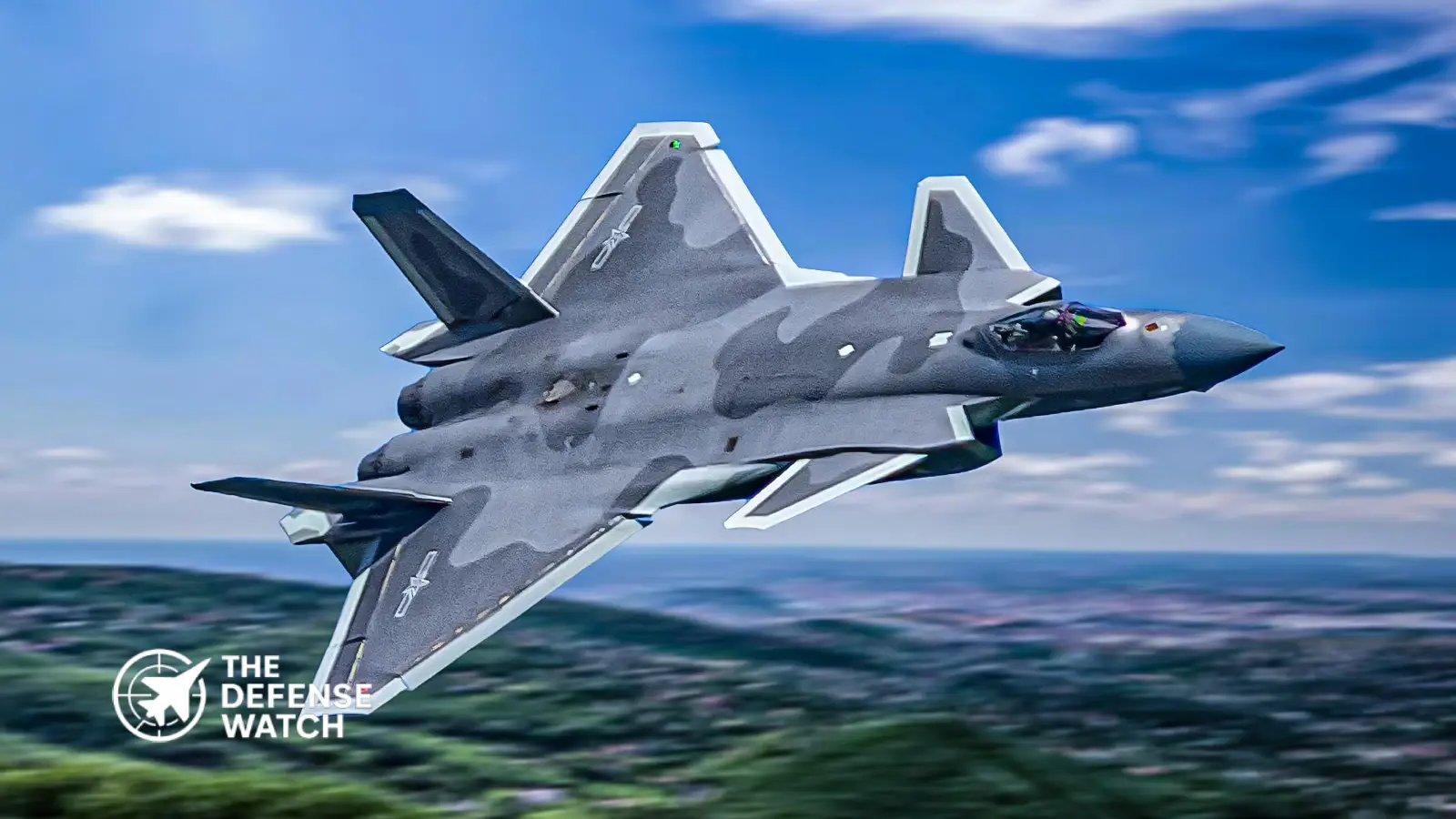
The J-20 entered service in 2017 and China is building roughly 120 per year. By 2030, the People’s Liberation Army Air Force could field as many as 1,000 of them. No Western or Russian platform comes close to that production velocity.
Estimated at $100 million per aircraft, the J-20 carries a massive 24,000-pound weapons payload — much of it internal — preserving its low-observable signature. Its WS-15 turbofan, now entering wider service, resolves earlier engine reliability concerns that undermined its performance claims. The PLAAF has also developed the J-35A as a carrier-capable variant and is flight-testing the J-36, a flying-wing design whose planform suggests sixth-generation intent.
The J-20’s stealth is generally assessed as inferior to the F-22 in front-aspect RCS, but its sheer volume of production means that any attrition-based conflict calculus shifts dramatically in China’s favor. Quality vs. quantity is not a new debate in air warfare. In a Taiwan Strait scenario spanning 30 days, fleet depth matters as much as individual aircraft performance.
Verdict: A genuine peer-level stealth fighter with a production scale that forces Western planners to rethink force structure entirely.
4. Dassault Rafale — Europe’s Most Lethal Export
The Rafale does not make every top-five list, but defense professionals who have worked with it rarely argue against its inclusion. It is the only Western fighter besides the F-35 with a validated carrier-capable and land-based variant in simultaneous service. France has deployed it in combat over Libya, Mali, Syria, and Iraq.
At approximately $100–120 million per unit (F3-R variant), it is not cheap. But its SPECTRA electronic warfare suite is genuinely world-class, capable of jamming, decoying, and direction-finding simultaneously. The RBE2-AA AESA radar and MBDA METEOR beyond-visual-range missile combination gives it a kill chain that analysts consistently rate as dangerous against any fourth-generation opponent and competitive against fifth-generation ones in contested electromagnetic environments.
India, Egypt, Greece, the UAE, Indonesia, and Croatia have all signed Rafale contracts in recent years. The aircraft’s export track record — and its combat operational record — distinguish it from the Su-57, which claims similar tier status but has deployed in far more limited numbers.
Verdict: The most combat-proven and diplomatically versatile high-end fighter outside the U.S.-Chinese duopoly.
5. Sukhoi Su-57 Felon — The Sanctioned Wild Card
Russia’s only operational fifth-generation fighter is genuinely fast — approximately Mach 2 — and its 3D thrust-vectoring nozzles produce supermaneuverability that the F-35 cannot match in a turning fight. Its Sh121 radar complex is architecturally interesting, combining a main AESA array with side-facing and L-band wing-leading-edge arrays for multi-band situational awareness.
The problem is production. As of early 2026, Russia has reportedly produced roughly 30 Su-57s. Sanctions resulting from the Ukraine war and industrial strain have constrained the program severely. Stealth quality assessments — based on platform geometry and coating analysis — consistently rate the Su-57 as the least capable low-observable design among the current fifth-generation cohort. Some analysts decline to classify it as a true stealth aircraft at all.
At an estimated $35–50 million per unit, it offers significant cost efficiency. But a 30-aircraft fleet has no strategic mass.
Verdict: Technically interesting, operationally marginal. The gap between design ambition and production reality is the Su-57’s defining characteristic in 2026.
Fighter Jet Comparison: Key Metrics at a Glance
Aircraft Country Unit Cost (est.) Max Speed Combat Radius Fleet Size (2026) Generation F-22 Raptor USA $143M (flyaway) / $334M (program) Mach 2.25 ~590 nm ~178 5th F-35A Lightning II USA/Allies ~$80M Mach 1.6 ~590 nm 1,000+ 5th J-20 Mighty Dragon China ~$100M Mach 2.0 ~680 nm 200–300+ (rising) 5th Dassault Rafale F3-R France/Export ~$110M Mach 1.8 ~1,000 nm 220+ (multi-nation) 4.5th Su-57 Felon Russia ~$35–50M Mach 2.0 ~930 nm ~30 5th (contested) Boeing F-47 (NGAD) USA ~$300M Classified Classified IOC ~2032 6th The Strategic Crossover: What Gaming Theory Gets Right About Air Dominance
The best fighter jet debate mirrors a dynamic competitive gamers understand intuitively: the difference between a “carry” character and a “meta” pick. In competitive strategy titles, the carry is the highest individual-skill ceiling unit — devastating in the right hands, but fragile if misused or under-supported. The meta pick is slightly less peak-capable but wins consistently across more map states and team compositions.
The F-22 is the carry. Its individual performance ceiling is unmatched. But with only 150 combat-coded airframes and $85,000 burned every hour it flies, the USAF cannot field it at scale, cannot export it, and cannot absorb attrition. A single squadron of F-22s is a first-strike or air-supremacy asset, not a sustained campaign workhorse.
The F-35 is the meta pick. It is slightly less dominant in a one-versus-one engagement, but it operates across every mission type — strike, ISR, electronic warfare, coalition networking — and its operator base of 20 nations creates an information-sharing architecture no adversary can replicate. In a real conflict, the side with 1,000 networked F-35s coordinating targeting data in real time holds a decisive advantage over the side with 178 technically superior jets that cannot communicate at scale.
This is the logic China is also applying, in reverse. The J-20 is not the world’s best individual fighter. But 1,000 J-20s operating under a unified command, data-linked, and supported by long-range anti-access missiles changes the strategic equation entirely.
The F-47’s design concept addresses exactly this gap. Boeing’s sixth-generation platform is being engineered from the ground up for CCA integration, meaning a single F-47 pilot may direct four to five autonomous wingmen simultaneously. That shifts the force multiplication math in ways that raw aircraft count alone cannot capture.
“Air superiority is no longer about which jet wins the knife fight. It’s about which network denies the adversary the option of getting to knife-fight range at all.” — Composite analytical assessment, USAF Air Force Research Laboratory doctrinal publications
The Sixth-Generation Horizon: Why the Answer Is About to Change
Boeing won the F-47 Engineering and Manufacturing Development (EMD) contract in March 2025, beating Lockheed Martin for the NGAD program after over a decade of concept refinement. The selection was unexpected — Lockheed has dominated U.S. fighter procurement since the F-16 era. Boeing’s win reflects both the F-47’s technical maturity and a deliberate Pentagon diversification strategy.
The F-47 will cost approximately $300 million per aircraft at full production. The Air Force plans roughly 185 units — mirroring the F-22 production run, a number critics argue is already too low given China’s J-20 ramp rate. First flight is targeted for 2028. Initial operational capability sits in the early 2030s.
Until the F-47 flies in anger, the F-22 retains its title. But the $11 billion Raptor upgrade program currently underway — adding conformal fuel tanks, infrared search-and-track, and CCA command capability — is not a platform extension. It is a bridge program. The Air Force is keeping its best fighter alive long enough to hand the baton to something it believes will be generationally superior to anything currently flying.
Final Assessment
The best fighter jet in the world in 2026 is the F-22 Raptor — in raw technical terms, at the individual platform level, in any scenario that rewards stealth depth, kinematic performance, and sensor dominance over everything else.
But the most strategically significant fighter in the world is the F-35. It is reshaping alliance air power on five continents, generating shared targeting data at a scale no adversary can match, and doing so at a unit cost that allows mass deployment.
The most dangerous trend in global air power is the J-20 production curve. Not because any single J-20 outperforms a Raptor — it does not. But because 1,000 peer-level stealth fighters, produced and sustained at industrial scale, represent a force structure challenge that unit-for-unit performance comparisons do not capture.
And the most consequential development over the next decade is the F-47. If Boeing delivers on its timeline and the Air Force funds it adequately, the sixth generation will reset the competitive baseline entirely — pairing a human pilot with five autonomous wingmen, operating at ranges and stealth depths that current Chinese and Russian platforms cannot contest.
The question is not which jet is best. The question is whether the West produces enough of what it needs, fast enough, to matter when it counts.
Executive Summary: The Tomahawk cruise missile costs roughly $2 million to $2.5 million per missile and offers long-range strike capability exceeding 1,000 miles, making it a strategic weapon for attacking high-value targets deep inside enemy territory. The Naval Strike Missile (NSM) typically costs $1 million to $1.5 million, prioritizing stealth, anti-ship warfare, and flexible deployment from ships and coastal launchers. Rather than competing directly, the two missiles fulfill complementary roles in modern naval strategy.
The Tomahawk cruise missile cost is typically estimated at $2 million to $2.5 million per round, while the Naval Strike Missile (NSM) generally falls between $1 million and $1.5 million. That price gap raises an obvious question: why would navies pay nearly twice as much for a Tomahawk?
The answer lies in mission design. The Tomahawk is a strategic strike weapon capable of reaching targets more than 1,000 miles away, while the NSM is a stealth-focused anti-ship missile built to dominate naval engagements closer to the battlespace. Comparing them is less about price and more about understanding two very different approaches to maritime warfare.
Modern fleet planners increasingly view the missiles as complementary systems rather than direct competitors. One delivers deep-strike capability across an entire theater of operations. The other helps secure sea control against hostile surface fleets.
Technical Analysis: Cost, Range, and Mission Profiles
The Tomahawk remains one of the most combat-proven cruise missiles ever developed. First introduced during the Cold War, the weapon has evolved through multiple upgrades and remains a cornerstone of U.S. naval strike capability. The latest Block V variants can engage both land targets and certain maritime threats while maintaining exceptional stand-off range.
-
The Naval Strike Missile represents a different generation of thinking. Developed by Norway’s Kongsberg and now fielded by the U.S. Navy and Marine Corps, the NSM prioritizes survivability, stealth, and advanced terminal attack profiles designed to penetrate modern air defenses.
Tomahawk vs NSM Comparison
Metric Tomahawk Block V Naval Strike Missile (NSM) Approximate Unit Cost $2.0M to $2.5M+ $1.0M to $1.5M Primary Role Land attack and maritime strike Anti-ship warfare Range 1,000+ miles (1,600+ km) 100 to 150+ miles (185 to 250+ km) Launch Platforms Destroyers, cruisers, submarines Surface ships, coastal batteries, mobile launchers Guidance GPS, INS, terrain matching, seeker GPS, INS, imaging infrared seeker Warhead Approximately 1,000 lbs Approximately 275 lbs Flight Profile Subsonic cruise Sea-skimming, low observable The most significant difference is range. A Tomahawk can strike strategic infrastructure, command centers, logistics hubs, and air defense sites deep inside enemy territory. Few conventional naval weapons offer comparable reach.
The NSM is optimized for a different mission set. Rather than attacking inland targets hundreds of miles away, it focuses on destroying enemy surface combatants. Its sea-skimming flight profile and sophisticated target recognition capabilities make interception significantly more difficult.
For naval commanders, the question is not which missile is better. The real question is which missile best supports the mission at hand.
Surface Ship vs Submarine Launch: The Logistics Battle
Launch platform considerations often shape procurement decisions as much as missile performance.
Tomahawk missiles are typically carried aboard major surface combatants equipped with the Mk 41 Vertical Launch System. These ships function as mobile strike platforms capable of influencing operations far beyond the horizon.
Submarine-launched Tomahawks add another layer of strategic value. Attack submarines can approach contested areas undetected, launch precision strikes, and withdraw before adversaries can respond. This combination of stealth and range has repeatedly proven effective during combat operations in the Middle East and elsewhere.
The NSM follows a more distributed model. It can be mounted on smaller warships, truck-based coastal defense systems, and expeditionary launchers. This flexibility aligns closely with emerging U.S. and allied concepts of distributed maritime operations.
Rather than concentrating firepower aboard a handful of expensive platforms, commanders can disperse missile batteries across multiple locations. This creates a targeting challenge for adversaries and improves force survivability.
From a logistics perspective, the NSM offers affordability and flexibility. The Tomahawk offers reach and strategic impact. Modern navies increasingly seek both capabilities.
Why Cost Alone Doesn’t Determine Value
Defense procurement rarely revolves around unit price alone.
A missile costing $2.5 million may appear expensive until planners consider what it replaces. A Tomahawk can strike a target more than a thousand miles away without risking a pilot, tanker aircraft, escort fighters, or support assets.
The cost equation changes further when considering strategic effects. Destroying a high-value command center or disabling a critical air defense network can influence an entire campaign.
Meanwhile, NSM delivers value through quantity and operational flexibility. A force equipped with larger numbers of anti-ship missiles can create significant challenges for hostile fleets operating in contested waters.
This is why many Western navies continue investing in both long-range strike missiles and dedicated anti-ship weapons rather than choosing one category over the other.
The Gaming Parallel: What Tomahawk And NSM Teach Us About Competitive Strategy
The distinction between Tomahawk and NSM mirrors the difference between strategic and tactical play in competitive gaming.
In Call of Duty esports, legendary players such as Clayster built their reputation not simply through mechanical skill, but through map control, timing, and understanding when to commit valuable resources. The Tomahawk fills a similar role. It is the high-value strategic asset that can reshape the battlefield from extreme distance, much like a perfectly timed game-changing play during a championship match.
The NSM operates differently. It resembles a dominant meta weapon that excels in repeated engagements. Rather than delivering one dramatic strategic strike, it focuses on controlling the immediate fight through survivability, precision targeting, and flexible deployment options.
Military planners face the same challenge that elite esports teams face. Should resources be concentrated into a few powerful capabilities, or distributed across larger numbers of specialized tools?
The Tomahawk wins through reach and strategic impact. The Naval Strike Missile wins through flexibility, survivability, and sea control. Modern naval doctrine increasingly relies on both.
Conclusion & Takeaway
Comparing the Tomahawk cruise missile cost to the Naval Strike Missile reveals two fundamentally different philosophies of naval warfare.
Tomahawk delivers strategic depth, long-range precision, and multi-domain strike capability. NSM provides a cost-effective, highly survivable anti-ship weapon designed for distributed maritime operations and contested naval environments.
The future of naval warfare is unlikely to be defined by a single missile. Instead, success will depend on combining long-range strike systems with agile anti-ship capabilities that can survive in increasingly dangerous battlespaces.
In the end, the million-dollar question is not whether Tomahawk or NSM is superior. It is whether a navy can effectively integrate both into a coherent strategy. The fleets that master that balance will hold a decisive advantage in the maritime conflicts of the coming decades.
Executive Summary: China’s People’s Liberation Army Rocket Force (PLARF) has fielded a three-tier suite of anti-ship ballistic and hypersonic missiles — the DF-21D, DF-26, and YJ-21/YJ-20 — capable of engaging carrier strike groups from stand-off ranges of 900 km to 4,500 km. Designed explicitly to challenge U.S. naval freedom of maneuver in the western Pacific, these systems collectively constitute an Anti-Access/Area-Denial (A2/AD) architecture that compels significant operational and doctrinal adjustments from the U.S. Navy and its regional allies. Their continued development and deployment represent the most consequential shift in naval threat calculus since the introduction of nuclear-powered carrier aviation.
Why “Carrier Killers” Matter
For nearly eight decades, the U.S. aircraft carrier has served as the preeminent instrument of power projection, capable of surging combat airpower to any ocean within days. That strategic calculus rested on a fundamental assumption: that no adversary possessed the precision strike capability to hold carriers at operationally relevant risk beyond the range of shipborne air defenses. China’s PLARF has systematically invalidated that assumption.
Beginning with the operational deployment of the DF-21D — the world’s first land-based ballistic missile explicitly designed to engage moving naval targets — and extending through the intermediate-range DF-26 and the shipborne hypersonic YJ-21, the PLA has constructed overlapping engagement envelopes that can hold carrier strike groups at risk from well within China’s continental territory. The strategic consequence is direct: any U.S. carrier operating within the first island chain faces a threat environment without historical precedent.
DF-21D: The Pioneer ASBM
Technical Specifications & Operational Concept
The DF-21D (Dongfeng-21D), designated CSS-5 Mod 5 in NATO parlance, represents the operational proof-of-concept for the anti-ship ballistic missile (ASBM) concept. Launched from road-mobile transporter-erector-launchers (TELs) that significantly complicate pre-launch targeting, the missile’s estimated range of 1,500–1,800 km — exact figures remain classified — covers a substantial portion of the western Pacific from launch positions within China’s interior.
The guidance architecture integrates inertial mid-course navigation with over-the-horizon targeting data fused from a constellation of sensors: the Yaogan series of imagery and electronic intelligence satellites, long-range maritime patrol aircraft, submarine-relayed acoustic intelligence, and surface vessel radar tracks. The terminal phase employs an active radar seeker capable of discriminating a carrier against sea clutter, combined with maneuvering reentry vehicle (MaRV) technology that allows terminal trajectory correction against a target moving at up to approximately 30 knots.
Key Capabilities at a Glance
- Mobile launch platform: Road-mobile TELs allow rapid repositioning, complicating adversary suppression-of-enemy-air-defenses (SEAD) targeting cycles.
- Maneuvering reentry vehicle (MaRV): Terminal course corrections challenge interceptors designed against ballistic trajectories.
- Over-the-horizon targeting: Dependent on satellite, airborne, and naval sensor fusion rather than organic seeker-only acquisition — a known vulnerability in high-EW environments.
- Anti-ship ballistic missile (ASBM) pioneer: First system in the world to transition from concept to declared operational status against moving naval targets.
- Estimated CEP: Open-source assessments suggest a circular error probable (CEP) of approximately 20–40 meters against a stationary target, with degraded accuracy against evasive maneuvering.
“To calculate the theoretical interception window for an Aegis combat system reacting to these ballistic trajectories, utilize our Missile Range & Time-of-Flight Calculator.”
DF-26: Dual-Role Intermediate Strike — The “Guam Express”
Extended Range and Nuclear Ambiguity
The DF-26, first publicly displayed during the September 2015 Beijing Victory Day parade and declared operational by the PLARF in April 2018, substantially extends China’s sea-denial envelope to approximately 4,000–4,500 km. This range brings the U.S. strategic hub at Guam — and the forward-deployed assets it supports — within persistent strike threat, earning the informal designation “Guam Express” in Western defense analyses.
The DF-26’s most operationally significant characteristic is its dual conventional/nuclear capability. Unlike the conventionally-dedicated DF-21D, the DF-26 is assessed by the U.S. Department of Defense as nuclear-capable, introducing a dangerous ambiguity problem: an adversary observing DF-26 launch preparation cannot immediately determine the warhead type, potentially triggering escalatory responses disproportionate to a conventional strike. The more recent DF-26D variant is reported to incorporate an upgraded guidance package and multi-warhead options designed to further complicate point-defense intercept solutions.
Key Capabilities at a Glance
- 4,000–4,500 km range: Covers Guam, the Philippine Sea operating areas, and portions of the Indian Ocean from western China.
- Dual conventional/nuclear role: Creates escalation ambiguity at the strategic level; adversary launch detection does not resolve warhead type prior to intercept decision window.
- DF-26D multi-warhead variant: Reported to carry multiple independently targetable or salvo sub-munitions to saturate shipborne point defenses.
- Rapid reload capability: PLARF mobile launchers are assessed to carry reload rounds, increasing salvo depth beyond a single-shot scenario.
- Land and naval target flexibility: Cleared for both fixed-infrastructure precision strikes and anti-ship missions, unlike the ASBM-specific DF-21D.
YJ-21 and YJ-20: The Hypersonic Sea-Launched Tier
Terminal Hypersonic Intercept Challenge
While the DF-21D and DF-26 represent land-based ballistic threats, the YJ-21 (Eagle Strike-21) and YJ-20 extend the carrier-killer concept to surface combatants, embedding hypersonic anti-ship strike capability directly into the PLA Navy’s (PLAN) surface fleet. The ship-launched YJ-20 integrates into the 112-cell vertical launch system (VLS) of the Type 055 Renhai-class cruiser — China’s most capable surface combatant — and is assessed to achieve cruising speeds in the Mach 4–6 envelope with a terminal-phase velocity reported to exceed Mach 10.
The combination of high terminal velocity, low radar cross-section in the terminal phase, and significant kinetic energy on impact creates an interception problem that exceeds the engagement parameters of current shipborne air defense systems, including the SM-6 Block IB, which has a maximum engagement velocity of approximately Mach 3.5 in the anti-air warfare mission. Directed-energy systems under development by the U.S. Navy are assessed to offer future capability against this threat class, but no currently fielded system provides reliable intercept assurance.
Key Capabilities at a Glance
- VLS integration: Fits standard vertical launch cells, enabling deployment from any Type 055 or future PLAN combatant without platform modification.
- Mach 10+ terminal velocity: Exceeds the kinematic intercept envelope of currently fielded U.S. Navy shipborne air defense missiles.
- Distributed threat: Unlike land-based systems, ship-launched missiles can be prosecuted from multiple geographic vectors simultaneously.
- Reduced warning time: High terminal speed compresses the intercept decision window from minutes (ballistic) to seconds at close range.
- Layered threat synergy: Designed to exploit air defense saturation created by simultaneous DF-21D/DF-26 engagement — forcing defenders to allocate interceptors against multiple simultaneous threat axes.
System Comparison: DF-21D vs. DF-26 vs. YJ-21/YJ-20 vs. Legacy Threats
Terminal Hypersonic Intercept Challenge
While the DF-21D and DF-26 represent land-based ballistic threats, the YJ-21 (Eagle Strike-21) and YJ-20 extend the carrier-killer concept to surface combatants, embedding hypersonic anti-ship strike capability directly into the PLA Navy’s (PLAN) surface fleet. The ship-launched YJ-20 integrates into the 112-cell vertical launch system (VLS) of the Type 055 Renhai-class cruiser — China’s most capable surface combatant — and is assessed to achieve cruising speeds in the Mach 4–6 envelope with a terminal-phase velocity reported to exceed Mach 10.
The combination of high terminal velocity, low radar cross-section in the terminal phase, and significant kinetic energy on impact creates an interception problem that exceeds the engagement parameters of current shipborne air defense systems, including the SM-6 Block IB, which has a maximum engagement velocity of approximately Mach 3.5 in the anti-air warfare mission. Directed-energy systems under development by the U.S. Navy are assessed to offer future capability against this threat class, but no currently fielded system provides reliable intercept assurance.
Key Capabilities at a Glance
- VLS integration: Fits standard vertical launch cells, enabling deployment from any Type 055 or future PLAN combatant without platform modification.
- Mach 10+ terminal velocity: Exceeds the kinematic intercept envelope of currently fielded U.S. Navy shipborne air defense missiles.
- Distributed threat: Unlike land-based systems, ship-launched missiles can be prosecuted from multiple geographic vectors simultaneously.
- Reduced warning time: High terminal speed compresses the intercept decision window from minutes (ballistic) to seconds at close range.
- Layered threat synergy: Designed to exploit air defense saturation created by simultaneous DF-21D/DF-26 engagement — forcing defenders to allocate interceptors against multiple simultaneous threat axes.
System Comparison: DF-21D vs. DF-26 vs. YJ-21/YJ-20 vs. Legacy Threats
Terminal Hypersonic Intercept Challenge
While the DF-21D and DF-26 represent land-based ballistic threats, the YJ-21 (Eagle Strike-21) and YJ-20 extend the carrier-killer concept to surface combatants, embedding hypersonic anti-ship strike capability directly into the PLA Navy’s (PLAN) surface fleet. The ship-launched YJ-20 integrates into the 112-cell vertical launch system (VLS) of the Type 055 Renhai-class cruiser — China’s most capable surface combatant — and is assessed to achieve cruising speeds in the Mach 4–6 envelope with a terminal-phase velocity reported to exceed Mach 10.
The combination of high terminal velocity, low radar cross-section in the terminal phase, and significant kinetic energy on impact creates an interception problem that exceeds the engagement parameters of current shipborne air defense systems, including the SM-6 Block IB, which has a maximum engagement velocity of approximately Mach 3.5 in the anti-air warfare mission. Directed-energy systems under development by the U.S. Navy are assessed to offer future capability against this threat class, but no currently fielded system provides reliable intercept assurance.
Key Capabilities at a Glance
- VLS integration: Fits standard vertical launch cells, enabling deployment from any Type 055 or future PLAN combatant without platform modification.
- Mach 10+ terminal velocity: Exceeds the kinematic intercept envelope of currently fielded U.S. Navy shipborne air defense missiles.
- Distributed threat: Unlike land-based systems, ship-launched missiles can be prosecuted from multiple geographic vectors simultaneously.
- Reduced warning time: High terminal speed compresses the intercept decision window from minutes (ballistic) to seconds at close range.
- Layered threat synergy: Designed to exploit air defense saturation created by simultaneous DF-21D/DF-26 engagement — forcing defenders to allocate interceptors against multiple simultaneous threat axes.
System Comparison: DF-21D vs. DF-26 vs. YJ-21/YJ-20 vs. Legacy Threats
System Range Launch Platform Terminal Speed Warhead Type Primary Target Key Technology Status DF-21D ~1,500–1,800 km Road-mobile TEL ~Mach 10 (reentry) Conventional HE, penetrator Carrier strike groups MaRV + active radar seeker; satellite/OTH targeting Operational (PLARF) DF-26 / DF-26D ~4,000–4,500 km Road-mobile TEL ~Mach 18 (reentry) Conv. / Nuclear (dual-capable) Carriers + land infrastructure Dual-role warhead; multi-warhead variant (DF-26D) Operational (PLARF, since Apr 2018) YJ-21 / YJ-20 Est. 1,000–1,500 km VLS (Type 055 cruiser) Mach 4–6 cruise; Mach 10+ terminal Conventional HE, penetrator Carriers, large surface combatants Hypersonic glide terminal phase; VLS-compatible airframe Operational (PLAN, Type 055) Legacy: P-700 Granit (SS-N-19) ~625 km Submarine / surface VLS Mach 2.5 Conventional / Nuclear Carrier groups Active radar + datalink; salvo logic In service (Russian Navy) Legacy: Harpoon Block II+ ~280 km Ship / air / sub ~Mach 0.85 Conventional HE Surface combatants GPS/INS + active radar terminal In service (U.S. Navy, allies) The Strategic Impact on U.S. Navy Operations and NATO Readiness
The U.S. Navy’s response calculus involves multiple concurrent lines of effort. The DDG(X) next-generation destroyer program incorporates directed-energy weapon provisions and substantially upgraded power generation for future hypersonic intercept lasers. The SM-6 Block IB upgrade extends engagement altitude and improves discrimination against maneuvering targets. The Conventional Prompt Strike (CPS) program — a hypersonic weapon carried aboard Virginia-class submarines — directly mirrors China’s land-attack hypersonic capability, signaling a bilateral hypersonic competition that carries its own escalation risks.
For NATO allies operating in the Indo-Pacific — particularly Australia, Japan, and South Korea — the DF-26 range ring fundamentally changes the geography of alliance commitments. Japanese Aegis destroyers, upgraded with SM-3 Block IIA interceptors under the bilateral Aegis cooperation program, provide the most capable currently-fielded allied intercept capability against the DF-26’s midcourse phase. However, intercept probability against a salvo of six or more missiles — a plausible PLARF employment option — remains a classified variable not addressed in open-source literature.
Technical Breakthroughs in Targeting Architecture
The most underappreciated element of China’s ASBM capability is not the missile itself but the targeting kill chain required to support it. A ballistic missile taking approximately 12–15 minutes from launch to impact at DF-21D range must be cued with carrier position data accurate enough to place the terminal seeker’s acquisition basket over the target. This requires a persistent, real-time maritime surveillance architecture.
China has invested substantially in this supporting layer. The Yaogan-30 constellation — a series of electronic intelligence (ELINT) and signals intelligence (SIGINT) satellites operating in low-Earth orbit in groups of three — provides persistent radar emission tracking of surface combatants. The Yaogan-31 series complements this with synthetic aperture radar (SAR) imagery. Shore-based over-the-horizon backscatter radars, operating in the 3–30 MHz band, provide wide-area cueing against major surface contacts at ranges exceeding 3,000 km. The integration of this multi-source picture into a coherent common operating picture remains a recognized Chinese military priority and a continuing intelligence-collection focus for the U.S. Navy.
The Kill Chain: How China Tracks Moving Targets at Sea
An anti-ship ballistic missile is, in isolation, a precision instrument without a target. The true operational capability of China’s DF-21D, DF-26, and YJ-21 systems is inseparable from the surveillance and targeting architecture that supports them — a multi-domain sensor network the PLA refers to internally as the Integrated Joint Operations Platform (IJOP) maritime branch. This kill chain is the operational linchpin that converts a ballistic missile’s physics into a credible naval threat, and it warrants dedicated examination.
A carrier strike group underway generates a substantial electromagnetic and acoustic signature. It radiates radar emissions, communications traffic, and aircraft sortie patterns across a wide electromagnetic spectrum. China’s targeting architecture is engineered to exploit each of these signatures simultaneously, fusing multiple sensor inputs into a continuously updated common operating picture that can cue a missile launch with sufficient accuracy to place the terminal seeker’s acquisition basket over a target moving at 25–30 knots.
The Five-Layer Sensor Architecture
Open-source analysis of Chinese military publications and observable satellite deployments indicates a layered sensor architecture with at least five distinct input streams, each providing different coverage geometry and update rates:
The Kill Chain: Multi-Layered Targeting Network
Layer 1Yaogan-30 ELINT/SIGINT Constellation
Low-Earth orbit triplets passively collect radar and radio emissions from surface combatants. Provides wide-area cueing at global range. Revisit rate estimated at 2–4 hours per triplet cluster.
Layer 2Yaogan-31 SAR Imaging
Synthetic aperture radar satellites provide all-weather, day/night imagery for track confirmation and group-size assessment. Complement ELINT data with physical contact geometry.
Layer 3OTH-B Backscatter Radar
Shore-based over-the-horizon backscatter radars operating in the 3–30 MHz HF band detect large surface contacts at ranges exceeding 3,000 km. Provides persistent wide-area cueing independent of weather.
Layer 4Y-8/Y-9 ELINT Patrol Aircraft
Airborne electronic intelligence platforms extend sensor reach beyond shore-based radar horizons. Capable of discriminating individual ship emissions within a strike group formation.
Layer 5SSK/SSN Submarine Acoustic Reporting
Forward-deployed Type 039A (Yuan-class) and Type 093 (Shang-class) submarines provide acoustic track data via low-probability-of-intercept communications buoys.
The Time-Distance Problem
The most technically demanding aspect of the ASBM targeting problem is temporal. At DF-21D maximum range of approximately 1,800 km, flight time from launch to target is estimated at 12–15 minutes. A carrier group maneuvering at 30 knots can translate approximately 9–11 km from its last known position during that interval. The missile’s terminal seeker must therefore be cued to a predicted position basket — not a last-known position — requiring the targeting system to maintain track continuity and apply a projection algorithm that accounts for likely course and speed variations.
“The performance of surface-based tracking radar against low-observable profiles can be calculated directly using our Radar Detection Range Calculator.”
For the longer-ranged DF-26 at 4,000 km, flight time extends to approximately 25–30 minutes, and the positional uncertainty cone grows proportionally. This is the primary engineering rationale for the DF-26D’s reported multi-warhead or salvo payload options: distributing submunitions or warheads across a wider footprint increases probability of engagement against a maneuvering target when track data is degraded.
Analyst note on EW vulnerability: The kill chain’s dependence on real-time sensor fusion creates a recognized operational seam. U.S. carrier strike group defensive doctrine employs electronic attack assets — including EA-18G Growlers — to deny, degrade, or deceive the targeting sensor layer. If the common operating picture fed to PLARF launch controllers contains falsified or degraded contact data, ASBM terminal seeker acquisition probability falls significantly. Whether China’s sensor redundancy is sufficient to overcome a sustained, coordinated EW campaign at scale remains a classified analytical debate within USINDOPACOM and the Office of Naval Intelligence.
Known Vulnerabilities in the Kill Chain
Assessed kill chain vulnerabilities (open-source)
- Satellite revisit gaps: Yaogan-30 triplets provide roughly 2–4 hour revisit cycles in any given ocean area — sufficient for cueing, but allowing maneuvering carriers to open significant positional uncertainty windows between passes.
- OTH radar geolocation imprecision: Backscatter HF radar provides area cueing, not precision targeting. Estimated CEP at maximum range is on the order of tens of kilometers — adequate to cue follow-on sensors but insufficient for direct ASBM launch authority.
- Communications relay latency: Submarine-relayed acoustic data requires buoy surfacing or VLF relay, introducing lag into the targeting picture and creating potential intercept opportunities for adversary anti-submarine forces.
- EW/deception susceptibility: ELINT-based tracking is inherently dependent on target emissions. Emissions-controlled (EMCON) operations by carrier strike groups significantly degrade the ELINT component, forcing greater reliance on SAR and OTH layers with lower update rates.
- C2 link integrity: The data fusion pipeline from satellite ground stations through PLARF launch authority chains is a high-value target for adversary cyber and kinetic operations. Disruption of even one relay node could deny timely launch authorization.
It is precisely these vulnerabilities that drive U.S. Navy investment in EMCON discipline, the EA-18G Growler electronic attack program, and emerging concepts of distributed maritime operations designed to present adversary ISR networks with a more diffuse, lower-signature target set. The kill chain is a system, and like any system, its operational effectiveness is bounded by its weakest node.
Looking Ahead
China’s carrier-killer architecture is not static. The DF-27, assessed by the U.S. DoD Annual Report on Chinese Military Power (2023) to be in development, is expected to extend ASBM range further while incorporating hypersonic glide vehicle (HGV) technology that renders mid-course intercept substantially more difficult than against a classical ballistic trajectory. Meanwhile, the YJ-21’s integration into PLAN combatants signals an intent to export the sea-denial problem far beyond China’s continental margins, as Type 055 cruisers operate increasingly in the central and western Pacific.
Executive Summary: Finland operates the most comprehensive civil defense shelter network in the NATO alliance, with 50,500 facilities capable of protecting approximately 4.8 million of its 5.6 million citizens. As Russia’s war in Ukraine enters its fourth year and European governments scramble to rebuild civilian preparedness infrastructure neglected since the Cold War, Helsinki’s decades-long investment in dual-use underground shelters has become a mandatory reference point — drawing delegations, defense planners, and heads of state from across the continent.
Finland’s Underground Civil Defense Network Draws Global Interest As Europe Scrambles For Shelter
Beneath Helsinki’s streets, families swim laps and children play on jungle gyms. Dozens of meters below the surface, carved into billion-year-old granodiorite bedrock, those same recreational spaces are engineered to become bombproof refuges within 72 hours. That combination — civilian normality layered over wartime readiness — is why defense planners, NATO officials, and heads of state are traveling to Finland to understand how it works.
Finland’s civil defense shelter network has become one of the most studied defense infrastructure models in the Western alliance. With Russia’s full-scale invasion of Ukraine now stretching into its fourth year and European governments confronting the reality that decades of post-Cold War optimism left their civilian populations dangerously exposed, Helsinki’s approach is no longer treated as a Nordic quirk. It is increasingly viewed as a strategic necessity that the rest of NATO failed to maintain.
Scale and Capability: What Finland Has Built
Finland operates approximately 50,500 civil defense shelters nationwide, with a combined capacity to protect roughly 4.8 million people — about 86 percent of the country’s 5.6 million citizens. Helsinki alone holds some 5,500 shelters with space for approximately 900,000 persons, exceeding the capital’s entire resident population.
The infrastructure ranges from small building-integrated shelters to massive bedrock facilities. The Itakeskus complex, home to the world’s largest swimming hall built inside a civil defense shelter, can evacuate its pools and transition to emergency use for 3,800 civilians within 72 hours. The Merihaka shelter in central Helsinki accommodates 6,000 people and includes an underground playground, ball courts, and a gym — all kept in operational condition through daily peacetime use.
We always have this multi-use — peacetime use and wartime use — of our shelters,” said Jarkko Hayrinen, a senior rescue officer at Finland’s interior ministry, during a recent media tour of the facilities. “The shelters are very well maintained because people are using them in normal times.”
That dual-use design philosophy is not incidental. It is the structural answer to a problem every country with civil defense infrastructure faces: maintaining readiness without the political will to fund facilities that sit empty.
According to assessment data, 91 percent of Finland’s shelters are rated capable of resisting conventional attack, while 83 percent are equipped with air filtration systems providing protection against nuclear, biological, or chemical threats — a CBRN capability threshold most European nations cannot approach.
A Preparedness Culture Built From Wartime Lessons
Finland’s shelter legislation dates to 1939 — enacted just two weeks before the Soviet Union launched the Winter War. The law mandated civilian protection infrastructure as a condition of national survival, not a peacetime luxury. That legal and cultural foundation has compounded over eight decades into a system no other NATO ally has replicated at scale.
“Back then, we weren’t prepared to shield civilians — and we learned the hard way,” Hayrinen noted during the tour.
The lesson Finland absorbed in 1939 is the same one European governments are now re-learning through the lens of Mariupol, Kharkiv, and Kyiv: civilian populations in modern conflict are targets, and their protection requires infrastructure built before the shooting starts.
Matti Pesu, a senior researcher at the Finnish Institute of International Affairs, characterizes Finland’s whole-of-society approach as a national “trademark.” The model — termed total defense — integrates military capability, civil preparedness, critical infrastructure resilience, and industrial mobilization planning into a unified strategic framework. Finland allocates approximately 2 percent of GDP to civil defense investments, with government plans targeting an increase toward 5 percent in coming years.
Since joining NATO in April 2023, Finland has continued deepening this framework rather than treating alliance membership as a substitute for domestic resilience. The 2025 Act on Population Protection and Civil Defense — entering force in 2026 — mandates shelter construction in all new multi-family residential buildings and public facilities, extending the network further.
Why Europe Is Paying Attention Now
The gap between Finland’s posture and the rest of Europe’s is stark. Most Western European nations dismantled or abandoned their Cold War-era shelter networks through the 1990s and 2000s, operating under the assumption that great-power conflict had been permanently retired. Russia’s 2022 invasion shattered that assumption.
Denmark’s King Frederik, Ukrainian President Volodymyr Zelensky, and Nordic cooperation ministers have all toured Helsinki’s Hakaniemi shelter — an underground car park and sports center that doubles as emergency housing for 6,000 people. The visits are more than symbolic. They reflect a genuine policy gap that NATO members are now trying to close.
Poland has allocated approximately 117 million zlotys toward shelter modernization in Warsaw alone, though analysts describe that figure as far short of what comprehensive coverage would require. Germany, Sweden, and the Baltic states have all launched or accelerated civil defense reviews, frequently citing Finland’s model as the benchmark.
For the United States and its NATO planning structures, Finland’s network carries a specific operational relevance. In a Baltic contingency or any conflict scenario involving Russian conventional or non-conventional strikes on alliance territory, the ability to shelter civilian populations rapidly reduces both casualties and the political pressure on governments to negotiate unfavorable terms. Civil defense capacity, in this framing, is deterrence infrastructure.
The Dual-Use Model: Operational Analysis
The most transferable lesson from Finland’s system is not the raw numbers — it is the design logic. Building recreational and civic infrastructure to military protection specifications, then operating it as a public amenity, solves the maintenance and funding problem that has historically caused civil defense networks to deteriorate.
Empty bunkers require budget allocation to maintain. Swimming halls and sports centers generate operating revenue and remain in a constant state of functional readiness. The transition time — 72 hours for a major complex, far less for smaller facilities — is a product of pre-positioned emergency supplies, pre-tested mechanical systems, and a population trained to use the infrastructure.
Finland’s interior ministry has documented the dual-use approach as a deliberate policy choice, not an architectural afterthought. New shelter mandates under the 2026 law extend the same principle to residential construction, ensuring that shelter capacity scales with population growth and urban development rather than lagging behind it.
The CBRN filtration capacity embedded in 83 percent of shelters addresses the threat spectrum that has most alarmed European defense planners since 2022 — not just conventional munitions, but the potential for radiological, chemical, or biological incidents in populated areas, whether from direct attack or infrastructure strikes on hazardous facilities.
Implications for NATO Civil Defense Planning
Finland’s admission to NATO in 2023 brought more than its military capabilities to the alliance. It introduced a civil defense model and a strategic culture that NATO’s collective defense planning had not previously incorporated at scale. The EU’s rescEU CBRN reserve — a rapid-response stockpile of protective equipment and medical countermeasures deployable within 12 hours — is hosted in Finland, a recognition of the country’s expertise and existing infrastructure.
For NATO planners, the Finnish model poses an uncomfortable question: how much does civilian resilience capacity contribute to collective deterrence, and how far behind is the alliance as a whole? The answer, based on current European shelter inventories, is considerably behind.
Closing that gap will require sustained political commitment and multi-decade investment — precisely the conditions Finland has sustained since 1939. The country’s message to its allies is straightforward: preparedness is not built in a crisis. It is built before one.
Key Facts At A Glance
- 50,500 civil defense shelters across Finland
- 4.8 million citizens with shelter access (86% of population)
- 900,000 shelter places in Helsinki alone — exceeding the capital’s population
- 91% of shelters rated resistant to conventional attack
- 83% equipped with CBRN air filtration systems
- Shelter legislation in force since 1939
- Finland joined NATO: April 2023
- New shelter construction mandates effective: 2026
- Civil defense investment: approx. 2% of GDP, targeting 5%
Executive Summary: SpaceX President Gwynne Shotwell has privately told FAA Administrator Bryan Bedford that the company is targeting 10,000 rocket launches per year within five years — a roughly 60-fold increase over its current pace. Bedford disclosed this figure publicly on May 21, 2026, while cautioning that regulatory approval at that scale will require dramatic improvements in launch reliability. The disclosure carries significant implications for U.S. national security space architecture, satellite communications, and American strategic superiority in the emerging space domain.
SpaceX Pushes For 10,000 Annual Launches As FAA Signals Reliability Must Come First
SpaceX has set an audacious target of 10,000 rocket launches per year within the next five years, a figure disclosed publicly by Federal Aviation Administration Administrator Bryan Bedford following a direct meeting with SpaceX President Gwynne Shotwell.
The FAA chief confirmed that Shotwell told him about the company’s five-year vision to reach 10,000 launches annually, but warned that government officials would need to see significantly improved reliability before any such expansion could be approved.
The revelation, made at a public forum in Arlington, Virginia, reframes the scale of America’s commercial space ambitions — and the regulatory infrastructure required to support them.
The Numbers Behind The Goal
SpaceX currently flies approximately 160 orbital missions per year, completing 154 launches in 2025 and reaching 50 by late April 2026. The entire world managed roughly 250 launches last year.
The 10,000-launch target represents a roughly 60-fold increase over SpaceX’s own current pace and a 40-fold increase over total global launch output. The FAA has currently approved SpaceX for a combined 195 launches per year across its four active sites, with the Starbase facility in Texas holding a 25-launch annual cap after the FAA raised it from five in May 2025.
Put plainly: SpaceX is proposing to do in one year what the entire global launch industry cannot do in 40.
The scale of this ambition is not purely commercial. For U.S. defense planners, a dramatically higher launch cadence translates directly into faster deployment of intelligence, surveillance, and reconnaissance (ISR) satellites, resilient communications constellations, and potential space-based missile defense architecture — capabilities that rival powers China and Russia are actively seeking to counter or replicate.
FAA Taps The Brakes — But Signals Openness
Bedford was candid about both the opportunity and the regulatory challenge.
He told reporters the FAA would need to see substantially greater reliability from SpaceX before approving a dramatic expansion. “We need to see a lot more reliability,” Bedford said. He added that the FAA was reviewing data from prior launches to better understand risks, and noted that safety protocols — including barring flights in certain airspace corridors at launch time — could become highly disruptive at extreme cadence.
Bedford also said the FAA was not currently the primary limiting factor for space launches, but warned: “I can see a future where we will be the limiting factor, because we are not putting enough funding into our space team.”
That statement has immediate policy implications. If the U.S. government views high-cadence commercial launches as strategically important — and the Pentagon’s growing reliance on commercial space assets suggests it does — then FAA staffing and funding will become a national security question, not merely a bureaucratic one.
Bedford noted that the purpose of his meeting with Shotwell was to work through constraints and plan ahead. “What can we do planning-wise now to put ourselves in a position to accommodate that type of a stretch goal,” he said.
Musk’s Vision And The Satellite Mega-Constellation
In a Forbes video interview that aired this week, SpaceX CEO Elon Musk confirmed the company already has 10,000 Starlink satellites in orbit and eventually wants to launch 10,000 communications satellites per year, though he did not specify a timeline. Separately, SpaceX announced in January that it intends to launch a constellation of 1 million satellites to orbit Earth and harness solar energy to power AI data centers.
The target also aligns with Musk’s March 31 post on X, in which he stated: “In 4 or 5 years, there will be a launch every hour” — which would equate to approximately 8,760 launches annually, slightly below the 10,000 figure Shotwell disclosed to Bedford.
The convergence of these statements suggests that the 10,000-launch figure is not an off-the-cuff projection but a coordinated internal target that SpaceX is now surfacing to regulators.
Strategic & Defense Implications
From a defense and national security standpoint, a SpaceX operating at 10,000 annual launches would fundamentally alter the geometry of space as a warfighting domain.
The U.S. Space Force and the National Reconnaissance Office have increasingly relied on commercial launch providers — SpaceX in particular — for rapid deployment of classified satellites. A launch cadence approaching dozens of missions per day would enable on-demand reconstitution of degraded satellite constellations, a key vulnerability that adversaries have identified and targeted in doctrine.
SpaceX conducted 170 launches in 2025 alone, deploying approximately 2,500 satellites in a single year. Scaling that by a factor of 60 would mean tens of thousands of new satellites entering orbit annually — potentially overwhelming any adversary’s ability to track, target, or neutralize American space assets.
President Donald Trump has stated his intent to return Americans to the moon before 2028, and Bedford connected that goal directly to the need for regulatory and industry partnership: “To do that, we are going to have to work with industry to unlock that innovation,” he said.
The lunar timeline and the 10,000-launch target are not unrelated. High-cadence Starship launches from Starbase would be central to any sustained lunar logistics architecture under NASA’s Artemis program.
The Reliability Hurdle
The FAA’s emphasis on reliability is not merely procedural. At extreme launch cadence, a single vehicle anomaly could cascade into prolonged airspace closures, satellite debris events, or mission failures with national security consequences.
Bedford acknowledged that launch-related airspace restrictions can already be “very disruptive” and indicated the agency is examining prior launch data to better model risk at scale.
SpaceX has not publicly responded to the 10,000-launch figure or the FAA’s reliability conditions. The company’s Falcon 9 booster reuse program has demonstrated strong consistency — the vehicle has now flown individual boosters more than 25 times — but Starship, the heavy-lift system central to any hyper-cadence scenario, remains in active development with an evolving flight record.
Conclusion: A Regulatory Race With Strategic Stakes
SpaceX’s five-year vision represents one of the most consequential proposals in the history of commercial spaceflight. Whether the company can technically execute — and whether the FAA can build the regulatory infrastructure to accommodate it — will shape not just the commercial launch market but American strategic posture in space for the next generation.
The FAA under Bedford appears to be approaching the challenge seriously rather than dismissively. That posture signals that Washington recognizes the strategic weight of what SpaceX is proposing. The next milestone to watch: whether future FAA licensing reviews begin to reflect the infrastructure, staffing, and policy frameworks needed to manage a launch rate of this magnitude.
For now, 10,000 annual launches remains a declared goal. Whether it becomes operational reality will depend on reliability, funding, and regulatory will — in equal measure.
Executive Summary: Iran’s Islamic Revolutionary Guard Corps has established a multi-tiered control mechanism over the Strait of Hormuz — the conduit for roughly one-fifth of global oil supply — using island checkpoints, government-to-government arrangements, detailed vessel vetting, and in some cases reported transit fees. The system, documented by Reuters after interviews with 20 industry and government sources, represents a deliberate strategic shift from wartime disruption to institutionalized control. The implications extend from global energy markets to international maritime law and U.S. naval strategy.
Iran Tightens Grip on the World’s Most Critical Oil Chokepoint
Iran’s de facto control of the Strait of Hormuz has moved beyond battlefield improvisation. A detailed investigative report by Reuters — drawing on interviews with 20 shipping, government, and intelligence sources — reveals that Tehran has erected a formalized, multi-tiered clearance system to decide which vessels may transit the narrow waterway separating the Persian Gulf from the Gulf of Oman.
The Strait of Hormuz, just 34 kilometers wide at its narrowest point, carries roughly 20 percent of global seaborne oil trade and 20 percent of the world’s liquefied natural gas (LNG) exports. Its effective closure since late February 2026 has sent energy prices surging and triggered warnings from Western governments about an imminent global food crisis.
The new Iranian system — now operating under what Tehran has designated the Persian Gulf Strait Authority, established in recent weeks — goes well beyond simple military obstruction. It represents a calculated attempt to institutionalize wartime leverage into long-term strategic and economic power.
How the System Works: Vetting, Diplomacy, and Fees
Outside of formal government arrangements, the primary pathway for commercial vessels is an IRGC-administered vetting process. Ship owners and operators must submit a detailed “affiliation document” through an intermediary, disclosing the ship’s cargo value, flag state, origin and destination, registered owner and manager, and full crew nationalities.
Multiple Iranian state agencies are involved in reviewing submissions: the Ports and Maritime Organization, the Ministry of Industry, Mine and Trade, the national shipping organization, and a representative of the Supreme National Security Council. The IRGC, which carries broad oversight over Iranian security operations, holds final evaluative authority.
For countries with direct diplomatic relations with Tehran, a separate government-to-government track exists. India — which imports approximately 90 percent of its oil needs and about half its gas, much of which passes through Hormuz — routes vessel clearance requests through its embassy in Tehran, liaising directly with IRGC and Iranian navy contacts, according to a senior Indian shipping ministry official.
Iraq negotiated directly with Iran for passage of the Maltese-flagged tanker Agios Fanourios I, a 330-meter crude carrier loaded with Iraqi oil and bound for Vietnam. The tanker, stranded off the coast of Dubai since late April, finally transited the strait on May 10 following a direct arrangement brokered by Iraq’s prime minister. Even then, IRGC speedboats intercepted the vessel as it passed Hormuz Island — reportedly on suspicion of smuggled cargo — turning a standard five-hour passage into a two-day ordeal.
“Once we were informed Agios passed Hormuz, we breathed a sigh of relief,” said one individual monitoring the passage, according to Reuters.
The Fee Question: Legal Gray Zone and Sanctions Exposure
Perhaps the most legally consequential dimension of Iran’s new system is the reported extraction of fees for transit clearance. Under international maritime law, states cannot charge for passage through an international strait. Iran has denied imposing such levies.
However, Reuters found that payments have been made in some cases. The transfers are closely guarded secrets, as ship owners making such payments face compound legal exposure: violations of international maritime law, potential breach of U.S. Treasury sanctions (which prohibit payments benefiting the IRGC, a designated foreign terrorist organization), and possible loss of maritime insurance coverage.
“Violators would also lose their insurance coverage for making payments that could benefit the IRGC,” two maritime insurance experts told Reuters.
Reports from Lloyd’s List Intelligence, dating to March 2026, suggested Iran had been imposing unusually high transit charges — with some foreign media reports citing figures as high as $2 million per vessel for guaranteed passage. Iran has disputed those figures.
The U.S. Treasury has issued explicit warnings that IRGC-related Hormuz transit payments are not authorized for American entities.
Strategic Context: From Wartime Closure to Permanent Control
The current crisis traces directly to February 28, 2026, when coordinated U.S. and Israeli airstrikes on Iran killed Supreme Leader Ali Khamenei. Iran’s immediate response was to close the Strait of Hormuz to foreign shipping. The IRGC issued navigation warnings, deployed sea mines, boarded and damaged merchant vessels, and seized at least two commercial ships. Fourteen crisis-related casualties — 12 seafarers and 2 port workers — have been recorded as of mid-May.
The U.S. responded with a counter-blockade of Iranian ports beginning April 13, and launched Operation Project Freedom to escort stranded vessels out of the Gulf. That operation was paused on May 6 following what U.S. officials described as “great progress” in Pakistan-mediated ceasefire talks.
At the United Nations, diplomatic resolution has been blocked by geopolitical fault lines: China and Russia vetoed a Security Council resolution on April 7 that would have demanded freedom of navigation in the strait.
China’s foreign ministry, responding to the Reuters findings, called for Hormuz to be opened and stated that “such arrangements should comply with international law and practice.” Beijing stopped short of condemning Iran’s clearance system directly.
Maritime analysts now assess that Tehran is deliberately transforming its wartime military leverage into a long-term structural claim over the world’s most critical energy transit corridor.
Global Impact: Energy, Food, and Alliance Stability
The cascading effects of the Hormuz closure extend well beyond oil markets. The United Kingdom’s Foreign Secretary, Yvette Cooper, warned on May 19 that the world is “sleepwalking into a global food crisis,” citing the disruption of fertilizer and fuel flows through the strait.
“We cannot risk tens of millions of people going hungry because one country has hijacked an international shipping lane,” Cooper stated, calling for the strait’s reopening within weeks.
The United Nations has echoed those warnings, noting a six-month window before food security disruptions escalate into a humanitarian crisis.
The U.S. naval posture in the Persian Gulf and Gulf of Oman remains elevated, though the administration has pursued diplomatic off-ramps. NATO allies, including the U.K., Germany, and Japan, have declined Washington’s requests to join a formal military escort operation — complicating allied coordination in one of the world’s most strategically sensitive waterways.
Analysis: A New Paradigm for Maritime Chokepoint Control?
What Iran has constructed is not merely a wartime obstruction strategy. It is an embryonic toll-and-vetting regime over an international strait — an arrangement with no clear precedent in the post-WWII international maritime order.
The Persian Gulf Strait Authority functions, in effect, as an extraterritorial regulatory body over waters that international law designates as a transit passage open to all flags. Tehran’s framing — invoking “legitimate security concerns of coastal states” — echoes language China has used to assert administrative authority over contested waters in the South China Sea.
The implications for U.S. naval strategy and global freedom of navigation are significant. If Iran’s control mechanism stabilizes into an accepted norm — even informally — it could embolden other coastal states with geographic leverage over critical waterways to adopt similar approaches.
For the Pentagon, the central question is whether ongoing diplomatic negotiations will roll back Iran’s structural gains before they harden into a new status quo. The answer will shape maritime security policy for years to come.
-