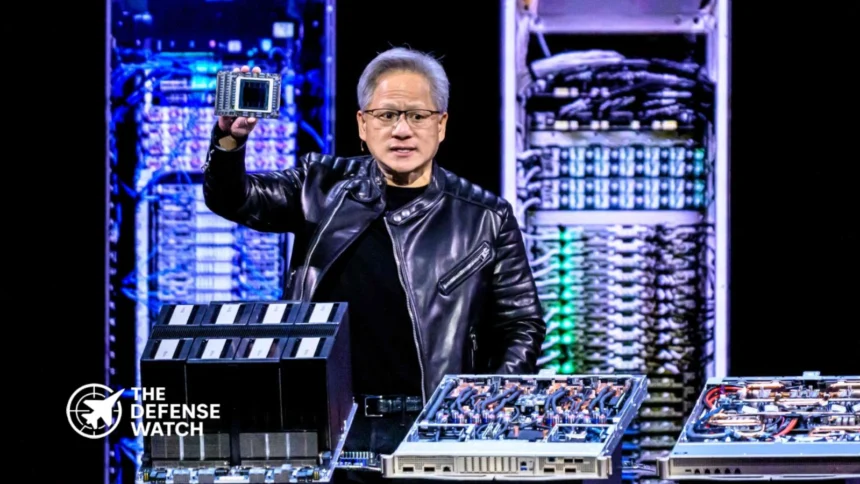
Jensen Huang resigned on Thursday, Nov. 12, as president, chief executive and board member of Nvidia, ending a 33-year run as head of the company he co-founded. Nvidia’s board said the departure was effective immediately. The announcement came days after reports that U.S. intelligence agencies believed Huang had been targeted by a Chinese intelligence effort, and as Congress weighs tighter controls on advanced AI chip exports.
Nvidia’s own announcement, filed with the U.S. Securities and Exchange Commission, gave no reason for the resignation. The reasons below come from news reporting, and several of the underlying allegations remain unproven.
What Nvidia has confirmed
According to the company’s Form 8-K and accompanying press release, the board has named Chief Financial Officer Colette Kress interim CEO. She keeps her finance role while she serves. Harvey C. Jones, a former CEO and executive chairman of Synopsys, becomes the board’s first-ever chair.
The board said it is starting a search for a permanent CEO and will consider internal and external candidates. It added that it expects “the company’s operations, customer commitments and product roadmap to continue without interruption.”
Nvidia said it will report third-quarter fiscal 2027 results on Tuesday, Nov. 17, as previously scheduled. The shares fell more than 4% by the close on Thursday, according to the Boston Globe.
How the week unfolded
The sequence, as reported by the New York Times, the Financial Times, Reuters and others, is as follows. The details are attributed because Nvidia has not confirmed most of them.
- Late October: The New York Times reported that U.S. intelligence agencies had concluded that Alice Huang, also known as Huang Le, a Chinese citizen and executive at the Singapore-based cloud company Megaspeed, was a Chinese intelligence asset. She is not related to Jensen Huang. Megaspeed did not respond to requests for comment cited by ABC News.
- Nov. 6 onward: The Financial Times reported that a classified U.S. memo describes a romantic relationship between her and Huang. Multiple outlets reported that the memo assesses she was recruited by China’s Ministry of State Security to gather information about Nvidia and its chief executive.
- Nov. 8: Nvidia’s board announced an independent investigation, overseen by independent directors with outside counsel, “in light of recent reporting that founder and CEO Jensen Huang has been the target of a foreign intelligence effort.” Huang wrote that he supported the inquiry and would cooperate fully. Reports said he told staff he had been unfaithful to his wife.
- Nov. 9: China’s foreign ministry rejected the allegations, calling them smears, according to TechRepublic.
- Nov. 11-12: Reports emerged of a separate relationship with an Nvidia executive who reported to him. The Wall Street Journal reported the board was weighing removing him, and he resigned the next day.
Nvidia has said it has found no reason to believe that U.S. national security or corporate secrets were compromised, according to coverage by the South China Morning Post. The board’s investigation has not published findings. A separate New York Times report, cited by one outlet, said Secretary of State Marco Rubio oversaw a classified memo last spring warning senior administration officials about the relationship. That claim is single-sourced in the material reviewed here.
President Donald Trump said in an interview that the FBI is examining whether the affair compromised national security, according to Al Jazeera. Trump also called what happened to Huang a “horrible thing,” per CNBC. House Foreign Affairs Committee Chair Brian Mast said Huang is willing to testify before Congress as soon as next week. Separately, the House Select Committee on China had asked Huang for a closed-door briefing on Nov. 18.
The Megaspeed question
The commercial link is why this is a national security story rather than only a corporate one. The New York Times reported that Megaspeed bought more than $4.8 billion of Nvidia chips over two years and builds Southeast Asian data centers that rent computing capacity to Alibaba. Those figures are the Times’s reporting and have not been independently verified here.
Buying chips in Singapore is lawful. The concern, raised in the reporting and by lawmakers, is whether hardware subject to U.S. export licensing can reach restricted Chinese users through intermediaries. Nvidia has not been accused in the material reviewed of knowingly facilitating diversion, and the available public record does not establish that any export control was violated in this case.
Why it matters for export policy
The timing sits on top of an existing legislative fight. Reuters reported on Nov. 10 that three chip measures are slated for possible inclusion in the FY2027 National Defense Authorization Act:
| Measure | What it would do (per Reuters) |
|---|---|
| AI Overwatch Act | Give Congress power over advanced chip exports |
| Chip Security Act | Require businesses to track their chips to combat smuggling |
| Match Act | Push U.S. allies to align with U.S. controls |
The House Foreign Affairs Committee advanced all three earlier this year, and they are now in the Senate NDAA management package, according to Reuters. A former congressional staffer told Reuters that Nvidia is the biggest opponent of the Chip Security and AI Overwatch acts. The Information Technology Industry Council, whose members include Nvidia, has also opposed the measures, arguing they could undermine U.S. competitiveness.
Representative Bill Foster, a co-author of the Chip Security Act with Representative Bill Huizenga, cited Huang’s situation in urging passage. Erich Grunewald of the Institute for AI Policy and Strategy told Al Jazeera that recent events “likely increase attention on export control loopholes.”
Two caveats apply. First, The Information reported that Commerce Department officials have also sought new rules covering manufacturing equipment and remote access to AI computing, but that report did not link them to the Huang allegations, and the agency has previously delayed such efforts. Second, no outcome is assured. The NDAA text is not final, and analysts quoted by the South China Morning Post tie the likely pressure to the incoming Democratic-controlled House as well as to this scandal.
Background: a contested export record
Huang had been one of Washington’s most prominent industry voices against tighter China controls. He told the Financial Times earlier this year that restrictions had spurred Chinese innovation, and he lobbied the administration. At the same time, he told shareholders on June 24 that “national security comes first” and that data centers built on smuggled Nvidia hardware would fail.
The administration cleared sales of Nvidia’s H200 to approved Chinese firms last year, but Huang said in June the company had generated no revenue from those licenses. China, including Hong Kong, was about 9% of Nvidia’s fiscal 2026 revenue, down from 13% the year before, according to The Next Web. Enforcement actions have also continued. Supermicro co-founder Wally Liaw was charged in March over an alleged scheme to send roughly $2.5 billion in Nvidia-equipped servers to China. He has pleaded not guilty, and trial is set for November.
What remains unknown
- The board has not said whether its investigation found wrongdoing, or whether the resignation followed from its findings.
- Neither the U.S. government nor Nvidia has publicly released the classified memo or any evidence on the relationship’s intelligence dimension. The assessment is attributed to unnamed officials.
- It is unclear whether the NDAA provisions will survive in final text, or in what form.
- A permanent CEO has not been named, and no search timeline has been given. Nvidia’s Nov. 17 earnings call will be the first test of how Kress and Jones address export policy and China.