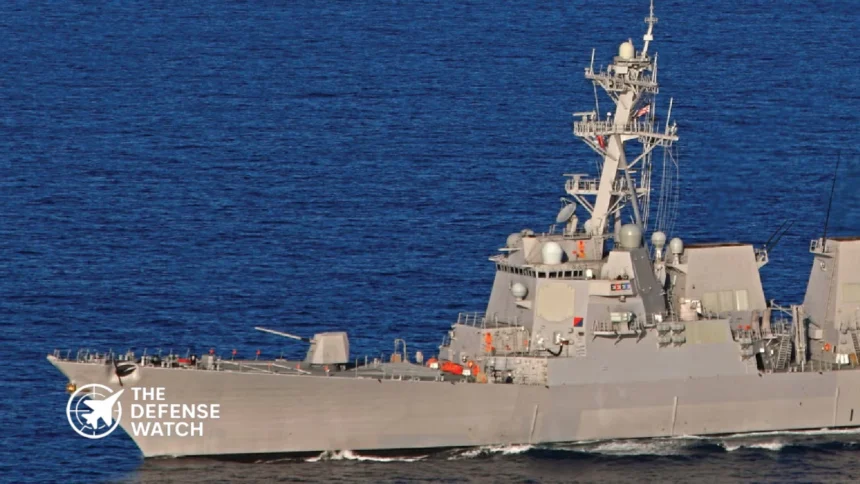
L3Harris Technologies has completed U.S. Navy operational testing of its FleetLink communications system aboard an Arleigh Burke-class guided-missile destroyer, advancing a modular radio architecture designed to improve secure communications between surface vessels and submarines.
Announced on November 12, 2026, the milestone provides evidence that FleetLink has progressed beyond its initial development phase to testing aboard an operational Navy platform. However, L3Harris has not disclosed the destroyer’s name, the test location, evaluation results or a timeline for fleet-wide installation.
The system is being developed under the U.S. Navy’s Scalable, Modular, Radio Cluster (SMRC) contract, awarded to L3Harris in 2023, according to the company.
Three configurations target different naval communication requirements
FleetLink combines L3Harris radios and waveforms within a modular architecture intended to replace older communications equipment and consolidate information exchange from multiple sources.
According to the manufacturer, the system has three configurations:
- Four-channel high-frequency configuration: Designed around high-frequency radio communications.
- Four-channel multi-band configuration: Supports communications across multiple radio bands.
- Submarine multi-band configuration: Adapted for communications requirements aboard undersea platforms.
The different configurations indicate that the Navy’s requirement extends beyond upgrading communications equipment on individual surface combatants. The system is intended to support a wider communications architecture that can accommodate different naval platforms.
L3Harris has not publicly identified the specific radio models, supported frequency bands, data throughput, waveform combinations or channel-level performance characteristics used in FleetLink.
These details will be important in assessing how much capability the system provides over existing shipboard radio installations.
Why high-frequency communications remain important
Naval communications depend on multiple transmission methods because no single network can provide uninterrupted connectivity under every operational condition.
Satellite communications provide important connectivity over long distances, but naval forces also require alternative communications pathways when satellite services become unavailable, degraded or unsuitable for a particular mission.
High-frequency (HF) radio is one such alternative. It can support beyond-line-of-sight communications through ionospheric propagation, allowing military forces to maintain radio links over distances that exceed conventional line-of-sight communications.
The U.S. Department of the Navy has previously identified HF as an important option for beyond-line-of-sight communications in satellite-denied environments.
Its 2022 discussion of the AGILE-HF initiative specifically described the band as a necessary component of modernized, interoperable military communications.
For naval forces, this capability matters when ships operate across large maritime areas, maintain contact with shore-based command authorities or coordinate with other units beyond conventional radio range.
HF is not a complete replacement for satellite communications. Propagation conditions, available bandwidth, interference and atmospheric disturbances can affect performance. Maintaining multiple communications methods therefore remains important for operational resilience.
FleetLink’s combination of HF and multi-band configurations is relevant to this requirement, although L3Harris has not released enough technical information to establish its performance under electronic attack or prolonged satellite denial.
Submarine interoperability adds another dimension
The inclusion of a dedicated submarine multi-band configuration is an important part of FleetLink’s development.
Submarines face different communications constraints from surface ships. Their ability to exchange information is affected by operating depth, antenna arrangements, exposure requirements and the need to limit activities that could compromise concealment.
The Navy already operates specialized communications infrastructure to support submarine command, control and information exchange.
Its Program Executive Office for Command, Control, Communications, Computers and Intelligence identifies the Common Submarine Radio Room and other dedicated systems as important elements of the submarine communications architecture.
FleetLink’s submarine configuration suggests an effort to extend a modular radio approach into this environment.
However, the manufacturer has not announced submarine operational testing or confirmed which submarine classes would receive the configuration. The completion of destroyer testing should therefore not be interpreted as evidence that the entire FleetLink family has completed qualification.
What the Navy’s testing establishes, and what remains unknown
The November 12 announcement confirms that L3Harris has completed operational testing aboard an Arleigh Burke-class destroyer.
That is a useful program milestone, but several important acquisition and technical questions remain unanswered.
The company has not disclosed:
- The name of the destroyer used during testing.
- The duration and location of the evaluation.
- Independent Navy test results or performance measurements.
- Whether the system has received approval for production.
- The number of ships planned for installation.
- The expected procurement and delivery schedule.
- The cost of the SMRC development effort.
L3Harris also has not announced a fleet-wide deployment decision.
The distinction matters because successful operational testing does not automatically establish that a system has completed every qualification requirement or received funding for full-rate production.
A separate Navy communications procurement provides some additional context for the company’s wider role in naval radio modernization.
In November 2025, the Department of Defense announced a $30.29 million modification to an existing L3Harris contract for equipment supporting the Battle Force Tactical Network Resilient Command, Control, and Communication System Enhancement High Frequency program.
That effort covers equipment, components and spares for a naval HF communications system. It is a separate procurement, and the available information does not establish that the award directly funds FleetLink.
FleetLink’s next challenge is moving from testing to deployment
FleetLink’s operational value will ultimately depend on more than its ability to combine different radios into a common architecture.
The Navy will need to establish how reliably the system operates across different platforms, how it integrates with existing communications networks and whether its modular design reduces maintenance and support requirements.
Interoperability will also depend on compatible waveforms, encryption arrangements, network interfaces and procedures across participating units.
L3Harris says FleetLink incorporates its latest National Security Agency-certified cryptographic capability. However, the company has not identified the certification details or explained how the security architecture is implemented across its three configurations.
For now, the completed destroyer testing is a company-announced operational milestone rather than confirmation of a broader Navy deployment decision.
The next meaningful indicators will be the release of Navy evaluation results, confirmation of submarine configuration testing and any procurement announcement establishing how FleetLink will enter the fleet.